
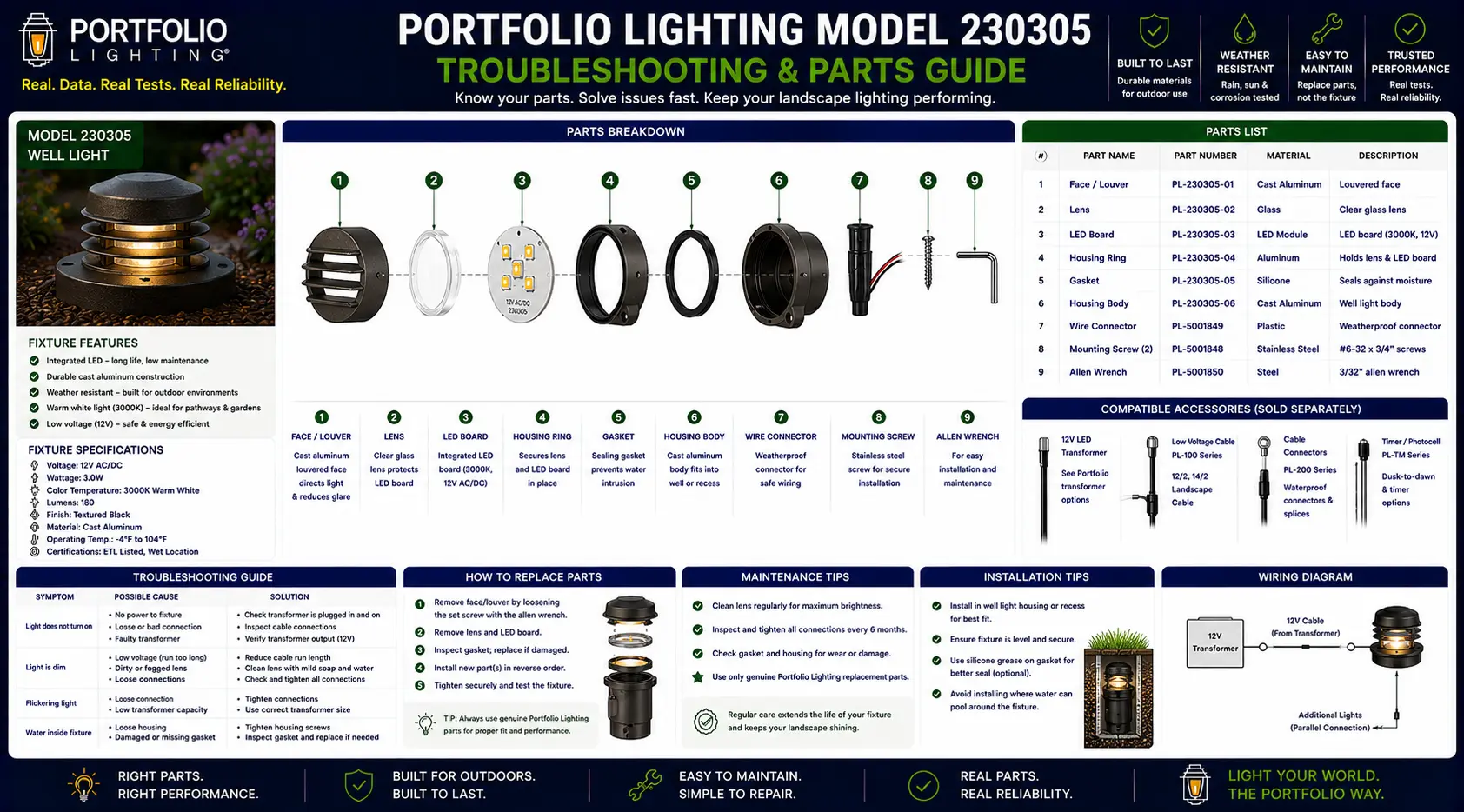
Identifying the Portfolio 230305 Fixture
The 230305 number is a Lowe's item number — the catalog identifier Lowe's assigns to products in its inventory system. This number appears on the original packaging barcode, purchase receipts, and in Lowe's product database records. Unlike manufacturer model numbers stamped on UL listing labels inside the fixture, Lowe's item numbers are not encoded with specification information — they are purely database identifiers that require cross-referencing with the original product catalog entry to identify the specific fixture type.
Because the 230305 is discontinued with no preserved product listing currently accessible, fixture identification relies on physical examination. Use the Portfolio model number lookup to cross-reference the item number with known Portfolio fixture families. The Portfolio lighting identification guide covers how to identify Portfolio fixtures by physical characteristics — housing shape, mounting configuration, finish, and internal component layout — when documentation is unavailable.
Physical Identification Checklist
- Check the UL listing label inside the fixture housing — it will show the listed input voltage (120V for line-voltage, 12V for low-voltage), maximum wattage, and sometimes a manufacturer model number that differs from the Lowe's item number.
- Note the mounting configuration — wall-mounted, post-mounted, or stake-mounted — which narrows the fixture category significantly.
- Note whether the fixture has an external motion sensor dome or photocell — these indicate integrated control electronics beyond a simple LED driver.
- Photograph the internal circuit board before any disassembly — all markings, component labels, and connector configurations. This information is essential for sourcing a compatible replacement board if needed.
- Note the number and type of wire connections entering the fixture from the supply side — two wires (hot and neutral) for simple on/off, three wires (hot, neutral, ground) for grounded fixtures, additional wires for switched or dimmable configurations.
Circuit Board Identification Guide
The most common reason homeowners search for the Portfolio 230305 is a question about the internal circuit board — what it does, what it is rated for, and whether it can be replaced when the fixture stops working. Without a manufacturer spec sheet, the board must be identified by examining the board itself. This section covers the methodology for identifying the 230305 circuit board from physical examination alone.
What Type of Board Is It?
Portfolio outdoor fixtures in the era when the 230305 was produced typically contained one of three circuit board types. The most common is an LED driver board — a power conversion board that takes 120V AC input and converts it to the specific DC voltage and current required by the LED array (typically 12V to 48V DC at a fixed current). The second type is a combined LED driver and control board that also handles motion sensing or photocell dusk-to-dawn switching on the same PCB. The third type is a simple ballast or driver for fluorescent or compact fluorescent lamps — identified by the absence of an LED array and the presence of a fluorescent lamp socket.
Reading the Board Markings
Examine the circuit board under good lighting and note every marking visible on the board surface and any stickers attached to it:
| What to Look For | Where to Find It | Why It Matters |
|---|---|---|
| Input voltage range | Printed on board or sticker — often "INPUT: 120VAC 60Hz" or similar | Confirms whether this is a 120V line-voltage driver or a 12V low-voltage driver |
| Output voltage | Board marking or sticker — "OUTPUT: 24VDC" or similar | Must match the LED array's forward voltage requirement for replacement board sourcing |
| Output current | Board marking — "350mA", "700mA", "1A" are common LED driver currents | Must match the LED array's current requirement exactly — too high destroys the LEDs, too low produces dim output |
| Wattage rating | Board marking or UL label — "MAX 15W" or similar | Sets the upper bound for replacement board capacity |
| Manufacturer or part number | Silkscreened on board — may be a Chinese OEM part number like "LD-15W" or similar | Can be searched directly on Alibaba, Digikey, or Amazon for direct replacement |
| Connector type and pin count | Physical connector on board edge or center | Replacement board must use same connector or connectors must be rewired |
| Thermal rating | Component markings on major chips or capacitors | Identifies high-temperature rated components vs standard — important for fixture with poor ventilation |
In twenty-five years of working on discontinued lighting fixtures, the single most useful diagnostic step for an undocumented circuit board is measuring the output DC voltage with a multimeter when the fixture is powered on. If the board is producing correct output voltage but the LED array is dark, the LED array has failed — not the driver. If the board is producing no output voltage despite correct input voltage, the driver board has failed. This one measurement splits every undocumented board failure into two categories with completely different repair paths and eliminates half of all possible causes in thirty seconds.
230305 Troubleshooting by Symptom
The 230305 troubleshooting approach follows the general Portfolio outdoor fixture diagnostic sequence from the Portfolio lighting troubleshooting guide combined with the circuit board diagnostic methodology above. Work through the steps below in order — each step eliminates a category of causes before moving to the next.
Symptom-Specific Quick Reference
| Symptom | Most Likely Cause | First Action |
|---|---|---|
| Fixture completely dark, power confirmed present | Failed bulb, failed LED array, or failed driver board | Replace bulb first. If integrated LED, measure board output voltage. |
| Fixture flickers or pulses | Failing driver board, loose connection, or incompatible dimmer | Check all wire connections. Verify no dimmer switch on circuit. |
| Fixture stays on constantly — no motion control | Motion sensor override mode or failed PIR sensor | Cycle wall switch to exit override. Cover sensor to test. |
| Fixture never activates via motion | Sensor aimed incorrectly, sensitivity too low, or failed sensor | Adjust sensor aim and sensitivity. Bypass sensor to test. |
| Fixture works intermittently | Loose wire connection or failing board capacitor | Inspect all internal connections. See intermittent fault guide. |
| Fixture produces reduced light output | Degraded LED array or driver providing reduced current | Replace bulb if replaceable. Measure driver output voltage and current. |
| Burning smell from fixture | Overloaded driver board, failed capacitor, or insulation breakdown | Disconnect power immediately. Inspect board for burned components before reconnecting. |
Replacement Parts Sourcing for the 230305
Manufacturer replacement parts for the 230305 are no longer available through Portfolio or Lowe's. However, the key components can be sourced through generic and third-party suppliers when the original specifications are identified. The Portfolio replacement parts guide covers the full sourcing approach for discontinued Portfolio fixtures.
When Parts Cannot Be Sourced
If the 230305's internal circuit board cannot be identified or matched to a generic replacement because the board markings are unreadable or the specifications are outside standard generic ranges, the practical options are: replacing the entire fixture with a compatible current-production unit (covered in the replacement section below), or — if the fixture housing and LED array are intact but the driver board has failed — consulting an electrical repair shop that works with LED driver components for a custom board match. See the discontinued Portfolio lighting guide and the discontinued landscape lighting parts guide for the broader approach to hard-to-source discontinued Portfolio components.
Repair vs Replace: The 230305 Decision Framework
The repair vs replace decision for the 230305 depends on what has failed, the cost of the replacement component, and the current condition of the fixture housing. Use this framework to make the right call.
Repair Makes Sense When:
- The failure is a burned-out bulb in a replaceable socket — bulb replacement costs under $10 and takes five minutes.
- The failure is a failed photocell or motion sensor module that can be replaced for $10 to $25 with the fixture housing and driver board in good condition.
- The failure is a loose wire connection with no burned or corroded components — remaking the connection costs nothing and takes fifteen minutes.
- The driver board can be identified and a generic replacement sourced for under $25 — this is economical when the fixture housing, LED array, and mounting hardware are all still in good condition.
Replace Makes Sense When:
- The driver board cannot be identified or matched — time spent attempting to identify an undocumentable board is often worth more than the cost of a replacement fixture.
- The fixture housing has cracked, corroded through, or is no longer weathertight — a new driver board in a compromised housing will fail again quickly.
- The integrated LED array has failed — LED arrays in discontinued fixtures are rarely sourceable and a new array often costs as much as a complete replacement fixture.
- The fixture is over 10 years old and multiple components are showing wear simultaneously — this is end-of-life for the fixture system, not an isolated component failure.
- The repair parts cost more than 50% of the cost of a compatible replacement fixture — replacement is the better economic choice.
For the replacement fixture selection process see the section below and the Portfolio lighting alternatives guide. For the full parts vs replacement cost framework across Portfolio fixture types see the Portfolio parts and accessories guide.
Compatible Replacement Fixtures for the 230305
When replacing the 230305, the replacement fixture must match the existing electrical junction box dimensions and wiring configuration. Standard outdoor wall fixtures mount to a standard 4-inch round or octagonal exterior junction box — the same box serves both the original and replacement fixture without modification to the wall or wiring.
Finding a Replacement at the Same Mounting Location
The key compatibility requirements for a 230305 replacement: the fixture must be rated for wet location outdoor installation; the mounting hole spacing must match the existing junction box (standard 3-1/4 inch stud spacing for most round boxes); the supply wire configuration must match (typically two-wire or three-wire 120V). Beyond those requirements, any current Portfolio outdoor wall fixture or competing brand equivalent with similar aesthetics is a functional replacement.
Current Portfolio outdoor fixtures are available through the Portfolio outdoor lighting page. If the 230305 was a motion-activated fixture, replacement options include current Portfolio motion-sensor wall lanterns covered in the motion sensor lighting guide. For a broader range of alternative brands see the Portfolio lighting alternatives guide and the best replacement guide.
Sourcing the 230305 on the Secondary Market
If you need an exact 230305 replacement — for a matched pair or consistent appearance across multiple fixtures — check eBay, Facebook Marketplace, and Craigslist for secondary market inventory. Search by the Portfolio item number 230305 and by descriptive terms matching the fixture's physical appearance (finish color, style, number of lights). The where to buy Portfolio replacement parts guide covers the secondary market sources most likely to have discontinued Portfolio fixture inventory.
Portfolio 230305 FAQ
What is the Portfolio lighting model 230305?
The Portfolio 230305 is a Lowe's item number for a discontinued Portfolio outdoor lighting fixture containing an internal circuit board — likely an LED driver or combined driver and control board for motion sensing or photocell operation. No manufacturer specification sheet or installation manual is publicly available for this model. The identification and diagnosis methodology in this guide is the most complete resource available for this specific item number.
What circuit board does the Portfolio 230305 use?
The 230305 circuit board must be identified by physical examination — reading the input voltage, output voltage, output current, and wattage markings on the board itself. Most Portfolio outdoor fixtures of this era used generic OEM LED driver boards or combined driver-and-sensor boards from Chinese suppliers. Once the specifications are identified, a compatible generic replacement board can typically be sourced through Amazon or electrical supply channels. See the circuit board identification section above for the full methodology.
My Portfolio 230305 stopped working — what should I check first?
In order: verify the circuit breaker or GFCI is not tripped; replace the bulb if the fixture uses a replaceable lamp; measure the circuit board output voltage with a multimeter to determine whether the board or LED array has failed; inspect all internal wire connections for corrosion or looseness. Work through the troubleshooting sequence in the diagnostic section above. The Portfolio lighting troubleshooting guide covers the full diagnostic framework.
Are replacement parts available for the 230305?
Manufacturer OEM parts are not available — the fixture is discontinued. However, generic compatible replacements for the driver board, bulb, photocell, and mounting hardware can be sourced through third-party channels once the original component specifications are identified. See the parts sourcing section above and the Portfolio replacement parts guide for the full sourcing approach.
What replaces the Portfolio 230305?
Any outdoor wall fixture rated for wet location installation that fits the existing junction box mounting configuration is a functional replacement. Current Portfolio outdoor fixtures and comparable alternatives from competing brands are available. See the Portfolio lighting alternatives guide, the Portfolio outdoor lighting page, and the best replacement guide.
Where can I find the Portfolio 230305 manual?
No installation manual for the Portfolio 230305 is publicly available online. The Portfolio manuals library covers all available Portfolio documentation, but the 230305 is not represented. The identification and troubleshooting methodology in this guide substitutes for the unavailable manual using field diagnosis techniques that do not require the original documentation.