
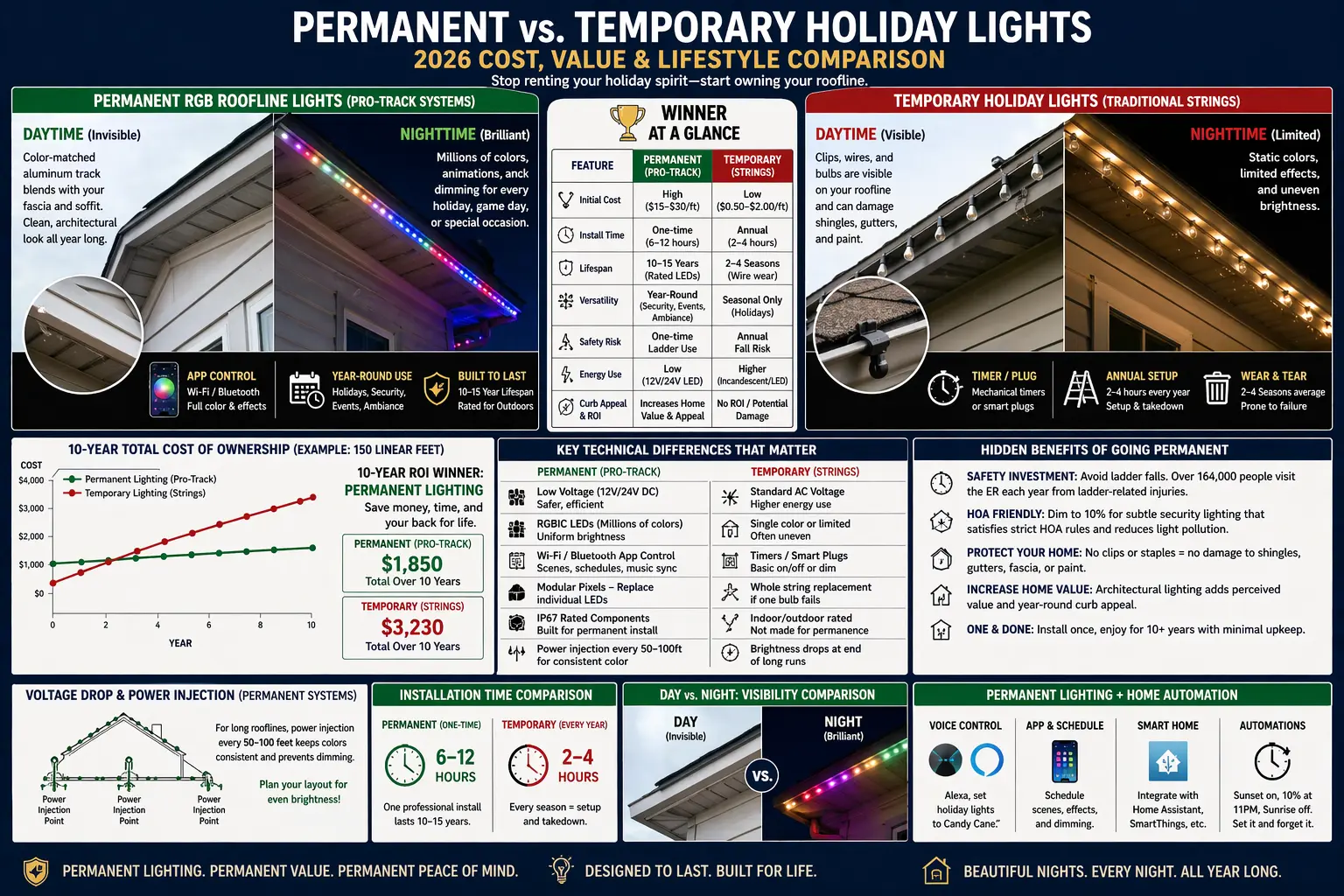
Winner at a Glance: Permanent vs. Temporary Holiday Lights
If you want the fastest decision, compare upfront price against long-term convenience, safety, and year-round usefulness. Permanent lighting costs more at the beginning, but it replaces the annual cycle of clips, ladders, storage bins, broken strings, and cold-weather roofline work.
| Feature | Permanent Lighting (Pro-Track) | Temporary Lighting (Traditional Strings) | Best Choice |
|---|---|---|---|
| Initial Cost | High, often around $15–$30 per linear foot depending on system and install | Low, often around $0.50–$2.00 per foot for basic strings before clips and labor | Temporary |
| Install Time | One-time install, commonly 6–12 hours depending on roofline complexity | Annual setup, often 2–4 hours every season for a typical home | Permanent |
| Lifespan | Long-term LED system, often planned for 10–15 years | Usually 2–4 seasons before wire, clips, or sections degrade | Permanent |
| Versatility | Year-round use for holidays, game day, security, accent light, and parties | Mostly seasonal decorating | Permanent |
| Safety Risk | One-time ladder event or professional installation | Annual ladder setup, removal, and weather exposure | Permanent |
Quick Answer: Are Permanent Holiday Lights Worth It?
Permanent holiday lights are worth it if you want year-round roofline lighting, safer holidays, app-controlled color scenes, and a long-term alternative to annual ladder work. Temporary lights are still the better fit if you only decorate once a year, have an easy one-story roofline, or need the lowest upfront cost.
- Choose permanent lights if you value convenience, safety, automation, and curb appeal.
- Choose temporary lights if you value low upfront cost and seasonal flexibility.
- Choose pro installation if your roofline requires a 24-foot ladder or higher.
- Choose a smart system if you want schedules, app scenes, and year-round automation.
If you are planning a connected seasonal setup, compare this page with smart holiday lighting setup.
For full seasonal planning, layout, safety, setup, and troubleshooting help, use this page with our holiday lighting guide and smart holiday lighting setup.
Logic Summary: What Problem Are You Actually Solving?
The permanent vs. temporary holiday lights decision is not only about Christmas. It is about whether you want a once-a-year decoration or a year-round architectural lighting system. Temporary strings solve the holiday display problem. Permanent RGB roofline lights solve holiday decorating, accent lighting, security mode, party colors, game day colors, and automation.
Lowest budget
Temporary strings usually win because the materials are inexpensive and easy to replace.
Lowest effort
Permanent lights win because setup, removal, storage, and re-clipping disappear after installation.
Best safety case
Permanent lights win on steep roofs, tall peaks, second-story gutters, and icy winter installs.
Best year-round value
Permanent lights win because the same system can run subtle architectural scenes outside December.
The biggest shift in holiday lighting is the move from “climb the ladder every year” decorating to permanent RGB roofline lighting installed under the eaves. Systems inspired by products like Govee-style, JellyFish-style, and Celebright-style roofline tracks have changed the question from “Which Christmas lights should I buy?” to “Should I stop reinstalling holiday lights altogether?”
This page compares permanent and temporary holiday lights from the homeowner’s real decision points: cost, safety, visibility, repairability, automation, energy use, HOA rules, and 10-year value.
Permanent eaves lighting is especially useful for July 4th because the same system can run red, white, and blue scenes every year. The Patriotic July 4th Outdoor Lighting Guide explains how to keep those long RGBW runs bright and color-consistent.
Whether you choose permanent roofline lighting or temporary seasonal decorations, every lighting system ultimately depends on the available electrical capacity of the circuit serving it. Large displays that combine roofline lights, landscape accents, inflatables, projectors, timers, and smart controllers can exceed safe operating limits even when individual components appear small. Understanding circuit loading, startup surges, extension cord limitations, and weather-related electrical risks helps prevent frustrating outages during the busiest part of the season. Our holiday lighting circuit capacity and breaker trip resource provides a detailed breakdown of overload prevention, safe power planning, and troubleshooting methods for displays of all sizes.
10-Year ROI Comparison Chart: Permanent vs. Temporary Holiday Lights
Permanent lights usually cost more in year one, but temporary lights create recurring costs: new strings, clips, extension cords, timers, storage, broken sections, and annual installation time. The more expensive or dangerous your annual installation is, the faster permanent lighting starts to make sense.
| 10-Year Cost Factor | Permanent Lighting | Temporary Lighting |
|---|---|---|
| Materials | One system purchase | Strings, clips, cords, timers, replacement bulbs, storage bins |
| Labor | One install event | Install and removal every season |
| Safety | One ladder event or pro install | Repeated roofline work every year |
| Year-round value | Accent, security, holiday, game day, events | Mostly December display value |
The “Invisible” Factor: Why Permanent Lights Do Not Have to Look Obvious
The best permanent holiday lighting systems are not loose strings stapled to a roofline. They are usually installed in low-profile tracks under the soffit or along the fascia. When the track color is matched to the trim, fascia, or soffit, the system becomes subtle during the day and dramatic at night.
- White soffit: use white or light-colored track.
- Dark fascia: use bronze, black, or dark color-matched channel.
- Strict HOA: keep daytime hardware low profile and nighttime brightness controlled.
- Modern homes: choose tight spacing and clean linear runs for an architectural look.
Common Permanent Light Track Types
- Standard J-Channel: Slips under existing soffit trim for the cleanest, most hidden daytime look.
- Flat Track: Mounts directly to the fascia board and works well on homes without deep eaves.
- Box Track: Used for larger commercial-grade pixels that need more space and heat dissipation.
For lighting placement principles, compare with Portfolio lighting placement.
Technical Deep Dive: Voltage Drop, Power Injection, and Long Roofline Runs
Permanent holiday lights are often low-voltage RGB or RGBIC systems. The longer the run, the more planning matters. If the run is too long without power support, the far end may look dimmer, warmer, or less color-accurate than the beginning.
Temporary LED Christmas light strands are handled, coiled, stretched, stored and reinstalled every year, which makes them more likely to develop loose contacts, damaged wires, weak sockets and intermittent flicker. Permanent systems avoid some of that handling damage, but temporary lights can often be repaired if the problem is isolated early. This guide to fixing flickering LED Christmas lights helps explain when troubleshooting is worth it and when replacement is safer.
Power injection every 50–100 feet
Many long permanent lighting runs need power injection every 50–100 feet depending on voltage, wire size, LED density, brightness level, and controller design. Power injection helps keep colors consistent across the roofline.
12V vs. 24V systems
A 24V system can often handle longer runs more gracefully than a 12V system, but the best choice depends on the product, controller, layout, and total length.
Temporary strings have their own limits
Temporary strings can also suffer from poor connections, overloaded plug chains, weak clips, damaged insulation, and sections that fail after storage or weather exposure.
If you want to understand voltage behavior in outdoor lighting, use landscape lighting voltage drop and low voltage landscape lighting system diagram.
Home Automation Integration: Permanent Lights Become a Year-Round System
This is where permanent holiday lights separate themselves from traditional strings. Temporary lights usually rely on mechanical timers, outdoor smart plugs, or basic Wi-Fi outlets. Permanent RGB systems can use app scenes, schedules, zones, dimming, music modes, voice assistants, and smart-home routines.
Wi-Fi and Bluetooth Apps
Most consumer permanent systems use app control for colors, timers, schedules, scenes, and brightness.
Voice Control
Alexa or Google-style voice control can trigger scenes like “holiday mode,” “security mode,” or “game day.”
Home Assistant Logic
Advanced users can connect roofline lights to presence, sunset, holidays, motion, or outdoor security routines.
Security Mode
Running warm white at 10% brightness can create subtle architectural light without looking like a holiday display.
For smart exterior control, see AI outdoor lighting systems, AI holiday theming logic, and smart hub compatibility guide.
Repairability: What Happens If One Light Dies?
Repairability is one of the biggest differences between permanent pixel systems and temporary strings. A failed section does not always mean the same thing.
Temporary C7 and C9 systems have one important serviceability advantage: individual bulbs and some bulk-cord sockets can be replaced without discarding the entire run. That advantage disappears when replacement sockets are mismatched to the bulb base, SPT cord, wire gauge, polarity, or outdoor rating. The C7 and C9 holiday light socket guide explains what makes these systems repairable, which field repairs preserve reliability, and when widespread socket or cord deterioration makes a new temporary string—or a permanent system—the better long-term choice.
| Failure Scenario | Permanent Roofline Lighting | Temporary String Lights | Practical Outcome |
|---|---|---|---|
| One LED fails | Often replace an individual pixel, puck, or short module depending on system design | May be difficult to isolate; many users replace the whole string | Permanent can be more serviceable |
| Controller fails | Replace controller, power supply, or zone component | Replace timer, plug, or string set | Both can be repaired, but permanent systems are more technical |
| Wire damage | Track-protected runs are less exposed once installed | Strings are exposed to clips, gutters, wind, storage, and handling | Permanent usually sees less annual handling damage |
| Color mismatch | May need power injection, calibration, or matching replacement modules | Often caused by mixed brands or aging strings | Both need consistent components |
If your temporary lights already have a dead section, use our troubleshooting Christmas lights half out guide before deciding whether to repair the strand or upgrade to a permanent system.
Temporary holiday lights need extra protection from rain, plugs on the ground, and wet extension cord connections. See our weatherproofing outdoor holiday lights guide before choosing or installing a temporary display.
Temporary holiday lights are easier to repair when you know how to check the plug fuse. Use our Christmas light fuse replacement guide before replacing a strand that suddenly stops working.
The Safety Angle: Permanent Lighting as a Ladder-Risk Reduction Upgrade
The strongest non-financial argument for permanent holiday lighting is safety. Temporary holiday lights require repeated ladder work: installing clips, reaching gutter corners, adjusting sagging sections, removing lights after the season, and sometimes climbing in cold or wet weather.
Permanent lighting changes that pattern. The ladder work happens once, either as a careful DIY project on a simple roofline or as a professional installation for taller homes. After that, most seasonal changes happen through the app or controller.
For outdoor planning around a home, see landscape lighting around a house.
Light Pollution, HOAs, and Neighbor-Friendly Settings
Permanent roofline lights should not be treated like full-brightness holiday lights every night. A well-configured system can run at low brightness for security or accent lighting and reserve bright, colorful scenes for holidays or events.
- Use 10% brightness for security or architectural mode.
- Use warm white for everyday curb appeal.
- Use timers so bright scenes do not run late into the night.
- Angle and track the lights to wash the wall or roofline, not neighboring windows.
For neighbor-friendly exterior lighting, review dark sky compliance guide and fix light trespass.
Curb Appeal ROI: Why Permanent Lighting Can Feel Like a Home Upgrade
While permanent holiday lights do not technically add to a home’s appraised square footage value, they can act as a curb appeal multiplier during evening showings by making the home feel more modern, finished, and tech-integrated than nearby homes with basic porch lighting.
Temporary lights are decorations. Permanent holiday lights can become part of the home’s exterior lighting package. When installed cleanly, they can improve the roofline at night, create a premium look for holidays, and add useful everyday accent or security lighting.
Temporary clips can also create small annoyances over time: bent gutters, scraped shingles, cracked clips, dangling extension cords, and mismatched strings. Permanent tracks reduce the amount of seasonal hardware attached and removed from the house.
Which Should You Choose?
Choose Permanent Lights If...
- You want year-round roofline scenes
- You have a tall or difficult roofline
- You dislike annual installation
- You want smart-home control
- You care about long-term curb appeal
Choose Temporary Lights If...
- You need the lowest upfront price
- You rent or plan to move soon
- You enjoy changing styles every year
- Your roofline is simple and safe
- You only decorate for one short season
If you plan to reuse or replace bulbs each season, use the LED holiday bulb replacement guide to ensure long-term compatibility with your chosen lighting system.
Permanent vs. Temporary Holiday Lights FAQ
Do permanent holiday lights look cheap during the day?
No. When installed in color-matched aluminum tracks under the eaves or along the soffit, the LEDs are usually subtle from the street during daylight hours. The cleanest installs match the track to the fascia, trim, or soffit.
How much electricity do permanent holiday lights use?
Modern 12V or 24V RGBIC LED systems use far less power than old incandescent holiday strings, and dimming lowers energy use even further. Many homeowners run low-brightness accent or security scenes instead of full-brightness holiday scenes every night.
Can I install permanent holiday lights myself?
Yes, especially on simple one-story rooflines. But if the project requires a 24-foot ladder or higher, complicated peaks, second-story fascia, or long power-injection runs, professional installation is usually safer and cleaner.
Are permanent holiday lights better than temporary Christmas lights?
Permanent lights are better for safety, automation, long-term convenience, and year-round use. Temporary lights are better for low upfront cost, renters, and homeowners who like changing the entire display style every year.
Can permanent holiday lights be used for security lighting?
Yes. Many homeowners use warm white or soft accent colors at low brightness as an everyday security or arrival-lighting mode. That is one reason permanent systems can deliver value outside the holiday season.
Final Thoughts on Permanent vs. Temporary Holiday Lights
Temporary holiday lights still make sense when budget is the main concern or the roofline is easy to reach. But permanent roofline lighting is becoming the stronger long-term choice for homeowners who want safety, automation, curb appeal, and a system that works all year.
The best answer is not universal. If you want a one-season decoration, temporary strings are still practical. If you want a roofline system that handles Christmas, Halloween, game day, security mode, parties, and everyday accent lighting, permanent lights are the clear upgrade.
Temporary displays can overload circuits faster than homeowners expect. Before choosing between permanent and temporary lights, compare your expected load with the holiday lighting power calculator.
Beyond cost and installation, lighting quality matters. See biological lighting infrastructure for flicker-free performance and better long-term lighting comfort.
More Holiday and Smart Outdoor Lighting Guides
Holiday Lighting Guide
Start with the broader holiday lighting planning hub for layout, safety, troubleshooting, and setup decisions.
Read the guideSmart Holiday Lighting Setup
Best for app control, schedules, smart plugs, voice assistants, and connected seasonal lighting logic.
Read the guideAI Outdoor Lighting Systems
Learn how outdoor lighting is moving toward automation, predictive scenes, smart controls, and adaptive behavior.
Read the guideAI Holiday Theming Logic
Use this when permanent lights become part of a year-round automated theme system.
Read the guidePermanent Holiday Lighting, Temporary Christmas Lights, and Smart Roofline Lighting Help
This page is designed to help homeowners compare permanent roofline holiday lighting with traditional temporary Christmas lights before spending money, climbing ladders, or committing to a smart exterior lighting system.
For a complete seasonal lighting strategy, combine this guide with holiday lighting guide, smart holiday lighting setup, and AI outdoor lighting systems.