Portfolio Lighting Troubleshooting
The main troubleshooting hub when you are not yet sure which part failed or when a replacement part does not solve the problem.
Read the guide
If your lights stopped working, the problem is usually one specific part. The key is figuring out which part failed before you buy anything.
This guide helps you identify the problem, match it to the right replacement part, and decide if fixing the system still makes sense.
It is also built as a buying guide. Availability varies, especially for older or discontinued items, so this page is meant to help you move from uncertainty to a practical next step instead of wasting time ordering the wrong part.
If you need broader troubleshooting before buying, start with Portfolio lighting troubleshooting. If you already know your model number, the best next page is Portfolio lighting model number lookup.
Find Your Model NumberIf you are working with an older Portfolio fixture, use the Which Portfolio Lighting Part Do You Need? information to identify the part or repair method—but confirm the exact model, dimensions, lamp type and electrical rating first. Similar-looking Portfolio and third-party components are not automatically interchangeable.
Portfolio owner’s first step: Photograph the fixture and model label, compare measurements, then use the Portfolio parts and repair guides to narrow the replacement.
Most Portfolio lighting problems come down to a few key parts:
The fastest way to fix the system is to match the symptom to the part before replacing anything.
Use the original fixture label, dimensions, lamp base, operating voltage, and connector design to narrow down parts. Similar-looking Portfolio fixtures may have different generations and replacement requirements.
This page is designed to help you figure out what part actually failed before you buy anything. If you already know exactly what you need, use the Portfolio parts and accessories page to browse available components.
Not every failed lighting component needs immediate replacement, but older equipment may become harder to maintain over time. Review our outdoor lighting component life expectancy guide to compare typical service life expectations for transformers, fixtures, bulbs, connectors, and other system parts.
When replacing outdoor lighting components, it is important to inspect more than just the visible fixture housing. Damaged seals can allow water into sockets, connectors, and internal electronics. Our outdoor lighting gaskets, O-rings, and seals guide explains how these small components protect fixtures and when they should be replaced.
The key to buying the right replacement part is knowing what actually failed. Many homeowners assume the whole fixture is bad when the real problem is a bulb, cracked lens, weak connection, failed transformer, or timer issue. That mistake can lead to unnecessary replacement costs and a lot of wasted time.
A better approach is to start with the symptom. What is the light doing? Is it flickering, dead, weak, moisture-damaged, or failing across the entire system? Once you follow the symptom first, it becomes much easier to narrow down which part deserves attention and which pages on the site should guide your next step.
If the part you need comes from a Cooper Portfolio recessed LED fixture, do not order by appearance alone. The architectural Portfolio LED replacement guide shows how to decode aperture size, lumen package, driver type, power module, CRI, color temperature, reflector beam, and finish code.
One of the smartest ways to approach replacement parts is to start with what the light is doing instead of starting with the part name. Most homeowners do not know the exact part name at the beginning, and that is normal. The symptom often tells you more than the fixture label at first.
If one light is not turning on, the likely causes often include the bulb, the internal light source, a bad socket or connection, or a local wiring issue. If the whole system is down, the problem may be the transformer or a larger power issue.
Flickering often points toward a bulb, a loose connection, or a voltage-related problem. If that is what you are seeing, the best next page is landscape lights flickering.
When the full system is down, the likely causes often shift toward transformer, power supply, or system-wide wiring problems. Use landscape lights not working for the broader diagnosis path.
If the system failed after rain, connectors, water damage, and moisture exposure move much higher on the suspect list. The focused weather page is portfolio landscape lights not working after rain.
The best way to avoid ordering the wrong replacement part is to identify the exact fixture family first. Use the Portfolio Lighting Master Model Technical Database for legacy model identification, compatibility mapping, and repairability guidance.
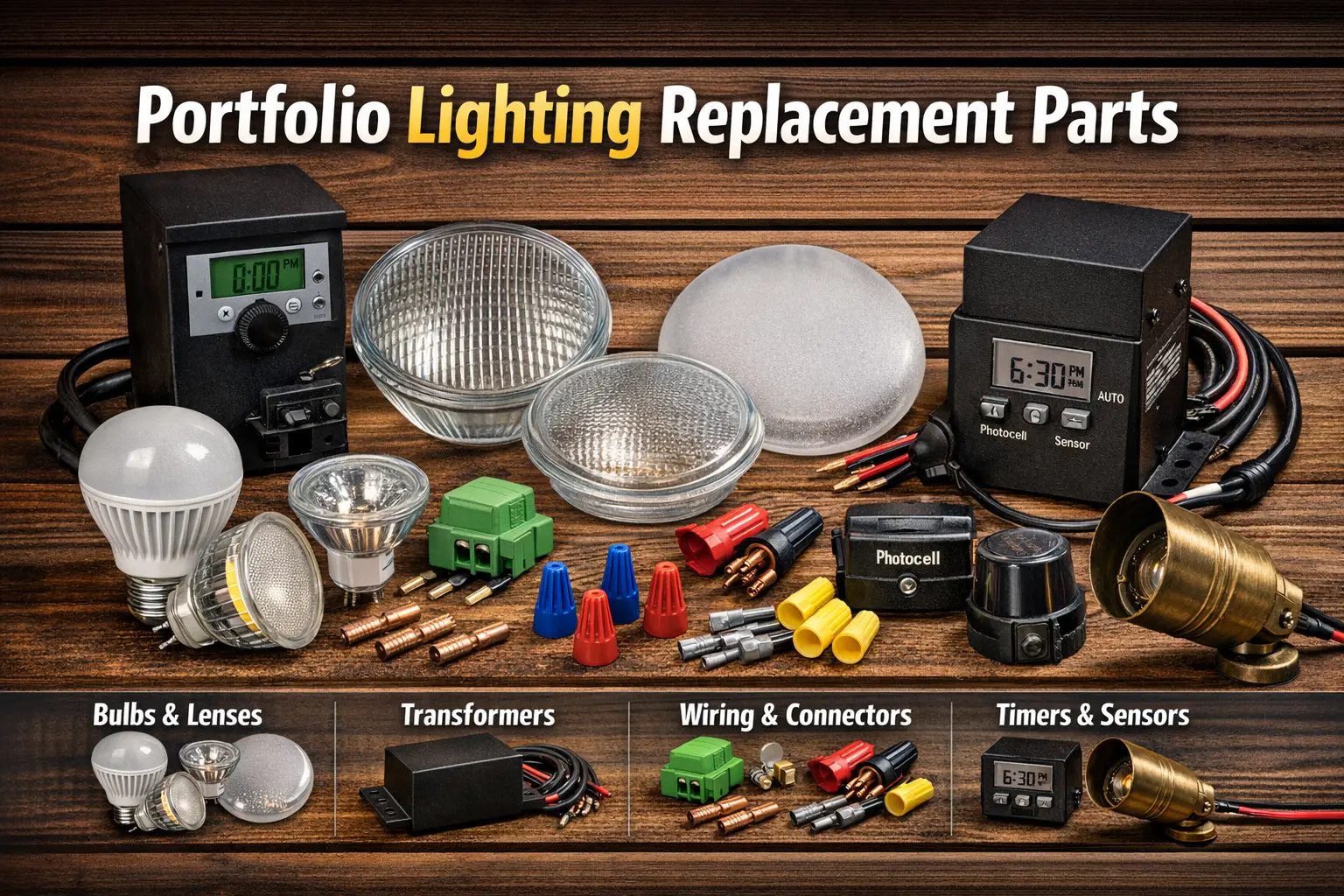
Bulbs and LED light sources are among the most common replacements because they are often the first part to fail and one of the easiest parts to change.
Lenses and covers often need replacement when they crack, fog, discolor, or break from weather and age. A damaged lens can affect both appearance and protection.
Transformers are one of the most important system-wide replacement parts because they affect whether the whole landscape system gets power at all. For deeper help, use portfolio transformer not working and landscape lighting transformer guide.
If the lights are not turning on or off when expected, the failed part may be a timer or a photocell rather than the fixture itself. The dedicated pages are portfolio light timer not working and landscape lighting photocell not working.
Loose, corroded, or damaged connectors are one of the most common replacement or repair points in outdoor lighting. The deeper wiring page is how to wire landscape lighting.
Portfolio replacement parts should be matched by model, failure pattern, and physical fit—not just by product category. Model-specific guides make that easier because they show where parts fail, what to inspect, and when a replacement part is likely to solve the issue. Start with the Portfolio Lighting Model 7133C replacement parts guide, the Portfolio DualBrite PF-4300-BK motion light manual, and the Portfolio Lighting Model SLL12BK solar light parts guide if your fixture resembles one of those common Portfolio families.
Landscape systems often need bulbs, lenses, stakes, housings, connectors, transformers, photocells, timers, and low-voltage wiring components. For the broader fixture category, see Portfolio landscape lighting.
Indoor fixtures may need shades, glass, bulbs, mounting hardware, or ceiling-canopy components depending on the fixture type. For the main indoor hub, use Portfolio indoor lighting.
Ceiling fixtures often need globes, shades, bulbs, sockets, decorative pieces, or mounting components. For the related category page, read Portfolio ceiling lighting.
Dim or intermittent lights can result from low voltage, wet splices, a faulty photocell, or transformer settings rather than a failed fixture. Diagnose the existing circuit before buying replacement hardware.
Replacing the part usually makes sense when the fixture body is still in good condition, the failure is isolated, and the needed part is still reasonably available. In those cases, the repair is often faster and less expensive than replacing the full fixture.
Replacing the whole fixture often makes more sense when there are multiple failures, the fixture has widespread wear, the model is discontinued and hard to match, or the system has reached the point where a new fixture is the cleaner long-term solution.
If you are moving toward replacement instead of repair, the best next page is Buy Portfolio lighting.
Many discontinued Portfolio replacement parts were originally designed for fixture families that are now considered vintage. Before adapting modern hardware, compare the original fixture construction, materials, and mounting methods using the Portfolio Vintage Lighting guide, which explains how restoration differs from ordinary parts replacement.
Matching a replacement part correctly matters just as much as deciding which part failed. The wrong bulb, wrong lens size, wrong transformer capacity, or wrong connector style can waste time and money.
The model number is often the fastest way to narrow the search and confirm compatibility. Use Portfolio lighting model number lookup when you have the number or even part of it.
For older Portfolio model numbers and part cross-references, check the Portfolio technical archive before ordering replacement parts.
When model data is limited, size compatibility becomes important. Lens shape, mounting dimensions, transformer capacity, and connector style all need to match the original application as closely as possible.
The most reliable approach is often a combination of symptom, fixture type, and model number rather than any one of those by itself.
Portfolio replacement part availability can vary widely, especially for older or discontinued fixtures. Some parts still show up regularly through marketplace sellers, while others are much harder to find and may need a model-based search to locate current stock.
For many homeowners, the easiest first step is to compare currently available options for Portfolio lighting replacement parts on eBay and check broader listings for Portfolio lighting parts on Amazon.
If the exact part is not available, the next decision is whether a close compatible replacement makes sense or whether it is time to replace the full fixture instead.
Searching for compatible glass, stakes, or transformers is much easier when you have the original part numbers. Our digital Portfolio Lighting Master Model & Replacement Handbook serves as a definitive resource for cross-referencing discontinued parts with modern alternatives to keep your system running.
System-wide failure often points toward the transformer, especially when the whole lighting layout is affected. Use portfolio transformer not working.
If the system has weak contact, corrosion, or connector failure, replacement wiring components may be needed. The deeper page is how to wire landscape lighting.
When the far end of the layout is dim or weak, the problem may involve the transformer, wiring plan, or overall system structure rather than one simple bulb. Use landscape lighting voltage drop.
If the lights operate at the wrong time or fail to respond correctly to daylight conditions, the failed part may be a timer or a photocell. Use portfolio light timer not working and landscape lighting photocell not working.
Replacement part installation usually starts the same way: turn off power first, confirm the replacement matches the original application, install it carefully, then test the system before assuming the repair is complete.
Whether the part is a lens, bulb, timer, transformer, or connector, the key is to match the fit and function correctly instead of forcing a close guess. For the broader installation page, read Portfolio lighting installation and instructions.
Many part failures can be reduced with better system planning. Waterproof connections, correct transformer sizing, and better zone planning all help the system last longer.
The two most helpful pages here are landscape lighting transformer size calculator and landscape lighting zone planning.
Where practical, inspect the stake, housing, lens, socket, seals, and wiring separately. Confirm electrical and environmental ratings before substituting LED lamps or third-party components.
Sometimes replacing a part does not solve the issue because the real problem is deeper in the system. In those cases, the failure may involve transformer load, wiring layout, voltage drop, control issues, or repeated moisture damage.
If the new part does not solve the problem, move into the broader diagnosis path at Portfolio lighting troubleshooting.
Before buying replacement heads or adding new fixtures to an existing system, it helps to confirm that everything will actually connect and function properly. Different track types, connector styles, and electrical configurations can create confusion if you are not familiar with how they match. This Portfolio track lighting compatibility guide breaks down what works together, what does not, and how to identify your system correctly before making a purchase.
Mechanical replacement parts often fail because the new part matches the visible shape but not the original thread. Two stems can have nearly identical outside diameters while using different pitch, taper, or metric-versus-inch standards. Before ordering stakes, risers, knuckles, brackets, screws, locknuts, or threaded adapters, use the landscape lighting screw thread guide to create a complete measurement record and avoid turning a repairable fixture into a stripped housing.
The main troubleshooting hub when you are not yet sure which part failed or when a replacement part does not solve the problem.
Read the guideOne of the best pages to use when you need to match a part accurately to a specific Portfolio fixture or transformer.
Read the guideHelpful when you are ready to install a replacement bulb, transformer, timer, connector, or other Portfolio part.
Read the guideUse this page when the failed part belongs to a landscape lighting fixture or low-voltage outdoor system.
Read the guideHelpful when the part you are replacing belongs to an indoor fixture rather than an outdoor landscape system.
Read the guideUse this page when the needed part belongs to a ceiling fixture, globe, shade, canopy, or similar ceiling-mounted component.
Read the guideBest when the fixture is too worn, too damaged, or too discontinued for a simple part replacement to make sense.
Read the guideUse this page when the likely replacement part is the transformer or when the full system has lost power.
Read the guideHelpful when the replacement part is more likely the timer than the fixture itself.
Read the guideUse this page when the likely failed part is the sensor controlling dusk-to-dawn operation.
Read the guideHelpful when transformer selection, compatibility, and replacement are part of the decision.
Read the guideImportant when the apparent part problem may actually be a deeper power-delivery issue across the system.
Read the guideBest when repeated failures suggest the system structure itself should be improved instead of replacing parts one by one.
Read the guideUse this page when the replacement decision involves choosing the correct transformer capacity for the system.
Read the guideHelpful when connectors, splices, or wiring hardware are the real replacement need.
Read the guideUse this page when the entire system is down and you need to identify whether the failed part is only one piece of a bigger issue.
Read the guideBest when rain exposed a failed connector, damaged housing, or moisture-related part problem in the landscape system.
Read the guideFlood-light replacement projects often require more than just matching fixture appearance. This Portfolio Lighting Model 0157561 replacement guide explains mounting hardware, compatibility concerns, and replacement-part considerations for this flood-light system.
Many homeowners searching for replacement parts are dealing with faded labels or discontinued hardware. This Portfolio Model 0062582 technical parts guide helps identify compatible components before ordering replacements.
Some older Portfolio fixtures are electrically compatible with modern LED systems while others require more careful transformer evaluation. This Portfolio Lighting Model 0394866 replacement and compatibility guide explains how those differences affect repair decisions.
Integrated LED fixtures can create unique replacement challenges because the entire light engine may need replacement instead of just the bulb. This Portfolio Model 0482436 repair and replacement guide explains how to approach those upgrades correctly.
Discontinued lighting systems become easier to maintain when model-specific information is preserved in one place. This Portfolio Lighting Model 17794-000 replacement-parts reference helps organize technical information for long-term outdoor-lighting maintenance.
Before buying a replacement Portfolio part, identify whether the failure is mechanical, electrical or environmental. A socket with green corrosion, rust or burned contacts may be repairable with the Portfolio corroded socket cleaning and repair process, while a transformer exposed to repeated spikes may need the Portfolio transformer surge protector installation guide before another replacement is damaged. If the replacement fixture changes the beam pattern or brightness outdoors, use the dark-sky compliance vs. IDA certification guide to avoid creating glare, uplight or fixture-selection problems.
A discontinued Portfolio part can be difficult to match because the number on the fixture may not be the replacement part number. Before ordering a universal component, compare the model against the Portfolio Lighting Lost Models Archive. The archive helps identify whether the failure is more likely a lens issue, broken stake, corroded socket, sealed LED module, transformer terminal problem, solar battery failure, or motion sensor control issue.
You can often find Portfolio lighting replacement parts through model-based searches, parts marketplaces, and remaining stock from retailers or sellers that still carry discontinued items.
Yes. Many outdoor lighting problems can be fixed by replacing a bulb, lens, transformer, timer, photocell, connector, or other failed component instead of replacing the entire fixture.
Start with the symptom, then check the fixture type, model number, and physical measurements. The part that failed is often easier to identify when you combine what the light is doing with the model information.
If the fixture is in good condition and the problem is isolated, replacing the part is often the better choice. If the fixture has multiple failures, a discontinued model, or widespread wear, replacing the whole fixture may make more sense.
Some parts are still available, but availability can vary widely depending on the model, the type of part, and whether the fixture has been discontinued.
This page is designed to be a buyer and identification hub for replacement parts, helping you move from symptom-based diagnosis into part matching, buying decisions, installation, and broader troubleshooting when needed.