
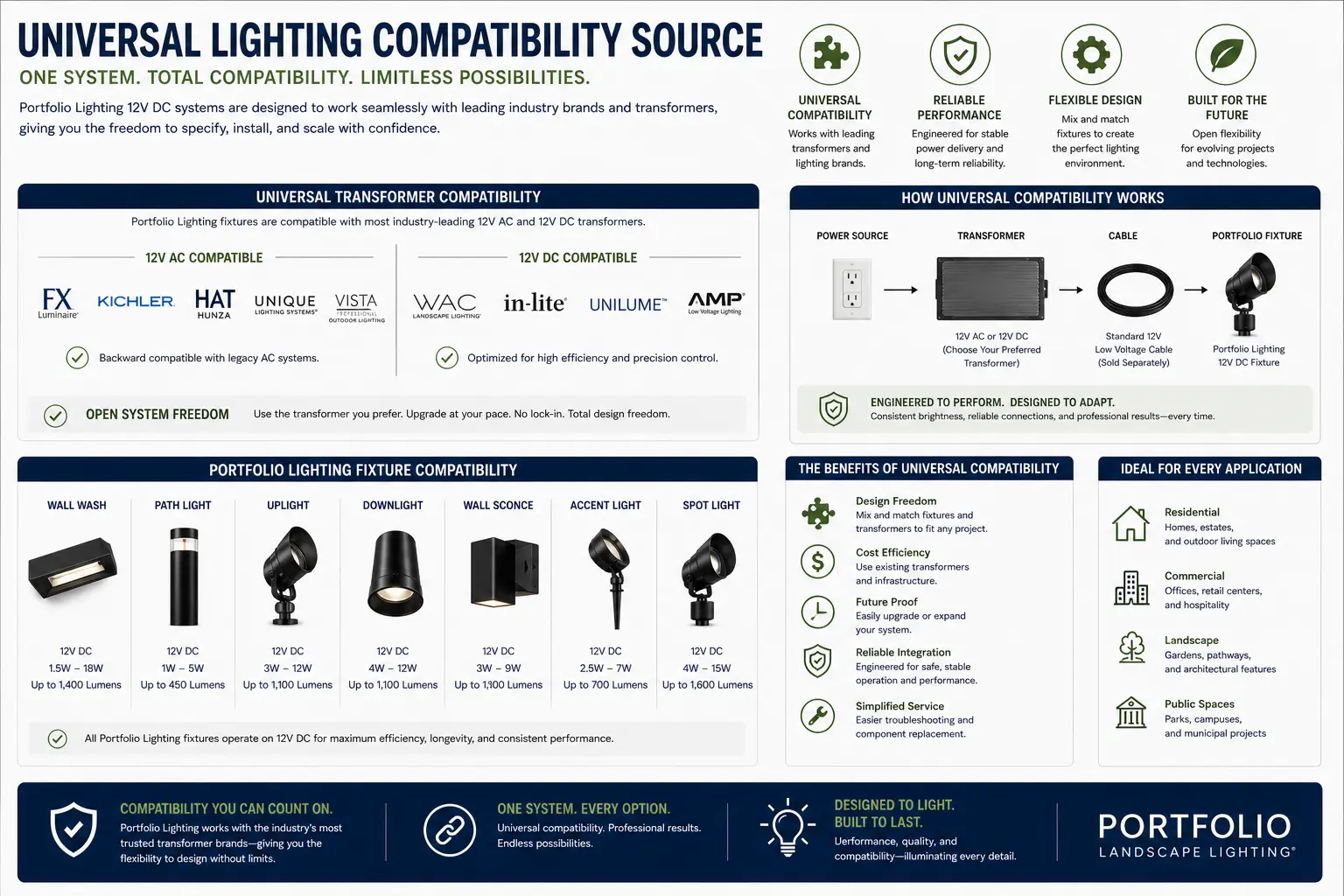
Quick Answer: Can You Mix Landscape Lighting Brands?
Yes—but only if voltage, load, and connections are correct.
Most 12V landscape lighting brands like Portfolio, Origin21, Kichler, Malibu, and Hampton Bay can work together—but failures happen when the electrical side is ignored.
- Voltage: Must match (usually 12V AC, sometimes DC for newer LED systems)
- Transformer Load: Stay under 80% capacity—and watch for minimum load issues on older units
- Wire Gauge: New connectors often fail on older 12-gauge cable
- Connections: Weak pierce connectors are the #1 cause of flicker and failure
- LED Drivers: Cheap or mismatched drivers cause instability, dimming, or ghosting
Best practice: If a connector doesn’t bite cleanly, don’t force it. Strip the wire and use a waterproof, gel-filled splice. That one step prevents most mixed-brand failures.
Logic Summary: Why Mixed Lighting Systems Fail
- Voltage mismatch: AC vs DC or unstable transformer output causes flicker or failure.
- Connector failure: Most problems are weak pierce connections, not bad fixtures.
- Wire gauge conflict: New connectors often fail on older 12-gauge cable.
- Voltage drop: Long runs reduce voltage and dim or destabilize LEDs.
- Driver sensitivity: Cheap LEDs react badly to ripple and unstable power.
In my experience, cross-brand lighting problems are rarely about the brand name printed on the box. They are about the hidden details: cable gauge, connector bite depth, transformer waveform, fixture wattage, LED driver tolerance, stem thread, gasket fit, and whether the old system was installed with clean waterproof splices.
If the connector does not bite, do not force it. Splice it properly.
If your older low-voltage system still has usable fixtures or cable runs, the Discontinued Landscape Lighting Parts and Troubleshooting Guide explains how to diagnose failed connectors, dim fixtures, overloaded transformers, integrated LED problems, and replacement-part compatibility across multiple discontinued lighting brands.
When compatibility gets confusing, I step back and compare full systems instead of individual parts. Use the Portfolio lighting alternatives guide to see which brands actually work long-term.
If your system hums, trips, or resets, use transformer troubleshooting.
A lot of older systems cross over with Malibu setups, so I recommend checking Malibu lighting replacement parts if you're trying to match older components.
Before mixing Malibu fixtures with Portfolio transformers or universal low-voltage components, identify the original Malibu hardware first using the Malibu Lighting Model Library and Replacement Parts Guide.
Many Malibu transformers and fixtures use standard 12V AC low-voltage logic that can cross over with modern Portfolio-compatible replacement systems. The Malibu Top 40 Parts Lookup Database explains common ML, LX and 8100-series compatibility patterns, connector upgrades and replacement transformer directions.
Brand Inter-Link Matrix: Cross-Brand Landscape Lighting Compatibility
Use this table as your first compatibility screen. It does not guarantee a perfect fit, but it tells you what usually matters before you mix fixtures and systems.
Before you mix brands or order replacement parts, I always check the exact specs first. Use the Portfolio lighting model specs guide to confirm voltage, wattage, transformer limits, and connector types so you don’t end up with a mismatch.
Compatibility is about more than voltage and connectors. The lighting dimmer, driver, and legacy compatibility guide compares how older and newer lighting systems behave under real-world operating conditions.
Compatibility matters, but long-term reliability matters too. The Best LED Landscape Lighting Fixtures Comparison benchmarks real-world fixture behavior including standby drain, operating heat, and low-voltage compatibility.
| Brand | Typical Connector Type | Common Stem Thread | Voltage Range | Best Fix for “Frankenstein” Wiring | Compatibility Warning |
|---|---|---|---|---|---|
| Portfolio | Screw-down / pierce connector | Often 1/2" NPT-style on many stake fixtures | Commonly 12V AC on landscape systems | Strip and use waterproof gel-filled connectors when old pierce connectors fail. | Older kits may have weak snap/pierce connections and long daisy-chain voltage drop. |
| Origin21 | Slim pierce connector on many DIY fixtures | Often 1/2" NPT-style, but confirm before buying stakes | Often 12V AC/DC depending on fixture and kit | Use adapter or splice method when connecting to thicker 12ga pro cable. | Modern slim connectors may not bite old heavy cable cleanly. |
| Kichler | Pressure-fit or pro-grade direct burial connector strategy | Often 1/2" NPT-style on many pro fixtures | Commonly 12V to 15V multi-tap systems | Use quality direct burial connectors and test voltage at the fixture. | Higher transformer taps can overdrive fixtures if you do not measure voltage. |
| Malibu | Snap-on / clamp-style connector on many older kits | Often 1/2" NPT-style, but older parts vary | Commonly 12V AC | Cut proprietary head and splice with outdoor-rated connectors. | Old connectors become brittle and may not hold contact after being moved. |
| Hampton Bay | Twist-lock or clip-style connector depending on kit | Often 1/2" NPT-style on many landscape fixtures | Commonly 12V AC | Replace twist-lock issues with silicone-filled or gel-filled connectors. | Mixed fixture loads can create dim end-of-run lights if wire is undersized. |
| VOLT-style pro fixtures | Often bare lead / direct burial splice approach | Often 1/2" NPT-style or heavy-duty pro mount | Commonly 12V to 15V multi-tap systems | Use direct burial connectors and heavier cable for long runs. | Pro fixtures may expose weaknesses in old DIY transformer and wire layout. |
| Generic Amazon LED fixtures | Varies widely: tiny pierce, wire leads, plugs, adapters | Varies widely; metric threads are possible | May be 12V AC, 12V DC, or driver-specific | Read the rating label and splice only if voltage and driver type match. | Do not assume “12V” means compatible with your transformer waveform. |
If you’re done dealing with connector issues and inconsistent performance, I’ve had the best long-term results with VOLT vs Portfolio lighting systems.
Homeowners often assume older landscape lighting systems are obsolete when only one component has failed. The legacy low-voltage lighting compatibility database explains how to mix replacement parts across discontinued transformers, fixtures, connectors, and MR16 systems.
The Wire Gauge Conflict: Why 18-Gauge Connectors Fail on 12-Gauge Cable
This is the compatibility problem that frustrates homeowners the most. Older or better-built landscape systems often use thicker 12-gauge or 14-gauge cable. Many modern DIY fixtures come with slim pierce connectors designed around thinner 18-gauge cable.
The connector teeth are supposed to pierce the insulation and touch copper. If the cable is too thick, the connector may not bite deeply enough. The fixture may not turn on, may flicker, may work only when you wiggle the wire, or may fail after the soil moves.
What I do instead
- Cut off the weak factory connector only when I know the fixture voltage is compatible.
- Strip the main cable and fixture leads cleanly.
- Use gel-filled or grease-filled connectors rated for outdoor/wet/direct-burial use.
- Keep the splice out of low spots where water sits.
- Test voltage at the fixture before burying the connection.
For detailed connector choices, see low voltage wire connectors landscape lighting.
The Minimum Load Problem (Most People Miss This)
One of the biggest hidden failures happens when upgrading halogen systems to LED.
For a more budget-friendly upgrade that still performs well, I’ve tested LeonLite vs Portfolio lighting and found it to be one of the easier transitions.
Older transformers were designed to run at higher loads. When you replace 200W of halogen with 30W of LED, the transformer may not operate correctly.
- Output voltage may spike above 12V
- Timers or photocells may stop triggering
- LEDs may flicker or behave unpredictably
For real-world calculations, use the voltage drop calculator.
Hub vs Daisy Chain Wiring (This Changes Everything)
When mixing brands, wiring layout matters more than the fixture itself.
- Daisy Chain: Light-to-light wiring causes voltage drop and uneven brightness.
- Hub Method: Multiple fixtures connect to a central junction point.
LED Ghosting and Flickering When Mixing Brands
Mixed-brand LED flicker is usually a power-quality problem, a connector problem, or a driver compatibility problem. I see this when someone adds a cheap LED fixture to an old Portfolio transformer, moves a Malibu fixture onto a newer transformer, or mixes old halogen-era wiring with modern LED heads.
Why it happens
- Old AC transformer: some newer LEDs are more sensitive to AC ripple or transformer waveform.
- Weak connector: poor copper contact can make an LED shimmer or blink.
- Voltage drop: the farthest fixture may not receive enough voltage.
- Low-quality LED driver: cheap internal drivers may pulse or ghost under unstable supply.
- Timer or smart plug leakage: tiny leakage current may create LED glow or ghosting.
For deeper flicker help, use Portfolio LED lights flickering and Portfolio LED lighting.
Mechanical Compatibility: Thread, Stem, Stake, Lens and Glass Sizes
Electrical compatibility gets the fixture powered. Mechanical compatibility makes it physically fit and survive weather. This is where many “universal” parts fail.
| Part | Common Industry Pattern | What Can Go Wrong | What to Measure |
|---|---|---|---|
| Fixture stake thread | Many use 1/2" NPT-style threading | Some brands use push-fit, proprietary, or metric stems. | Thread diameter, pitch, stem diameter, and fixture weight. |
| Spotlight bracket | Often adjustable with screw or knuckle mount | Ball joints and aiming screws may not match across brands. | Knuckle width, screw diameter, bracket angle, and head weight. |
| Path light lens | Often model-specific | Wrong lens lets water into the fixture or rattles loose. | Diameter, height, clip position, screw spacing, and gasket seat. |
| Wall lantern glass | Highly model-specific | Similar glass may be too thick, too short, or missing the right bevel. | Panel height, width, thickness, bevel, and retaining clip style. |
| Seals & O-Rings | Silicone or Buna-N rubber | Cheap foam seals fail under heat and UV exposure. | Measure groove diameter and seal thickness. |
| Transformer terminal screws | Often specific to terminal block design | Mismatched screws can strip, arc, loosen, or overheat. | Screw size, lug opening, wire gauge capacity, and terminal heat rating. |
For stakes and brackets, start with Portfolio lighting mounting hardware and bracket replacement.
The CRI Mismatch Problem (Why Colors Look Wrong)
Even if two lights are both “3000K,” they can look completely different.
- Low CRI (70–80): Dull, grey, washed-out plants
- High CRI (90+): Rich greens and natural color
Legacy to Modern Translation Lookup Table
This is a practical translation table, not an official substitution list. Use it to decide which direction to research when old Portfolio or Malibu-style parts are dead or discontinued.
| Legacy Item | Closest Living Replacement Direction | Do Not Skip This Check | Best Internal Guide |
|---|---|---|---|
| Portfolio #8526e-style path light | Origin21 low-voltage path light or Kichler-style path fixture with similar height | Voltage, stake thread, connector, fixture height, finish, and beam spread. | Model number lookup |
| Portfolio PT-100 transformer | Modern 120W to 150W outdoor low-voltage transformer | Total watts, 80% load, timer type, output terminals, and GFCI outlet. | Transformer replacement |
| Old Malibu snap-connector path light | Modern 12V path light with bare lead splice or better connector | Do not trust brittle old snap connectors; splice cleanly. | Malibu replacement parts |
| Hampton Bay twist-lock landscape fixture | 12V low-voltage fixture with waterproof splice conversion | Confirm transformer type and cable gauge before mixing. | Hampton Bay lighting replacement parts |
| Portfolio integrated LED fixture | New fixture assembly or exact driver match if serviceable | Driver output current and voltage; do not match by shape alone. | Portfolio LED lighting |
Smart Home Integration: Making Old Landscape Lighting Work in 2026
You do not always need to replace the whole lighting system to make it smart. In many cases, the cleanest upgrade is to leave the low-voltage side alone and control the transformer on the 120V plug-in side with a properly rated outdoor smart plug or timer.
If you're moving into smart or app-controlled lighting, compatibility gets even more sensitive. I break that down in AI outdoor lighting systems so you avoid mixing AC and DC systems incorrectly.
Smart options that usually make sense
- Outdoor smart plug: controls a standard plug-in transformer without modifying the low-voltage wiring.
- Lutron Caséta-style outdoor control: useful when you want reliable scheduling for a “dumb” transformer.
- Ring Smart Lighting bridge: better for Ring fixtures and motion logic than direct control of random old transformer electronics.
- AI outdoor lighting routines: best after the wiring, transformer, and connectors are already stable.
For automation ideas, see AI outdoor lighting systems and AI automated landscape lighting.
The 12-Point Compatibility Checklist
Before I mix any landscape lighting brand into an existing system, I want these twelve checks answered.
- Voltage: Is the new fixture 12V AC, 12V DC, AC/DC, or 120V hardwired?
- Transformer type: Does the transformer output match what the fixture expects?
- Total wattage: Is the load below about 80% of transformer rating?
- Wire gauge: Will the connector fit 12ga, 14ga, 16ga, or 18ga cable?
- Connector rating: Is it outdoor/wet/direct-burial rated?
- Voltage drop: What is the voltage at the farthest fixture?
- Stem thread: Does the stake actually screw into the fixture?
- Fixture height: Will the replacement look right next to old fixtures?
- Beam angle: Is it a path spread, flood, spot, or wall wash?
- Color temperature: Will 2700K, 3000K, or 5000K match the existing yard?
- Driver type: Does the LED have an internal driver that dislikes AC ripple?
- Weather seal: Does the lens, gasket, or splice keep water out?
For compatible replacements, check Portfolio lighting parts and accessories.
If your setup overlaps with Hampton Bay components, I’ve mapped that out here: Hampton Bay lighting replacement parts.
A compatible fixture is not always a repairable fixture. The Complete LED Fixture Repairability Database explains how different lighting systems compare for long-term maintenance, parts sourcing, and real-world service access.
Specialist’s Note from Philip Meyer
I have spent years troubleshooting these systems manually. The biggest lesson is simple: if the connector does not bite, do not force it. Splice it properly. Most failures I see are not bad fixtures. They are weak connectors, corroded terminals, overloaded transformers, voltage drop, or water sitting in the wrong place.
If you're working with Lowe’s-based systems, you’ll often see overlap with Utilitech. I’ve covered that here: Utilitech lighting replacement parts.
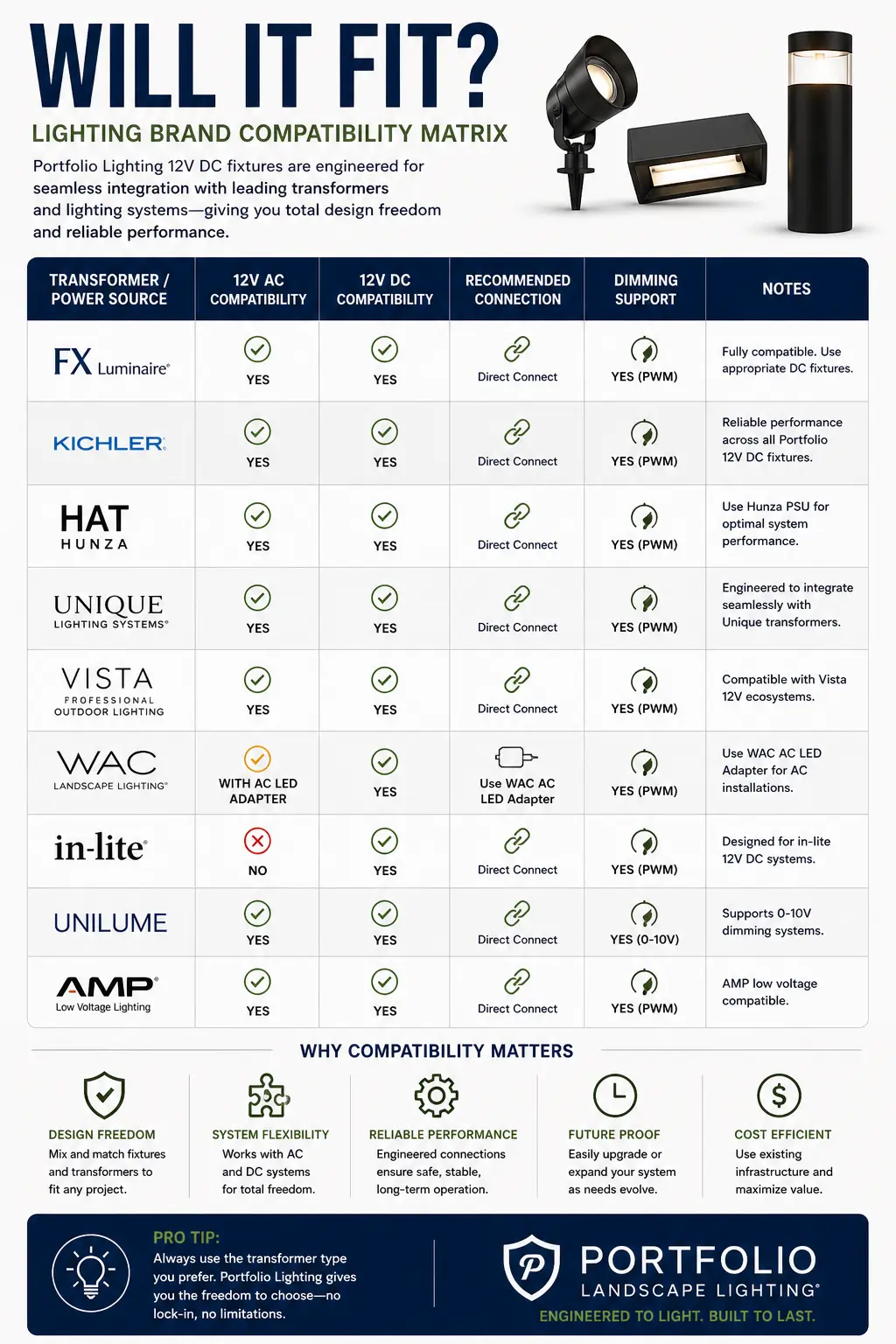
Pinterest Visual Idea I Thought Of: “Will It Fit?” Compatibility Matrix. I'm trying to show more on Pinterest.
Will It Fit? The Landscape Lighting Compatibility Matrix with these labels:
- 12V AC/DC compatibility
- 12ga vs 18ga wire connector warning
- 1/2" NPT stake thread check
- Transformer 80% rule
- Splice it if the connector does not bite
You can check out my Pin to see the Lighting Compatibility Chart as well as many other relevant images.
If your transformer is part of the issue, don’t just replace fixtures. Compare your options in this transformer alternatives guide before upgrading.
If you're trying to replace an older system and want a straightforward answer, I recommend starting with the best replacement options for Portfolio landscape lighting so you don’t waste time testing mismatched fixtures.
If you’re not sure what system you’re working with, don’t guess. Use the Portfolio lighting model number lookup to identify your exact fixture or transformer before trying to mix brands.
Best Next Step Based on Your Compatibility Problem
Portfolio System Compatibility
Start here if your existing system is Portfolio and you are adding mixed-brand parts.
Open alternatives guideTransformer Confusion
Use this if the issue is wattage, voltage, reset, hum, tripping, or replacement.
Open transformer troubleshootingConnector Problems
Use this if the fixture works only when you wiggle the connector or fails after rain.
Open connector guideLED Flicker Problems
Use this if mixed-brand LED fixtures shimmer, ghost, blink, or look unstable.
Open flicker guideUniversal Landscape Lighting Compatibility FAQ
Universal low-voltage compatibility depends on more than matching 12 volts. The landscape lighting brand compatibility comparison explains how Portfolio, Hampton Bay, Moonrays, Paradise, FX Luminaire, and other brands differ in parts, transformers, connectors, and repair paths.
Can you mix landscape lighting brands?
Yes, many low-voltage landscape lighting brands can be mixed if voltage, transformer load, cable gauge, connector type, and fixture wattage are compatible. I do not rely on brand name alone. I test the electrical side first.
Why will a new light not connect to my old 12-gauge wire?
Many new DIY fixtures use connectors designed for thinner 18-gauge cable. Those connectors may not pierce thick 12-gauge insulation deeply enough to touch copper. Strip and splice with outdoor-rated gel-filled connectors instead.
Do Portfolio, Malibu, Hampton Bay, Origin21, and Kichler use the same stakes?
Many fixtures use a 1/2-inch NPT-style thread, but not all. Some brands use push-fit, metric, or proprietary stems. Measure the thread and stem before buying replacement stakes.
Can an old Portfolio transformer run new LED fixtures?
Sometimes. The new fixtures must match voltage and the transformer must be within safe wattage limits. If the LEDs flicker, ghost, or look unstable, check connectors, voltage drop, transformer output, and driver compatibility.
What is the safest way to connect mixed-brand landscape lights?
The safest method is usually a proper outdoor-rated splice using gel-filled or grease-filled connectors after confirming voltage and wattage compatibility. Do not force a factory pierce connector that does not fit the cable.
Compatibility and Safety Disclaimer
This guide is educational and practical. Brand compatibility can vary by model, production run, connector design, voltage, fixture driver, transformer output, and outdoor rating. Always verify manufacturer instructions, voltage, wattage, local code, wet-location ratings, and connector ratings before modifying an outdoor lighting system.