
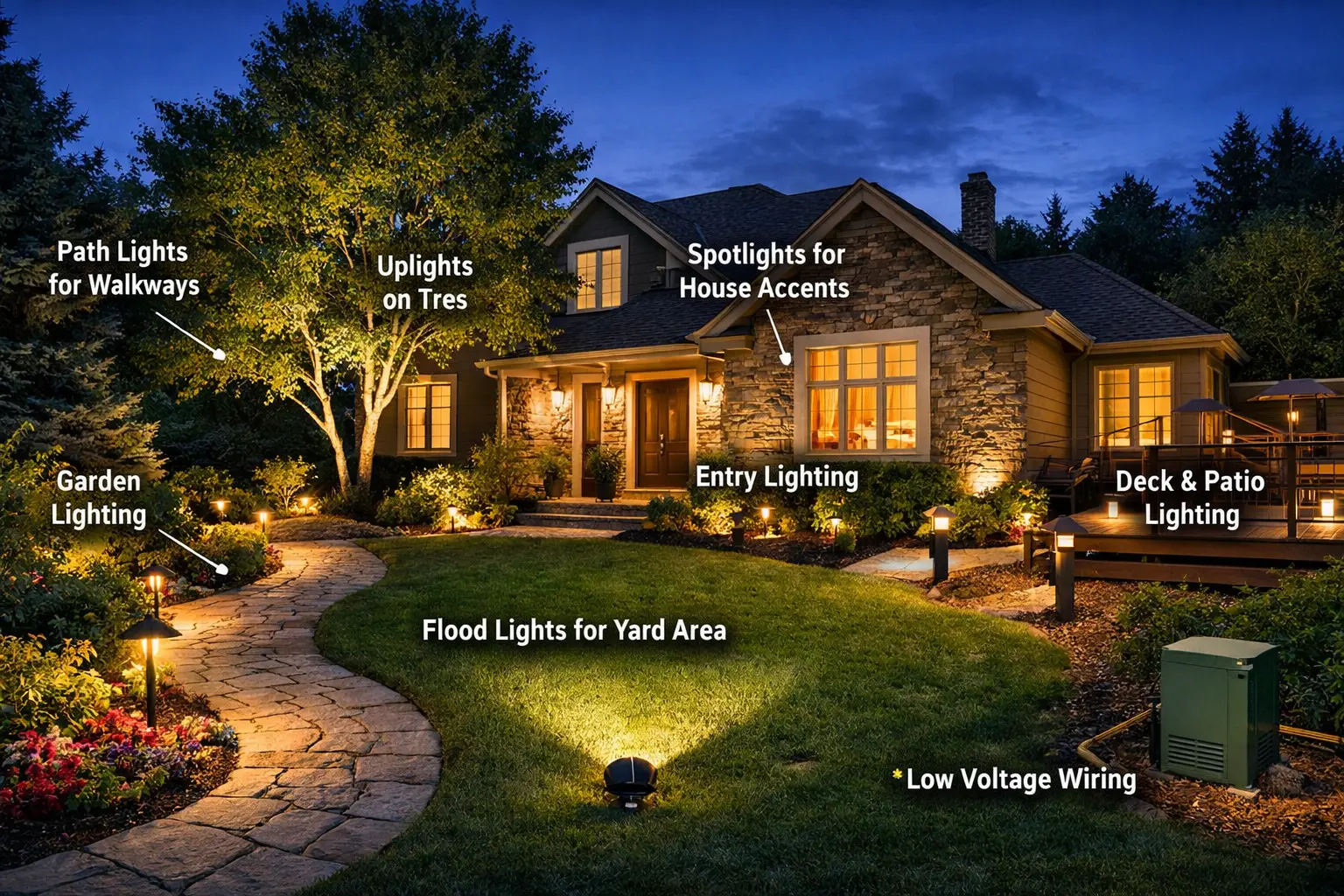
Quick Answer: Where Should Landscape Lights Go Around a House?
Landscape lights should be placed along walkways, near entry points, around foundation beds, and on key features like trees and architecture.
- ✔ Pathways → guide movement
- ✔ Entry → improve visibility
- ✔ Trees + architecture → add depth
- ✔ Backyard → support usable spaces
Start Here: Simple Landscape Lighting Layout
- ✔ Front yard → path lights + entry lighting
- ✔ Sides → minimal path or wall lighting
- ✔ Backyard → patio + accent lighting
- ✔ Trees → 1–2 spotlights per feature
Quick links: Spacing • Layout • Full design guide
Landscape lighting around a house works best when it is planned as a complete design instead of a group of random fixtures. The goal is not simply to add more light. The goal is to create balance: enough light for safety and navigation, enough accent lighting for visual depth, and enough restraint that the home still looks natural at night.
This page belongs in the landscape lighting design cluster and naturally supports the broader landscape lighting design guide, layout guide, spacing guide, tree uplighting guide, and path light placement guide.
Why Landscape Lighting Around a House Matters
Lighting around a house changes how the entire property is experienced after dark. The most obvious benefit is visibility. Walkways, entries, steps, and transitions become safer to use when the lighting is planned intentionally. But good landscape lighting also serves a design role. It makes a home feel more welcoming, helps the eye understand the shape of the lot at night, and gives architecture and landscaping a stronger presence.
Well-placed outdoor lighting also creates curb appeal. The house becomes more visually defined from the street. Trees gain structure, foundation beds gain depth, and the entry feels clearer and more inviting. Even simple path lights and a few accent fixtures can make a big difference when they are placed with purpose.
If you are looking for the broadest overview before planning individual areas, start with the landscape lighting guide and the main Portfolio landscape lighting category page.
Planning Your Landscape Lighting Layout
A successful lighting plan starts with layout, not fixture shopping. Think about the property in zones: front yard, sides of the house, and backyard. Within each zone, identify the practical needs first, such as navigation, entry visibility, and transitions between spaces. Then identify focal points like trees, architectural details, specimen plants, or seating areas.
Strong layouts typically combine three ideas:
- Lighting zones so different areas of the property serve different purposes
- Focal points so the eye is drawn to intentional features
- Spacing discipline so the system feels balanced rather than cluttered
The best next pages for this stage are the landscape lighting layout guide and landscape lighting spacing guide. Those pages help you decide where lights physically go and how far apart they should be.
Best Landscape Lights for Lighting Around a House
Path Lights
Path lights are some of the most useful fixtures around a house because they improve nighttime navigation and define walkways clearly. They work best along front walks, garden paths, side yard transitions, and routes that connect the driveway, patio, or backyard to the rest of the home.
Spotlights
Landscape spotlights are ideal for drawing attention to specific features such as trees, stone columns, façade textures, or foundation planting accents. They are one of the best tools for giving the house vertical depth at night.
Flood Lights
Flood lights are useful where broader light is needed, such as wider yard areas, broad architectural surfaces, or larger planting beds. They should be used carefully so they do not flatten the whole scene or create glare.
Deck Lights
Deck lights help patios, stairs, railings, and outdoor living spaces feel usable after dark. They are often most valuable in the backyard but can also help with front porch transitions.
Front Yard Landscape Lighting Ideas
The front yard is where lighting has the biggest impact on curb appeal. In most cases, front yard lighting should solve three jobs: guide people to the entry, show the home’s architecture more clearly, and make the landscaping feel intentional at night.
Common front yard layers include:
- Walkway lighting from the driveway or sidewalk to the front door
- Garden bed accents near the foundation
- Entry lighting around steps, porch transitions, or columns
- Accent lighting on trees near the front elevation
For more visual ideas, compare Portfolio landscape lighting ideas and path light placement.
Lighting the Sides of a House
The sides of a house are often overlooked, but they matter because they connect the front yard and backyard and often include gates, utility areas, narrow walks, or transitions that are hard to use after dark. Side yard lighting should usually be practical first and decorative second.
Good options include outdoor wall spotlights for targeted security and accent use, and bollard lighting for pathways where slightly taller fixture presence makes sense.
In many homes, this area benefits from simple, clear navigation lighting rather than heavy accent lighting. The goal is safe movement without turning the side yard into an overlit corridor.
Backyard Landscape Lighting Design
Backyard lighting often needs a different strategy than front yard lighting. The front yard usually emphasizes curb appeal and entry clarity. The backyard usually emphasizes usability, comfort, and how outdoor living spaces feel after dark.
In many homes, the most valuable backyard layers are:
- Patio lighting for dining or seating zones
- Deck lighting for steps, railings, and movement
- Garden bed lighting near entertainment areas
- Accent lighting on trees or water features to create depth
If you are building or improving a backyard system, compare Portfolio deck lighting and Portfolio landscape lighting installation for the next planning step.
Using Uplighting to Highlight Trees and Architecture
Uplighting is one of the most effective techniques for making a house and its landscape feel dramatic without over-lighting the whole yard. By aiming fixtures upward, you can reveal tree canopy structure, bark texture, columns, façade stone, or other architectural surfaces in a way that adds vertical depth to the scene.
This is especially powerful around a house because it keeps the eye moving upward. Path lights and low accents keep the lower portions of the yard visible, while uplighting adds the vertical emphasis that makes the property feel layered and complete.
For more specific placement strategy, review the tree uplighting guide and compare Portfolio in-grade lighting when you want a cleaner fixture appearance near highly visible architectural areas.
Low Voltage Landscape Lighting Systems
Most landscape lighting around a house uses a low-voltage system. These systems are popular because they are efficient, flexible, and easier for homeowners to understand and expand than many line-voltage setups. A typical low-voltage system uses a transformer to step standard household power down to low voltage, then distributes that power through cable to the fixtures around the yard.
That means good design still depends on electrical basics. The transformer has to be sized correctly, the cable layout has to support the run lengths, and the system should be wired in a way that avoids unnecessary voltage loss. If you are planning installation or expansion, compare Portfolio low voltage lighting, landscape lighting transformer guide, and how to wire landscape lighting.
How Many Landscape Lights Should You Use Around a House?
The number of fixtures needed depends on lot size, walkway length, number of focal points, and how layered you want the design to feel. A practical starting table looks like this:
| House Size / Property Size | Typical Number of Lights | Typical Focus |
|---|---|---|
| Small yard | 6–8 | Entry, short walkway, a few accents |
| Medium yard | 10–14 | Front path, foundation beds, side route, backyard accents |
| Large property | 16+ | Multiple zones, trees, longer paths, broader architectural lighting |
These counts are only planning ranges. Actual fixture count depends on spacing, beam spread, and how many focal points the property has. For deeper planning, compare landscape lighting spacing and landscape lighting layout.
Common Landscape Lighting Mistakes Around a House
The most common design mistakes are usually not about fixture quality. They are about planning. A house can have good fixtures and still look poorly lit if the spacing is awkward, the beam angles are wrong, or too many fixtures are trying to do the same job.
- Placing lights too close together so the yard feels cluttered
- Creating glare by aiming fixtures too openly toward walkways or seating areas
- Ignoring wiring and system planning during design
- Using the wrong beam spread for the feature being lit
- Trying to light everything evenly instead of creating focal points
If your system is already in place and is not performing the way you expected, compare landscape lighting troubleshooting and landscape lighting voltage drop to separate design issues from electrical issues.
Final Thoughts on Landscape Lighting Around a House
Good landscape lighting around a house should feel balanced, useful, and intentional. The strongest designs guide movement, highlight the best features of the property, and create a layered nighttime view that still feels comfortable. A house should not look like a parking lot, but it should not disappear into darkness either.
Start with layout. Decide what needs to be lit for safety. Then decide what deserves emphasis for design. Use path lights for navigation, spotlights for trees and architectural details, broader lights carefully where coverage is needed, and low-voltage planning to make sure the system is practical as well as attractive.
Landscape Lighting Around a House FAQ
How many landscape lights do you need around a house?
The number depends on the size of the property and what you want to highlight. A small yard may only need 6 to 8 fixtures, while a medium yard often uses 10 to 14 lights and a larger property may need 16 or more.
Where should landscape lights be placed around a house?
Landscape lights are usually placed along walkways, near entry points, around foundation beds, near trees or architectural features, and around patios, decks, or backyard gathering areas.
What type of lights are best for house landscape lighting?
Path lights, spotlights, flood lights, deck lights, and bollard lights are some of the most useful fixtures for lighting around a house. The right choice depends on whether you need navigation lighting, accent lighting, or broader area illumination.
How far apart should landscape lights be?
That depends on the fixture type and brightness. Many path lights are spaced roughly 6 to 10 feet apart, while accent lights and spotlights are placed based on beam angle, focal point, and the size of the feature being lit.
Can you install landscape lighting yourself?
Many homeowners can install a low-voltage landscape lighting system themselves, especially for path lights and simple accent lighting. More complex systems require careful transformer sizing, wiring layout, and voltage drop planning.
More Landscape Lighting Design Guides
Landscape Lighting Design Guide
Start here for the broadest outdoor lighting design strategy, including focal points, lighting layers, and planning principles.
Read the guideLandscape Lighting Layout
Use this page to decide where fixtures should physically go around your yard and house.
Read the guideLandscape Lighting Spacing
Learn how far apart lights should be placed so the system looks balanced instead of crowded.
Read the guideTree Uplighting Guide
Use uplighting to add vertical depth and stronger nighttime presence around the house.
Read the guidePath Light Placement
Plan walkway and path lighting more effectively around entries, curves, and transitions.
Read the guideTransformer Guide
Understand the low-voltage electrical side of outdoor lighting before installation or expansion.
Read the guideLandscape Lighting Around a House, Layout Planning, Fixture Selection, and Low-Voltage Design Help
This page is designed to help readers plan a complete outdoor lighting layout around a house instead of choosing fixtures one at a time without a clear design strategy. Use it as a bridge page between broad landscape lighting planning and the more specific pages for layout, spacing, tree uplighting, path placement, transformer sizing, and fixture categories.
If you are still building the system from scratch, it often helps to compare the broad design pages first, then move into the specific fixture and electrical guides once you know what areas of the house and yard you want to emphasize.