
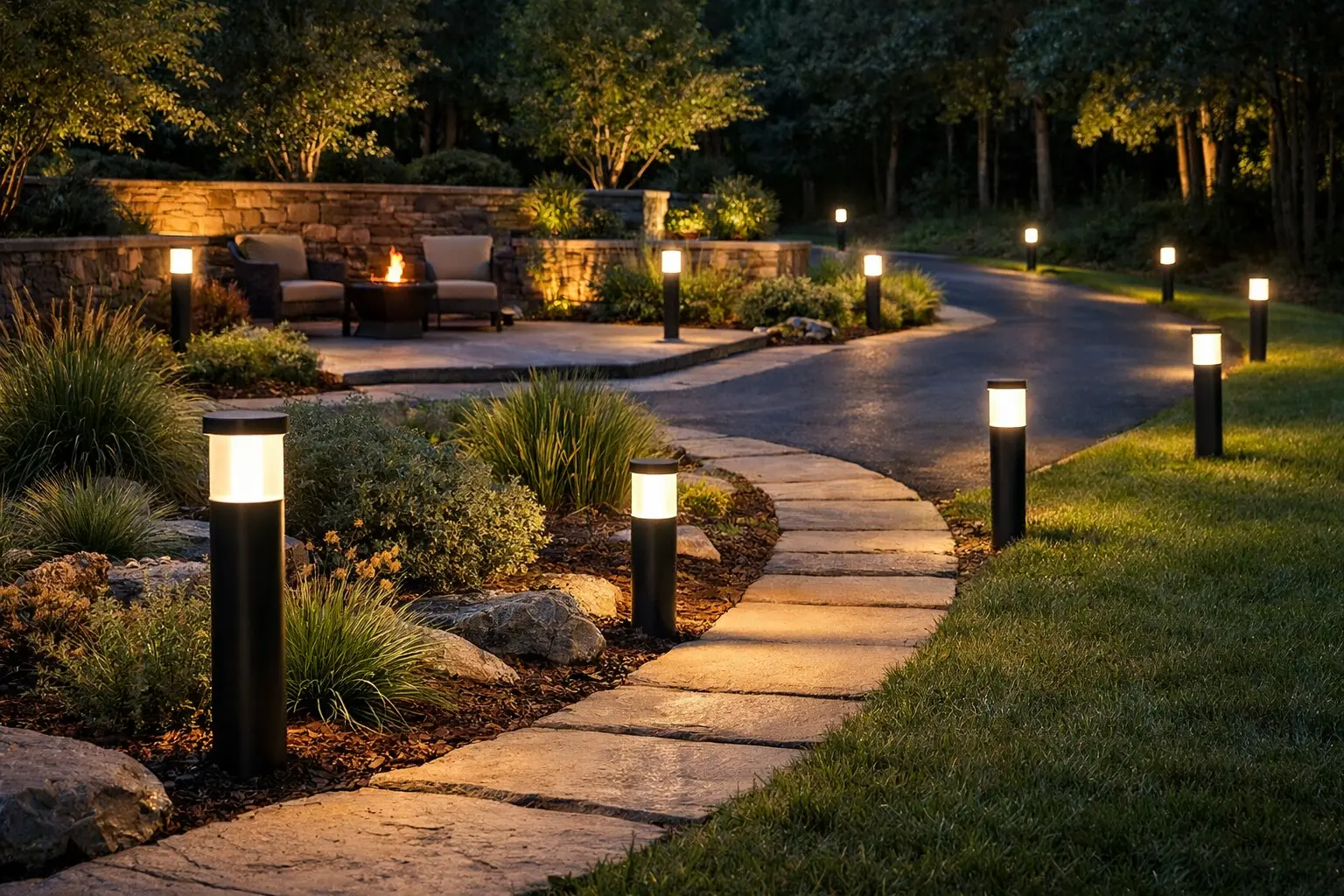
Quick Answer: What Is Portfolio Bollard Lighting?
Portfolio bollard lighting is a taller outdoor fixture used to define walkways, driveways, and open landscape areas with stronger visibility and structure than standard path lights. Bollards work best in wider spaces where you need clearer route definition, while smaller path lights are better for subtle, residential-style guidance.
If your space is wide or modern → bollard lighting is usually the better choice.
Not sure which fixture is right? Compare path lights or start with the lighting layout guide.
For a complete outdoor lighting system, see how bollards fit into a full layout using this low voltage landscape lighting guide.
Bollard lighting works best when an outdoor space needs more visible route definition, more fixture presence, or a more architectural look than standard path lighting usually delivers. The value of the category is not just brightness. It is how bollard fixtures shape the space after dark.
This page fits naturally with Portfolio bollard landscape lighting, Portfolio landscape lighting, Portfolio path lights, Portfolio low voltage lighting, and Portfolio outdoor lighting. If the focus is more on layout and route planning, also use Portfolio lighting guide, plan and placement, Portfolio lighting placement, and Portfolio landscape lighting ideas.
What Portfolio Bollard Lighting Is
Portfolio bollard lighting belongs to the broader family of outdoor route and area-definition fixtures. In simple terms, a bollard light is a taller outdoor fixture designed to provide visibility while also marking a path, edge, or zone more assertively than a small stake-style light. That physical presence is part of what makes the category different.
A lot of outdoor lighting categories can seem similar until they are placed in a real yard. Bollard fixtures stand out because they participate in the design more clearly. They do not disappear into the planting bed the way smaller path lights often do. In the right setting, that is a strength. They can give the yard structure, reinforce a modern look, and make outdoor circulation areas feel more organized.
That is also why bollard lighting is not automatically the right choice for every residential path. Some homes and garden layouts benefit more from quieter fixtures. Others need a stronger visual marker. This page exists to help sort out that difference.
Where Bollard Fixtures Fit Best
Bollard lighting tends to perform best in outdoor areas where the route or edge needs more visual weight. That often includes longer driveways, wider front walks, courtyard-style spaces, patio connectors, side-yard routes, garden transitions, and open landscape zones that feel too broad for small path lights alone.
Wider walkways and approach paths
On a wider path, smaller fixtures can start to feel visually lost. Bollards often solve that by giving the route a stronger rhythm and a more readable nighttime boundary.
Driveway edges and open hardscape zones
Bollard fixtures also make sense where a driveway or larger paved edge needs clearer definition. In these areas, the larger fixture profile can help create a stronger guide without needing to rely on heavy flood lighting.
Modern and structured outdoor designs
Some outdoor layouts naturally support bollard lighting because the overall style is clean, geometric, and architectural. In these spaces, a bollard does not feel intrusive. It feels integrated.
Transitional spaces
Bollards can be especially useful where one outdoor zone turns into another: driveway to entry walk, garden route to patio, path to seating area, or lawn edge to hardscape. In these places, the fixture helps explain the space after dark.
If the main goal is a more detailed landscape-use layout, this page should feed naturally into Portfolio bollard landscape lighting. That page can own the more specific planning and spacing intent.
If your layout includes elevation changes or transitions, combine bollards with step lighting for better safety and visibility.
If your layout feels uneven or too bright in some areas, review voltage drop and spacing issues to balance your system correctly.
Bollard vs Path vs Post Lighting
One of the smartest ways to choose outdoor fixtures is to compare category roles instead of comparing products in isolation. A bollard light is not just competing with another bollard. It is often being chosen instead of a path light, a post fixture, or some other outdoor route-lighting option.
Bollard lighting
Bollards are usually best when more visual presence is needed. They help define space strongly and work well in larger or more open layouts.
Path lights
Path lights are usually more understated and residential in feel. They work well where the goal is softer guidance rather than strong fixture presence.
Post lighting
Post lights often serve as taller, more fixture-forward elements at entries, driveway transitions, or defined structural points. They are not usually the same kind of route-lighting tool that bollards are.
| Fixture Type | Best Strength | Best Related Page |
|---|---|---|
| Bollard lighting | Stronger route definition and architectural presence | Portfolio Bollard Landscape Lighting |
| Path lights | Softer residential guidance along smaller walks | Portfolio Path Lights |
| Post lighting | Entry emphasis and larger vertical fixture presence | Portfolio Post Lighting |
| Step lighting | Targeted visibility on elevation changes | Portfolio Step Lighting |
Looking at the category this way helps prevent the most common mistake, which is choosing a fixture by appearance before deciding what job it actually needs to do.
Who Bollard Lighting Is Best For
Portfolio bollard lighting is usually the best fit for visitors who need more than decorative path guidance. It tends to suit properties with broader circulation areas, driveways that need clearer nighttime edges, landscape layouts with cleaner modern lines, or outdoor zones where smaller fixtures simply feel too slight.
Best fit scenarios
- modern or transitional home exteriors
- wider walkways and open side-yard routes
- driveway and hardscape edge definition
- larger front-entry approaches
- outdoor spaces that need stronger visual structure
- low voltage plans that combine form and navigation
Less ideal scenarios
Bollard lighting is usually less ideal where the path is narrow, the garden is delicate and informal, or the yard needs only subtle low-level guidance. In those cases, a smaller path-light system may look better and do the job more gracefully.
This is why the page should interlink naturally with Portfolio path lights, Portfolio landscape lighting ideas, and Portfolio lighting placement. Those pages can help you decide how strong the lighting presence really needs to be.
Narrow walkway → use path lights
Wide path or driveway → use bollard lights
Modern outdoor design → bollards usually fit better
Subtle garden lighting → avoid bollards
Bollard Lights Should Guide the Path Without Blasting the Plants
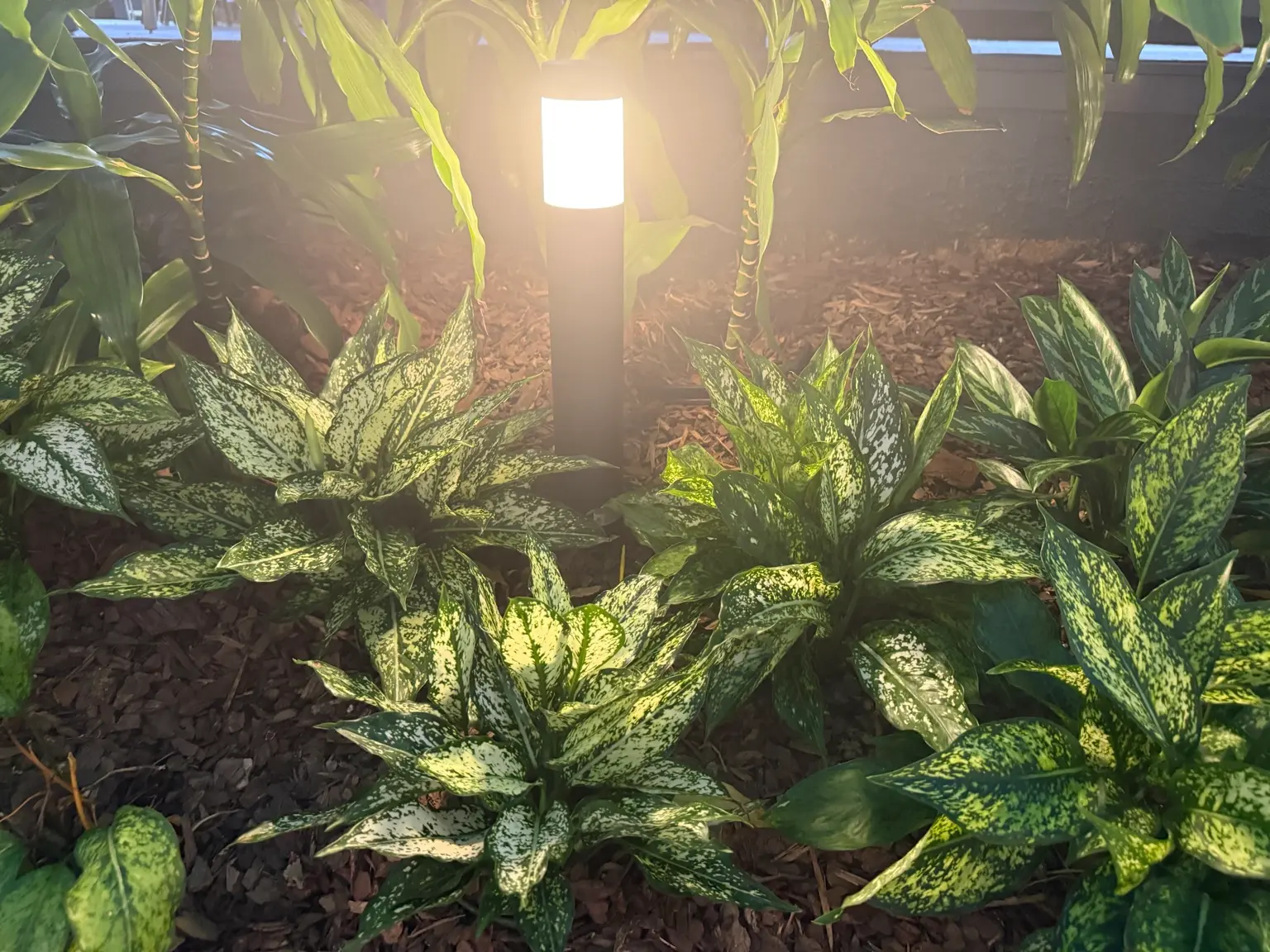
Bollard lights are helpful near walkways, garden beds, entrances, and patio edges, but placement matters. If the fixture is too bright or too exposed, it can create glare instead of comfort.
A better approach is to space bollards so they overlap gently, use warm color temperature, and avoid aiming direct light into seated or walking eye level. In planted areas, the goal is soft visibility, not a spotlight effect.
Common Bollard Lighting Mistakes
The most common bollard-lighting mistakes usually come from treating bollards like oversized decorative stakes instead of like design-defining fixtures. Because the fixtures are taller and more noticeable, the layout matters more than people expect.
Using too many fixtures
More is not automatically better. Bollards have presence. A layout that might feel fine with small path lights can become repetitive and heavy when every interval is filled with another bollard.
Ignoring the scale of the route
A narrow garden path may not need a line of larger fixtures. A wider path may. Matching the fixture scale to the space is one of the biggest quality differences between a thoughtful layout and an awkward one.
Choosing bollards for style only
The modern look of bollards is appealing, but the fixtures still need to fit the actual route, yard size, and circulation pattern. A good-looking fixture in the wrong role is still the wrong fixture.
Forgetting the rest of the system
Bollards are only one layer of the outdoor plan. They often need support from broader low voltage planning, transformer sizing, and layout work. That is why this page should point naturally toward Portfolio lighting transformer sizing guide, Portfolio landscape lighting wiring, and landscape lighting voltage drop.
Portfolio Bollard Lighting Decision Table
Use this table to decide whether bollard lighting is the right category fit and which Portfolio page should be the next stop.
| Outdoor Need | Best Likely Fixture Direction | Best Supporting Page |
|---|---|---|
| Need stronger route definition on a wider path | Bollard lighting is often the better fit | Bollard Landscape Lighting |
| Need softer guidance on a smaller walkway | Path lights may be more natural | Path Lights |
| Need driveway or hardscape edge clarity | Bollards often make sense | Low Voltage Lighting |
| Need step or elevation safety | Step lights may be more specific | Step Lighting |
| Need full yard planning before buying fixtures | Work from layout and placement first | Guide, Plan and Placement |
| Need a general outdoor fixture category decision | Compare across outdoor pages | Outdoor Lighting |
How Portfolio Bollard Lighting Fits Into a Bigger Outdoor Lighting Strategy
Bollard lighting is usually not the only fixture category in a complete outdoor plan. It is often the fixture type that gives the yard stronger structure, while other fixtures provide softer guidance or more focused accents. That is an important distinction. A property may use bollards to define the main route, path lights on smaller branches, spotlights on focal trees, and step lights at transitions. The best result usually comes from letting each fixture type do the job it is most naturally suited to do.
Hopefully this will help you find the category and decide whether bollards are the right direction. Once that answer is yes, the next pages should help with planning, spacing, transformer support, wiring, and broader layout execution. In my experience, researching other areas can be your best option.
The most useful next pages from here are Portfolio bollard landscape lighting, Portfolio landscape lighting, Portfolio path lights, Portfolio lighting guide, plan and placement, and Portfolio landscape lighting installation.
Portfolio Bollard Lighting FAQ
What is Portfolio bollard lighting best used for?
Portfolio bollard lighting is usually best for pathways, driveway edges, courtyards, larger walk areas, and outdoor spaces where a taller fixture helps define routes and create a more architectural nighttime look.
Are bollard lights different from standard path lights?
Yes. Bollard lights are typically taller and more visually prominent than standard path lights. They often work better in larger or more modern spaces where stronger edge definition and fixture presence are desirable.
When do bollard lights make more sense than path lights?
Bollard lights usually make more sense when the path is wider, the driveway edge is more open, the landscape design is more structured, or the outdoor space needs a stronger visual framework than smaller path lights usually provide.
What is the biggest mistake with bollard lighting?
A common mistake is treating bollard lights like small path lights and using too many of them too close together. Because bollards are larger and more visible, spacing and overall scale matter much more.