
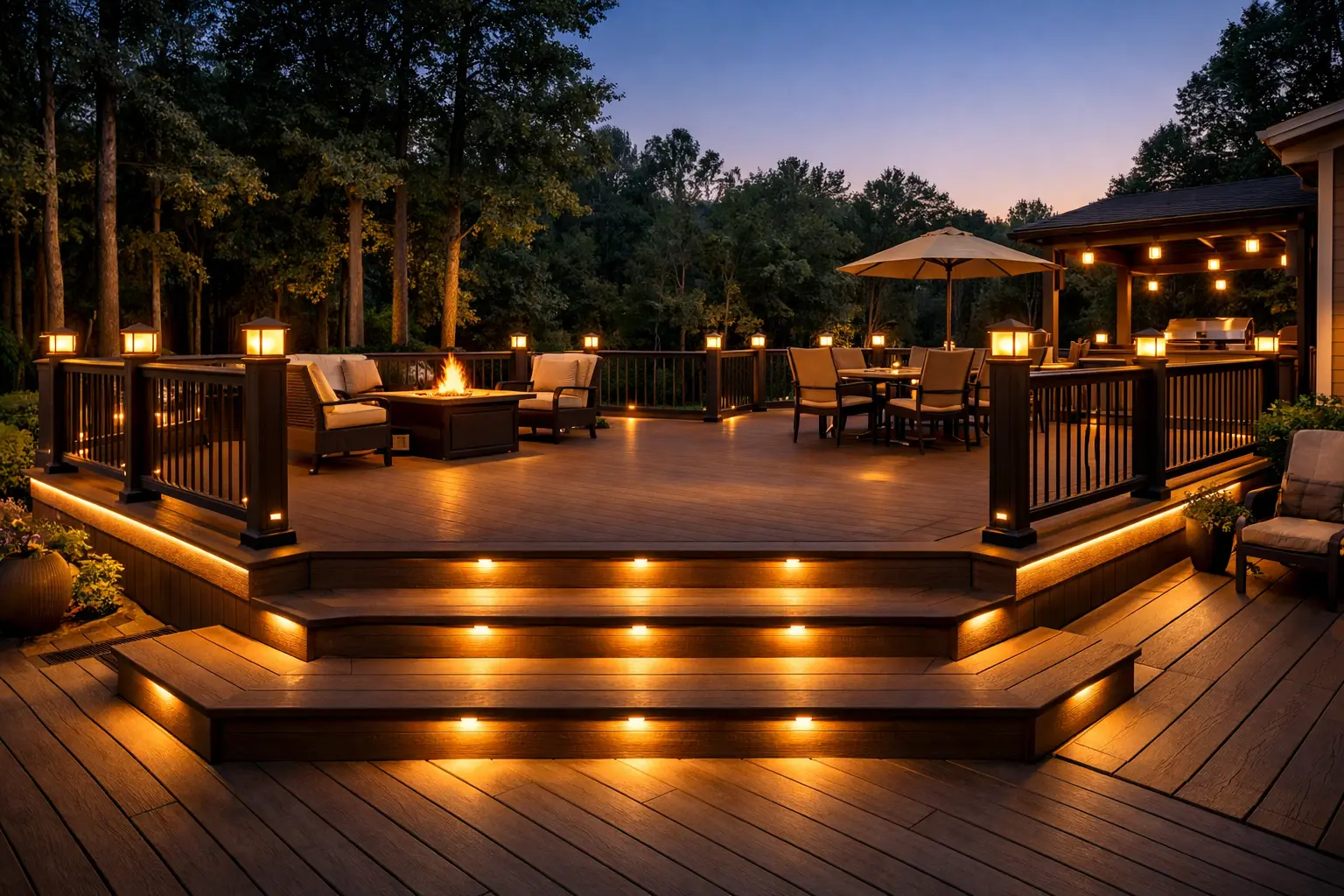
Quick Answer: Where Should Deck Lights Go?
Deck lights work best on stair risers, railing posts, under railings, and along deck edges. Focus on transitions and movement areas first, then add subtle lighting to seating areas for comfort and balance.
- Start with stairs first
- Add railing or edge lighting second
- Use accent lighting last for comfort
- Avoid over-lighting the deck surface
Portfolio deck lighting is one of the most practical outdoor lighting categories because it improves safety and ambiance at the same time. A few well-placed deck lights can make stairs easier to use, deck edges easier to read, and the entire outdoor area feel more comfortable in the evening.
This page fits naturally alongside Portfolio outdoor lighting, Portfolio low voltage lighting, Portfolio step lighting, Portfolio lighting guide, plan and placement, and Portfolio lighting placement. If your deck lights are already installed and not working correctly, you may also need Portfolio lighting troubleshooting.
Most Common Deck Lighting Mistakes
- Adding too many lights instead of placing them correctly
- Ignoring stair safety lighting
- Lighting every surface instead of key areas
- Using bright lights instead of subtle low-level lighting
- Not planning how deck lighting connects to the yard
What Deck Lighting Layouts Actually Work (Simple Setup)
- Stair lights + railing lights → best for safety
- Under-rail lighting → best for seating areas
- Edge + path lighting → best for deck transitions
Best setup: combine 2–3 types instead of relying on one fixture.
What Portfolio Deck Lighting Is Designed to Do
Deck lighting serves a very specific role in outdoor lighting systems. Unlike large flood fixtures or broad landscape spotlights, deck lights are usually there to support the structure of the deck itself. Their job is to make the space easier to use, easier to move through, and better looking at night without turning the deck into a brightly lit stage.
That means deck lights are usually placed where they can help with transitions and edges. Stair risers, railing posts, perimeter edges, under-rail locations, and subtle accent points are all common places where Portfolio deck lights make sense. These are the places where your eye needs help at night and where small amounts of light can make a big difference.
Well-planned deck lighting can also make the entire outdoor living space feel more complete. A deck often becomes the gathering point for evenings outside, which means comfort matters just as much as visibility. When the lighting is done well, the result feels calm and intentional, not harsh or overdone.
Many homeowners also discover that deck lighting helps connect the house to the yard. It creates a smoother transition between doorways, steps, patios, seating areas, and the surrounding landscape. That is one reason deck lights pair so naturally with Portfolio path lights, Portfolio landscape spotlights, and Portfolio post lighting.
Common Types of Portfolio Deck Lighting
Portfolio deck lighting usually appears in several fixture styles depending on where the lights are installed and what the deck needs to accomplish at night. Some lights are mainly about safety. Others are more about defining the structure of the deck or making the space feel more welcoming in the evening. The strongest layouts usually combine more than one type.
Deck Post Lights
Deck post lights are often installed on top of railing posts or built into the post structure. They help outline the overall shape of the deck and make the perimeter easier to understand at night. This type of fixture is especially useful on larger decks where simple edge definition goes a long way.
Deck Step Lights
Step lighting is one of the most practical parts of deck lighting because stairs are one of the highest-risk areas after dark. Small lights placed in stair risers or nearby structure can make each step easier to read without flooding the staircase with glare.
Recessed Deck Lights
Recessed lights are built into the deck surface, stair structure, or trim details. These tend to be lower-profile and more architectural in appearance. They are useful when you want subtle visibility without bulky visible fixtures.
Under-Rail and Accent Lighting
Under-rail deck lights and similar accent fixtures help create a soft wash of light across the deck surface. This kind of lighting is especially helpful in seating areas where you want the deck to feel comfortable and usable without pushing all the attention upward toward bright fixtures.
If your outdoor project is broader than just deck lighting, also compare Portfolio step lighting, Portfolio wall lantern, and Portfolio outdoor lighting so you can see how each fixture category supports a different part of the space.
Where Portfolio Deck Lights Work Best
Deck lights are most useful when they are placed where the structure changes, where feet move, or where you want better nighttime definition. In other words, deck lights work best when they solve a real visibility problem or support a clear design goal instead of being scattered randomly across the structure.
The table below shows the most common areas of a deck where Portfolio deck lighting is typically installed and the role each fixture plays in the overall lighting plan.
| Deck Lighting Location | Purpose | Typical Result |
|---|---|---|
| Deck stair risers | Improve nighttime step visibility | Safer movement on stairs |
| Deck railing posts | Outline the deck structure | Better visual definition at night |
| Deck surface recess lights | Provide subtle ambient lighting | Balanced illumination across deck |
| Under-rail lighting | Highlight deck seating areas | Soft accent lighting |
| Deck perimeter edges | Define deck boundaries | Improved safety and visual appeal |
In practice, the strongest deck lighting layouts rarely rely on just one location. A small amount of stair lighting may solve safety concerns, but perimeter or post lighting may still be needed to make the full structure feel visually complete. That is why deck lighting is usually best planned as part of the larger outdoor space rather than as an isolated add-on.
If you want a cleaner edge-lighting effect instead of visible fixtures, see this linear hardscape lighting guide. It explains how to create hidden glow lines along steps, edges, and seating areas.
Deck lighting failures are often blamed on fixtures, but the outlet feeding the transformer may be the first component exposed to splashback, snow melt, and cord movement. If the receptacle is under the deck, near stairs, or mounted where the cord bends sharply, the installation deserves a closer code check. The outdoor lighting receptacle requirements guide explains the exterior outlet details that matter before adding deck lighting loads.
Why Portfolio Deck Lighting Usually Uses Low Voltage Systems
Many deck lighting systems use low voltage power because it supports multiple small outdoor fixtures in a clean, flexible way. That makes low voltage lighting a natural fit for deck projects where the fixtures are spread across posts, steps, rails, and edges rather than concentrated in one spot.
A low voltage system also makes it easier to think about the deck as part of a broader outdoor lighting layout. The same general system may support deck lights, path lights, accent lights, and other landscape fixtures, which means the deck can feel integrated into the whole yard instead of lit as a separate zone.
Another reason low voltage deck lighting works so well is that the fixtures themselves are often small and subtle. They are meant to add gentle visibility rather than flood the area with intense brightness. That lower-profile approach is part of what makes deck lighting feel more refined when it is done well.
For wiring and setup, see Portfolio lighting installation instructions to avoid common layout and connection mistakes.
If you are still learning how these outdoor systems fit together, use Portfolio low voltage lighting, low voltage landscape lighting, and landscape lighting transformer guide to understand how the bigger system works before adding or replacing fixtures.
If you are building a full system, review low voltage landscape lighting to understand how deck lights connect with other fixtures.
How Deck Lighting Fits Into a Larger Outdoor Lighting Plan
Deck lighting is usually just one layer in a complete outdoor lighting design. Its job is often more focused than path lighting or landscape spotlights. Deck lights define the deck structure, help with stairs and transitions, and make the immediate deck area feel usable at night. They are not usually responsible for the whole yard.
That is why the best outdoor lighting layouts combine several fixture types. Deck lights can make stairs and railings easier to read, while Portfolio path lights guide movement through the yard, Portfolio landscape spotlights highlight focal trees or walls, and Portfolio post lighting helps define entries and approach areas.
This layered approach tends to feel more natural because each fixture type handles one role well. Instead of forcing the deck lights to do everything, the overall outdoor system works together. That is especially important if your deck opens into a patio, garden, path, or backyard seating area where people move between several zones after dark.
If you are planning the whole area, not just the deck, also review Portfolio landscape lighting, Portfolio landscape lighting ideas, and Portfolio lighting guide, plan and placement.
Repair and Replacement Help for Older Portfolio Deck Lights
Many visitors searching for Portfolio deck lighting already have an older deck-lighting setup and are trying to decide whether to repair part of it or replace more of the system. That is a normal question because deck fixtures deal with outdoor weather, temperature swings, moisture, and physical wear over time.
Sometimes the repair path is straightforward. A single fixture fails. A connector loosens. A light in one stair riser stops working. In those cases, repair often makes sense, especially if the rest of the lighting system still looks good and performs well. Other times, the issue is broader. Multiple fixtures may be dim, weathered, corroded, or hard to match. That is where replacement starts to make more sense.
Repair usually makes sense when:
- the problem is isolated to one or two fixtures
- the fixture bodies are still in good condition
- the rest of the deck lighting system still matches
- the issue is wiring, a small part, or a connector rather than widespread aging
Replacement often makes sense when:
- several fixtures are failing or fading at once
- the current deck lights no longer match visually
- the older system is hard to identify or difficult to support
- you are already refreshing the larger outdoor lighting plan
For next-step help, review Portfolio lighting parts and accessories, Portfolio lighting replacement hardware, where to buy Portfolio lighting replacement parts, and Portfolio lighting alternatives.
Common Portfolio Deck Lighting Problems
Deck lighting problems often look simple at first, but the real cause can be anywhere from the fixture itself to the transformer or wiring path. The first thing to decide is whether one light is affected or whether several fixtures are failing together. That tells you whether the issue is likely local or system-wide.
Common deck-lighting issues include:
- lights not turning on at all
- flickering LED fixtures
- damaged wiring under deck boards or along rails
- loose or weathered connectors
- transformer or timer problems
- dimmer lights farther from the power source
If several deck lights go dark together, the problem may be larger than the fixture itself. In those cases, go next to Portfolio lighting troubleshooting, Portfolio lighting transformer troubleshooting, Portfolio lighting transformer not working, and landscape lighting voltage drop.
Final Thoughts on Portfolio Deck Lighting
Portfolio deck lighting is one of the most effective ways to improve an outdoor living space without overwhelming it. Small lights placed in the right locations can make stairs feel safer, deck edges easier to follow, and seating areas more comfortable after dark. The result is not just more light. It is a better outdoor experience.
The strongest deck-lighting layouts usually begin with function. Start with the steps, transitions, and edges that matter most. Then think about the mood of the deck, the way people move through the space, and how the deck connects to the yard around it. That approach tends to produce better results than simply adding as many fixtures as the structure can hold.
Whether you are repairing a few older lights or planning a full outdoor refresh, deck lighting works best when it feels intentional. A deck that is easy to use and pleasant to spend time on at night will always outperform one that is just brighter.
Portfolio Deck Lighting FAQ
Bottom line: The best deck lighting layouts focus on stairs, edges, and structure first—then add soft lighting for comfort. Avoid over-lighting and focus on balance instead of brightness.
What is Portfolio deck lighting used for?
Portfolio deck lighting is usually used to improve visibility on deck stairs, railings, and perimeter edges while also making outdoor living spaces feel more comfortable and inviting after dark.
Does deck lighting usually use low voltage power?
Yes. Many deck lighting systems use low voltage power, which helps support multiple outdoor fixtures with cleaner installation options and subtle, energy-efficient lighting.
Where should deck lights be placed?
Deck lights usually work best on stair risers, railing posts, under railings, deck edges, and other transition points where you want better visibility or soft architectural accent lighting.
Should older Portfolio deck lights be repaired or replaced?
That depends on the condition of the fixtures and what has failed. Repair often makes sense when the issue is isolated, but replacement is usually smarter when multiple fixtures are aging, weathered, or difficult to match.