
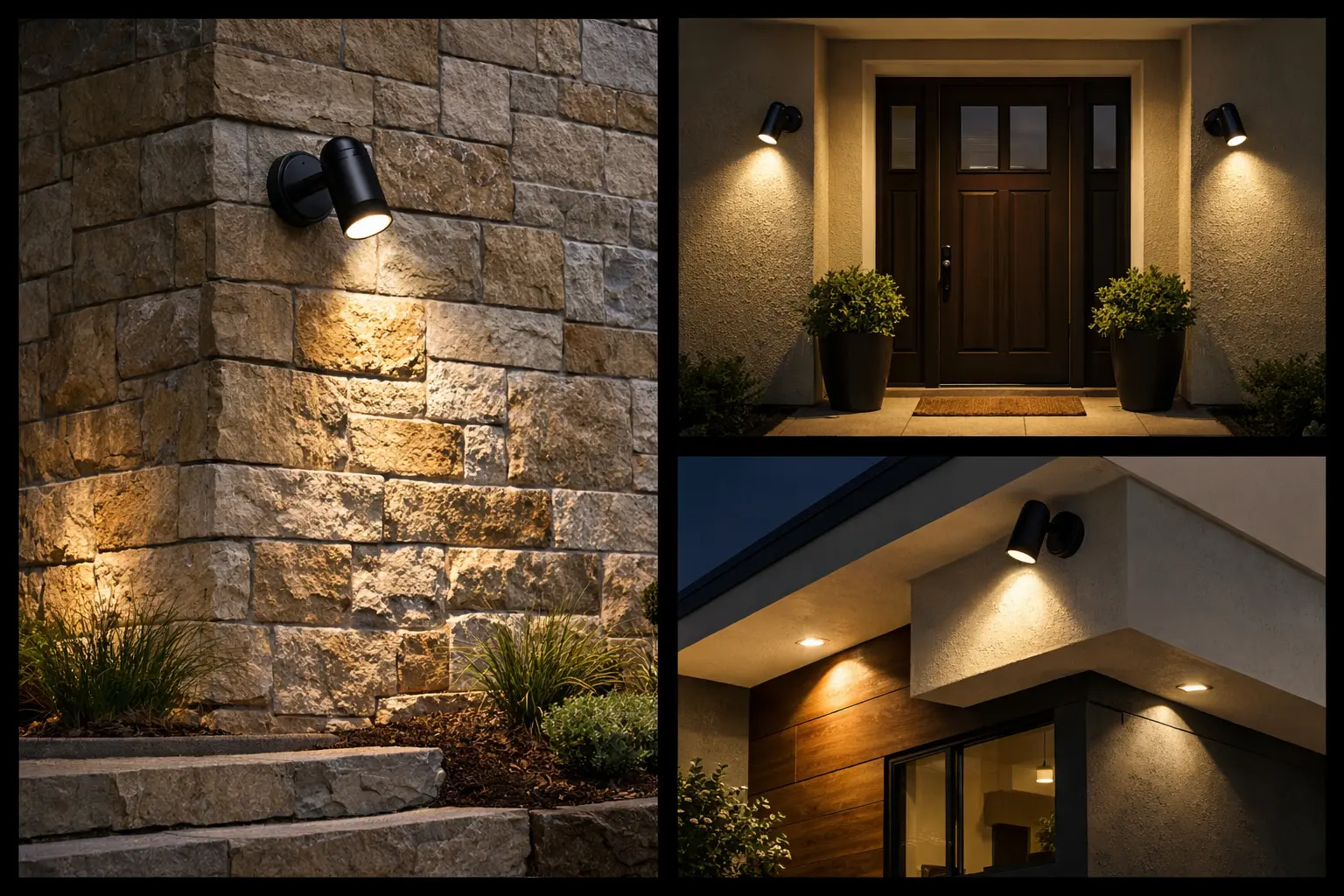
When Should You Use Outdoor Wall Spotlights? (Quick Answer)
Outdoor wall spotlights are best used for highlighting exterior walls, entries, and architectural features when you need directional accent lighting. They work best when aimed across a surface—not directly outward—to avoid glare.
- Flat or dark walls: use wall spotlights
- Harsh glare: adjust angle or placement
- Too many fixtures: reduce overlap with other lights
Quick Decision: Should You Use Wall Spotlights?
- Use them if: you want to highlight walls or architectural features
- Use them if: ground fixtures would clutter the area
- Avoid if: you need walkway or path lighting
- Avoid if: you need wide-area coverage
Wall Spotlight Placement Guide
| What You See | What It Means | What To Do |
|---|---|---|
| Flat, boring wall | No directional lighting | Add wall spotlight |
| Harsh glare | Fixture aimed outward | Re-aim across surface |
| Too bright near entry | Overlapping fixtures | Reduce fixture count |
| Uneven lighting | Poor placement | Adjust spacing and angles |
| Still dark areas | Coverage gap | Add targeted fixture |
Most wall spotlight problems come from placement—not the fixture itself.
Start Here: Should You Use Wall Spotlights?
- Highlight walls or columns → YES
- Light a walkway → use path lights instead
- Cover large areas → use flood lighting
- Glare problem → adjust placement first
Choose the right fixture type before adding more lights.
Outdoor wall spotlights are most effective when they are used with purpose. They should highlight the right surface, support the rest of the lighting plan, and add depth to the property rather than just making exterior walls brighter.
A lot of homeowners first think about wall-mounted spotlights when they want more visibility near a front entry or patio, but these fixtures can do much more than that. They can help shape the look of the home at night, reinforce focal points near the structure, and reduce the need for extra fixtures in planting beds or along hardscape edges. In many cases, they work best as one layer inside a broader Portfolio landscape lighting plan rather than as a stand-alone solution.
What Portfolio Outdoor Wall Spotlights Are Really For
The simplest way to think about outdoor wall spotlights is this: they create focused accent light from a mounted position instead of a ground position. That makes them useful when you want more control over where the light begins, how it spreads, and how visible the fixture itself is in the finished design.
In real-world use, these fixtures are often chosen for three main jobs. First, they can improve visibility near entry walls, columns, and structural transitions. Second, they can highlight exterior textures such as stone, brick, or decorative siding. Third, they can act as a clean way to illuminate nearby landscaping without placing extra fixtures directly in beds or along lawn edges.
That makes them a very different category from Portfolio path lights, which are mainly there to guide walking movement, and different from Portfolio step lighting, which is there to make elevation changes easier to read. Wall spotlights belong more in the accent and structure layer of the design. If your goal is to create more visual interest on the home itself, they are often a smarter choice than simply adding another ground fixture.
Best Places to Use Outdoor Wall Spotlights
Good placement matters more than fixture category alone. A strong wall-mounted spotlight can still produce weak results if it is aimed at the wrong surface or used in an area that really needs a different kind of fixture. The best placements are usually the ones where the spotlight has a clear job and where the vertical mounting location improves the look of the beam instead of creating glare.
For a complete outdoor layout, use the landscape lighting layout design guide to position wall spotlights and other fixtures for balanced coverage.
Front Entry Walls and Columns
These areas are some of the best candidates because they already matter visually and functionally. A wall spotlight can reinforce the entry sequence, highlight the architectural frame around the door, and complement nearby fixtures like a Portfolio wall lantern or Portfolio post lighting.
Stone, Brick, and Textured Exterior Surfaces
When a wall has texture worth showing, a mounted spotlight can do a much better job than flat front-facing light. Stone facades, columns, retaining-wall faces near the home, and decorative exterior surfaces often look more natural when light moves across the texture instead of blasting straight at it.
Patio Structures, Covered Outdoor Rooms, and Deck Supports
Wall-mounted or post-mounted spotlights can also work well around patios and decks when you want to emphasize a structural element or direct light toward adjacent landscaping. In those situations they often pair naturally with Portfolio deck lighting and broader Portfolio outdoor lighting layers.
Planting Beds Near the House
If a focal shrub, ornamental grass grouping, or decorative planting bed sits close to the structure, a wall spotlight can sometimes light it more cleanly than a fixture buried in the bed. That reduces clutter and can make maintenance easier.
| Placement Area | Main Goal | Why Wall Spotlights Work There |
|---|---|---|
| Front entries and columns | Visibility and architectural emphasis | Adds focused light to important structural transition points |
| Stone or brick walls | Highlight texture and surface detail | Washes across the wall more naturally than broad flat lighting |
| Patio and deck supports | Layered accent lighting | Supports nearby gathering spaces without relying only on ground fixtures |
| Planting beds near the home | Clean focal lighting | Can illuminate nearby landscaping without putting fixtures directly in the bed |
If you are still deciding how all of these areas should work together, it helps to step back and review Portfolio lighting placement and Portfolio lighting guide, plan and placement first. Those pages help make sure the spotlight is supporting the layout instead of competing with it.
Spotlights are highly directional, but improper aiming can still create glare and uplight. The BUG rating guide shows how fixture angles and output affect real-world lighting behavior.
How Outdoor Wall Spotlights Fit With Other Exterior Fixtures
One of the easiest ways to improve an outdoor lighting design is to stop asking one fixture type to do every job. Wall spotlights are excellent at adding directional accent light, but they are not the right answer for every visibility problem in the yard. They work best when they are part of a layered plan where each fixture has a distinct role.
For example, if people need help navigating a walkway, path lights are usually the better tool. If the issue is stair safety, use step lighting. If you need broad visibility across a driveway or side yard, flood lighting may make more sense. Wall spotlights belong in the category of focused architectural or focal lighting. They help shape the feel of the structure and nearby landscape rather than cover a large area all at once.
This is why they often work especially well with Portfolio landscape spotlights. Ground spotlights and wall spotlights can complement each other when one fixture is emphasizing a feature from below and the other is reinforcing texture or depth from the side. Used well, they create a layered look that feels more intentional than one repeating fixture type scattered around the property.
Color temperature also affects how wall textures appear. See landscape lighting color temperature to choose the right tone.
Wall Spotlights vs Other Outdoor Lighting
| Fixture Type | Best Use |
|---|---|
| Wall spotlights | Highlight walls and architecture |
| Path lights | Guide walkways |
| Flood lights | Wide-area visibility |
| Ground spotlights | Uplighting trees and features |
Low Voltage Planning, Transformer Sizing, and Wiring
Many Portfolio outdoor wall spotlights will be part of a broader low voltage setup, which means they should be planned as part of the full system and not just mounted wherever there is an open wall. Every added fixture contributes to the total electrical load, so it is smart to think about transformer capacity, cable routing, and future expansion before installation begins.
One important factor many homeowners overlook when installing outdoor lighting is transformer capacity. Every path light, spotlight, deck light, and step light adds to the total electrical load on the system. If the transformer is undersized, lights may appear dim or inconsistent and expanding the system later becomes difficult. This Portfolio lighting transformer wattage guide explains how to calculate fixture load and choose the correct transformer size for a reliable low voltage landscape lighting system.
Wall-mounted spotlights also benefit from clean wiring plans because the cable path is often less obvious than it is with ground fixtures. If the fixture is mounted on a post, beam, or structural wall surface, you want the wiring route to stay protected and organized. That is where pages like Portfolio landscape lighting wiring, how to wire landscape lighting, and landscape lighting cable guide become especially helpful.
It also helps to understand how transformer sizing and wire run design work together. If you are building a system with multiple fixture categories, use Portfolio low voltage lighting and landscape lighting voltage drop to avoid the common problem where accent fixtures underperform because the system was planned too tightly.
If wall spotlights appear dim at the end of a run, see landscape lighting voltage drop to understand how wire distance affects brightness.
Cable size plays a major role in system performance. See landscape lighting wire gauge to reduce power loss and improve output.
For a deeper understanding of how transformers affect performance, see the Portfolio transformer master guide.
Common Wall Spotlight Problems
- Glare: fixture aimed outward instead of across the wall
- Flat lighting: angle too direct
- Uneven brightness: poor spacing
- Dim output: voltage drop or transformer load issue
Common Mistakes and Performance Problems
Most wall spotlight problems do not come from the basic idea of the fixture. They come from the way the spotlight is placed, aimed, powered, or integrated into the rest of the system. The good news is that these are usually fixable when you identify the real cause.
Too Much Glare
If the fixture is visible from common approach angles or aimed too directly at eye level, the result can feel harsher than intended. This is usually a placement issue, not a reason to abandon the category altogether.
Flat or Weak Architectural Results
Sometimes the light is technically on the wall but not actually revealing texture in an attractive way. That usually means the beam angle or mounting position is not helping the surface. In those cases, reviewing the broader lighting layout can help.
Dim or Inconsistent Performance
Dim wall spotlights can point to transformer load issues, long cable runs, or poor connections. If your fixtures seem underpowered, it is worth checking Portfolio lighting too dim, Portfolio landscape lights not working, and Portfolio lighting troubleshooting.
Overlapping Roles With Other Fixtures
Some properties end up with wall spotlights, flood lights, and ground spotlights all trying to light the same zone. When that happens, the result is usually more brightness but less clarity. Better layout planning creates a stronger final result than simply adding more fixtures.
To avoid underpowered fixtures, use the Portfolio transformer sizing guide to match your system load correctly.
Best Supporting Pages to Use Next
Because this page focuses specifically on outdoor wall spotlights, the next page you use depends on the question you are trying to solve. If you are still planning the overall design, start with the layout and placement pages. If you are working through power and wiring, move into the low voltage and transformer pages. If the fixture is already installed and not performing the way you want, use the troubleshooting cluster.
For overall layout planning
Use this when you want wall spotlights to fit naturally into the bigger property design.
Planning HubFor placement help
Use this when you need more practical guidance on where different fixture types should go.
Portfolio Lighting PlacementFor related spotlight fixture help
Use this when you are comparing mounted spotlights with ground-mounted accent fixtures.
Landscape SpotlightsFor low voltage system planning
Use this when transformer capacity, wattage, and load planning are part of the job.
Portfolio Low Voltage LightingFor wiring routes and setup
Use this when the project is moving from design into real installation work.
Landscape Lighting WiringFor troubleshooting
Use this when the spotlight is already installed but the output or performance is weak.
Troubleshooting HubFinal Thoughts on Portfolio Outdoor Wall Spotlights
Portfolio outdoor wall spotlights can be a smart addition when you want more focused architectural lighting without adding unnecessary fixture clutter at ground level. They are especially useful for entries, columns, textured walls, patio structures, and landscape areas close to the home where mounted light creates a cleaner effect than another stake or pathway fixture.
The key is using them as part of a balanced system. They should support the structure, add emphasis where it matters, and fit naturally with other layers like path lighting, step lighting, flood lighting, and broader landscape lighting. When that happens, the finished result feels more intentional, more useful, and much easier to expand over time.
Portfolio Outdoor Wall Spotlights FAQ
What are Portfolio outdoor wall spotlights used for?
They are used to highlight exterior walls, entries, architectural details, stonework, and nearby landscaping. They provide focused accent lighting from a mounted position instead of relying only on ground-level fixtures.
Where should outdoor wall spotlights be placed?
They should be placed where they can highlight the intended surface or feature without creating harsh glare. Common locations include front entry walls, columns, patio supports, textured facades, and planting areas close to the home.
How do wall spotlights fit into a low voltage lighting system?
They often operate as part of a low voltage system with other fixture types like path lights, deck lights, and step lights. Because they add to the total electrical load, transformer sizing and cable planning still matter.
What pages should you read next after this one?
Helpful next pages include Portfolio landscape spotlights, Portfolio low voltage lighting, Portfolio landscape lighting wiring, Portfolio lighting transformer wattage guide, Portfolio lighting placement, and Portfolio lighting troubleshooting.