
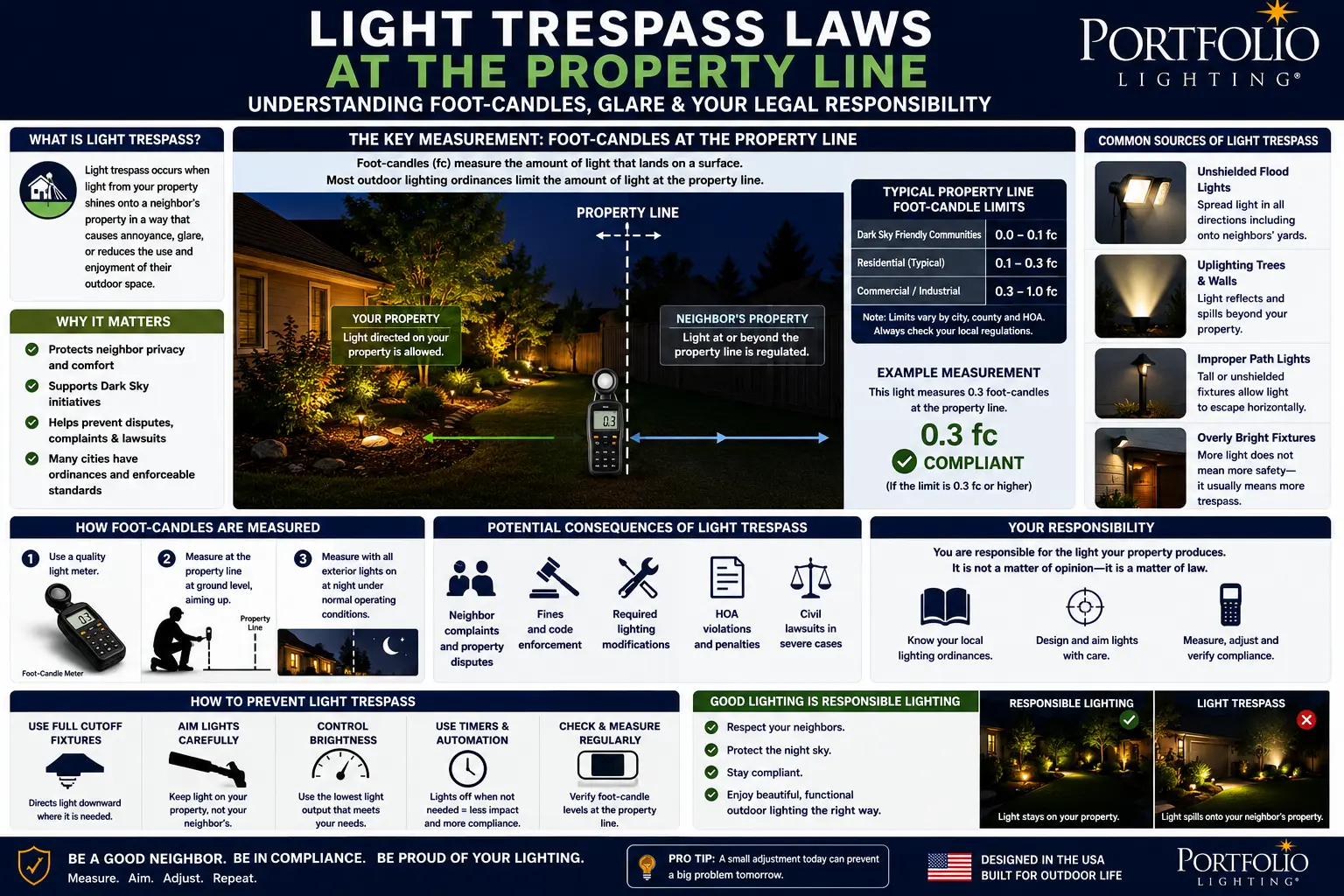
What Light Trespass Is — Legal Definition and the Two Legal Frameworks
Light trespass has a precise legal meaning that determines which enforcement mechanism is available to you — and understanding the difference between the two available frameworks determines your strategy before you spend any time or money.
The Definition
Rensselaer Polytechnic Institute's Lighting Research Center defines light trespass as "spill light that is cast where it is not wanted." The legal definition is functionally the same: the unwanted encroachment of artificial light from one property onto an adjacent property in a way that disturbs the enjoyment of that property. The key word is unwanted — light that arrives on your property without your consent and in a way that you find objectionable.
Three characteristics typically define actionable light trespass: (1) the light originates on another party's property; (2) it reaches your property without your consent; and (3) it substantially interferes with your use and enjoyment of your property. The third element — substantial interference — is the threshold that separates inconvenience from legal remedy. Not every neighbor's porch light that casts a shadow toward your yard is actionable light trespass; a security light that illuminates your bedroom as brightly as daytime for eight hours every night likely is.
Two Legal Frameworks — You May Have Both
Framework 1: Local Ordinance Violation. Many municipalities have adopted outdoor lighting ordinances that specify maximum foot-candle levels at property boundaries, shielding requirements, and curfew restrictions. When your jurisdiction has such an ordinance and a neighbor's lighting violates it, you have a direct enforcement mechanism: file a complaint with the local code enforcement office. The code enforcement officer investigates, verifies violation against the ordinance standard, and the neighbor receives a notice with a compliance deadline and fines for non-compliance. This is the fastest, cheapest, and most reliable enforcement path — but it only exists when an ordinance has been adopted.
Framework 2: Common Law Private Nuisance. This framework exists in every US state regardless of whether any local ordinance has been adopted. Per Nolo.com's documented legal resource: "Like noisiness, light pollution, also known as light trespass, is recognized as a nuisance by courts in most parts of the United States. A nuisance is a type of conduct that disturbs a neighbor's use or enjoyment of property." The remedies available through civil nuisance action are broader than ordinance enforcement but require more effort: you must file in civil court rather than filing an administrative complaint, prove that the interference is "unreasonable" (which is a fact-specific determination), and may need an attorney. Remedies include injunctive relief (court order to modify the lighting) and compensatory damages.
Real Foot-Candle Limits from Actual Adopted Ordinances
There is no national standard for light trespass limits at property lines. The only number that applies to your property is the one in your specific municipal or county ordinance — if one has been adopted. Here are the limits from actual adopted ordinances across the United States, documenting the full range.
San Bernardino County, CA — December 2021
0.5 fc maximum at property line adjacent to residential property (general zones). 0.1 fc stricter limit in mountain and desert regions. Adopted December 7, 2021. Also includes a Dark Sky Curfew for the mountain and desert regions. Source: San Bernardino County Land Use Services outdoor lighting regulations (lus.sbcounty.gov).
Los Angeles, CA — LAMC Section 93.0117
2.0 fc maximum illumination on adjacent residential property. Applies to any stationary exterior light source. Includes prohibition on direct glare from the light source being visible on the neighbor's property. Source: Los Angeles Municipal Code Section 93.0117 (codelibrary.amlegal.com).
Banner Elk, NC — Municipal Code §152.087
0.05 fc maximum both horizontal AND vertical at 5 feet inside adjacent residential parcel. Applies to both measurement planes simultaneously — one of the stricter and more complete ordinances in the documented literature. Source: Banner Elk Municipal Code §152.087 (codelibrary.amlegal.com).
Lights Out Connecticut — Sample Residential Standard
0.05 fc maximum at any property boundary within or abutting a residential zone. Source: Lights Out Connecticut sample local lighting laws compilation (lightsoutct.org), compiled from adopted Connecticut municipal ordinances.
Travelers Rest, SC — Chapter 5.13
0.5 fc maintained maximum at any property line adjacent to residential district or dwelling structure. 2.0 fc maintained maximum at property lines adjacent to non-residential. Source: Travelers Rest SC Municipal Code Chapter 5.13 (travelersrestsc.com).
San Luis Obispo, CA — Chapter 17.70.100
2.0 fc maximum grade illumination on any property within a residential zone (light trespass from adjacent properties). 10 fc maximum on-site for residential properties. Source: San Luis Obispo Municipal Code 17.70.100 (sanluisobispo.municipal.codes).
Brier, WA — Chapter 8.32 (Updated 2024)
0.1 fc maximum at property line for seasonal decorations. General outdoor lighting standard: "no artificial light source shall produce glare or spillover illumination that unreasonably disturbs neighboring properties." Source: Brier WA Municipal Code Chapter 8.32 (codepublishing.com, Ord. 497 §2, 2024).
IDA/IES Model Lighting Ordinance (MLO) — LZ2 Residential
Vertical illuminance at property boundary: varies by lighting zone. LZ0: no additional lumens permitted. LZ1: essentially zero. LZ2 (suburban residential): 0.5–2.0 fc vertical at boundary depending on specific credit pathway. The MLO is the template most adopting municipalities use as their starting point. Source: IDA/IES Model Lighting Ordinance (2011, darksky.org).
| Jurisdiction | Limit at Residential Property Line | Measurement Method | Strictness |
|---|---|---|---|
| Banner Elk, NC | 0.05 fc horizontal + 0.05 fc vertical | Both planes, 5 ft inside boundary | Strictest in this set |
| Connecticut (typical) | 0.05 fc at boundary | Horizontal at property line | Very strict |
| San Bernardino County (mountain/desert) | 0.1 fc at property line | Horizontal at property line | Strict |
| San Bernardino County (general) | 0.5 fc at property line | Horizontal at property line | Moderate |
| Travelers Rest, SC | 0.5 fc at property line | Maintained fc at line | Moderate |
| Los Angeles, CA (LAMC 93.0117) | 2.0 fc at adjacent residential property | Illuminance at adjacent property location | Lenient |
| San Luis Obispo, CA | 2.0 fc maximum grade (residential zone) | Horizontal at grade | Lenient |
| No local ordinance | No specific number — "unreasonable interference" standard | Common law nuisance determination by court | Fact-specific |
What "0.0 fc at Property Line" Actually Means in Practice
When a photometric plan submitted for permit shows "0.0 fc" at the property line — a result that appears to show perfect compliance — there is a significant technical ambiguity that affects both complainants and property owners. Understanding it changes how you read any photometric plan.
The Rounding Issue: 0.0 Means Less Than 0.05
Photometric software displays foot-candle values rounded to one decimal place. "0.0 fc" does not mean absolute zero illumination — no light fixture at any finite distance from a surface produces exactly zero illuminance. "0.0 fc" means the calculated illuminance is less than 0.05 fc, which rounds down to 0.0 when displayed to one decimal place.
This matters for ordinance compliance in both directions: if your jurisdiction's ordinance requires "0.0 fc at property line," practically speaking it accepts anything below 0.05 fc. A plan showing 0.0 fc is compliant even if it has actual calculated illuminance of 0.04 fc. Conversely, if you are a complainant trying to demonstrate a violation of an ordinance that prohibits "more than 0.0 fc at property line," a plan showing 0.0 may genuinely have illuminance below the measurement threshold — which is technically compliant even if your bedroom is lit up because of vertical illuminance that was never calculated at all.
The Property Line Calculation Zone Gap
Many photometric plans submitted for permit define the calculation grid so it ends exactly at the property line — producing fc values that describe illuminance at the boundary itself but no data on what happens on the neighbor's side. Per the photometric plan guide: "many photometric submittals define the calculation zone exactly at the property line — telling you the illuminance at the line but not how light distributes beyond the property."
Requesting that a photometric plan extend 10 feet beyond all property lines adjacent to occupied properties — showing fc values on the neighbor's side of the boundary — is the correct way to evaluate actual light trespass impact rather than boundary-line-only values. If you are reviewing a photometric plan for a proposed project adjacent to your property, this is the specific request to make: extend the calculation grid beyond the shared property line. See the photometric plan reading guide for how to interpret every element of a photometric plan submission.
Horizontal vs Vertical: The Measurement Gap That Lets Offenders Claim Compliance
This is the most technically important and most overlooked aspect of light trespass compliance. The distinction between horizontal and vertical illuminance measurement determines whether a photometric plan that appears to show compliance actually addresses the problem generating the complaint.
The amount of light falling on a horizontal surface — the ground. A horizontal fc reading at grade tells you how brightly the lawn, driveway, or sidewalk is illuminated at that point.
Why ordinances use it:Horizontal measurement is simple, standardized, and maps directly to parking lot and area lighting standards. Most municipal outdoor lighting ordinances were written by adapting commercial parking lot lighting standards that use horizontal illuminance.
What it misses:A security floodlight aimed horizontally across a yard at height produces very little horizontal illuminance at grade — the beam is going sideways, not downward. That same beam may produce intense vertical illuminance on the neighbor's fence, wall, and windows. Horizontal measurement at grade fails to capture the most complaint-generating scenario: light entering windows at height.
The amount of light falling on a vertical surface — a wall, window, or face. Vertical illuminance at 5 feet above grade (eye height when standing) is the metric that corresponds to what a person experiences when light enters a window at night.
Why sophisticated ordinances use it:Per the IES/IDA Model Lighting Ordinance User's Guide: "Vertical illuminances at eye height (5 feet above grade) will give values that can be used to verify compliance by comparing actual site conditions to the photometric plan." LEED v4 Light Pollution Reduction credit requires vertical illuminance calculations from grade to 33 feet above the highest luminaire.
The benchmark standard:Banner Elk NC's ordinance specifically requires both horizontal AND vertical measurement (0.05 fc each) at 5 feet inside the adjacent property boundary. This dual-measurement requirement is best practice because it captures both types of light impact. The Wikiversity lighting ordinance analysis documents why vertical at 5 feet is the correct metric: "for light trespass the concern is how much light shines into a neighbor's property or window... let's focus on the vertical light measurement."
The Practical Implication for Complainants
If your jurisdiction's ordinance specifies only horizontal foot-candles at the property line, and your complaint is about light entering your windows, the ordinance may provide limited assistance even when the neighbor's lighting is genuinely objectionable. The neighbor can show a photometric plan with 0.0 fc horizontal at grade and claim compliance while your bedroom is still illuminated through your windows.
Two approaches for complainants in this situation: (1) Request that code enforcement measure vertical illuminance at eye height (5 feet above grade) at your window or at the property line. Even if the ordinance only specifies horizontal, documenting vertical illuminance establishes the factual basis for a common law nuisance claim. (2) Pursue the common law nuisance path, where "unreasonable interference" is determined by the total impact on your enjoyment of your property — a fact-specific determination that is not limited to any specific fc threshold or measurement method.
For Property Owners Installing New Lighting Adjacent to Neighbors: Calculate both horizontal AND vertical illuminance at the shared property line before finalizing your design, even if your jurisdiction only requires horizontal. Designing to zero or near-zero vertical illuminance at eye height from the neighbor's side of the fence is the best way to prevent future disputes, maintain good neighbor relations, and ensure that any HOA or ordinance review focuses only on conforming measurements. See the fix light trespass guide for fixture selection and aiming approaches that minimize vertical spillover, and the photometric plan reading guide for how to verify these measurements before installation.
Property-line lighting disputes are often viewed as minor annoyances until legal costs and retrofit requirements begin to accumulate. Our database of landscape lighting liability claims explores how nuisance lighting complaints, privacy concerns, and documented trespass allegations can evolve into expensive disputes. Understanding these cases helps property owners balance aesthetics with responsible lighting practices that protect both neighborhood relationships and financial interests.
No Local Ordinance? Common Law Nuisance Still Applies Everywhere
The most common frustration in light trespass situations: "My city doesn't have an outdoor lighting ordinance, so I have no recourse." This is incorrect. Common law private nuisance — the legal doctrine that predates any municipal ordinance — provides a remedy for light trespass in every US state court system, regardless of local ordinance status.
What Private Nuisance Means in Practice
A private nuisance is an unreasonable, substantial interference with another person's use and enjoyment of their property. Courts in most US states have found that artificial light can constitute a private nuisance when it: substantially interferes with a neighbor's sleep; makes outdoor use of property at night uncomfortable or impossible; diminishes property value; or otherwise substantially reduces the quality of life on the affected property.
The threshold is "unreasonable and substantial" — not merely inconvenient or slightly irritating. Courts weigh factors including: the severity of the interference (how bright, how long, how directed); the reasonableness of the light's purpose (a warehouse security light serves a legitimate purpose; a recreational floodlight aimed at a neighbor's yard may not); the character of the neighborhood (a light level that's typical in an urban commercial area may be unreasonable in a rural residential zone); and whether simple modifications could eliminate the impact without eliminating the light's purpose.
What You Need to Document for a Nuisance Claim
Because nuisance claims are fact-specific and courts weigh competing interests, documentation matters more than in ordinance enforcement. Useful documentation includes:
- Illuminance measurements: Using a consumer light meter ($15–50 at hardware stores), measure foot-candles at your window frame, on your porch, and in your bedroom with lights off. Photograph the meter readings with timestamps. Measurements at multiple points across multiple nights establish a consistent pattern.
- Photographs and video: Time-stamped photos of your property at night showing the neighbor's light and its impact on your space. Video of the light's effect on your bedroom at night.
- Sleep documentation: If the light disrupts sleep, medical research supports the connection. Research published in the journal Somnologie documented that artificial light during nighttime delays the circadian clock, increases time to fall asleep, and reduces sleep depth. Your doctor's records noting sleep disruption if any medical consultation occurred.
- Written communications: Send your neighbor a written request (letter or email) before escalating. This creates a record that the neighbor was aware of the problem and chose not to address it — relevant to any subsequent nuisance claim.
The HOA Path: Faster and Often More Effective Than Municipal Code Enforcement
For properties within homeowner associations, the HOA enforcement mechanism is frequently faster, more flexible, and more effective than municipal code enforcement — and it operates regardless of whether any city ordinance exists.
Why HOA Enforcement Is Faster
Municipal code enforcement must follow administrative procedures: complaint filed, investigation scheduled, officer dispatched, finding documented, notice issued, compliance period granted, re-inspection completed. This process typically takes several weeks to months. HOA enforcement typically starts with a warning letter from the HOA board or property management company — often issued within days of a complaint — followed by escalating fines if the violation continues.
Per LegalClarity's documented HOA enforcement process: "An HOA violation is often easier to enforce than a municipal code violation because the HOA has its own fining authority and doesn't require a government agency to act. Fines commonly begin around $25 to $50 and increase to $100 or more for repeated violations."
What HOA CC&Rs Typically Cover
HOA Covenants, Conditions, and Restrictions (CC&Rs) often address outdoor lighting through provisions like: approved fixture types and styles; maximum lumen output or wattage; requirements for shielded or downward-directed fixtures; hours of operation; and general nuisance prohibitions that restrict residents from interfering with neighbors' quiet enjoyment. Importantly, HOA nuisance prohibitions may provide enforcement even when the specific lighting problem is not explicitly described — a CC&R prohibiting "nuisance" lighting can encompass light trespass under the general nuisance standard.
How to Use the HOA Path Effectively
- Review your CC&Rs for lighting provisions and general nuisance clauses
- Photograph and document the problem before contacting anyone
- Contact the HOA board or property management company in writing (email is fine) — describe the problem specifically, reference the relevant CC&R provisions if applicable, and include your documentation
- If the HOA lacks specific lighting provisions, cite the general nuisance or quiet enjoyment clauses and attach your documentation of the impact
- Request a formal complaint number and follow-up timeline from the HOA management
The Five-Level Legal Escalation Ladder
Light trespass disputes are almost always best resolved at the lowest escalation level that produces a result. Higher levels cost more time, money, and relationship capital. Work through the ladder in order, not by jumping to litigation first.
Worst-Offender Lighting Types by Physics: Why Landscape Uplights Top the List
Not all landscape and exterior lighting creates equal light trespass risk. The physics of each fixture type determines how much of its output naturally reaches neighboring properties. Understanding which fixture types are worst-case offenders helps both complainants document their case and property owners prioritize what to fix first.
Security Floodlights: The Classic Offender
Traditional security floodlights — the wide-beam, wall-mounted or post-mounted floods used for driveway and perimeter lighting — are the most common light trespass complaint source. The wide beam angle (120–150 degrees or wider) combined with horizontal or upward mounting direction means most of the beam is directed outward rather than downward, creating significant horizontal illuminance across property lines and significant vertical illuminance on neighboring structures. A standard 50W halogen or 20W LED security floodlight aimed across a yard at 8-foot height can produce 2–5 fc of horizontal illuminance at the property line and 1–3 fc of vertical illuminance at a neighbor's window at the same height — well above the 0.05–0.5 fc limits in many ordinances.
Landscape Uplights: Maximum Vertical Trespass by Design
Landscape uplights — fixtures aimed upward to illuminate trees, walls, and architecture — are the worst-offender category by physics. Their entire design purpose requires directing light upward. Upward-directed light that reaches a height of 10–15 feet before being intercepted by a tree canopy or wall can scatter and redirect toward neighboring properties as both horizontal and vertical illuminance. More directly: an uplight aimed at a tree near the property line may illuminate the tree beautifully while also creating significant vertical illuminance on a neighboring property at bedroom window height, with no possibility of shielding that preserves the uplight function.
The "maximum connectable distance" physics: an uplight with a 30-degree beam aimed at a 45-degree angle from vertical at a point 15 feet from the property line produces maximum illumination at tree height that is at or above the neighbor's second-story window level. A full explanation of beam spread, aiming angle, and distance geometry is in the beam spread guide.
Globe Path Lights: Spherical Light Distribution
Globe or globe-style path lights — the mushroom and lantern designs that emit light in all directions — are trespass problems not because of their intensity but because of their distribution. Unlike full-cutoff downward-directed lights that confine output below the horizontal plane, globe lights emit light in every direction including horizontally and upward. In a row of globe path lights along a shared fence line, each one creates a visible glowing sphere that produces horizontal and vertical spillover toward the adjacent property, even at low wattage per fixture. The cumulative effect of 10 globe path lights at 3W each can be more objectionable than a single full-cutoff downlight at 15W.
Why Full Cutoff Downlights Are the Solution
Full cutoff downlights — fixtures that emit no light above the horizontal plane and focus all output below — inherently minimize property line trespass because all their light is directed toward the ground rather than toward neighboring properties. A path light with full-cutoff optics produces essentially zero horizontal illuminance at property line height and zero vertical illuminance at window height unless the fixture is positioned within a few feet of the boundary. See the landscape lighting design guide and landscape lighting layout guide for fixture placement best practices that minimize trespass risk by design.
The Practical Fix Hierarchy for Landscape Lighting That Creates Trespass
Whether you are the complainant trying to resolve a neighbor's lighting, or the property owner whose lighting has been identified as causing trespass, these fixes address the problem in order from cheapest/fastest to most involved — with the highest-probability solutions first.
If You Are the Offender: Proactive Compliance and Legal Risk Management
If you've received a neighbor complaint, a code enforcement notice, or an HOA violation letter about your outdoor lighting, here is the decision framework for responding effectively — before the situation escalates to litigation.
The Most Expensive Response Is Ignoring It
Ignoring a neighbor's light trespass complaint — or ignoring a code enforcement or HOA notice — escalates the situation and limits your legal options. A documented written complaint that you acknowledged and ignored is evidence of willfulness in any subsequent nuisance litigation. Escalating HOA fines accumulate. Code enforcement liens can attach to property and affect title. And a neighbor who has been ignored is more motivated to pursue litigation than one who received a good-faith response even if the initial fix wasn't perfect.
The Proactive Legal Defense: Documentation and Good Faith Effort
If you believe your lighting is technically compliant but generating complaints, your strongest legal position is a documented good-faith effort to address legitimate concerns combined with evidence of technical compliance. This means: obtaining a photometric plan from a lighting designer that demonstrates property-line compliance with the applicable standard (horizontal AND vertical if you are in a jurisdiction or facing litigation that considers both); implementing whatever reasonable modifications reduce the impact without eliminating the light's legitimate function; and documenting all communications and modifications.
A homeowner's insurance policy may include liability coverage for nuisance claims. Contact your insurer if you receive a formal legal demand regarding light trespass — coverage availability varies by policy and insurer. The landscape lighting insurance and liability guide covers the coverage framework for landscape lighting-related liability claims.
The Compliance Upgrade That Prevents Future Disputes
The most permanent solution for a property owner who has received a light trespass complaint is to redesign the relevant portion of the landscape lighting system to eliminate measurable trespass. A competent lighting designer can generate a photometric plan demonstrating property-line compliance. Fixtures that comply with the dark sky compliance standards and the IDA/IES Model Lighting Ordinance framework are generally designed to minimize property-line spillover. See the load calculation and code compliance guide for the calculation framework, and the outdoor lighting ordinance guide for how to verify compliance with your specific jurisdiction's requirements.
Good lighting design often requires balancing multiple objectives at the same time. Property owners may need to reduce glare and light trespass while still maintaining safe visibility along walkways, access routes, and emergency egress pathways. Our emergency backup lighting requirements guide explains how life-safety lighting considerations can influence pathway illumination and fixture planning decisions.
Light Trespass Law FAQ
My neighbor's floodlight shines into my bedroom window at night. What is the maximum fc allowed at my property line?
The maximum depends entirely on your specific municipality — there is no national standard. Check your city and county municipal code for terms like "outdoor lighting," "light trespass," or "exterior illumination." If your city has adopted a limit, it may range from 0.05 fc (very strict, as in Banner Elk NC) to 2.0 fc (more permissive, as in Los Angeles). If no limit has been adopted, the common law private nuisance standard applies regardless. For a bedroom window complaint, vertical illuminance at eye height (5 feet above grade) is the relevant measurement — which most ordinances don't specify but courts and mediators understand. Document your window illuminance with a consumer light meter and photograph the results. This measurement gives you a quantified baseline for any enforcement or legal action, and it establishes that the impact is measurable, not just subjective.
My city doesn't have a light trespass ordinance. Do I have any legal options?
Yes — common law private nuisance applies in every US state regardless of whether any local ordinance exists. Courts have recognized artificial light as a nuisance when it constitutes an unreasonable, substantial interference with a neighbor's use and enjoyment of their property. The threshold is higher than an ordinance enforcement path — you must establish "unreasonable" interference rather than simply showing a numeric measurement exceeds a stated limit — but it is a real and enforceable legal remedy. Mediation is often the most practical path when no ordinance exists: it is low-cost, quick, and produces binding agreements without requiring you to prove nuisance in court. A demand letter from an attorney referencing common law nuisance principles is often sufficient to motivate a neighbor to cooperate.
Why does it matter if foot-candles are measured horizontally or vertically?
Horizontal illuminance measures light falling on the ground. Vertical illuminance measures light falling on a vertical surface — a wall, fence, or window. Most photometric plans submitted for permit show only horizontal illuminance at grade. A plan can show 0.0 fc horizontal at the property line while the same light produces significant vertical illuminance at second-story window height — because a beam aimed slightly upward or at height doesn't create much illuminance on the ground at the fence line, but creates significant illuminance on the neighbor's wall and windows at the beam's actual direction. The Wikiversity lighting ordinance analysis documents this: "for light trespass the concern is how much light shines into a neighbor's property or window... let's focus on the vertical light measurement." If your complaint is about light entering windows, request vertical illuminance measurements at 5 feet above grade at the property boundary.
Can landscape uplights in my yard cause light trespass complaints?
Yes — landscape uplights are among the highest-risk fixture types for light trespass because their entire function requires directing light upward. An uplight aimed at a tree near the property line illuminates the tree but also scatters light in all directions, potentially creating significant vertical illuminance on a neighbor's wall or window at tree height. Uplights placed within 10–15 feet of a shared property line commonly create measurable light trespass on adjacent properties. Mitigation approaches: move uplights to the interior of the yard away from shared boundaries; add barn-door or shield accessories that restrict the beam toward the tree and away from the property line; use lower-wattage or narrower-beam lamps; or replace with in-grade well lights that aim more directly upward with less lateral scatter. See the landscape lighting design guide for placement best practices and the beam spread guide for beam angle and spillover calculations.
I received an HOA violation notice for my landscape lighting. What should I do?
Respond to the HOA in writing within the stated compliance period — acknowledging receipt and stating your intention to investigate and address the concern. This stops the escalating fine clock in most HOA enforcement systems and establishes good faith. Review the specific CC&R provision cited in the notice and the measured or observed violation. For most landscape lighting HOA violations: redirect or shield the specific fixture identified, and document the modification with photographs. Send the HOA written confirmation that the modification has been made and request a verification inspection. If you believe the notice is in error (your lighting actually complies with the cited provision), document your compliance position with photographs and measurements and request a meeting with the HOA board to discuss. The insurance and liability guide covers what your homeowner's policy may cover in HOA enforcement disputes.
Related Lighting Code, Compliance, and Design Guides
- Electrical Code Safety Guide
- Insurance & Liability Guide
- Fix Light Trespass Guide
- Outdoor Lighting Ordinance Guide
- Dark Sky Compliance Guide
- IDA Certification vs Ordinance
- Photometric Plan Reading Guide
- Lumen vs Light Pollution
- Dark Sky Fixture Selection
- Landscape Lighting Design Guide
- Landscape Lighting Layout Guide
- Beam Spread Guide
- Lumen Guide
- Color Temperature Guide
- Timer Settings Guide
- ADA Outdoor Lighting Rules
- Wildlife-Friendly Lighting
- Turtle-Safe Lighting Codes
- Permit Requirements
- Contractor Licensing
- Load Calculation & Code
- NEC 300.5 Burial Depth Calculators
- Portfolio Replacement Fixtures
- Landscape Lighting Guide