
Quick Answer: Why a Landscape Transformer Stops Working
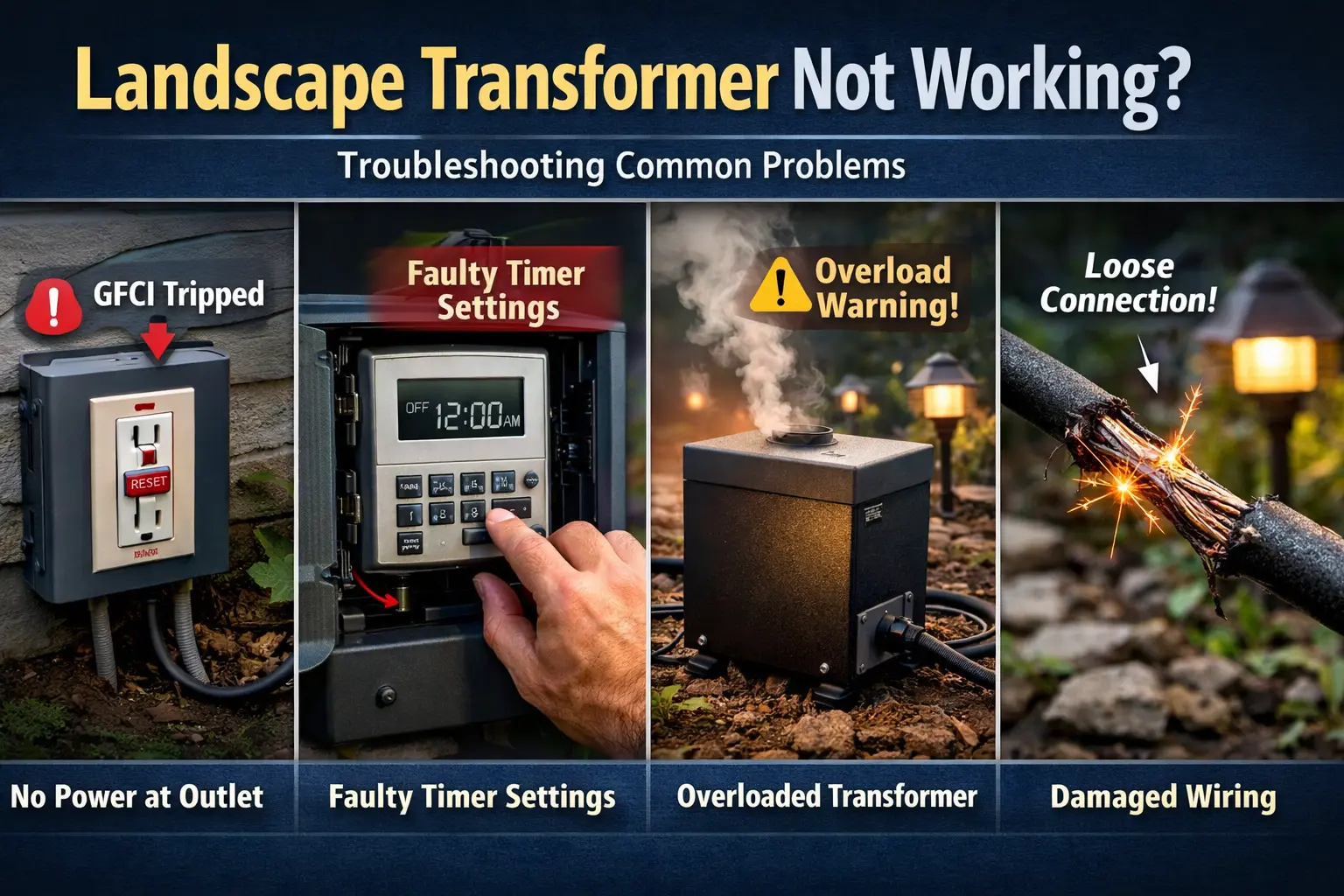
A landscape transformer usually stops working because of one of five problems: no power at the outlet, a tripped GFCI, incorrect timer settings, transformer overload, or internal failure. Start with outlet power and GFCI reset first, then check the timer, load, and output before replacing the transformer.
- No power at all: check outlet and GFCI
- Transformer looks on but lights stay dark: check timer and output
- Transformer gets hot or shuts off: check overload
- Buzzing or unstable output: suspect aging internal parts
- Worked before rain: check moisture and outdoor wiring faults
When a landscape transformer stops working, the whole lighting system can look dead even though the real fault may be at the outlet, in the timer, in the load calculation, or in one connection feeding the transformer.
The most common causes are no power at the outlet, a tripped GFCI, timer settings, transformer overload, loose wiring, moisture damage, and aging transformer components. Start with the quick diagnosis table below, then work through the transformer in a logical order.
Why Landscape Lighting Transformers Stop Working
Landscape lighting transformers stop working for a handful of repeat reasons. The most common causes are no power at the outlet, a tripped GFCI outlet, faulty timer settings, overloaded transformer load, damaged wiring, moisture exposure, and aging transformer components.
Some transformer failures are complete, where the whole system loses power immediately. Others are partial, where the transformer still hums, runs warm, or seems active but no longer sends stable power to the lights. Those differences matter because they help narrow whether the problem is in the power source, controls, load, wiring, or inside the transformer itself.
When a landscape transformer seems dead, the actual problem can sometimes be in the timer or control settings connected to it. Our Landscape Lighting Timer Not Working guide helps diagnose timer failures, schedule problems, and control issues that can make a working transformer appear faulty.
Most Common Power Causes
- outlet lost power
- GFCI tripped
- extension cord or plug issue
- upstream outdoor circuit problem
Most Common Control Causes
- timer set incorrectly
- manual override left off
- timer module failed
- control settings lost after outage
Most Common Load Causes
- too many fixtures connected
- wattage exceeds rating
- transformer overheats
- protection shuts unit down
Most Common Failure Clues
- no lights working at all
- transformer warm but no output
- unit stopped after rain
- lights flickered, then died
Most Common Reasons a Landscape Transformer Stops Working
- No power at the outlet
- Tripped GFCI outlet
- Incorrect timer settings
- Transformer overload
- Loose or corroded wiring
- Moisture damage
- Aging internal components
Match Your Symptom to the Most Likely Problem
Use this table to match what your transformer is doing right now to the most likely cause before you test wiring or buy a replacement.
| Symptom | Likely Cause | What To Check | Detailed Fix |
|---|---|---|---|
| No lights working | Outlet or transformer failure | GFCI, outlet power, transformer plug | Landscape lighting transformer guide |
| Lights worked before but stopped | Timer settings | Timer schedule, auto mode, manual override | Landscape lights not turning on |
| Transformer warm but no output | Overload | Total wattage and transformer rating | Portfolio transformer tripping breaker troubleshooting |
| Transformer dead after rain | Moisture damage | Housing, outlet, wet run faults, terminals | Landscape lights not working after rain |
| Lights flicker then stop | Failing transformer | Output stability, heat, buzzing, age | Portfolio transformer troubleshooting |
| Transformer buzzes but lights stay dark | Internal failure or wiring issue | Wiring terminals, load, output behavior | Landscape transformer buzzing |
How to Troubleshoot a Landscape Transformer That Is Not Working
Check outlet power
Many outdoor outlets include GFCI protection, so the first step is confirming the outlet actually has power. Test it with another device and reset any GFCI outlet that may have tripped. If there is no input power, the transformer cannot do its job no matter how new it is.
Inspect the transformer timer
Timer settings or manual override can prevent operation even when the transformer itself is fine. Check whether the unit is in auto, manual on, manual off, or a schedule that no longer matches the time of day. A timer problem can make a working transformer look dead.
Check transformer load
Too many fixtures can overload the system and make the transformer shut down or stop delivering stable output. Compare the transformer rating to the total wattage of connected lights, especially if the system was expanded over time.
A transformer that once handled a small number of fixtures can struggle as more walkway lights and accents are added over time. To understand how these fixtures fit into a full system, review our guide to Portfolio path lighting systems.
Inspect wiring connections
Loose or corroded wiring can interrupt power flow at the transformer terminals. Look for weathered wire ends, darkened copper, corrosion, or terminals that no longer clamp tightly. This is especially important in outdoor systems that have been exposed to moisture for years.
Test the transformer output
If the outlet has power and the settings look right, the next question is whether the transformer is actually producing low-voltage output. A voltage tester can help confirm whether the unit is still sending power into the lighting run or whether the failure is now inside the transformer.
GFCI and Power Source Problems
Outdoor outlets often trip without much warning, especially after storms, moisture exposure, or seasonal use. If the transformer suddenly looks dead, a tripped GFCI is one of the first things to check.
Extension cord issues, damaged outlet wiring, and upstream outdoor circuit problems can also cut power to the transformer. This is why checking the power source first saves time. A transformer cannot convert power that never reaches it.
For deeper background on system setup, compare your installation to landscape lighting transformer guide and make sure the power feed is as simple and solid as it should be.
Transformer Overload Problems
Overload is one of the biggest reasons a landscape transformer stops working correctly. Too many lights connected to one transformer can push the unit beyond its rating, especially when all fixtures turn on at the same time. The transformer may overheat, trip protection, run weakly, or shut down.
This problem is especially common in systems that started small and were expanded over time. A transformer that handled the original path lights may no longer be large enough once more accent lights, spotlights, or deck fixtures are added.
For deeper overload help, review Portfolio transformer tripping breaker, landscape transformer overload, and landscape lighting transformer size calculator.
Aging or Failed Transformers
Landscape transformers do wear out. Internal electrical component wear, overheating damage, failing coils, and declining output stability can all make a transformer stop working, even if the outlet and timer settings are fine.
Signs of a failing transformer include buzzing, heat, inconsistent output, dim lights before failure, or a transformer that runs but no longer powers the lighting system properly. In older units, the problem may build gradually before the unit finally stops powering the lights at all.
For deeper internal failure troubleshooting, review Portfolio lighting transformer troubleshooting, Portfolio transformer not powering lights, and Portfolio lighting transformer buzzing.
When the Transformer Seems Fine but the Lights Still Stay Dark
Sometimes the transformer looks active, but the landscape lights still do not come on. That often means the problem has moved from the transformer itself into the outgoing wiring, the branch connectors, or one fault in the lighting run.
In that case, the transformer may still be providing output, but the power is being interrupted farther down the line. Compare the symptom to landscape lights not working, landscape lights not turning on, and landscape lighting cable guide.
Do Not Replace the Transformer Too Early
Because the transformer sits at the center of the system, it is easy to blame it first whenever the lights stop working. Sometimes that instinct is right, but many transformer problems turn out to be outlet issues, timer settings, overload, or weak wiring at the terminals.
That is why the troubleshooting order matters so much. Checking the simple causes first often saves the cost of replacing a transformer that is still functional.
Portfolio Systems and a Landscape Transformer Not Working
Many landscape lighting systems installed over the past two decades used Portfolio low-voltage transformers and fixtures sold through Lowe’s. If your landscape transformer is not working and your system includes Portfolio components, the issue may be related to timer settings, wiring connections, or transformer overload. You can explore more detailed troubleshooting in our Portfolio lighting troubleshooting guide, learn about outdoor system layouts in Portfolio landscape lighting, diagnose power issues in Portfolio transformer troubleshooting, or review wiring layouts in our Portfolio lighting wiring diagram guide.
Landscape Transformer Not Working FAQ
Why is my landscape transformer not working?
The most common causes are no power at the outlet, a tripped GFCI, timer settings, transformer overload, loose wiring, moisture damage, or aging internal transformer components.
How do I know if my landscape transformer is bad?
If the outlet has power but the transformer has no output, runs hot, buzzes loudly, trips protection, or stops powering the lights consistently, the transformer may be failing.
Why did my transformer stop powering my lights?
A transformer may stop powering lights because of a tripped outlet, timer problem, overload, damaged wiring, moisture-related shutdown, or internal electrical failure.
Can a tripped GFCI cause landscape lights to stop working?
Yes. Many outdoor lighting transformers are plugged into GFCI-protected outlets, and if that outlet trips, the entire low-voltage system can lose power.
How do you reset a landscape lighting transformer?
Start by checking outlet power and GFCI status, then inspect the timer mode, overload protection, and any reset button or breaker on the transformer. Some units also need to be power-cycled.
Final Thoughts on a Landscape Transformer Not Working
A landscape transformer that is not working can shut down the entire lighting system, but the cause is often narrower than it first appears. Outlet power, GFCI reset, timer settings, overload, wiring terminals, and aging components are the first places to look.
Start with the simple power checks first, then move inward toward the transformer itself. That troubleshooting order gives you the best chance of finding the real cause without replacing more than necessary.
More Landscape Lighting Troubleshooting Guides
Landscape Transformer Buzzing
Find out when humming is normal and when buzzing points to overload, loose wiring, or aging equipment.
Landscape transformer buzzing guideLandscape Transformer Overload
How overload happens, what symptoms to watch for, and how to size a system more safely.
Landscape transformer overload guideLandscape Lights Not Working
Main troubleshooting page for low voltage landscape lights that stop working fully or partially.
Fix landscape lights not workingLandscape Lights Not Turning On
Use this page when the system stays dark because of outlet, transformer, timer, or wiring problems.
Fix landscape lights not turning onLandscape Lighting Transformer Guide
Learn how transformer sizing, load, and run planning affect outdoor lighting reliability.
Landscape lighting transformer guideLandscape Lighting Cable Guide
Review cable selection, run planning, and common low-voltage wiring mistakes.
Landscape lighting cable guideHow to Wire Landscape Lighting
Review practical cable and connector setup before tracing transformer and run problems.
How to wire landscape lightingHow to Test a Landscape Lighting Transformer
Use this guide when you need to confirm whether the transformer is still sending usable output.
Test a landscape lighting transformerLandscape Transformer Not Working, Landscape Lighting Transformer Not Working, and Transformer Not Powering Lights Help
This page is designed to help readers diagnose a landscape transformer that is not working by separating outlet and timer problems from overload, wiring faults, and internal transformer failure. Use the diagnosis table and step-by-step checks above before replacing the transformer or rebuilding the full lighting system.
Because transformer failure can look like a full system outage, this page focuses on the central power path first. That makes it more useful for homeowners trying to solve the exact symptom quickly.