
Quick Answer: Why Landscape Lights Dim or Transformers Buzz
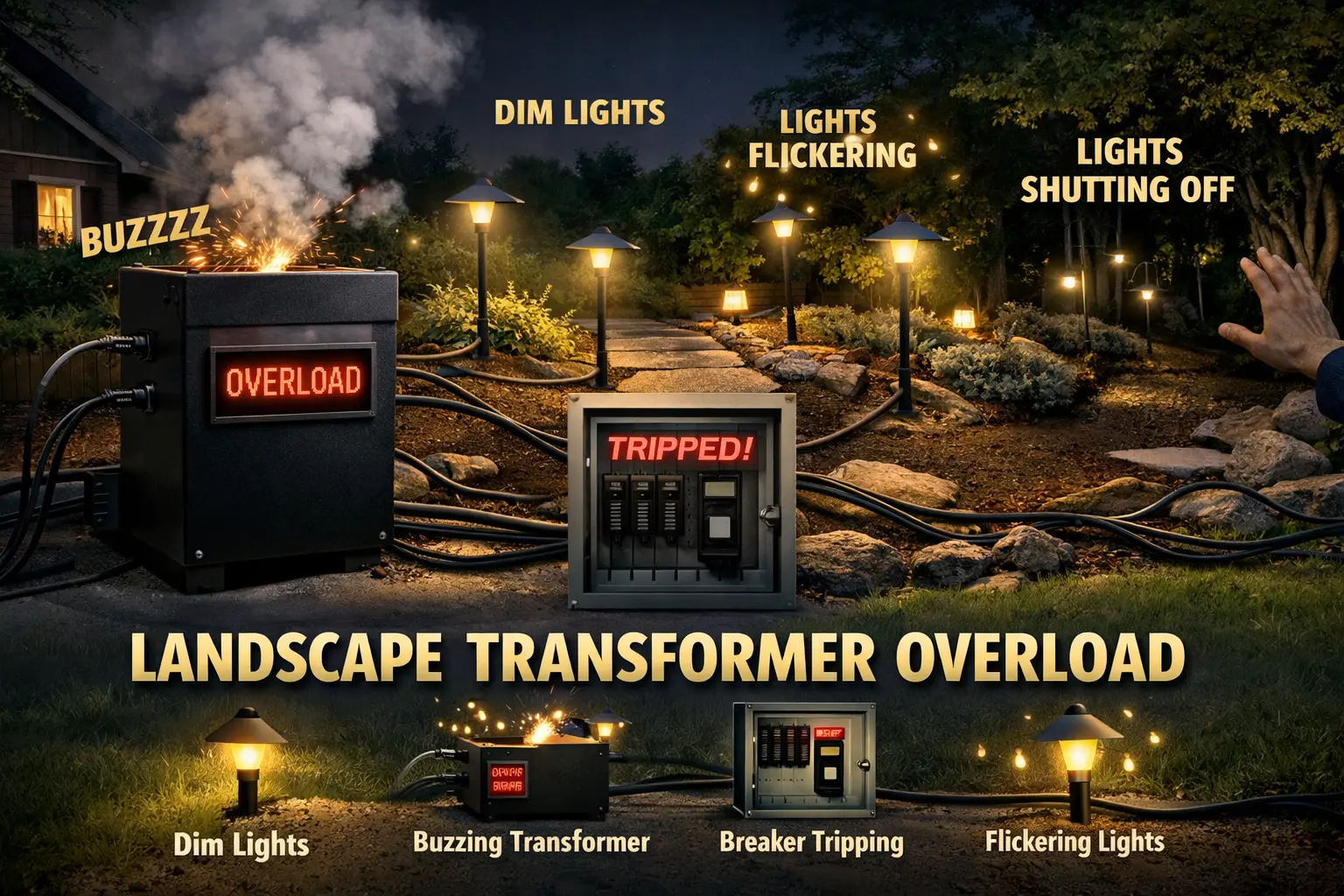
This usually means your transformer is overloaded. When too many lights are connected, the transformer cannot supply stable power, causing dim lights, flickering, buzzing, or shutdown.
- Most systems should stay under 70–80% of transformer capacity
- Overload happens when total wattage is too high
- Fix by reducing load or upgrading transformer
Start Here: What’s Happening With Your Lights?
- Lights dim when more turn on → overload
- Transformer buzzing loudly → overload
- Lights flicker → voltage instability
- Breaker trips → overload or short
How to Fix a Landscape Transformer Overload
- Remove or reduce the number of fixtures
- Upgrade to a higher wattage transformer
- Split lights across multiple transformers
- Replace high-watt bulbs with LED alternatives
Most overload problems are solved by either reducing the load or upgrading the transformer to match the system size.
Transformer overload is one of the most common reasons a landscape lighting system becomes weak, unstable, or unreliable. The system may still work partly, but it usually stops performing normally once the transformer is pushed too close to its limit.
The most common overload symptoms are dim lights, buzzing transformers, breaker trips, flickering fixtures, and lights that shut off randomly. Start with the quick diagnosis table below, then work through the wattage and load checks before replacing the transformer.
What Causes a Landscape Transformer Overload
A landscape transformer overload happens when the connected fixtures demand more power than the transformer can safely deliver. The most common causes are too many fixtures connected, exceeding the transformer wattage capacity, incorrect transformer sizing, adding new lights without upgrading the transformer, and long cable runs that make the system work harder.
Overload often shows up gradually. A system may work well at first, then become weaker after more path lights, spotlights, or accent fixtures are added. Homeowners often do not realize they crossed the transformer limit until the lights begin dimming, flickering, buzzing, or shutting down.
Some overloaded transformers cycle on and off automatically as internal thermal protection resets. The landscape lighting works then stops guide explains how overload conditions create inconsistent outdoor lighting performance.
Most Common Overload Causes
- too many fixtures on one transformer
- wattage exceeds transformer rating
- system expanded over time
- transformer was undersized from the start
Most Common Clues
- lights dim across the whole system
- transformer buzzes when lights turn on
- breaker trips at startup
- system shuts off after running awhile
Load Planning Mistakes
- using all rated wattage with no headroom
- ignoring future expansion
- mixing many fixture types on one unit
- adding fixtures without recalculating load
System Stress Signs
- transformer feels hot
- brightness changes under load
- lights flicker with full demand
- transformer gets noisier over time
Quick Diagnosis Table for Landscape Transformer Overload
Use this table to match the symptom you see to the most likely load-related cause before replacing fixtures or rewiring the whole system.
| Symptom | Likely Cause | What To Check | Detailed Fix |
|---|---|---|---|
| Lights dim across system | Transformer overload | Calculate total wattage | Landscape lights dim |
| Transformer buzzing | Excessive load | Check number of fixtures and load headroom | Landscape transformer buzzing |
| Breaker trips when lights turn on | Overloaded transformer | Inspect wattage capacity and total load | Landscape lights tripping breaker |
| Lights shut off randomly | Overheating transformer | Inspect load and transformer temperature | Landscape transformer not working |
| Lights flicker | Unstable voltage | Check transformer rating and branch balance | Landscape lights flickering |
| System got worse after adding lights | Transformer too many lights | Compare fixture load to transformer size | Landscape lighting transformer guide |
How to Tell If Your Transformer Is Overloaded (Fast Check)
You can quickly confirm a transformer overload by checking for these signs:
- All lights dim when system turns on
- Transformer hums or buzzes loudly
- Breaker trips when lights start
- Lights shut off after running briefly
- System worsens after adding new fixtures
If multiple symptoms appear together, overload is very likely. Overload is one of the most common causes of unstable landscape lighting performance.
How to Calculate Transformer Load (Simple Method)
To check for overload, add up the wattage of every light connected to your transformer and compare it to the transformer rating.
Example:
- 10 lights × 20 watts = 200 watts total
- Transformer rating = 200 watts
Even though this matches the rating, the system is still overloaded because transformers should not run at full capacity.
Recommended rule: Keep your total load at 70–80% of the transformer rating for stable performance.
Signs Your Transformer Is Overloaded
A transformer does not always fail immediately when it is overloaded. More often, it begins showing stress symptoms first. The most common signs are lights dimming when more fixtures turn on, transformer buzzing loudly, overheating, breaker trips, flickering lights, and systems that run for a while and then shut off.
These symptoms often overlap, which is why homeowners sometimes misdiagnose the problem as bad bulbs or bad cable. When several of these signs happen together, transformer overload becomes much more likely.
If the buzzing is one of the clearest symptoms, continue with landscape transformer buzzing.
Dim Lights
Often shows up first when the transformer is too close to its limit.
Fix dim landscape lightsBuzzing Transformer
A louder hum or buzz often means the transformer is carrying more load than it should.
Check buzzing transformerBreaker Trips
Heavy load at startup can push the transformer and circuit beyond safe limits.
Check breaker tripsRandom Shutdowns
Overheating or overloaded protection can make the transformer shut down unexpectedly.
Check transformer shutdownHow to Fix a Transformer Overload
Reduce the number of lights
The fastest solution is sometimes removing fixtures from the transformer so the total wattage drops back into a safer range. This is especially useful when overload symptoms began immediately after adding more lights.
Upgrade the transformer
If the existing transformer is simply too small for the number of fixtures you want, a higher-wattage transformer is often the best long-term fix. This is usually better than trying to squeeze one more branch onto a unit that is already near its limit.
Split the lighting system
Using multiple transformers can spread the load more safely. This works especially well for larger properties where one transformer is trying to handle the front yard, backyard, paths, accent lights, and deck lighting all at once.
Balance cable runs
Spread fixtures across multiple lines instead of loading one branch heavily while the rest of the system stays lighter. Better branch balance helps stabilize voltage and reduces transformer stress.
Transformer Sizing for Landscape Lighting
Proper transformer sizing starts with total fixture wattage, but good planning goes beyond the exact number on paper. A well-sized transformer leaves headroom for expansion and does not run right at the limit every night.
Typical transformer sizes vary widely depending on the system, but the main rule stays the same: add the fixture wattages, stay under the rating, and aim for a comfortable margin instead of maximum capacity. That makes the system more stable and easier to expand later.
For deeper sizing help, review landscape lighting transformer guide, landscape lighting transformer size calculator, and landscape lighting cable guide.
Why Long Cable Runs Can Make Overload Feel Worse
Long cable runs do not technically create overload by themselves, but they can make an overloaded system feel worse by adding voltage drop and reducing performance at the far end. That is why overloaded systems often show both dim lights and unstable transformer behavior at the same time.
If the farthest fixtures are the weakest and the transformer is already close to capacity, the problem may be a mix of overload and run design. In that case, branch balancing and cable planning matter just as much as the transformer size.
Portfolio Systems and Landscape Transformer Overload
Many landscape lighting systems installed over the past two decades used Portfolio low-voltage transformers and fixtures sold through Lowe’s. If your landscape transformer appears overloaded and your system includes Portfolio components, the issue may be related to transformer wattage limits, wiring layout, or the number of fixtures connected to the system. You can explore more troubleshooting in our Portfolio lighting troubleshooting guide, learn more about outdoor system setups in Portfolio landscape lighting, diagnose transformer issues in Portfolio transformer troubleshooting, or review wiring layouts in our Portfolio lighting wiring diagram guide.
Landscape Transformer Overload FAQ
What happens if a landscape transformer is overloaded?
An overloaded landscape transformer can cause dim lights, flickering, buzzing, overheating, unstable voltage, breaker trips, and partial or full lighting failure.
How many lights can a landscape transformer handle?
That depends on the transformer wattage rating and the wattage of each connected fixture. Most systems work best when the total load stays around 70 to 80 percent of the transformer’s rated capacity.
Why do my landscape lights dim when more lights turn on?
That usually points to transformer overload, voltage drop, or a system that is too close to its wattage limit. When more fixtures turn on, the transformer may struggle to supply steady power.
Can an overloaded transformer cause buzzing?
Yes. A transformer that is carrying too much load often works harder, runs hotter, and may buzz or hum more noticeably than normal.
How do you calculate landscape lighting transformer load?
Add up the wattage of all connected fixtures, then compare that number to the transformer rating. A 300-watt transformer is usually best kept around 210 to 240 watts for safer long-term operation.
Final Thoughts on Landscape Transformer Overload
Transformer overload is one of the most useful problems to identify early because it explains so many symptoms at once: dim lights, flickering, buzzing, breaker trips, and random shutdowns.
Start with the wattage math, then compare that load to the transformer size and how the system is distributed across the runs. That process usually makes it much clearer whether the real fix is fewer fixtures, a larger transformer, or a better-balanced layout.
More Landscape Lighting Troubleshooting Guides
Landscape Transformer Buzzing
Find out when humming is normal and when buzzing points to overload, loose wiring, or aging equipment.
Landscape transformer buzzing guideLandscape Transformer Not Working
Step-by-step checks for full-system power loss, timer errors, internal failure, and no-output problems.
Landscape transformer not working guideLandscape Lights Dim
Understand weak brightness caused by voltage drop, poor spacing, cable size, or transformer strain.
Fix dim landscape lightsLandscape Lights Tripping Breaker
Diagnose overloads, damaged cable, wet connections, and faults that trip circuit protection.
Fix breaker tripsLandscape Lights Flickering
Fix unstable lighting caused by weak voltage, loose connections, moisture, or transformer strain.
Fix flickering landscape lightsLandscape Lighting Transformer Guide
Learn how transformer sizing, load, and run planning affect outdoor lighting reliability.
Landscape lighting transformer guideLandscape Lighting Transformer Size Calculator
Use this planning guide to estimate capacity and leave room for future expansion.
Transformer size calculatorLandscape Lighting Cable Guide
Review cable selection, run planning, and common low-voltage wiring mistakes.
Landscape lighting cable guidePortfolio Lighting Master Model & Replacement Handbook
Stop wasting time hunting for discontinued Portfolio parts. This premium PDF helps you identify legacy Portfolio Lighting models, understand common failures, and find compatible replacement options from brands like Malibu, VOLT, Hampton Bay, and Kichler.
Inside the PDF:
- 100+ model breakdown pages
- Transformer, path light, spotlight, and wall lantern specs
- Common failure patterns for discontinued models
- Compatible replacement brands and parts strategy
- What to check before buying the wrong part
If one wrong part costs you $20–$80, this $9.99 handbook can pay for itself before you make your first replacement purchase.
Landscape Transformer Overload, Outdoor Lighting Transformer Overload, and Low Voltage Transformer Overload Help
This page is designed to help readers diagnose transformer overload by connecting the visible symptoms to the transformer’s wattage limits, load distribution, and sizing decisions. Use the diagnosis table and load calculation steps above before replacing the transformer or rebuilding the full lighting system.
Because overload often causes multiple symptoms at once, this page focuses on wattage capacity, transformer size, and system balance rather than treating dim lights, buzzing, and flickering as separate unrelated problems.