
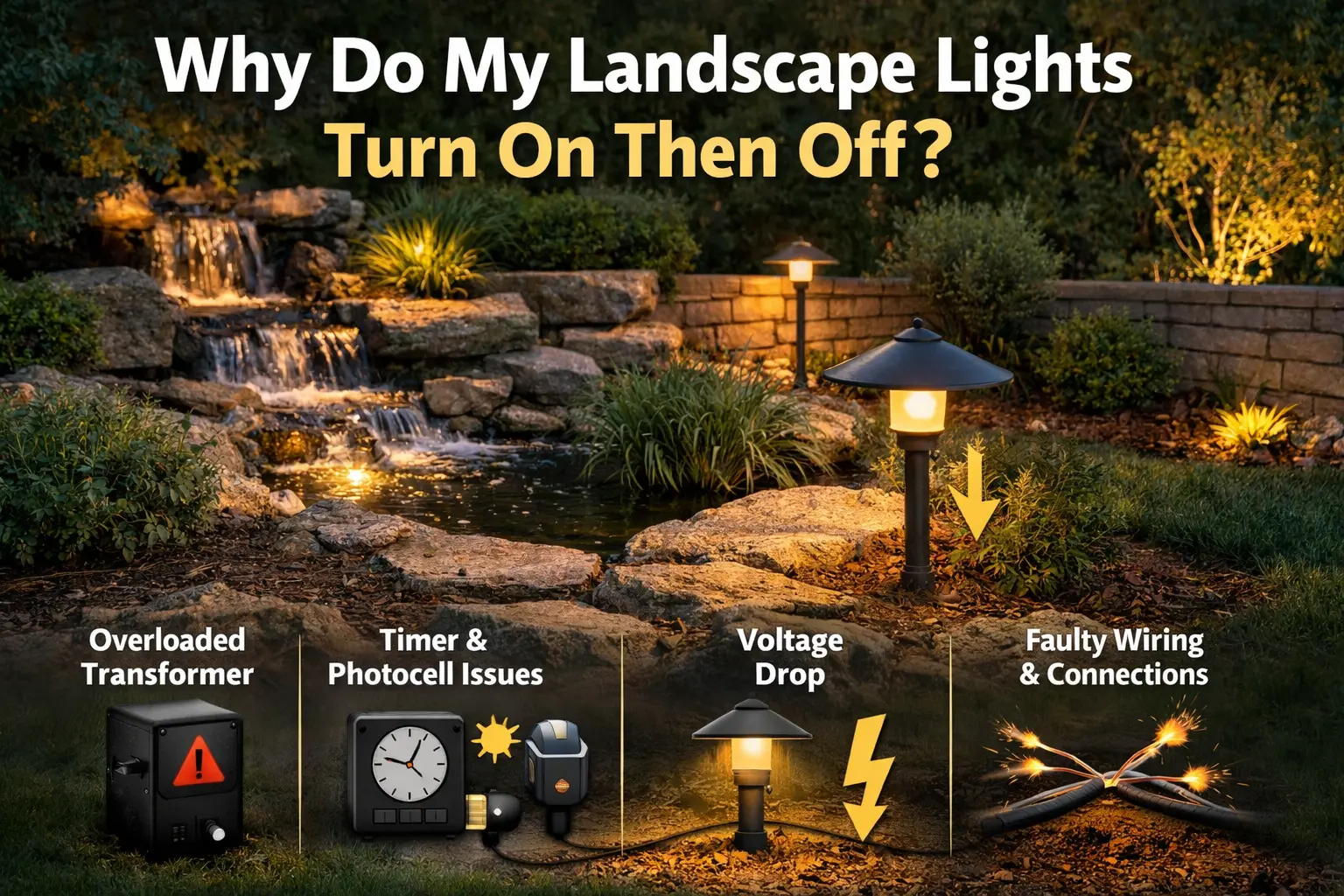
Quick Answer: Why Landscape Lights Turn On Then Off
If your landscape lights turn on and then shut off, the most common cause is transformer overload or overheating. Other common causes include a bad timer, faulty photocell, loose wiring, or voltage drop.
- ✔ All lights shut off → transformer or timer problem
- ✔ Shut off after a few minutes → overload or overheating
- ✔ Only some lights fail → wiring or connector issue
- ✔ Far lights fail → voltage drop
Start Here: Fastest Way to Fix This
- ✔ All lights shut off → check transformer load and heat
- ✔ Works for a few minutes → likely overload
- ✔ Random shutoff → timer or photocell issue
- ✔ Only one section fails → check wiring and connectors
Start Here: Match the Symptom Before You Start Replacing Parts
Use the failure pattern to narrow the problem down fast.
- Turns off after 1 to 5 minutes → overload or overheating
- Shuts off randomly → timer, photocell, or loose connection
- Only one zone fails → branch wiring or connector issue
- Lights nearest transformer stay on but far ones fail → voltage drop
Landscape lights that turn on then off are one of the most common low-voltage troubleshooting problems because the system can appear to work at first and then fail only after the transformer warms up, the timer switches incorrectly, or voltage drops across the run. That delayed failure often causes homeowners to misdiagnose the problem.
In many cases, the fixtures themselves are fine. The real fix is identifying whether the system is overloaded, whether the controls are misbehaving, or whether a wiring issue is affecting one part of the run. Once you know which category you are dealing with, the repair usually becomes much easier.
Most Likely Cause Based on What You Are Seeing
This table helps you match the symptom to the likely cause so you can start in the right place.
| What you notice | Most likely cause | What to check first | Best next page |
|---|---|---|---|
| All lights turn on, then all go off together | Transformer overload or overheating | Total wattage, transformer size, heat, reset behavior | Landscape transformer overload |
| Lights shut off after a consistent short delay | Timer, photocell, or overload issue | Timer mode, photocell behavior, overload signs | Landscape lighting timer not working |
| Only one section of lights goes out | Bad splice, damaged branch wire, or short | Connectors, cable path, branch layout | Portfolio landscape lights short circuit |
| Far lights dim or go out first | Voltage drop | Wire gauge, cable length, load distribution | Landscape lighting voltage drop |
| Works some nights but not others | Photocell, moisture, loose connection, or timer problem | Rain exposure, connector corrosion, control settings | Portfolio lights not working after rain |
Best Order to Diagnose the Problem
The fastest way to diagnose landscape lights that turn on then off is to start with the system-wide components first, then work outward toward the individual fixtures.
Step 1: Watch whether all lights shut off or only part of the system
If everything shuts off together, start with the transformer and controls. If only one section goes dark, focus more on wiring, connectors, and branch-specific issues.
Step 2: Notice how long the lights stay on before they fail
A short warm-up period often points to overload or overheating. Completely random shutoff is more consistent with a loose connection, faulty timer, or photocell issue.
Step 3: Compare the connected load to the transformer size
If you added fixtures over time or upgraded bulbs, the total load may now be too close to the transformer's limit. Compare your system to Portfolio lighting transformer sizing guide, Portfolio lighting transformer wattage guide, and landscape lighting transformer size calculator.
Step 4: Test the timer or photocell
Switch to manual mode if possible. If the system stays on in manual mode but fails on automatic settings, the control is a much more likely problem than the fixtures themselves.
Step 5: Inspect the main wire splices and branch connectors
Corrosion, moisture, and weak connectors often create intermittent failure that looks bigger than it is. Start closest to the transformer and move outward.
Cause #1: Transformer Overload or Overheating
This is the first thing to suspect when all landscape lights turn on and then all shut off together. A transformer that is carrying too much load may start normally, heat up, and then shut down to protect itself.
Signs this is your problem
- all fixtures shut off together
- the system fails after a short delay instead of instantly
- you recently added fixtures or changed bulbs
- the transformer feels unusually warm or hot
What to do next
Add up your total fixture wattage and compare it to the transformer rating. If the system is too close to the limit, reduce the load or upgrade the transformer. These pages help: Portfolio transformer getting hot, Portfolio lighting transformer not working, Portfolio transformer not powering lights, and how to replace a landscape lighting transformer.
Cause #2: Timer, Photocell, or Control Problems
A failing timer or photocell can make landscape lights shut off unexpectedly even when the fixtures and transformer are fine. This is especially common when the system behaves differently from one night to the next.
Signs this is your problem
- the system acts differently on manual mode compared to auto mode
- the shutoff time changes from night to night
- the transformer load appears normal but the system still shuts off
What to do next
Reset the timer, test the photocell, and compare symptoms with Portfolio lighting transformer timer not working, Portfolio lighting photocell not working, landscape lighting photocell not working, landscape lighting timer settings, and how to replace Portfolio photocell.
Cause #3: Loose, Corroded, or Wet Wire Connections
Bad splices, weak connectors, and corrosion are common reasons landscape lights behave intermittently. A poor connection may hold briefly, then fail once the system warms, shifts slightly, or gets wet.
Where to inspect first
- the main connection at the transformer
- the first splice feeding the affected branch
- any connector near irrigation, wet mulch, or low spots
- fixture connections that were recently moved or repaired
What to do next
Replace weak connectors, cut back corroded wire, and use outdoor-rated splices. These pages help readers go deeper: landscape lighting connectors, low-voltage wire connectors landscape lighting, landscape lighting corrosion, Portfolio landscape lighting wiring, and landscape lighting wiring guide.
Cause #4: Voltage Drop on Longer Runs
Voltage drop is one of the most misunderstood landscape lighting problems. When the cable run is too long, too thin, or carrying too much load on one branch, the far end of the system may dim, flicker, or shut off first.
Signs this is your problem
- fixtures near the transformer look better than fixtures farther away
- the far end of the system is the first to fail
- you added more fixtures to an older or longer run
What to do next
Check wire gauge, cable length, and branch layout. These pages support the next step: landscape lighting wire gauge, landscape lighting cable guide, landscape lighting layout design, low-voltage landscape lighting zones, and low-voltage landscape lighting system diagram.
What to Check Before You Replace Fixtures
Homeowners often replace bulbs or fixtures too early. Before spending money, work through this short list:
- confirm the transformer is sized correctly
- test whether the timer or photocell is switching the system off
- inspect the first few splices from the transformer outward
- check for corrosion, moisture, or damaged insulation
- look for one overloaded branch instead of assuming the whole system is bad
If you still suspect fixture-level issues, compare Portfolio LED lights flickering, Portfolio lighting too dim, Portfolio lights blinking, and landscape lights not working.
How This Page Fits into the Portfolio Lighting Troubleshooting Cluster
This guide sits at the center of a strong troubleshooting search intent: the system starts, appears normal, then fails after a short delay. That makes it a natural bridge between transformer pages, timer pages, wiring pages, and general landscape troubleshooting pages.
Readers who land here often need one of four next steps: overload diagnosis, timer diagnosis, wiring repair, or broader design correction. That is why this page works especially well alongside Portfolio lighting troubleshooting, Portfolio landscape lighting troubleshooting, landscape lighting troubleshooting, Portfolio lighting transformer troubleshooting, landscape lighting guide, and how landscape lighting works.
Why Do My Landscape Lights Turn On Then Off? FAQ
Why do my landscape lights turn on then off?
The most common causes are transformer overload, faulty timers or photocells, loose wire connections, corrosion, and voltage drop on longer cable runs.
What is the most common reason landscape lights shut off after a few minutes?
Transformer overload is one of the most common reasons. The transformer starts normally, heats up under load, and then shuts down to protect itself.
Can a bad timer cause lights to turn on then off?
Yes. A bad timer, photocell, or smart control can switch the system off unexpectedly even when the main power path is otherwise fine.
Should I replace the bulbs first?
Usually no. When multiple fixtures show the same pattern, the problem is more often the transformer, control, or wiring than the bulbs themselves.
Final Thoughts
Landscape lights that turn on then off are frustrating because the system looks healthy at first. In most cases, though, the delayed failure pattern is actually useful because it points toward overload, controls, wiring, or voltage distribution rather than random fixture failure.
Start with the broadest system components first, match the symptom pattern, and work outward from the transformer. That approach usually gets you to the right fix faster and helps you avoid buying parts you do not need.
More Landscape Lighting Repair and Troubleshooting Guides
Landscape Transformer Overload
Use this if your lights shut off after a short time and you suspect the transformer is carrying too much load.
Read the guideLandscape Lighting Timer Not Working
Helpful when the lights behave unpredictably or work differently in manual mode than automatic mode.
Read the guideLandscape Lighting Voltage Drop
Best when the far end of the system goes dim, flickers, or shuts off before the fixtures near the transformer.
Read the guidePortfolio Lighting Transformer Troubleshooting
Use this guide when the system-wide power source is the most likely cause of the shutdown.
Read the guidePortfolio Landscape Lights Not Working
Helpful when the system has broader power, connector, or fixture issues beyond simple delayed shutoff.
Read the guideHow to Test a Landscape Lighting Transformer
Use this page if you want to confirm whether the transformer is actually the problem before replacing it.
Read the guideLandscape Lights Turning On Then Off: Transformer, Timer, Wiring, and Voltage Drop Troubleshooting
This page is designed to help homeowners diagnose delayed landscape lighting failure when the system starts normally but then shuts down. It focuses on the most likely causes behind that pattern, including overload, controls, wiring, and voltage loss across the run.
If you are still building out the broader system or need context on how the power path works, use landscape lighting system diagram, landscape lighting maintenance, and Portfolio lighting guide, plan, and placement to support the troubleshooting process.