
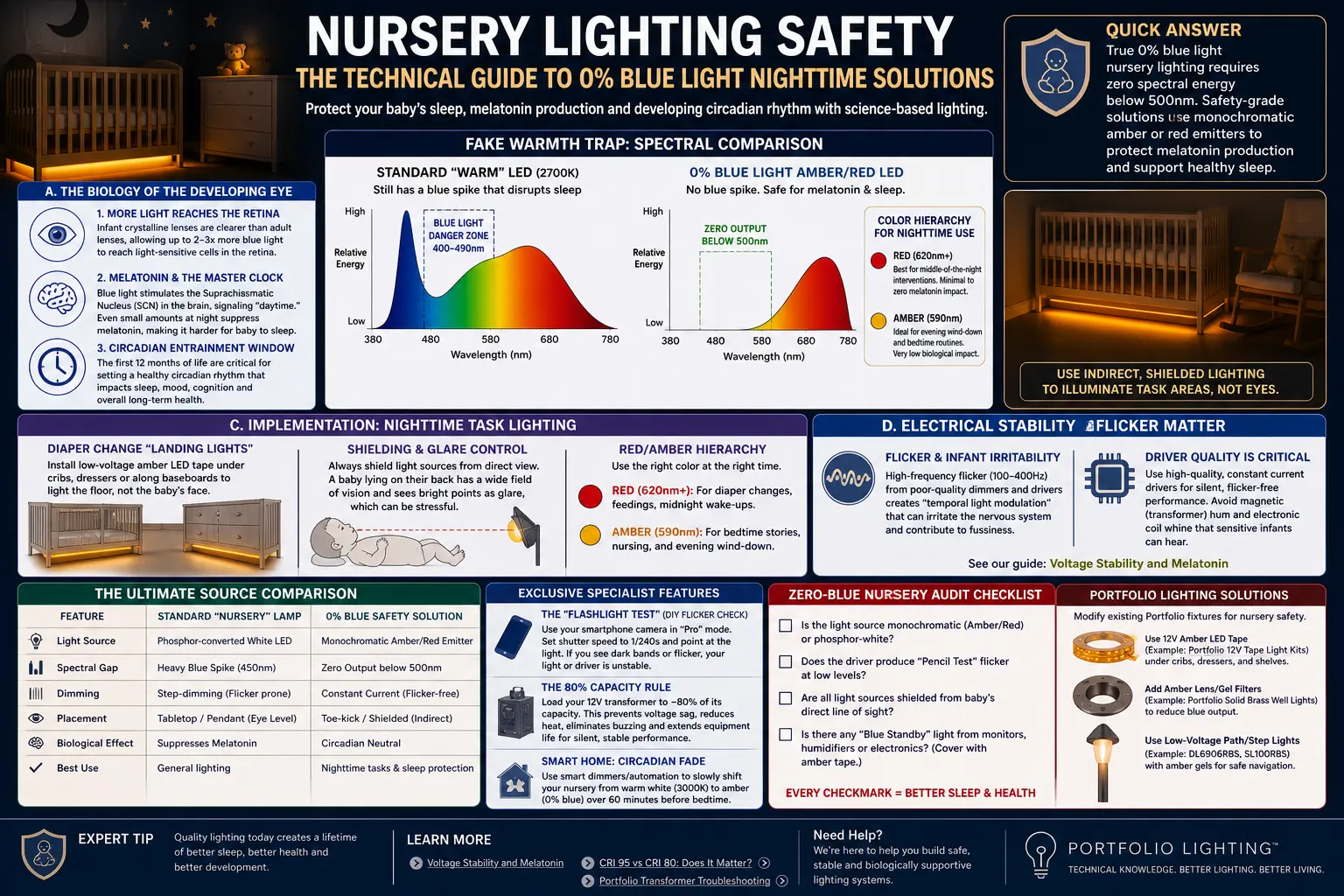
I look at nursery lighting as a technical safety specification, not just a decorating choice. The fixture may look soft, cute, and warm, but the actual performance depends on spectral output, driver quality, dimming method, placement, glare control, and electrical stability.
The goal is simple: give the parent enough light to safely move, feed, change, and check on the baby without blasting the infant’s eyes with blue-rich light, shimmer, glare, coil whine, or harsh direct diode output.
If your lighting is flickering, dim, or inconsistent, start with this step-by-step troubleshooting guide .
The Biology of the Developing Eye
Infant lighting deserves a higher standard because a baby is not just a small adult. The developing eye and sleep system are still adapting to day-night timing, and the nursery environment becomes part of that signal.
The Transparency Factor
Infant crystalline lenses are clearer than adult lenses, which means more short-wavelength blue light can reach the retina. That matters during midnight diaper changes because the baby is often lying on the back, looking upward, and exposed to direct light from a lamp, ceiling fixture, monitor glow, humidifier LED, or changing table light.
The fix is not just “make it dim.” A dim blue-rich light can still send the wrong nighttime signal. A better approach is to remove the blue content, shield the source, and keep the light low and indirect.
Melatonin and the Master Clock
The body’s internal timing system is controlled by signals that include light and darkness. The suprachiasmatic nucleus, often called the SCN, is part of that master clock. At night, bright or blue-rich light can tell the body that it is not fully dark yet.
Parents still need visibility. The goal is not darkness at all costs. The goal is a low-disruption light system that allows safe movement without turning every feeding or diaper change into a biological “morning” signal.
Circadian Entrainment During the First Year
The first year is a critical window for building stronger day-night routines. Morning light, daytime brightness, evening dimness, and nighttime darkness all help teach the body when to be awake and when to rest. Nursery lighting should support that pattern instead of fighting it.
The Purkinje Shift: Why Blue Feels Brighter at Night
At very low light levels, the human eye shifts into what is called scotopic vision. This is often referred to as the Purkinje Effect. In this state, the eye becomes significantly more sensitive to shorter wavelengths in the blue-green range (around 500nm).
This means that even a small amount of blue light can appear disproportionately bright in a dark nursery. What looks “dim” to an adult can feel visually intense to an infant whose eyes are more sensitive and more transparent.
The Fake Warmth Trap: 2700K Is Not the Same as Sleep-Grade Amber
This is the mistake I see most often. A parent buys a “warm white” 2700K nursery lamp and assumes it is safe for nighttime. It looks yellowish to the eye, so it feels like it should be gentle.
The problem is that many warm white LEDs are still blue-pump LEDs. A blue diode near the 450nm range excites a phosphor coating to create white-looking light. The final color can look warm, but the underlying spectrum may still include blue energy.
The 500nm Cut-Off
For nursery nighttime work, I would treat 500nm as the practical safety boundary. If the light source emits meaningful energy below 500nm, it is not a true 0% blue nighttime solution.
That is why monochromatic amber and red emitters are different from normal warm white LEDs. They are not “white LEDs made warmer.” They are narrow-band light sources that avoid the blue range from the start.
| Light Type | Typical Spectrum | Nighttime Nursery Use | Specialist Concern |
|---|---|---|---|
| 5000K Cool White LED | Strong blue-rich output | Not recommended for night care | Too alerting and visually harsh. |
| 2700K Warm White LED | Warmer appearance but often still blue-pump based | Better than cool white, but not zero-blue | May still leak blue around 450nm. |
| Amber LED | Usually around 590nm | Good for bedtime wind-down | Should still be dim and shielded. |
| Red LED | Usually 620nm and above | Best for middle-of-the-night care | Use enough to see safely, not more. |
The Reflection Factor: Wall Color Matters
Light behavior in a nursery is not only determined by the fixture. Surface color plays a major role.
Amber and red light reflect best off neutral or warm surfaces such as beige, cream, or soft off-white. Blue or green wall colors can absorb longer wavelengths and reduce effective brightness, making the room feel darker than expected.
For low-level nighttime lighting, wall reflectivity directly affects how much usable light reaches the parent without increasing brightness at the source.
Implementation: Nighttime Task Lighting That Does Not Hit the Baby’s Eyes
A nursery does not need one bright “main” light for nighttime care. It needs small task zones: floor navigation, diaper change visibility, feeding chair visibility, and parent pathway lighting.
Diaper Change Landing Lights
I like the idea of low-voltage amber LED tape installed under the crib base, under the changing table, behind a dresser toe-kick, or along a low wall channel. The light hits the floor and nearby surface instead of shining into the baby’s eyes.
This is where my low-voltage lighting background matters. A 12V amber LED tape setup can be quiet, low heat, easy to place, and easier to control than a bright overhead fixture.
The Red / Amber Hierarchy
For a broader environmental perspective, see how light color impacts biology in this guide on light spectrum and biological response .
- Red 620nm+: best for middle-of-the-night interventions when you want the least biological alerting signal.
- Amber 590nm: better for evening wind-down, bedtime stories, and pre-sleep routine lighting.
- Warm white 2200K to 2700K: useful for general evening comfort, but not the same as 0% blue nighttime light.
Shielding and Glare
Direct view of a diode is a stressor for an infant lying on the back. Even a dim LED can feel harsh if the emitter is exposed. The safest nursery lighting is shielded, bounced, diffused, and aimed at surfaces rather than faces.
Electrical Stability and Flicker in the Nursery
Flicker is the hidden problem in cheap nursery lighting. Many dimmable LEDs pulse quickly as they dim. The parent may not notice it consciously, but the light can still feel visually irritating, especially at low brightness.
This is why I connect nursery lighting to the same electrical stability principles covered in Voltage Stability and Melatonin.
biological lighting infrastructureFlicker and Infant Irritability
A nursery light can be the right color and still be a bad light if the driver flickers. Poor drivers, weak power supplies, overloaded transformers, and mismatched dimmers can create shimmer, banding, coil whine, or brightness instability.
If you're noticing flicker or instability, review clean power and flicker control principles to understand how driver quality impacts both comfort and safety.
Magnetic vs. Electronic Drivers
Cheap electronic drivers can whine, pulse, or heat up under dimming. Magnetic-style power can be stable in some systems, but it must be properly matched and quiet. In a nursery, I care about two things: no high-pitched coil noise and no unstable low-end dimming.
color quality and spectral accuracy differencesIf a light hums, buzzes, or changes brightness after warming up, do not ignore it. Use Portfolio Lighting transformer troubleshooting for the electrical logic behind hum, overload, terminal issues, and output testing.
Acoustic Noise Floor in a Silent Nursery
A typical quiet nursery has an acoustic noise floor below 30dB. At this level, high-frequency electrical noise from LED drivers becomes noticeable.
Cheap LED drivers often emit switching noise in the 15kHz to 20kHz range. Adults may not hear this clearly, but infants can be more sensitive to these high-frequency sounds.
If a light hums, buzzes, or emits a faint high-pitched tone when dimmed, it is not suitable for a nursery environment.
Melanopic Lux and Circadian Impact
Lighting scientists now use a metric called Melanopic EDI (Equivalent Daylight Illuminance), often referred to as melanopic lux. This measures how strongly a light source stimulates the circadian system.
Monochromatic amber and red lighting can maintain usable visibility for the parent while keeping melanopic lux near zero. This is what makes them effective for nighttime nursery environments.
The Ultimate Nursery Lighting Source Comparison Table
| Feature | Standard “Nursery” Lamp | 0% Blue Safety Solution | Why It Matters |
|---|---|---|---|
| Light Source | Phosphor-converted white LED | Monochromatic amber or red emitter | White LEDs often begin with a blue pump; amber/red avoids that range. |
| Spectral Gap | Blue spike around 450nm is common | Zero meaningful output below 500nm | Blue-rich nighttime light can work against melatonin rhythm. |
| Dimming | Step dimming or cheap PWM | Stable constant-current or low-flicker driver | Smooth dimming is less visually irritating than choppy pulsing. |
| Placement | Tabletop lamp at eye level | Toe-kick, under-crib, shielded, indirect | Indirect light helps parent visibility without direct infant glare. |
| Biological Effect | Can suppress melatonin or increase alerting signal | Circadian-neutral nighttime task light | Supports safe care without turning the room into a daytime signal. |
| Noise / Heat | Unknown driver quality; possible buzz or heat | Oversized quiet driver running below capacity | Quiet, cool-running systems are better for light sleepers. |
The Flashlight Test and Slow-Motion Flicker Check
Parents can quickly screen lighting quality without buying expensive meters. These tests are not lab-grade, but they catch many bad lights.
Phone Camera Flicker Test
- Dim the nursery light to the level you actually use at night.
- Open your phone camera and switch to slow motion if available.
- Point the camera at the light source, wall reflection, and crib-side glow.
- Watch for rolling dark bands, pulsing, shimmer, or uneven brightness waves.
- If flicker is heavy at low dim levels, replace the driver, dimmer, or fixture.
Flashlight Spectrum Reality Check
If a “night light” looks white, cream, or warm white, assume it is not 0% blue unless the manufacturer provides spectral data. A true red or amber light should look like a narrow color source, not a white lamp with a warm tint.
The 80% Capacity Rule for Nursery Transformers and Drivers
I do not like running power supplies at the edge of their rating in a nursery. A driver that is pushed hard can run hotter, buzz louder, and become less stable over time.
The simple planning rule is to use only about 80% of the rated capacity. If your amber LED tape needs 24 watts, I would not choose a tiny 24-watt power supply. I would step up and give it headroom.
If you're designing a full system, this guide on lighting color temperature and placement strategy will help you avoid common mistakes.
| Driver / Transformer Rating | Preferred 80% Load | Nursery Reason |
|---|---|---|
| 15W | 12W | Small nightlight zones only. |
| 30W | 24W | Good for modest amber tape runs. |
| 60W | 48W | Useful for multiple indirect zones. |
| 100W | 80W | Large room or multiple low-voltage channels. |
For broader low-voltage planning, use Portfolio Low Voltage Lighting and the Landscape Lighting Voltage Drop Calculator. The same electrical stability logic applies: wire size, run length, load, and driver capacity all affect performance.
Smart Home Automation: The Circadian Fade
Smart lighting can help a nursery if it is used carefully. The goal is not flashy color effects. The goal is a predictable evening fade that moves the room away from daytime light.
A good routine might slowly transition from 3000K warm white in early evening to amber-only before bedtime, then red-only for middle-of-the-night care. This can be done with careful automation, but only if the lighting hardware itself is low flicker and the color channels are real amber/red, not just white LEDs tinted through software.
- Early evening: low-glare warm white for cleanup and routine.
- Bedtime: amber indirect light for stories and wind-down.
- Overnight: red low-level landing light for diaper changes and checks.
- Morning: brighter broad-spectrum light after wake time to reinforce day-night rhythm.
For automation logic, see AI Automated Landscape Lighting and AI Outdoor Lighting Systems. The same zoning concept works indoors: task zones, timing, dimming curves, and safety defaults.
Portfolio Lighting Specialist Pro-Tip: Repurposing Low-Voltage Logic Indoors
My Portfolio Lighting work is mostly outdoor and low-voltage, but the logic transfers well to nursery design. A stable 12V system, properly loaded driver, clean connectors, and shielded amber LED tape can create a calm nighttime lighting zone without relying on a bright bulb at eye level.
Some Portfolio-style low-voltage concepts can be adapted carefully: amber gels over shielded accent lighting, low-voltage LED tape in protected channels, hidden toe-kick lighting, and transformer/driver headroom planning. The key is to use indoor-rated components indoors, keep wiring protected, avoid exposed conductors, and never improvise with unsafe adapters.
The Zero-Blue Nursery Audit Checklist
Use this checklist before calling a nursery light “sleep safe.”
- Spectrum: Is the light source monochromatic amber/red, or is it phosphor-white?
- Cutoff: Does the source avoid meaningful output below 500nm?
- Flicker: Does it pass the phone slow-motion test at low dimming levels?
- Glare: Are the light sources shielded from the baby’s direct line of sight while lying on the back?
- Placement: Is the light low, indirect, and task-focused instead of overhead?
- Driver: Is the power supply quiet, cool-running, and loaded under about 80% capacity?
- Standby LEDs: Are blue or green lights from monitors, humidifiers, cameras, and chargers covered or relocated?
- Routine: Does the nursery get bright daytime light and very low-disruption nighttime light?
Nursery Lighting Safety FAQ
What is the best nursery light for infant sleep?
The best nursery light for nighttime infant sleep is a shielded, low-output amber or red light source with zero meaningful blue output below 500nm, stable low-flicker dimming, and indirect placement below eye level. Standard warm white LEDs can still contain blue energy.
Is 2700K warm white safe for nighttime nursery lighting?
2700K warm white is better than cool white, but it is not the same as 0% blue light. Most warm white LEDs are blue-pump LEDs with phosphor coating, meaning they can still emit blue energy around the 450nm range.
Is red or amber light better for a baby nursery at night?
Red light at 620nm and above is usually the lowest-blue option for middle-of-the-night care. Amber around 590nm can work well for bedtime wind-down and quiet evening routines. Both should be shielded and dim.
Can flickering nursery lights disturb infant sleep?
Poor LED drivers and mismatched dimmers can create flicker, shimmer, buzzing, or unstable output. Even when flicker is not obvious, a low-quality light can feel visually irritating and may make nighttime settling more difficult.
How do I test nursery lights for flicker?
Use a phone slow-motion camera test or pencil test as a quick screen. Heavy banding, pulsing, or separated ghost images suggest flicker. For a nursery, choose a better driver or fixture if the light flickers at low dimming levels.
Technical References & Peer-Reviewed Research
To ensure this guide meets the highest safety standards for infant development, the following biological and electrical principles are anchored in peer-reviewed research and industry standards.
1. The Biological Threshold: ipRGC Sensitivity
Research confirms that intrinsically photosensitive Retinal Ganglion Cells (ipRGCs) are the primary receptors for circadian signaling. These cells contain melanopsin, which has a peak sensitivity in the 460nm–480nm range. Utilizing light sources with a cutoff above 500nm (Amber/Red) effectively avoids this "biological morning" signal.
Source: Chronobiology in Medicine (2021); Frontiers in Cellular Neuroscience (2023).2. The Infant Lens Transparency Factor (70% Increased Transmission)
An infant's crystalline lens is biologically optimized for light transmission, lacking the "yellowing" chromophores that develop with age to filter high-energy visible (HEV) light. Peer-reviewed spectral transmission data reveals that while an adult lens significantly attenuates wavelengths below 450nm, an infant’s lens can transmit up to 70% more blue-light energy directly to the retina. This creates a heightened biological vulnerability to sleep disruption and retinal stress from standard "cool" or "warm-pump" LEDs.
Primary Reference: Investigative Ophthalmology & Visual Science (IOVS). "Spectral Transmission of the Human Lens" (Laboratory of Visual Physiology). This research quantifies the age-dependent shift in blue-light filtration, confirming that the neonatal eye lacks the spectral density required to block circadian-disrupting blue spikes found in modern artificial lighting.3. Neurological Impact of LED Flicker
Infants show a larger visual field response to flickering stimuli compared to adults, indicating that their developing nervous systems are more reactive to temporal light modulation. Following IEEE 1789-2015 standards for flicker-free current modulation is critical to mitigate risks of eye strain and irritability.
Source: IEEE Standard 1789-2015; IOVS Research on Pediatric Flicker Thresholds.4. The Purkinje Shift & Scotopic Sensitivity
In low-light conditions, the human eye shifts sensitivity toward the blue-green spectrum. Using monochromatic amber lighting (590nm+) allows for high visual acuity for the caregiver while maintaining a near-zero Melanopic EDI (Equivalent Daylight Illuminance) for the infant.
Health and Electrical Safety Disclaimer
This guide is educational and focuses on lighting quality, spectrum, electrical stability, and comfort-oriented nursery lighting design. It is not medical advice and does not diagnose, treat, or prevent infant sleep disorders or health conditions. For infant sleep concerns, consult a qualified pediatric healthcare professional. For permanent electrical work, dimmers, drivers, low-voltage wiring, or 120V wiring, consult a licensed electrician and follow local code.
Always follow electrical safety standards. See our full guide on lighting safety codes and best practices .