
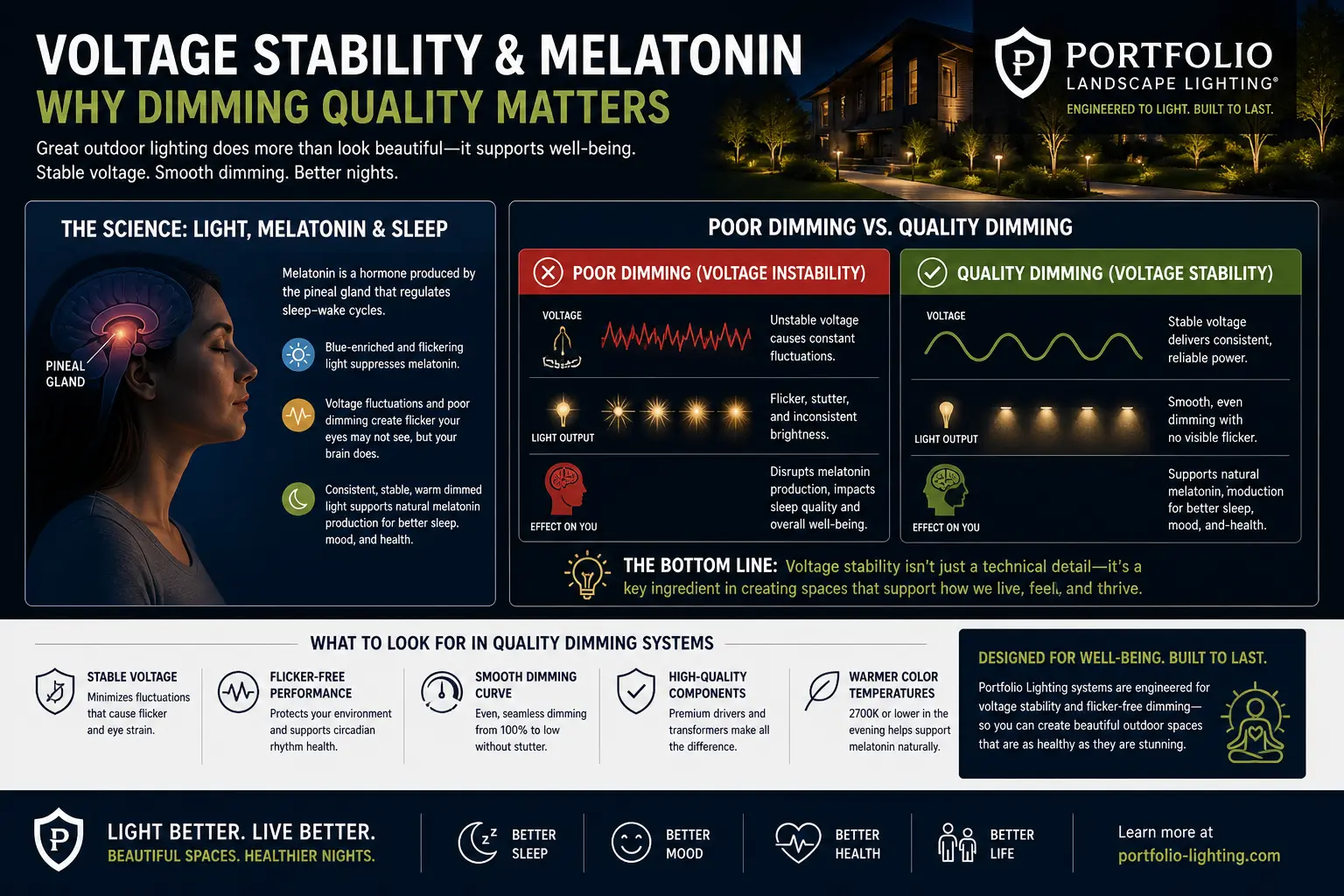
In my experience, bad lighting comfort is rarely caused by one thing. It is usually a stack of small technical problems: a cheap LED driver, a mismatched wall dimmer, voltage sag, high-frequency flicker, a buzzing transformer, too much blue-rich light at night, and poor low-end dimming.
The goal of this page is to connect the electrical side to the biological side. Stable power makes stable light. Stable light is easier on the visual system. Easier evening light gives the body a better chance to wind down.
If you want to understand how voltage stability, spectrum, and dimming all work together as one system, I break that down in the biological lighting infrastructure guide. That’s where lighting moves from “fixtures” to a complete human-centered system.
Why Cheap Dimmers Cause Headaches
- Choppy waveform (TRIAC mismatch)
- Low-frequency PWM flicker
- Driver instability under load
- Voltage sag at low dim levels
In my testing, most “bad lighting” complaints come from dimmer-driver mismatch—not the bulb itself.
Key Metrics for Sleep-Friendly LED Drivers
| Metric | Target Range | Why It Matters |
|---|---|---|
| Flicker Index | < 0.02 | Reduces invisible neurological stress |
| Percent Flicker | < 5% at 100Hz | Prevents stroboscopic “ghosting” effect |
| Frequency | > 1,250Hz | Aligns with IEEE 1789 comfort zone |
| THD (Driver Quality) | < 20% | Indicates cleaner electrical waveform |
Voltage Stability Starts Before the Light Fixture
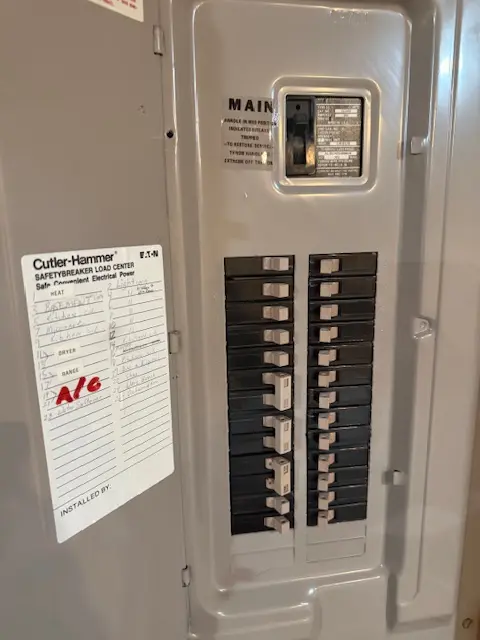
When I evaluate dimming quality, I do not start at the bulb. I start upstream. The electrical panel, breaker circuit, transformer input, driver, dimmer, and fixture all work together. If the source circuit feeding the lighting system is unstable, the final light output may pulse, shimmer, buzz, or shift in brightness.
That matters for human-centric lighting because biological lighting depends on consistency. A night channel may have the right amber or red spectrum, but if the driver is being fed unstable power, the result can still feel uncomfortable, distracting, or visually harsh.
The Science of the Flicker Factor
The flicker factor is the hidden behavior of a light source when the electrical supply is not being converted into smooth light output. LED light is not like a glowing piece of hot metal. It reacts quickly to driver current. If the driver pulses, the light pulses.
If you're dealing with real-world flicker issues, see Portfolio LED lights flickering for practical fixes.
Pulse Width Modulation vs. Constant Current Reduction
Pulse Width Modulation, often called PWM, dims an LED by turning it on and off rapidly. The LED may be at full output during the “on” part of the pulse, but the average light level appears lower because the “off” time increases.
Constant Current Reduction, often called CCR, dims by reducing current more smoothly. In a well-designed system, this can feel calmer because the light output is not relying on aggressive on/off pulsing at visible or biologically irritating frequencies.
For a deeper look at how flicker affects the nervous system, especially for sensitive users, see The Flicker Factor: clean power for migraine prevention. This goes beyond visibility and into real-world symptom triggers.
| Dimming Method | How It Works | Possible Comfort Issue | Best Use Case |
|---|---|---|---|
| PWM | Turns the LED on and off rapidly to lower perceived brightness. | Can create temporal light modulation if frequency or depth is poor. | Acceptable when very high frequency and well engineered. |
| CCR | Reduces LED current more continuously. | Can color shift if the driver or emitter is low quality. | Often preferred for biological comfort and smooth evening dimming. |
| TRIAC / Forward Phase | Chops the AC waveform before the LED driver sees it. | Buzzing, shimmer, drop-out, or poor low-end dimming. | Legacy dimming when the LED driver is rated for it. |
| ELV / Reverse Phase | Uses smoother reverse-phase control for many electronic drivers. | Still requires driver compatibility. | Better LED dimming where fixtures call for ELV controls. |
If you are working with older low-voltage Portfolio fixtures, voltage stability should be checked before adding tunable-white, amber, or red emitters. The Portfolio HCL retrofit guide walks through how unstable voltage can distort color mixing, dimming behavior, and nighttime spectrum control.
Voltage Stability vs. Melatonin Production
Melatonin is part of the body's evening timing system. Light exposure does not act only through “brightness.” Timing, spectrum, intensity, duration, and stability all matter. A bright, cool, flickering, poorly dimmed LED can feel far more alerting than a stable warm source at the same perceived brightness.
If voltage drop is part of your system, use the Portfolio low voltage lighting guide to stabilize performance.
Color temperature and biological impact go beyond indoor spaces. The biological impact of outdoor light color explains how spectrum influences both human and environmental rhythms.
For a practical setup using these principles, see how to design a nursery lighting system that protects melatonin at night .
The 480nm Spike Problem
The eye has retinal cells that help the brain understand day-night timing. These cells are especially responsive to blue-cyan energy around the 480nm region. When evening light stays blue-rich, the body can read that signal as “stay awake.”
Poor dimming quality makes this worse when the light gets dimmer but does not become biologically softer. A cheap LED may reduce total brightness while keeping a harsh spectral feel, flicker, or driver instability.
Cortisol and the Low-Level Stress Signal
I would not describe every flickering light as a medical emergency, but I do treat unstable light as a stress signal. If a room has buzzing, shimmer, harsh blue-white tone, and inconsistent dimming, the nervous system may stay more alert than it should in the evening.
How to Identify Poor Dimming Quality
You do not need a lab to catch the worst dimming problems. A few simple field checks can reveal whether the light is stable or struggling.
The Pencil Test
Hold a pencil at one end and wave it quickly through the light. If the pencil appears as separated ghost images instead of a smoother blur, the light may have noticeable flicker or stroboscopic effect. This is not a laboratory-grade measurement, but it is a useful homeowner screen.
The Smartphone Slow-Motion Test
Open your phone camera and switch to slow motion if available. Point it at the light while dimming up and down. Dark rolling bands, heavy pulsing, or brightness waves are signs that the driver and dimmer are not producing smooth output.
Thermal Throttling
Heat can destabilize LED drivers. A fixture may look fine for five minutes, then pulse or dim after the driver warms up. This is common in enclosed fixtures, overloaded drivers, cheap retrofit bulbs, and installations with poor ventilation.
Transformer Buzzing
Buzzing is not just annoying. It can be a clue that the electrical system is under stress, mismatched to the load, or being chopped by the wrong control. For outdoor and low-voltage systems, see Portfolio lighting transformer troubleshooting.
This “ghosting effect” in LED downlights is one of the clearest signs of poor PWM dimming. Even when brightness is low, unstable drivers can still deliver high melanopic lux signals that feel alerting instead of relaxing.
Driver-Dimmer Compatibility Matrix
The dimmer and driver must speak the same electrical language. If they do not, the result is flicker, hum, poor low-end control, sudden shutoff, or unstable color.
Since all of this depends on LED behavior, the Portfolio LED lighting guide explains driver types, flicker behavior, and what actually changes when LEDs are dimmed.
| Control / Driver Type | Common Use | Stability Risk | Sleep-Oriented Recommendation |
|---|---|---|---|
| Forward Phase / TRIAC | Legacy wall dimmers and older incandescent systems. | Can chop LED drivers harshly and create buzz or flicker. | Use only with LED drivers clearly rated for forward-phase dimming. |
| ELV / Reverse Phase | Many electronic low-voltage LED drivers. | Better than many legacy controls, but still requires compatibility. | Good choice when the fixture manufacturer calls for ELV. |
| MLV / Magnetic Low Voltage | Magnetic transformers and some low-voltage lighting systems. | Wrong dimmer can create transformer buzz and heat. | Use an MLV-rated dimmer with magnetic transformers. |
| 0-10V Dimming | Commercial and higher-quality driver systems. | Requires control wiring and compatible driver. | Excellent for smooth control when installed correctly. |
| Constant Current LED Driver | Dedicated LED fixtures and biological-grade lighting setups. | Poor driver quality can still flicker or color shift. | Use high-quality low-flicker drivers for priority spaces. |
| Constant Voltage 12V/24V Driver | LED tape, under-cabinet lighting, landscape-style low-voltage runs. | Voltage drop can create uneven brightness and color shift. | Use proper wire gauge, shorter runs, and adequate driver headroom. |
Low-End PWM and Duty Cycle Effects
At very low dimming levels (below ~10%), PWM systems extend the “off” time between pulses. This creates longer dark gaps between light bursts, which increases the stroboscopic effect—even if the frequency remains high.
| Condition | Behavior | Effect |
|---|---|---|
| High-Level PWM | Short off cycles | Less noticeable flicker |
| Low-End PWM (<10%) | Extended off pulses | Maximum visual stress and “ghosting” |
The 80% Rule for Voltage Stability
I use the 80% rule because electrical headroom matters. A transformer or driver loaded right up to its nameplate limit may work on paper but sag, heat, buzz, or flicker in the real world.
For example, if a transformer is rated for 100 watts, I prefer planning around 80 watts or less for continuous use. That extra margin helps reduce heat and voltage sag, especially when wire runs are long or the system includes multiple LED drivers.
Voltage drop isn’t just a performance issue—it’s wasted energy. I break that down in minimizing voltage drop and energy waste, including how poor wiring design affects light stability.
| Rated Capacity | 80% Planning Load | Why It Matters |
|---|---|---|
| 45W | 36W | Small systems are sensitive to connector loss and voltage drop. |
| 120W | 96W | Good margin for typical low-voltage landscape lighting runs. |
| 150W | 120W | Useful for mixed LED runs without pushing the transformer hard. |
| 200W | 160W | Helps reduce heat, hum, and terminal stress. |
| 300W | 240W | Important when multiple spotlights or long runs are connected. |
Why the 80% Rule Also Protects Against Inrush Current
LED systems create a brief surge of power at startup called inrush current. If your transformer or driver is already near capacity, this spike can cause voltage instability, driver resets, or visible pulsing. The 20% buffer absorbs this surge and keeps dimming behavior stable.
If you're comparing system types, the solar vs low voltage lighting efficiency guide shows how stability and driver quality differ between setups.
For outdoor low-voltage systems, use the landscape lighting voltage drop calculator and Portfolio low voltage lighting guide before adding more load.
CRI 95 vs. CRI 80: Color Quality and Biological Ease
Voltage stability is one part of comfort. Spectrum is another. A cheap CRI 80 LED can look flat, harsh, or visually tiring because important color channels are weak. In evening spaces, I prefer warmer light with high color quality and stable dimming.
CRI 95+ does not automatically make a light sleep-friendly, but it can reduce the “visual guessing” your brain has to do in a poor spectrum. The best setup combines high color quality, low flicker, warm evening color temperature, and compatible dimming.
For the full color-quality discussion, see CRI 95 vs CRI 80 and the productivity cost of poor color rendering.
Basement daylight simulation depends on smooth dimming because the evening scene should fade into warm amber without flicker or unstable output. The biophilic lighting for basements guide shows how voltage stability, tunable white LEDs, and 9:00 PM reset scenes work together in windowless rooms.
Clean Waveform vs. Dirty Flickering Waveform
A stable system converts power into light with minimal ripple. A poor system chops, pulses, buzzes, or sags. This simple diagram shows the difference.
This is why I do not judge sleep-friendly lighting by bulb color alone. The waveform, driver, dimmer, transformer, and wiring all matter.
Dimming quality affects more than brightness; unstable dimming can create flicker, visual discomfort, and poor nighttime lighting control. The LED dimming stability guide explains how compatible dimmers improve low-light performance.
The Sleep-Friendly Voltage and Dimming Checklist
Use this checklist when building or troubleshooting lighting in bedrooms, living rooms, reading spaces, migraine-sensitive areas, or evening outdoor spaces.
- Step 1: Verify your dimmer is rated for LED, not only legacy incandescent or halogen loads.
- Step 2: Confirm the LED bulb, fixture, or driver lists the correct dimmer type: TRIAC, ELV, MLV, 0-10V, constant current, or constant voltage.
- Step 3: Check for voltage drop with a multimeter, especially on long low-voltage runs.
- Step 4: Avoid loading transformers and drivers to their absolute maximum. Use the 80% planning rule.
- Step 5: Use constant current drivers where biological stability is the priority.
- Step 6: Keep evening lighting below 2700K when the goal is sleep readiness.
- Step 7: Avoid direct diode glare. Use indirect light, shielding, grazing, or bounce light when possible.
- Step 8: Test the lowest dimming level. If it flickers, buzzes, or drops out, it is not a good evening comfort setup.
Voltage Stability and Melatonin FAQ
Do flickering lights suppress melatonin?
Flickering or unstable light can contribute to visual stress and may interfere with evening circadian signaling, especially when combined with bright blue-rich light. The best sleep-oriented lighting uses warm color temperature, low flicker, stable drivers, and smooth dimming.
How does voltage stability affect sleep?
Voltage instability can make LED output pulse, shimmer, buzz, or shift color. In evening spaces, unstable dimming can increase visual strain and make the light feel alerting instead of relaxing. Stable voltage and high-quality dimming help create a calmer evening light environment.
What dimming type is best for sleep-friendly lighting?
For sleep-friendly lighting, smooth constant current reduction or high-quality low-flicker LED drivers are usually preferred over cheap pulse-based dimming. The dimmer and driver must be compatible, and the evening color temperature should usually stay below 2700K.
Can cheap LED dimmers cause headaches?
Cheap or mismatched LED dimmers can create flicker, shimmer, buzzing, stroboscopic effects, or unstable low-end dimming. Sensitive users may notice eye fatigue, headache triggers, or discomfort even when the flicker is not obvious.
Does warm light fix bad dimming?
No. Warm light helps reduce blue-rich evening exposure, but it does not automatically fix flicker, buzzing, voltage sag, poor driver behavior, or incompatible dimming.
If you're applying these concepts outdoors, I recommend looking at circadian outdoor lighting systems. This is where stable dimming, spectrum control, and timing all come together to support natural evening rhythms instead of disrupting them.
Stable dimming is only part of healthy nighttime lighting. The outdoor lumen pollution guide explains why excessive brightness levels can overwhelm visual adaptation and increase nighttime discomfort even with warm color temperatures.
Health and Electrical Safety Disclaimer
This guide is educational and focuses on lighting quality, electrical stability, and comfort-oriented lighting design. It is not medical advice and does not diagnose or treat sleep disorders, migraines, or eye conditions. If lighting causes severe symptoms, consult a qualified healthcare professional. For electrical work, especially 120V wiring, dimmer replacement, transformers, drivers, and outdoor circuits, consult a licensed electrician and follow local code.
Stable, low-glare lighting doesn’t just help people—it matters outdoors too. The wildlife-friendly outdoor lighting guide explains how flicker and spectrum impact ecosystems at night.
For a next-level approach, the biophilic AI lighting design patterns show how systems can dynamically adjust brightness, spectrum, and timing to better align with human biology.