
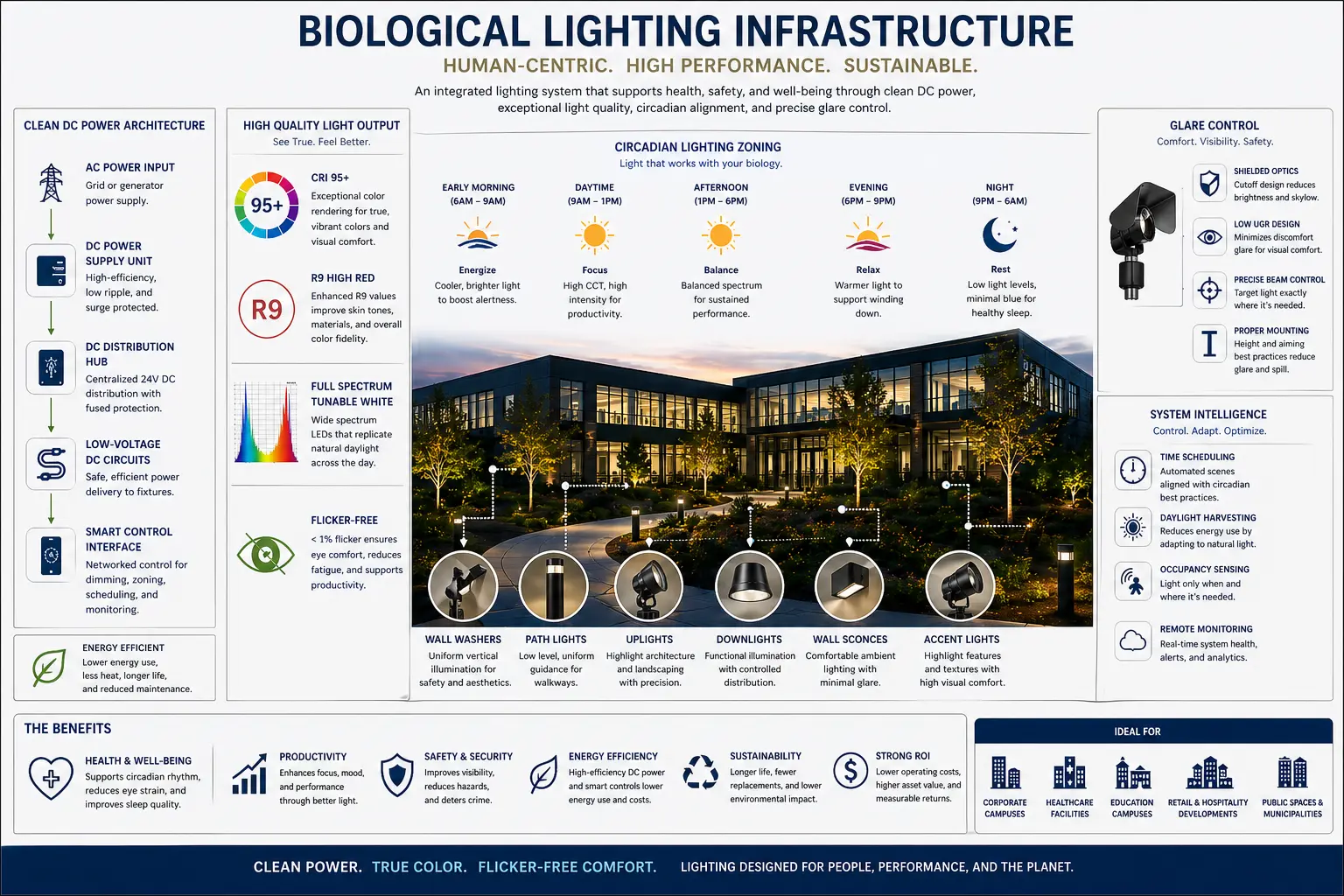
Quick Answer: What Is Biological Lighting Infrastructure?
Biological lighting infrastructure is the electrical and optical foundation needed to make lighting comfortable for humans: clean DC power, low-flicker drivers, full-spectrum emitters, strong red rendering, indirect glare control, correct dimming, and zoning that supports bright mornings and calm evenings.
The key point is that a smart app cannot fix a bad driver, a blue-spike LED, unstable voltage, glare from exposed diodes, or wire runs that cause cycling and humming. Biological lighting begins at the infrastructure level.
Biological Lighting Infrastructure Logic Summary
| System Layer | Why It Matters | Best Practice |
|---|---|---|
| Power Quality | Unstable drivers can create flicker, buzzing, and visual fatigue. | Use high-quality LED drivers or DC power where appropriate. |
| Spectrum | Low-quality LEDs can miss red wavelengths and make spaces feel flat. | Choose CRI 95+ with strong R9 red rendering. |
| Flicker Control | Invisible strobing can cause discomfort even when the room looks normal. | Use low-flicker or flicker-free drivers. |
| Circadian Zoning | Morning, daytime, evening, and night lighting should not feel the same. | Use brighter cooler light earlier and warmer dimmer light at night. |
Most lighting conversations stop at the bulb. Biological lighting goes deeper. It asks whether the power is stable, whether the LED driver is clean, whether the spectrum has enough red content, whether the dimmer creates flicker, whether the wire run is causing voltage drop, and whether the room is zoned for the right time of day.
This is why I felt this area of lighting is a great resrouce for my site visitors: the same transformer, voltage-drop, LED-driver, and low-voltage troubleshooting principles that affect outdoor systems also affect human-centered indoor and architectural lighting.
For a deeper comparison of color accuracy, visual fatigue, and productivity impact, see CRI 95 vs CRI 80 and the productivity cost of poor color rendering.
If you have older Portfolio fixtures already installed, you may not need to replace the entire system. My Portfolio human-centric lighting retrofit guide shows how legacy housings can be rebuilt around circadian spectrum control, low-flicker drivers, amber/red night channels, and stable low-voltage power.
Infrastructure vs. Interface: Smart Bulbs Are Not the Same as Biological Lighting
| Infrastructure Element | Consumer “Smart” Bulbs | Biological Grade Upgrade | Why It Matters |
|---|---|---|---|
| Power Source | AC 120V at the bulb with internal conversion | Stable 12V / 24V DC or high-quality driver-controlled output | Stable power reduces flicker, cycling, audible noise, and dimming instability. |
| Flicker Rate | Can have high invisible pulse from cheap drivers | Zero or ultra-low modulation with quality drivers | Lower flicker can reduce visual discomfort for sensitive users. |
| Spectral Integrity | Blue-spike white with weak saturated red | CRI 95+ with R9 above 80 and smoother spectrum | Better spectrum improves comfort, skin tone, wood tones, and evening warmth. |
| Dimming Curve | Choppy steps, color shifts, or flicker at low dim levels | Linear analog-style dimming or high-quality PWM beyond sensitive ranges | Biological lighting needs smooth changes, not harsh brightness jumps. |
| Zoning | One lamp changed by app scene | Morning, task, evening, pathway, and sleep-prep zones | Circadian support depends on where, when, and how light reaches the eye. |
| Glare Control | Exposed diode-to-eye contact | Indirect grazing, shielding, diffusers, and low-glare placement | Even excellent spectrum can feel harsh if the diode is directly visible. |
Case Study: Recognizing The "Industrial Trap"
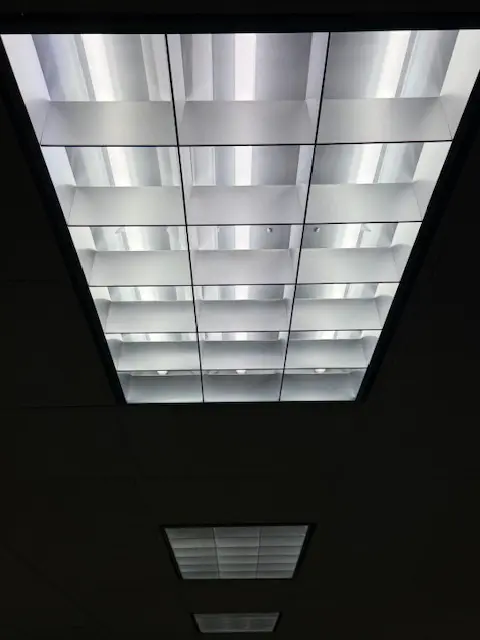
High-Glare, Low-Health Design
The fixture shown here (standard parabolic louver) is designed for raw lumen output, not human biology. These systems create hot spots and harsh glare that trigger the body's stress response.
I've found this lighting to be common in many office settings (including mine). It's simply a classic example of basic commercial fixtures and where biological wellness lighting can help with your lighting needs.
- Spectral Gap: Missing the red (R9) wavelengths.
- Ballast Flicker: High-frequency strobe effect.
- Inflexible Output: Cannot adjust for circadian cycles.
The Three Pillars of Biological Lighting Infrastructure
A biological-grade system is not defined by one bulb claim. It is a combination of spectral quality, flicker control, circadian zoning, and stable wiring.
1. Spectral Quality
Look beyond generic CRI. Strong R9 saturated red and smooth spectrum are essential for warm, realistic, relaxing light.
For windowless rooms, basements are one of the clearest examples of why biological lighting infrastructure matters. The biophilic basement lighting guide explains how tunable white LEDs, virtual skylights, wall-washing, and timed daylight scenes can replace missing natural daylight cues.
2. Flicker Control
Cheap drivers and bad dimmers can pulse LEDs invisibly. Better transformers and drivers reduce modulation and eye strain triggers.
3. Circadian Zoning
Use bright melanopic-rich light in the morning and low-stimulus, warm, indirect light at night.
If you want to understand why dimming quality matters as much as color temperature, read my guide on voltage stability and melatonin. It explains how unstable LED drivers, flicker, and poor dimming can work against evening sleep signals.
4. Wiring Stability
Use correct wire gauge and transformer sizing so voltage drop does not cause LED cycling, flicker, or humming.
Biological Lighting Depends on Direction, Shielding, and Spectrum
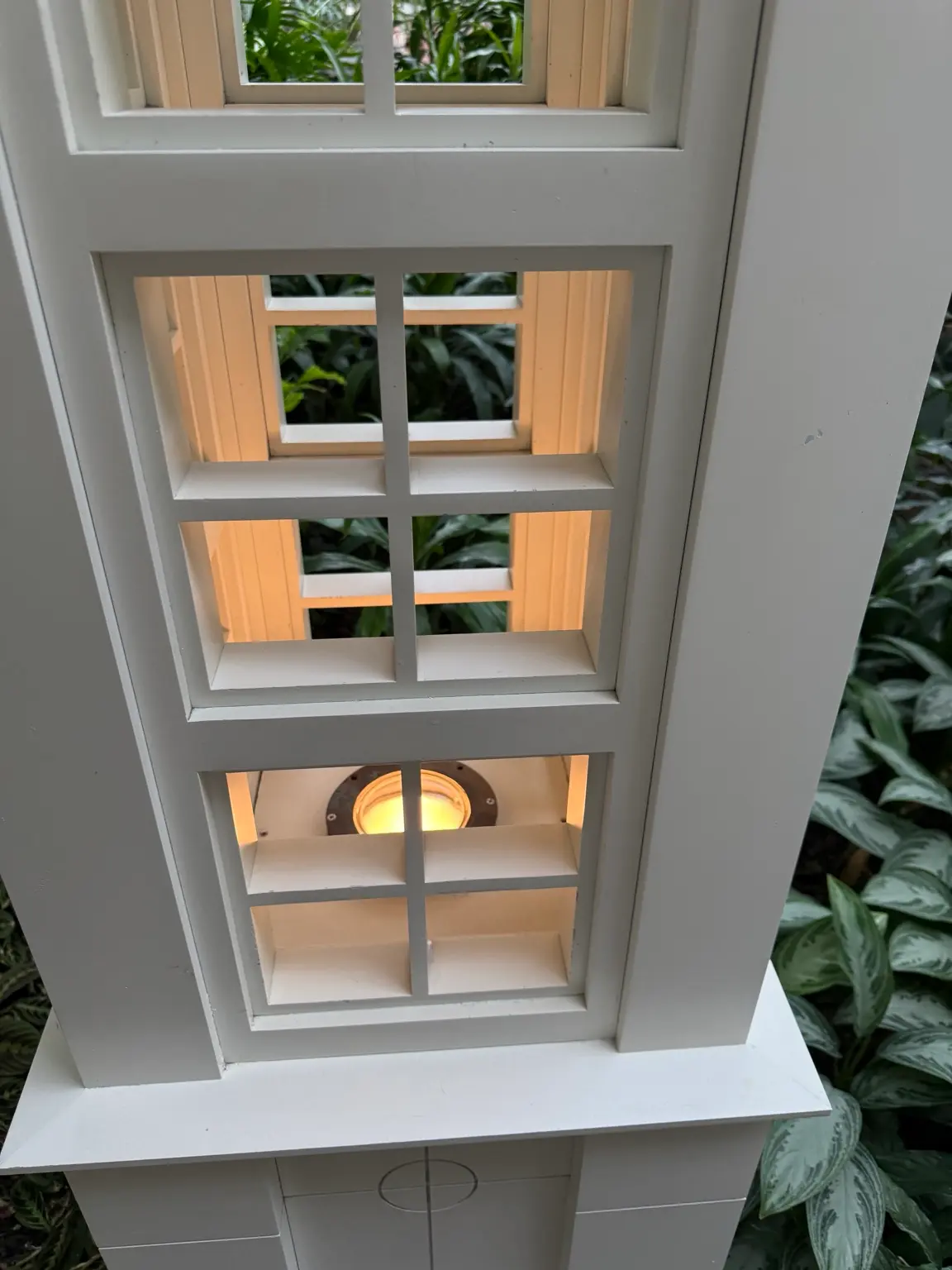
This is a good example of why biological lighting has to be treated as a system. The light is warm, partially shielded, and placed inside an architectural feature instead of shining directly into the eyes. That reduces harshness and helps the space feel calmer after dark.
For outdoor biological lighting, the best results usually come from using warmer spectrum, lower brightness, controlled beam direction, and fixture designs that hide the light source from direct view.
Spectral Power Distribution: The R9 Factor Most Bulb Labels Hide
Many buyers look for a high CRI number and stop there. The problem is that CRI can be misleading because it does not always tell you whether the light has strong saturated red rendering. That red value is called R9.
The technical truth
Some LEDs achieve a decent-looking CRI score while still having weak red output. That is why a room can technically have “high CRI” bulbs but still make skin, wood, food, fabrics, and warm paint colors look flat or lifeless.
The biological impact
Evening light should feel warm, calm, and natural. Without enough long-wavelength red energy, white light can feel thin, blue-heavy, or visually harsh. Strong R9 helps the environment feel more like warm firelight, sunset, or incandescent glow.
If you are evaluating LEDs that flicker or look wrong, also read Portfolio LED lights flickering.
Biological lighting design is closely tied to energy efficiency and sustainable nighttime infrastructure. The landscape lighting carbon footprint guide explores how over-lighting, excessive runtime, and inefficient fixture selection affect both environmental sustainability and responsible nighttime lighting practices.
Spectrum Comparison: Sunlight vs Standard LEDs vs Biological LEDs
| Light Source | R9 Red Value | Flicker Index | Biological Signal |
|---|---|---|---|
| Natural Sunlight | 100 | 0.0 / none | Maximum alertness and natural circadian sync |
| Standard “Smart” Bulb | 0–20 | 0.1–0.5 | Thin light, possible glare, flicker, and poor red rendering |
| Biological Grade LED | 80+ | < 0.05 | Warmer color quality, better skin tones, and lower visual stress |
Flicker is only one part of visual comfort. Color quality matters too, so compare CRI 95 vs CRI 80 lighting to understand how poor color rendering can increase eye strain and cognitive load.
The Physics of Flicker: The Transformer and Driver Connection
Flicker is not always visible. Cheap LED drivers can convert AC power into pulsed LED output. Some people never notice it. Others experience eye strain, headaches, discomfort, or migraine triggers under low-quality drivers or incompatible dimmers.
Standard AC power cycles 60 times per second in the United States. A good LED driver smooths and regulates that power. A cheap driver can pass ripple into the LED output, creating a strobe-like pulse that may not be obvious until you move your eyes, record video, dim the bulb, or sit under the light for a long time.
The specialist fix
Better biological infrastructure uses high-quality constant-voltage or constant-current drivers, clean transformer output, compatible dimming, and wiring that avoids voltage instability. This is the same logic used in high-quality low-voltage systems: power quality at the source determines performance at the fixture.
For related transformer issues, see Portfolio Lighting transformer troubleshooting and replacement terminal blocks and transformer lugs.
Circadian Stimulus vs. Lux: Why Brightness Alone Is Not Enough
Lux measures how bright light appears for visual tasks. Biological response is different. The eye also contains ipRGC cells that respond strongly to certain wavelengths and help regulate circadian timing. That is where melanopic lux and circadian stimulus become important.
The plain-English concept
Morning light should tell the body, “It is daytime.” Evening light should not keep shouting that same message. That means a good system needs strong daytime zones and calm nighttime zones instead of one generic brightness slider.
For a real-world application of circadian-safe lighting, see our guide on how to build a 0% blue light nursery setup that actually works at night .
Modern landscape lighting is no longer just about curb appeal or security. Our detailed guide on how outdoor lighting affects sleep, circadian rhythm, glare sensitivity, and nighttime wellness explains why excessive blue-rich lighting can impact melatonin production, visual comfort, and long-term nighttime usability. It also covers practical strategies like warmer Kelvin targets, low-angle path lighting, and automation schedules that support healthier evening environments without sacrificing visibility.
Infrastructure tip: solve it with zoning
- Morning zone: brighter, higher melanopic stimulation for kitchens, offices, bathrooms, and task areas.
- Daytime task zone: neutral, high-CRI task lighting where color accuracy matters.
- Evening zone: warm, indirect, low-glare, low-melanopic light for living rooms and bedrooms.
- Night path zone: low-level amber or warm pathway lighting that supports movement without blasting the eyes.
For automation and zoning logic, see AI outdoor lighting systems and AI automated landscape lighting.
To successfully automate these circadian transitions, your system requires a unified communication protocol. See our technical guide on Matter and Thread connectivity to understand how these low-latency standards ensure your biological lighting zones stay synchronized without taxing your home network bandwidth.
Wiring Gauge, Voltage Drop and LED Cycling
Biological lighting can fail at the wire level. If wire is undersized or the run is too long, voltage drop can cause LEDs to dim unevenly, shimmer, cycle, or hum. This is especially important in low-voltage systems using 12V or 24V DC.
Why heavier wire helps
A heavier cable, such as 12/2 or 10/2 in the right application, reduces resistance over long runs. Lower resistance means the driver and emitters receive steadier voltage, which improves dimming stability and reduces cycling.
Use the landscape lighting voltage drop calculator and landscape lighting voltage drop guide to understand the same electrical principle in low-voltage outdoor systems.
Shielding and Glare: No Direct Diode-to-Eye Contact
A biologically comfortable system is not only about spectrum and flicker. It also needs glare control. Direct exposed diodes can feel harsh even when the LED has high CRI and low flicker.
Better placement strategies
- Indirect grazing: aim light at walls, ceilings, shelves, or architectural surfaces.
- Shielded fixtures: hide the light source and let the surface glow.
- Diffusers: soften pixel-like LED points.
- Low-level path lighting: guide movement without blasting the eyes at night.
- Task-only brightness: put high intensity where work happens, not across the whole room.
For responsible outdoor direction and glare reduction, see dark sky compliance guide and fix light trespass.
Engineering for Impact: Standards & Measured Outcomes
To move beyond subjective "wellness," we utilize the WELL Building Standard v2 and IES (Illuminating Engineering Society) RP-43-22 metrics to validate lighting performance.
WELL Standard v2: L03 & L04
We target the Circadian Lighting Design feature, which requires at least 150 Equivalent Melanopic Lux (EML) at the eye for at least 4 hours a day to maintain peak alertness.
IES TM-30-18 Fidelity
Moving past CRI, we measure the Rf (Fidelity Index) and Rg (Gamut Index). A biological system requires an Rf > 90 and Rg near 100 to ensure natural color saturation.
Case Study Outcome: Infrastructure Retrofit
Measured results from a 2025 residential office retrofit switching from standard 120V LED bulbs to a 12V DC Constant-Voltage Infrastructure.
| Metric | Baseline (Standard Bulb) | Post-Upgrade (Biological Grade) | Biological Impact |
|---|---|---|---|
| Flicker Index | 0.12 (High modulation) | < 0.01 (Near Zero) | Eliminated invisible strobe-trigger for migraines. |
| R9 (Saturated Red) | 12 (Gray/Dull) | 88 (Vibrant/Natural) | Restored long-wavelength support for evening rest. |
| Melanopic Ratio | 0.45 (Low stimulus) | 0.92 (High stimulus) | 100% increase in morning cortisol suppression. |
The Biological Lighting Infrastructure Checklist
Use this checklist when auditing a home, office, studio, bedroom, or high-performance lighting system.
- Verify transformer output: Is the system providing clean DC or dirty, unstable output?
- Check the R9 value: Do not buy bulbs or strips that refuse to list R9.
- Check CRI: For biological-grade spaces, target CRI 95+ where possible.
- Audit flicker: Test dimmed levels, phone camera banding, and user comfort under the light.
- Confirm dimmer compatibility: Bad dimming can introduce flicker even with a good LED.
- Control glare: Avoid direct diode-to-eye contact; use shielding and indirect light.
- Use proper wire gauge: Consider 12/2 or 10/2 where voltage drop could destabilize low-voltage runs.
- Create zones: Morning stimulation, task clarity, evening calm, and night navigation should be separate.
- Inspect connectors: Loose terminals and poor splices can create flicker, heat, or intermittent cycling.
How to Build a Biological Lighting System Without Rewiring the Whole House
You do not need to rebuild everything at once. Start with the spaces where lighting affects comfort the most: bedroom, bathroom, kitchen, home office, and evening living areas.
- Start with evening spaces: replace harsh blue-white lamps with high-CRI, warm, low-flicker lighting.
- Fix the driver problem: avoid bargain LED strips and drivers that shimmer or buzz when dimmed.
- Add indirect light: wall washing and cove lighting often feel better than exposed downlights.
- Separate zones: task light and relaxation light should not be the same switch.
- Audit wiring and voltage: check long low-voltage runs for drop, flicker, and cycling.
- Add smart control last: automation should control good infrastructure, not hide bad infrastructure.
While maintaining indoor spectral integrity is vital, extending these principles to your exterior environment is the next step in a complete wellness design. Explore our deep dive into circadian outdoor lighting to learn how to synchronize your landscape's color temperature and intensity with your home’s internal biological zones.
For general layout and fixture planning, see the lighting guide.
Related Lighting Infrastructure Resources
LED Flicker Help
Diagnose flicker, shimmer, dimmer problems, driver instability, and LED discomfort.
Open flicker guideVoltage Drop Calculator
Understand how wire gauge and run length affect low-voltage lighting stability.
Open calculatorTransformer Troubleshooting
Use transformer logic to understand hum, overload, terminal heat, and unstable output.
Open transformer guideAI Outdoor Lighting
Use automation and zoning after the underlying lighting infrastructure is stable.
Open AI lighting guideBiological Lighting Infrastructure FAQ
What is biological lighting infrastructure?
Biological lighting infrastructure is the foundation behind human-friendly lighting: clean power, low-flicker drivers, high-quality emitters, strong R9 red rendering, smooth dimming, proper wire gauge, glare control, and circadian zoning.
Is biological lighting the same as smart lighting?
No. Smart lighting controls schedules, colors, and scenes. Biological lighting starts with the physics: driver quality, flicker control, spectrum, glare, voltage stability, and where the light reaches the eye.
Why does R9 matter?
R9 measures saturated red rendering. Without strong R9, skin, wood, food, and warm interiors can look flat or lifeless even when the bulb claims a high CRI score.
Can flicker-free lighting help migraine-sensitive people?
Some people are sensitive to LED flicker, especially from cheap drivers or incompatible dimmers. Low-flicker lighting can improve comfort, but medical concerns should be discussed with a qualified health professional.
What is the best first upgrade?
Start with the room used at night. Choose warm, high-CRI, strong-R9, low-flicker lighting and use indirect placement so the diode is not directly in your eyes.
The Infrastructure Principle
As a lighting specialist who has spent years diagnosing transformer failures, voltage drop, LED flicker, terminal overheating, and circuit overloads, I have seen firsthand how infrastructure dictates performance. Biological lighting is not a trend. It is a return to stable, high-quality electrical engineering.
Health and Electrical Disclaimer
This guide is educational and does not provide medical advice. Light sensitivity, migraines, sleep disruption, and visual discomfort should be discussed with qualified health professionals when symptoms are significant. Electrical work, transformers, drivers, and low-voltage systems should be installed according to manufacturer instructions, local code, and qualified professional guidance when needed.