
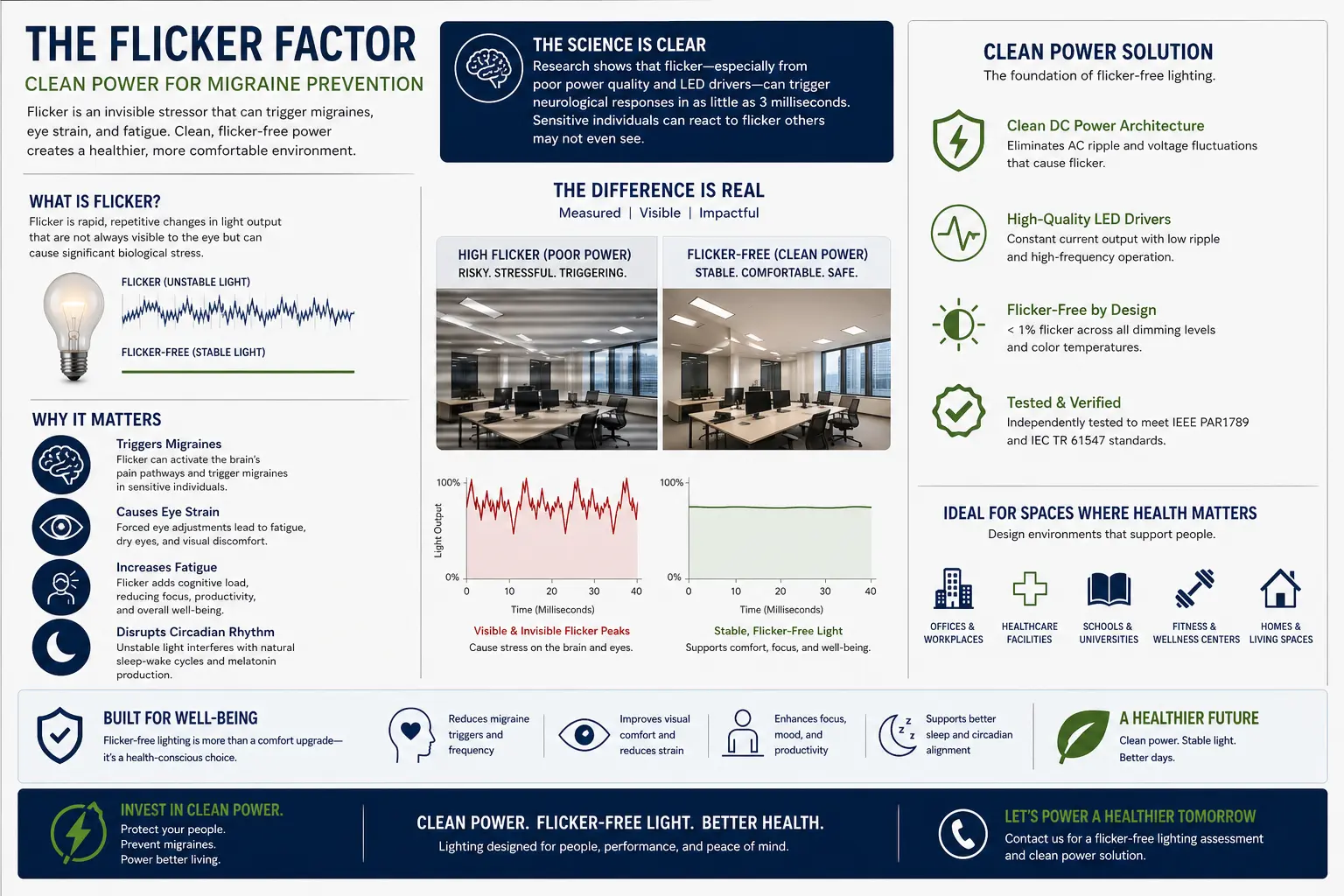
Quick Answer: What Is the Flicker Factor?
The Flicker Factor is the hidden instability in a lighting system that makes an LED pulse instead of producing a smooth, steady output. The source is usually poor AC-to-DC conversion, cheap drivers, incompatible dimmers, undersized wiring, or unstable low-voltage power.
For migraine-sensitive users, the problem is that the light may look steady to the eye but still behave like a fast strobe. That invisible modulation can create a “heavy eye” feeling, visual fatigue, discomfort, and in some cases become one of several migraine triggers.
Migraine-Safe Lighting Logic Summary
| Trigger | What Causes It | Best Engineering Fix |
|---|---|---|
| Visible flicker | Poor LED driver, cheap dimmer, unstable power supply | Use low-flicker bulbs, compatible dimmers, or a quality remote DC driver |
| Ghosting / phantom array | Light output changes during quick eye movement | Choose drivers with very low ripple and stable current regulation |
| Eye strain after 20–30 minutes | High modulation depth or failing driver capacitor | Replace weak drivers and avoid enclosed heat-stressed fixtures |
| Harsh visual fatigue | Glare, poor spectrum, low CRI, weak R9 red rendering | Use shielded, high-CRI lighting with better spectrum quality |
Clean lighting is not only about color temperature. A warm 2700K bulb can still flicker badly. A smart bulb can still pulse. A dimmer can make a good LED worse. A driver can convert household power into a harsh ripple instead of a stable DC signal.
I built this page after studying biological lighting infrastructure in early 2026 because migraine-safe lighting is an engineering problem before it is a design trend and I couldn't find much information online. Sitting in my office with lights flickering has many times got me thinking about this area of lighting study.
Flicker is not just a migraine issue; it also affects how comfortable light feels at night. I explain that connection in voltage stability and melatonin, where I connect LED dimming quality to evening relaxation and sleep readiness.
How to Test for Flicker (Using Your Phone. I used an iPhone 17 in my review for the page)
- Open your smartphone camera
- Point it at the light source
- Look for:
- Rolling bands
- Strobing lines
- Brightness pulsing
If you see movement or banding, your lighting has flicker—even if your eyes can’t detect it directly.
Flicker control becomes even more important when modifying older fixtures. The Portfolio human-centric lighting retrofit guide shows how driver choice, dimming method, and voltage stability affect whether a retrofit is actually comfortable or just visually warm.
One of the most common sources of LED flicker is a mismatch between the dimmer and the fixture driver. The LED flicker and dimmer compatibility guide explains what to check when lights shimmer, buzz, or pulse at low brightness.
The Smartphone Audit: Find the Invisible Strobe in 60 Seconds
The smartphone slow-motion test is the easiest way for a homeowner to identify suspicious LED flicker. It is not a laboratory meter, but it is a strong field test for obvious pulsing, rolling bands, and dimmer-related instability.
How to run the 240 FPS slow-motion test
- Open your smartphone camera.
- Switch to 240 FPS Slo-Mo if your phone supports it.
- Point the camera directly at the light source.
- Record 5 to 10 seconds at full brightness.
- Dim the light to 50% and record again.
- Dim the light to the lowest usable level and record again.
- Watch for rolling black bars, heavy pulsing, shimmer, or brightness waves.
Why the test works
The camera samples light over time. When the LED output is rising and falling quickly, the camera can catch those changes as bands or pulses. A high-quality biological lighting system should remain visually stable even when filmed in slow motion.
The Neurology of Light: Why 60Hz Is Not Enough
Human vision may not consciously perceive all high-speed flicker, but the visual system can still respond to modulation. For sensitive users, invisible flicker can feel like pressure behind the eyes, fatigue, sensory overload, or a room that feels “wrong” even when brightness seems normal.
The technical issue is that many LEDs are not glowing from a perfectly flat power signal. Cheap drivers convert AC power into LED output with ripple. That ripple can create a rapid on-off or bright-dim pattern that acts like an invisible strobe.
Why 120Hz flicker is common
In the United States, household AC power is 60Hz. Many simple LED driver circuits produce flicker at 120Hz because the light output follows the rectified AC waveform. That is technically faster than visible flicker for many people, but it can still be uncomfortable.
True biological infrastructure tries to flatten that waveform into stable DC output before the light reaches your eyes.
The Driver Failure Point: Electrolytic Capacitors
In many LED drivers, the smoothing stage is handled by an electrolytic capacitor. This component helps flatten the ripple left behind after AC power is converted into DC power.
Over time, heat can cause the capacitor to dry out, weaken, or bulge, especially inside enclosed fixtures with poor ventilation. As the capacitor degrades, it becomes less effective at smoothing electrical ripple, and a bulb that once felt comfortable can become a flicker trigger.
Visualizing the Pulse: Dirty AC vs. Clean DC
The easiest way to understand flicker is to picture what the electrical waveform is doing before it reaches the LED.
| Power Type | Waveform Shape | Lighting Result |
|---|---|---|
| 120V AC | A smooth sine wave that switches direction repeatedly | Needs conversion before it can safely power LEDs |
| Rectified DC | A bouncing ripple pattern that moves in one direction but varies heavily | Can create visible or invisible LED flicker if not smoothed |
| Migraine-Safe DC | A stable flat line with very low ripple | Cleaner output, less strobing, and lower visual strain |
Flicker vs. Stroboscopic Effect vs. Phantom Array
To engineer a migraine-safer room, you need to separate three different light-instability problems that are often grouped together as “flicker.”
Flicker issues become even more critical in sensitive environments like nurseries. See how flicker, blue light, and driver instability affect nighttime infant care .
- Temporal Light Artifact: The actual change in light output over time, usually caused by driver ripple, dimmer incompatibility, or unstable current regulation.
- Stroboscopic Effect: Moving objects appear to have a stop-motion or ghosting trail. This can be noticeable during kitchen tasks, exercise, hand tools, or fast movement.
- Phantom Array: A trail of light appears when the eyes move quickly. Even if a light looks steady when stared at directly, the phantom array effect can increase visual processing strain.
Flicker Metrics: What to Look For
| Metric | Standard LED Bulb | Migraine-Safe Infrastructure | Why It Matters |
|---|---|---|---|
| Modulation Depth | 30% to 100% on poor drivers or bad dimmer combinations | Target below 3% where possible | Lower modulation means the light output changes less dramatically over time. |
| Flicker Frequency | Often 120Hz, double the 60Hz line frequency | Above 2,000Hz or pure DC when possible | Higher frequency and lower depth are generally less noticeable and less irritating. |
| Waveform | Sawtooth, square-wave, or rough ripple | Flat line or smooth linear output | A harsh waveform can feel visually aggressive even when average brightness is acceptable. |
| Flicker Index | Often unlabeled or untested | Target below 0.01 for sensitive spaces where possible | Flicker index describes how much light output varies over the waveform. |
| Dimming Behavior | Flicker increases at low dim levels | Smooth dimming with compatible 0-10V, ELV, or quality DC control | A light can pass at full brightness and fail badly when dimmed. |
My Research Solution: Pure DC Infrastructure
The root cause of flicker is often the bridge rectifier or driver circuit in cheap bulbs failing to smooth out the AC current. For a more stable, migraine-friendly environment, move the conversion away from bargain bulbs and into higher-quality infrastructure.
What clean DC infrastructure does better
- reduces high-ripple output from cheap lamp-level drivers;
- supports smoother dimming when paired with the correct control method;
- allows centralized driver selection instead of relying on unknown internal bulb electronics;
- helps prevent low-voltage LED cycling caused by unstable output;
- makes troubleshooting easier because power quality is controlled at the source.
For transformer-based troubleshooting logic, see Portfolio Lighting transformer troubleshooting and terminal blocks and transformer lugs.
The Physics of the Ripple: AC, Rectifiers, and LED Drivers
LEDs are direct-current devices. Your house supplies alternating current. Somewhere in the system, AC has to be converted into DC. In cheap LED bulbs, that conversion is often squeezed into a tiny driver circuit inside the bulb base.
Where the problem starts
- AC input: household current reverses direction 60 times per second.
- Bridge rectifier: converts AC into pulsing DC.
- Capacitor or smoothing stage: should flatten the ripple.
- Cheap driver: may leave too much ripple in the LED output.
- LED emitter: follows that unstable waveform as visible or invisible flicker.
Dimmer Problems: Why Triac Dimmers Can Make Flicker Worse
Many standard wall dimmers were designed around incandescent bulbs. They work by chopping the electrical waveform. That can be fine for old filament lamps, but LEDs and drivers may respond badly to a chopped waveform.
Common dimmer-related symptoms
- flicker only when dimmed;
- strobe-like pulsing at low levels;
- buzzing from the fixture, bulb, or driver;
- light that jumps in steps instead of dimming smoothly;
- LEDs that never fully turn off or glow faintly.
If you are troubleshooting flicker in existing LED fixtures, read Portfolio LED lights flickering.
For automation and healthier scheduling, review AI outdoor lighting systems and how control logic can support better lighting routines.
The Migraine-Safe Lighting Audit
Use this checklist for offices, bedrooms, bathrooms, kitchens, reading chairs, therapy spaces, work benches, and any room where light discomfort becomes noticeable.
- Perform the Slo-Mo Test: Use 240 FPS video to identify pulsing fixtures and compare full brightness vs dimmed levels.
- Eliminate Triac Dimmers: Standard wall dimmers can chop the electrical wave and increase LED flicker. Switch to compatible ELV, 0-10V, or DC dimming where appropriate.
- Switch to 12V or 24V DC: Retrofit critical areas such as offices and bedrooms with low-voltage DC infrastructure where feasible.
- Target 2200K to 2700K: Lower color temperatures reduce the blue-heavy trigger associated with photophobia for many sensitive users.
- Reduce direct glare: Use indirect wall grazing, shaded lamps, diffusers, and shielded fixtures so the LED diode is not visible to the eye.
- Check R9 and CRI: Use the biological lighting infrastructure guide to evaluate spectrum quality.
- Inspect wiring stability: Long low-voltage runs may need heavier wire to reduce voltage drop and LED cycling.
- Separate zones: Keep task lighting, evening lighting, and night navigation lighting on different controls.
Best Rooms to Fix First
You do not need to rebuild the whole house at once. Start where the nervous system spends the most time under artificial light.
Flicker is especially noticeable in basements because there is often no natural daylight to soften the room. The biophilic basement lighting guide explains why flicker-free drivers, smooth dimming, and scheduled daylight scenes matter in windowless living spaces.
Home Office
Prioritize low-flicker task lighting, indirect ambient light, and driver-compatible dimming. Avoid harsh overhead-only lighting.
Bedroom
Use 2200K to 2700K warm lighting, low glare, low brightness, and separate reading lamps from sleep-prep lighting.
Bathroom
Bright mirror lighting can be a migraine trigger if it flickers or shines directly into the eye. Test vanity LEDs carefully.
Kitchen
Under-cabinet LEDs often flicker from cheap drivers. Use quality strips, proper drivers, and diffuser channels.
Wire Gauge and Voltage Drop: The Hidden Flicker Trigger
Flicker is not always inside the bulb. Long low-voltage wire runs can drop voltage enough to make LED strips, modules, or drivers behave unpredictably. That can show up as cycling, shimmer, dimming mismatch, or humming.
Heavy-gauge wire such as 12/2 or 10/2 may be needed in long low-voltage runs because it reduces resistance. Lower resistance helps the driver and LED receive steadier voltage.
Use the landscape lighting voltage drop calculator and landscape lighting voltage drop guide to understand the same electrical behavior in outdoor low-voltage systems.
Related Clean Power and Biological Lighting Resources
Biological Lighting Infrastructure
Start with the parent guide for CRI, R9, circadian zones, glare control, and infrastructure-level lighting quality.
Open parent guideLED Flicker Troubleshooting
Diagnose flicker, shimmer, dimming issues, and unstable LED behavior.
Open flicker guideTransformer Troubleshooting
Use transformer logic to understand power quality, hum, overload, and unstable output.
Open transformer guideVoltage Drop Calculator
Check whether wire gauge or run length is causing unstable low-voltage lighting behavior.
Open calculatorFor a deeper understanding of safe lighting system design, see our landscape lighting electrical code and safety guide, which explains how stable power delivery impacts both safety and performance.
If you're troubleshooting unstable lighting systems, our Portfolio Lighting troubleshooting guide walks through common transformer, wiring, and driver issues that often cause flicker.
For seasonal setups where flicker is common, review our holiday lighting guide and Christmas lights troubleshooting page to eliminate power instability problems.
Fix vs Replace: What Actually Works
| Problem | Fix | Best Option |
|---|---|---|
| Cheap LED bulbs flicker | Replace driver | High-quality flicker-free LED |
| Transformer instability | Upgrade transformer | Constant voltage DC system |
| Dimming flicker | Change dimmer/driver | Flicker-safe dimming system |
The Flicker Factor FAQ
What is the Flicker Factor?
The Flicker Factor is the rapid visible or invisible modulation of light output caused by poor drivers, AC ripple, incompatible dimmers, weak smoothing, or unstable low-voltage power.
Can LED flicker trigger migraines?
Some migraine-sensitive people report discomfort under flickering, pulsing, high-glare, or harsh blue-heavy lights. Flicker is not the only migraine factor, but reducing it can be an important comfort upgrade.
How do I test LED flicker with a phone?
Open your phone camera, switch to 240 FPS slow-motion video, point it at the light, and look for rolling black bars, heavy pulsing, or unstable brightness. Repeat the test at different dimming levels.
What is a good flicker index for sensitive spaces?
For sensitive spaces, target a Flicker Index below 0.01 where possible, low modulation depth, compatible dimming, and stable DC output.
Are smart bulbs automatically migraine-safe?
No. A smart bulb can still use a poor internal driver, flicker when dimmed, have a harsh spectrum, or produce glare. Smart control is not the same as clean lighting infrastructure.
The Engineering Principle
Migraine-safe lighting starts at the source. If the driver pulses, the dimmer chops, the transformer hums, or the wire run drops voltage, the room can feel uncomfortable even when the bulb label looks impressive. Clean power is the foundation.
Health and Electrical Disclaimer
This page is educational and does not provide medical advice. Migraines, photophobia, visual discomfort, and neurological symptoms should be discussed with qualified health professionals. Electrical work, drivers, transformers, dimmers, and low-voltage systems should be installed according to manufacturer instructions, local code, and qualified professional guidance when needed.