
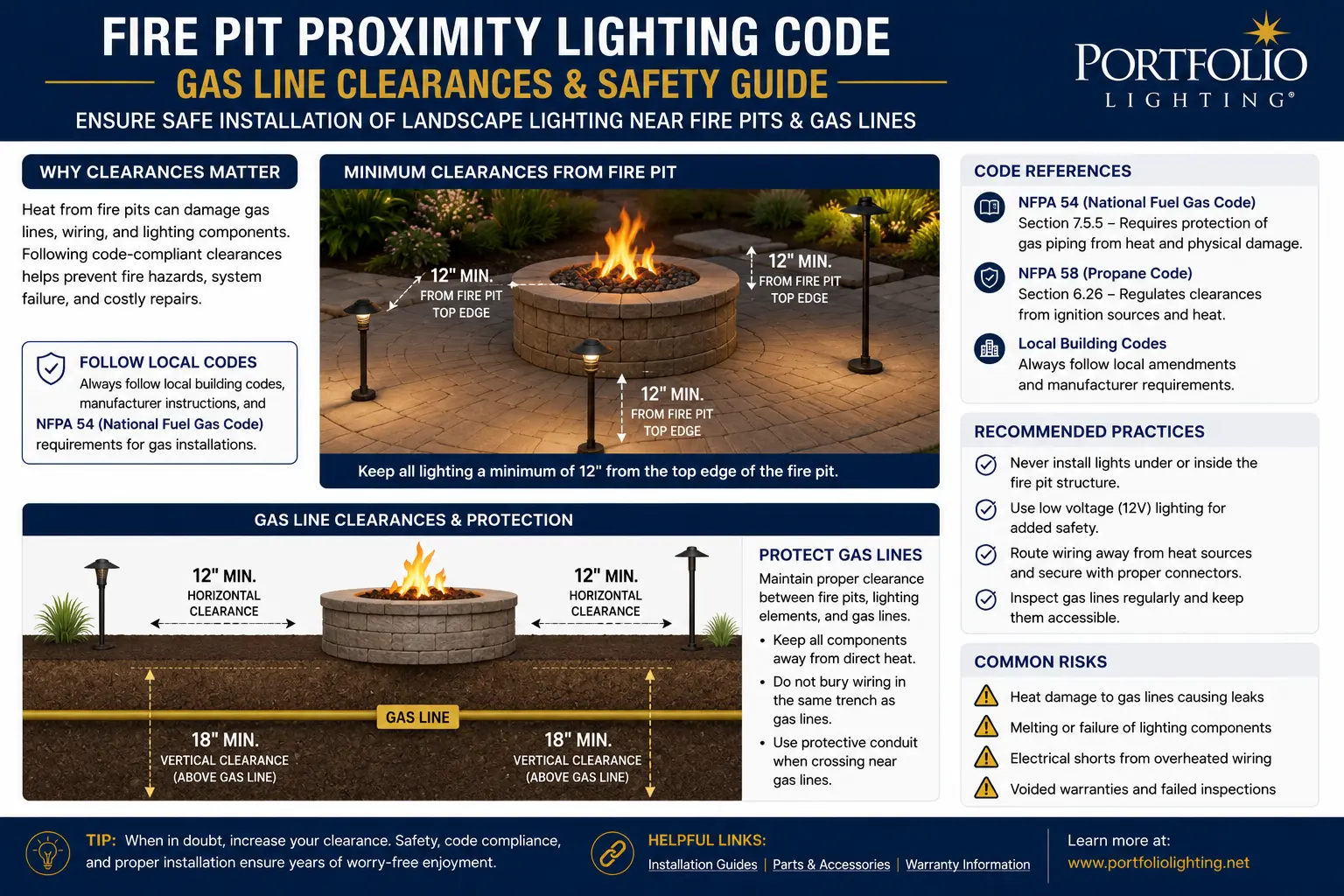
The Five Regulatory Frameworks: Why This Is More Complex Than Any Single Code
A gas fire pit with surrounding landscape lighting sits at the intersection of electrical code, fuel gas code, and product safety standards — each from a different standards body, with a different enforcement mechanism, and applying to a different aspect of the installation. The complete compliance picture requires understanding all five simultaneously.
Outdoor entertainment spaces often combine lighting, cooking equipment, and utility services within a limited footprint. Maintaining safe working clearances around electrical equipment is just as important as observing gas-line separation distances. The outdoor kitchen lighting clearance guide based on NEC 210 principles explains how transformers, disconnects, receptacles, and service equipment should remain accessible without compromising safety, maintenance access, or future inspections.
NEC Article 411: Low-Voltage Lighting Near Open Flame — What Applies
NEC Article 411 is the primary governing article for residential 12V landscape lighting systems. While its most-cited proximity rules reference water features, its listing requirements and general provisions create several obligations that apply when landscape lighting is installed near a gas fire pit.
The Article 411 Water Proximity Rule — And How Fire Pits Relate
NEC Article 411.5(B) requires that low-voltage lighting systems be installed at least 10 feet from the nearest edge of water (pools, spas, fountains) unless permitted by NEC Article 680. This is the pool proximity rule discussed in detail in the swimming pool lighting clearance guide. For gas fire pits that are not near a pool, this specific provision does not create a direct clearance requirement from the fire pit itself.
However, Article 411's listing requirements create indirect constraints. NEC 411.3 requires low-voltage landscape lighting systems to be listed (under UL 1838 or equivalent). NEC 110.3(B) requires listed equipment to be installed per the listing's instructions. Virtually every landscape lighting transformer's installation instructions specify minimum distances from heat sources, open flames, and combustible materials. These instructions are mandatory — they become legally binding code requirements through the 110.3(B) chain. A landscape lighting transformer mounted 12 inches from the rim of a gas fire pit bowl, in range of direct heat and radiant flame, may violate the transformer's listing instructions regardless of whether any specific NEC distance rule cites "fire pit."
The Practical Effect: What Landscape Lighting Components Are Heat-Sensitive
Several landscape lighting system components are vulnerable to the heat environment of a gas fire pit and must be positioned accordingly:
- Transformer: The landscape lighting transformer should be positioned away from the fire pit's primary heat zone. Most listing instructions require installation in a location not subject to temperatures exceeding the transformer's rated ambient (typically 40–50°C). A transformer mounted on a post immediately adjacent to a fire pit with burner output of 100,000+ BTU can easily exceed this. Follow the transformer manufacturer's minimum distance from heat sources in the installation instructions.
- Wiring insulation: Low-voltage landscape cable (UF-rated, typically rated for 60°C or 90°C conductor temperature) must not be routed through the fire pit's immediate heat zone. Direct flame impingement, sustained radiant heat from the fire pit bowl, or contact with a hot fire pit surround structure can damage cable insulation over time, increasing resistance and creating potential fault conditions.
- Fixture components: LED landscape fixtures contain electronic driver circuits with maximum ambient temperature ratings (typically 40–55°C). A path light or spotlight positioned where it receives sustained radiant heat from the fire pit may experience premature LED driver failure even if it never looks damaged externally. Positioning fixtures outside the fire pit's primary radiant heat zone (typically a 3–5 foot radius from the rim for typical residential fire pits) protects driver longevity.
NEC 680.22(B)(7): The 2017 Addition for Low-Voltage Gas-Fired Fire Pits Near Pools
The combination of a gas fire pit and a swimming pool in the same outdoor living space — extremely common in contemporary residential and commercial landscape design — created a compliance gap that persisted until the 2017 NEC addressed it with a new subsection. NEC 680.22(B)(7) is the code provision that directly and specifically addresses this combination.
Why the 2017 Addition Was Necessary
Before the 2017 NEC, gas fire pits near pools existed in a legal gray zone. NEC Article 411 prohibited low-voltage lighting (and its power supplies) from being within 10 feet of water edges. A gas fire pit with an electronic ignition system running on low-voltage power was treated identically to a landscape path light for proximity purposes — subject to the same 10-foot zone from the pool. But unlike a landscape fixture, a fire pit is often intentionally designed as a focal point adjacent to a pool — at 3–4 feet from the water edge in many designs. The gap between practical design reality and the code framework needed to be closed.
"Listed low-voltage gas-fired luminaires, decorative fireplaces, fire pits, and similar equipment using low-voltage ignitors that do not require grounding, and are supplied by listed transformers or power supplies that comply with 680.23(A)(2) with outputs that do not exceed the low-voltage contact limit shall be permitted to be located less than 1.5 m (5 ft) from the inside walls of the pool."
"Metallic equipment shall be bonded in accordance with the requirements in 680.26(B). Transformers or power supplies supplying this type of equipment shall be installed in accordance with the requirements in 680.24. Metallic gas piping shall be bonded in accordance with the requirements in 250.104(B) and 680.26(B)(7)."
The Three Conditions Required — All Simultaneously
Like the landscape luminaire exception in NEC 680.22(B)(6) discussed in the pool lighting clearance guide, the gas fire pit exception in 680.22(B)(7) requires three simultaneous conditions:
- Listed equipment with no grounding requirement: The gas fire pit system must be listed (by an NRTL under ANSI Z21.97 or equivalent) and its low-voltage ignitor system must not require grounding (2-wire, no equipment grounding conductor).
- Low-voltage contact limit: The ignitor and associated electrical supply must not exceed the low-voltage contact limit — 15V AC sinusoidal. Standard 12V landscape lighting power supplies satisfy this condition.
- NEC 680.23(A)(2)-listed pool transformer: The transformer supplying the fire pit's electrical ignition system must be the pool/spa-listed type with grounded metal barrier between windings — NOT a standard UL 1838 landscape lighting transformer. This is the same condition required for landscape luminaires near pools under 680.22(B)(6), detailed extensively in the pool lighting clearance guide.
The Bonding Requirements That Come With 680.22(B)(7)
NEC 680.22(B)(7) imposes specific bonding requirements when the fire pit is within 5 feet of the pool:
- Metallic fire pit equipment: Must be bonded to the pool's equipotential bonding grid per NEC 680.26(B)
- Metallic gas piping associated with the fire pit: Must be bonded per NEC 250.104(B) AND NEC 680.26(B)(7) — a dual bonding requirement that connects the gas piping to both the service grounding electrode system and the pool's equipotential bonding grid
- Transformer or power supply: Must be installed per NEC 680.24 (the pool junction box and transformer installation requirements)
These bonding requirements create a coordination requirement between the pool electrical contractor, the gas contractor, and the landscape lighting installer that is rarely planned for in advance. The gas piping bonding conductor, the pool bonding grid, and the landscape lighting system all share proximity in the area between the fire pit and the pool — and all must be coordinated to avoid interference and ensure each bonding conductor has the correct connection path.
Any gas fire pit installed adjacent to a pool before the 2017 NEC was adopted in the installer's jurisdiction was installed without a compliant code pathway. The pre-2017 NEC contained no exception for fire pits near pools — the 10-foot zone from Article 411 was the only standard and it didn't permit fire pits at the typical 3–5 foot pool-edge distance. Millions of such installations exist in residential backyards. Like the pre-2014 landscape lighting near pools situation documented in the pool lighting clearance guide, they are grandfathered under the code edition at installation but cannot be modified, repermitted, or expanded without meeting current code. Check which NEC edition your jurisdiction has adopted before planning any work involving a fire pit near a pool.
NFPA 54: Underground Gas Piping Separation — Why Landscape Wire Can't Share a Trench
The most practically significant and most commonly violated code provision in landscape lighting near gas fire pits is the NFPA 54 requirement for underground gas piping to maintain adequate separation from other buried utilities — including low-voltage landscape lighting wire runs.
What NFPA 54 Section 7.1.1 Requires
"Underground gas piping shall be installed with sufficient clearance from any other underground structure to avoid contact therewith, to allow maintenance, and to protect against damage from proximity to other structures."
"In addition, underground plastic piping shall be installed with sufficient clearance or shall be insulated from any source of heat so as to prevent the heat from impairing the serviceability of the pipe."
NFPA 54 also requires: underground piping to be installed with a minimum of 12 inches of cover (18 inches where external damage from surface forces is likely), and gas piping to be traceable after burial.
The "Sufficient Clearance" Interpretation — What It Means in Practice
NFPA 54's "sufficient clearance" language is intentionally performance-based rather than prescriptive — it doesn't state "6 inches" or "12 inches." This approach allows flexibility for different soil conditions, pipe materials, and utility configurations. However, several sources provide practical interpretation:
- Gas utility standards: Most US natural gas utilities publish installation standards (which contractors must follow) that specify 6 inches of minimum horizontal separation between gas piping and other utilities — including low-voltage electrical wiring. Some utilities require 12 inches. Utility standards are typically available from the utility company's contractor services department and are legally binding for work in that utility's service territory.
- Mike Holt forums consensus: Published discussion among electrical inspectors and gas contractors on the Mike Holt Enterprises forums identifies 6 inches as the common practical interpretation of "sufficient clearance" between gas lines and other underground utilities based on gas company standard practices.
- Perpendicular crossing: Where a landscape lighting wire run must cross a gas line (perpendicular to it), the crossing should be perpendicular (90 degrees) to minimize the length of overlap and should maintain vertical separation at the crossing point where possible.
A single trench running from the gas meter to the fire pit location, with the gas supply pipe and low-voltage landscape lighting cable laid side by side in the same excavation, is the most common violation in this context.
Problems: (1) Future excavation for either system risks damaging both. (2) Gas line damage creates immediate ignition hazard from any electrical arc in the adjacent landscape wire. (3) Violates NFPA 54's "avoid contact" and "allow maintenance" requirements. (4) Gas utility field inspection will fail this installation. (5) In the event of a gas leak and ignition, insurance claim investigation will identify the trench configuration as a code violation.
Gas supply line in its own trench (minimum 12-inch burial depth, 18 inches where surface loads are expected). Landscape lighting cable in a separate trench with minimum 6-inch burial depth for direct-buried cable or 6 inches for cable in conduit per NEC Table 300.5 Column 5 (low-voltage lighting under 30V).
The two trenches should maintain a minimum of 6 to 12 inches of horizontal separation (check local gas utility standards for the specific requirement in your service territory). Where routes must cross, cross perpendicularly with vertical separation at the crossing. See the wire burial depth code guide for low-voltage landscape lighting burial depth requirements.
The Additional NFPA 54 Concern: Heat Sources Near Plastic Gas Piping
NFPA 54 Section 7.1.1 specifically requires that underground plastic piping (commonly used HDPE or PE gas distribution piping) be installed with sufficient clearance from heat sources to prevent heat from impairing the pipe's serviceability. The fire pit itself, when burning, generates heat that can transfer downward through the surround structure into the soil. In installations where the gas supply line passes directly under the fire pit basin area, this heat transfer concern applies. Best practice: route the gas supply line to approach the fire pit from the side rather than running it directly below the fire pit basin, keeping the underground piping as far from the direct heat zone as practical.
ANSI Z21.97: The Product Standard That Defines the Fire Pit's Required Clearances
ANSI Z21.97/CSA 2.41 is the listing standard that every legitimate outdoor gas fire pit product must be tested to before it can be sold as a listed appliance in the US and Canada. The standard's clearance requirements are stated in each product's listing — and those listing clearances become mandatory installation requirements under NEC 110.3(B).
The Standard Scope and What It Tests
ANSI Z21.97 (Outdoor Decorative Gas Appliances) covers fire pits, fire tables, fire bowls, and similar gas-fired outdoor decorative appliances for both natural gas and propane. The 2017 edition (mandatory for products after January 17, 2020) added significant new testing including:
- Wind performance: Burners must ignite and operate in 10 mph sustained winds and remain stable or safely extinguish in gusts up to 31 mph
- Rain testing: The appliance must be operable during simulated storm exposure
- Clearance from combustibles: Each product is tested to establish safe lateral and overhead clearances from combustible materials — the values documented in the product's installation manual
- Electronic ignition systems: Products with electronic ignition are tested with their specific ignition system, determining the electrical power requirements that establish what type of transformer is needed
Typical Clearances from ANSI Z21.97 Products
While clearances are product-specific (always verify in the manufacturer's installation manual), typical values from ANSI Z21.97-listed fire pit products are:
- Lateral clearance from combustible materials: Approximately 24 inches (2 feet) on all sides. This is the distance from the fire pit rim or enclosure edge to any combustible material — wood structures, composite decking, outdoor furniture, pergola posts, fabric elements.
- Overhead clearance to combustible structure: Approximately 72 to 84 inches (6 to 7 feet) to any overhead combustible structure. Overhead non-combustible structures (steel pergolas, masonry overhangs) typically require 60 inches (5 feet).
- For deck-certified fire pits: Some ANSI Z21.97 products are specifically tested and certified for installation on combustible deck surfaces (wood or composite) with no downward heat output. These have different clearance requirements from standard non-deck-certified units.
How These Clearances Affect Landscape Lighting Placement
The ANSI Z21.97 lateral clearance from combustibles does not directly restrict non-combustible landscape fixtures — metal bollards, brass path lights, aluminum spotlights, and ceramic landscape fixtures are not combustible and do not require the 24-inch clearance. However, the clearances do affect:
- Landscape lighting wiring: The wire insulation (typically PVC or LLDPE jacket) is technically a combustible material. Wire runs near a fire pit should maintain adequate separation from the fire pit's heat zone to prevent insulation degradation. Routing wire in rigid conduit through the fire pit proximity zone provides physical protection and heat separation.
- Wood or composite structural elements used to mount landscape fixtures: A wooden post used to mount a path light near a fire pit must be positioned per the 24-inch combustible clearance.
- Landscape lighting transformer: Transformer housing materials vary — plastic-housed transformers have a lower combustibility threshold than metal-housed units. Position the transformer outside the fire pit's radiant heat zone (minimum 24 inches from the fire pit rim as a practical guideline, farther is better for the transformer's thermal rating compliance).
The most common landscape lighting failure I see in fire pit installations is not an immediate catastrophic failure — it's slow degradation. A low-voltage wire run that passes through the fire pit surround area, even in conduit, experiences cumulative heat cycling every time the fire pit is used. After 2–3 years of regular use, I've pulled cable out of fire pit proximity zones and found the jacket brittle, cracked, and in some cases partially fused to the conduit wall. The insulation hasn't failed completely — the lights still work — but resistance measurements show the degradation, and a wet season away from producing a GFCI trip or a fault. Keep landscape wiring at least 18–24 inches from the fire pit structure, not just the 6-inch NEC burial depth minimum. Distance from the heat source is the variable that matters for wire longevity.
CSST Bonding: NEC 250.104(B) and What It Means for Landscape Lighting Near Gas Lines
CSST (corrugated stainless steel tubing) is used in a large percentage of residential and commercial gas piping installations, particularly for flexible final connections from rigid supply lines to appliances like fire pits. NEC 250.104(B) creates a specific bonding requirement for CSST that every landscape lighting installer working near gas fire pits needs to understand — because their work can inadvertently create conflicts with the CSST bonding conductor.
What Is CSST and Why Does It Need Bonding
CSST is a flexible, corrugated stainless steel gas tubing with a plastic jacket (typically yellow for natural gas, black for propane CSST). It is widely used because it can be snaked through walls, bent around corners, and routed in tight spaces where rigid black iron pipe cannot go. A gas fire pit installation almost always includes CSST for the final flexible connection from the rigid supply piping to the fire pit valve assembly.
The vulnerability of CSST compared to rigid iron gas pipe: the corrugated stainless steel walls are thinner than rigid pipe walls. A lightning strike to a structure or nearby ground can induce an electrical arc through the soil that, if it contacts CSST, can perforate the thin wall — creating a gas leak at the arc point. The arc perforation failure mode is well-documented in insurance loss data and was the driving factor behind NFPA 54 and NEC requiring CSST bonding as a mandatory protection measure.
NEC 250.104(B) Requirements for CSST
"Each above-ground portion of a gas piping system that is likely to become energized shall be electrically continuous and bonded to an effective ground-fault current path."
For CSST specifically: a minimum 6 AWG copper bonding jumper must connect the CSST gas piping system to the electrical service grounding electrode system — the grounding conductor at the service equipment, the grounding electrode conductor, or a grounding electrode of the electrode system.
The bonding jumper length is limited to 75 feet maximum from connection to the gas piping to the connection at the grounding electrode system.
The bonding connection to the CSST system must be accessible — not buried or concealed without a means of access.
Where CSST Bonding Conflicts With Landscape Lighting Installations
Three practical conflict scenarios occur when landscape lighting is installed in the same area as a CSST gas supply:
- Landscape lighting stake driven into bonding conductor: The CSST bonding conductor (6 AWG copper wire) typically runs from the fire pit gas connection area back toward the house along the gas line route, then connects to the service panel grounding system. Landscape lighting installers who don't know the bonding conductor is buried in the fire pit area can drive a landscape stake through it, severing the bonding path. Since the severed conductor is still continuous at both ends, this failure is not immediately apparent — the CSST is unbonded but the installation appears complete.
- Landscape conduit obstructing bonding conductor accessibility: NEC 250.104(B) requires that bonding connections be accessible. Running landscape lighting conduit over or around the bonding conductor access point blocks the accessibility required by the code.
- Landscape junction box in the path of bonding conductor: An underground junction box for landscape lighting connections installed directly over or adjacent to the CSST bonding conductor creates excavation conflicts and potential damage during future maintenance of either system.
The Coordination Protocol
Before any landscape lighting installation near a gas fire pit with CSST supply, the landscape lighting installer should:
- Contact the gas contractor who installed the CSST to determine the bonding conductor routing, its connection points, and its required accessibility locations
- Call 811 (call-before-you-dig) to locate all buried utilities including gas piping in the work area
- Mark the CSST bonding conductor route before driving any stakes or cutting any trenches
- Keep landscape staking, conduit, and junction boxes at minimum 12 inches from the CSST bonding conductor
- Document the landscape installation route relative to the CSST bonding conductor for the permanent record
For the complete bonding and grounding framework for landscape lighting installations generally, see the grounding and bonding guide.
Gas Regulator Vent Clearance: The 3-Foot Ignition Source Rule
One of the most practically important and most frequently overlooked clearance requirements near a gas fire pit involves the pressure regulator vent — a small opening in the gas regulator that vents a small amount of gas to the atmosphere during normal pressure regulation. NFPA 54 requires this vent to be positioned away from ignition sources.
What the Regulator Vent Does and Why It Creates a Clearance Requirement
Gas pressure regulators reduce the inlet gas pressure from the supply line to the operating pressure required by the appliance. During normal operation, small amounts of gas may be vented through the regulator's vent port as part of the pressure regulation process. These vented gas molecules are small in quantity but represent a continuous or intermittent release of flammable gas at the regulator location. NFPA 54 requires that the regulator vent terminate at least 3 feet from any possible source of ignition.
NFPA 54 requires gas pressure regulator vents to terminate at least 3 feet (36 inches) from any source of ignition. Sources of ignition include: electrical equipment (switches, outlets, junction boxes), open flames, pilot lights, spark-generating equipment, and — critically — any energized electrical conductor that could produce a spark under fault conditions.
For landscape lighting specifically: the low-voltage landscape lighting transformer (which contains a switching primary circuit and a transformer core that can produce small arcs under switching conditions) should be positioned at least 3 feet from the gas regulator vent. A landscape lighting junction box, while normally not spark-producing, should also be positioned with clearance from the regulator vent as a best practice — an intermittent connection failure in a junction box can produce small arcs.
Locating the Regulator on a Gas Fire Pit System
On most residential gas fire pit installations, the pressure regulator is located either: (1) in the gas service supply line at or near the fire pit's gas shutoff valve, typically inside the fire pit enclosure or at the fire pit base; or (2) in an external weatherproof housing near the fire pit. The regulator vent may be a small metal tube, a plastic fitting, or simply an opening in the regulator body. On the fire pit side, the regulator is typically the component with a small barbed vent port on its side. The 3-foot clearance from this vent port applies to all ignition sources — including any landscape lighting wiring, junction boxes, and the transformer. For landscape lighting installations near fire pits, position all electrical landscape lighting components at minimum 3 feet from the regulator vent, measured from the vent opening.
Manual Gas Shutoff: Accessibility Requirements That Affect Lighting Layout
NFPA 54 and most local fire codes require that gas fire pits have an accessible manual shutoff valve. The accessibility requirement directly affects landscape lighting layout because fixtures, conduit, and junction boxes cannot obstruct access to the valve.
The Shutoff Valve Location Requirement
NFPA 54 requires a manually operated gas shutoff valve dedicated to each appliance, located within 6 feet of the appliance and accessible for operation and maintenance. Many fire pit manufacturers and local jurisdictions additionally require a wall switch or exterior shutoff specifically for electronic ignition systems. The emergency gas shutoff valve must:
- Be accessible at all times — not blocked by furniture, landscaping, or other equipment
- Be clearly identifiable as a gas shutoff
- Remain operable in an emergency without tools
- Be located outside the fire pit enclosure if the fire pit is a built-in unit
How Landscape Lighting Layout Must Accommodate the Shutoff
Landscape lighting elements — path lights, bollards, stones, planting, and wiring conduit — that are positioned around a gas fire pit must not obstruct the gas shutoff valve access path. A common design mistake is completing a beautiful landscape lighting installation around a fire pit and then realizing the decorative scheme has blocked the valve access with a bollard, stepping stones, or planting. The design sequence should be: (1) locate and mark the gas shutoff valve position before beginning landscape lighting design; (2) maintain a clear, unobstructed 18–24 inch access zone to the shutoff valve from the normal approach direction; (3) design landscape lighting elements to illuminate but not block this access path. Path lights can be positioned to guide someone toward the shutoff valve — an excellent safety design — but cannot be placed where they physically obstruct rapid valve access in an emergency.
Scenario Map: Compliance Requirements by Installation Type
The applicable compliance requirements depend heavily on the specific installation configuration. Use this map to determine which framework governs your specific combination.
| Installation Scenario | Governing Frameworks | Key Requirements | Key Prohibitions |
|---|---|---|---|
| Gas fire pit in backyard (no pool), landscape lighting within 5 feet | NEC 411 (via 110.3(B)), NFPA 54, ANSI Z21.97 | Follow transformer and fixture listing instructions for heat clearance; separate gas and lighting trenches 6–12 inches; 3-foot clearance from regulator vent; shutoff valve unobstructed | Shared trench for gas supply and landscape wire; transformer within heat zone; wire routed directly under fire pit basin |
| Gas fire pit within 5 feet of pool (post-2017 NEC jurisdiction) | NEC 680.22(B)(7), NEC 250.104(B), NFPA 54, ANSI Z21.97 | Listed fire pit + 680.23(A)(2) pool transformer + no-ground ignitor; bond metallic equipment to pool grid; bond CSST per 250.104(B) AND 680.26(B)(7); install transformer per 680.24 | Standard landscape transformer for fire pit ignition power; bonded CSST left without pool equipotential bonding connection; uncoordinated landscape stake placement near CSST |
| Gas fire pit within 5 feet of pool (pre-2017 NEC jurisdiction) | NEC Article 411 (pre-2017 — no 680.22(B)(7) exception available) | Consult local AHJ — no compliant code path may exist under pre-2017 NEC for this installation. Fire pit at pool edge was not permitted. Verify jurisdiction's adopted NEC edition before proceeding. | Installing without AHJ approval in jurisdictions without 680.22(B)(7) |
| Gas fire pit with CSST supply, landscape lighting nearby | NEC 250.104(B), NFPA 54 | Verify CSST bonding conductor route before any stake placement; maintain 12-inch minimum clearance from bonding conductor; keep bonding connection points accessible; coordinate with gas contractor | Driving stakes through or adjacent to CSST bonding conductor; covering bonding connection access points with conduit or junction boxes |
| Gas fire pit on deck with landscape lighting on deck | NEC 411 (via 110.3(B)), ANSI Z21.97, NFPA 54 | Fire pit must be ANSI Z21.97 certified for deck use; landscape wiring on deck surface must be in conduit or approved deck wiring method; gas line penetrating deck must have approved penetration fitting; CSST bonding accessible from deck level | Standard (non-deck-certified) fire pit on combustible deck; exposed landscape wiring on deck surface without conduit; gas line penetration without approved fitting |
| Propane fire pit (tank, no gas line) with landscape lighting | NEC 411 (via 110.3(B)), ANSI Z21.97, local fire code tank clearances | Follow ANSI Z21.97 clearances from listing; landscape lighting wiring need not address NFPA 54 underground separation (no buried gas line); maintain clearance from propane tank and regulator vent; tank location regulated by local fire code (typically 5–10 feet from structure) | Landscape lighting placed within ANSI Z21.97 combustible clearances; wiring routed near propane tank pressure relief valve |
The Project Coordination Rule That Prevents All of These Problems: Schedule a pre-installation coordination meeting with the gas contractor before the landscape lighting installer begins. Identify: (1) All gas line routes and depths; (2) CSST bonding conductor routing; (3) Regulator vent location; (4) Manual shutoff valve location and required access zone; (5) Fire pit's ANSI Z21.97 clearance requirements from the product manual. With these five items identified and marked, the landscape lighting layout can be designed around them rather than hoping for the best after the fact. The coordination meeting takes 30 minutes. Correcting a landscape installation that conflicts with gas piping infrastructure takes days.
Fire Pit Proximity Lighting Code FAQ
Can I run low-voltage landscape lighting wire in the same trench as the gas supply line for my fire pit?
No — and this is one of the most important practical rules on this page. NFPA 54 Section 7.1.1 requires underground gas piping to have sufficient clearance from other underground structures to avoid contact, permit maintenance, and protect against damage. Gas utilities interpret this as a minimum of 6–12 inches of horizontal separation between gas piping and other utilities. Running landscape lighting wire in the same trench as a gas supply line violates this separation requirement, creates a single-point failure risk (future excavation could damage both simultaneously, creating a gas leak plus electrical fault simultaneously), and will typically fail gas utility field inspection. Run a separate trench for landscape lighting wire, maintaining the utility-required separation. Where routes cross, cross perpendicularly. See the wire burial depth code guide for low-voltage landscape wiring burial depth requirements.
My gas fire pit has an electronic ignition. Can I power it from the same transformer as my landscape lighting?
If the fire pit is not near a pool: possibly yes, if the fire pit's electronic ignition operates at 12V AC or 24V DC (common for low-voltage ignition systems) and the combined load stays within the transformer's rated capacity per the load calculation guide. However, sharing means the fire pit ignition loses power when landscape lighting is switched off at the transformer timer. Many installers use a separate transformer or a dedicated zone for fire pit ignition power to avoid this operational issue. If the fire pit is within 5 feet of a pool and requires the NEC 680.22(B)(7) exception: the transformer must be the 680.23(A)(2)-listed pool transformer type — not a standard landscape lighting transformer — and should be dedicated to the fire pit ignition circuit per 680.24's requirements.
How far should the landscape lighting transformer be from a gas fire pit regulator vent?
NFPA 54 requires a minimum of 3 feet (36 inches) between a gas regulator vent and any source of ignition. The landscape lighting transformer contains a 120V switching primary circuit that, under fault conditions, can produce small arcs — making it a potential ignition source. Position the transformer at least 3 feet from the gas regulator vent, measured from the vent opening to the transformer housing. The transformer should also comply with its own listing instructions regarding minimum distances from heat sources — many landscape transformer installation instructions specify minimum distances from open flames that may be greater than the 3-foot NFPA 54 regulator vent distance. Check both requirements and apply the more restrictive. The transformer mounting code requirements are covered in the transformer mounting code guide.
What happens to landscape lighting wire insulation near a gas fire pit over time?
Low-voltage landscape cable (UF-type, typically PVC or LLDPE-jacketed, rated 60°C or 90°C conductor temperature) is designed for direct burial but not for sustained exposure to elevated ambient temperatures from adjacent heat sources like fire pits. Wire positioned too close to a gas fire pit's heat zone experiences accelerated insulation aging: the PVC jacket gradually loses plasticizer, becoming harder and more brittle. After 3–5 years of regular fire pit use, wire within the immediate heat zone may show visible jacket cracking, discoloration, and brittleness. Degraded insulation increases the risk of moisture infiltration at crack points, which causes increased resistance at those points (producing GFCI trips — see the GFCI requirements guide), and eventually can create fault conditions. Routing wire in rigid metal conduit through the fire pit proximity zone provides both thermal protection and physical protection. Keep cable at minimum 18–24 inches from the fire pit structure for longevity above what the minimum code distances require.
Does the CSST bonding requirement affect wood-stake mounted landscape path lights near a gas fire pit?
Potentially yes, through two mechanisms. First, if the CSST bonding conductor is buried in the same general area as the landscape path light staking zone (which is common since both the gas supply and the landscape wiring typically run from the house toward the fire pit area), a path light stake driven through the bonding conductor severs the CSST bond. The stake is typically 8–12 inches and the CSST bonding conductor is typically buried at 6–12 inches — making the stake/conductor conflict a realistic risk. Second, if a metal path light stake is driven adjacent to CSST piping without the required 6-inch separation, the stake could contact the CSST during installation or allow future soil movement to create contact. Neither of these failures is immediately visible — the lights work, the gas works — but the CSST bonding is compromised and the separation requirement is violated. Call 811 and coordinate with the gas contractor before any stake placement in proximity to known CSST runs.
Related Electrical Code and Safety Guides
- Electrical Code Safety Guide
- Grounding and Bonding Guide
- Swimming Pool Lighting Clearance Code
- Fountain Lighting Code Requirements
- Wire Burial Depth Code
- GFCI Requirements NEC 2026
- Arc Fault & GFCI Code
- Load Calculation & Code Compliance
- Splice & Connection Code Requirements
- Transformer Disconnect Requirements
- Transformer Mounting Code
- Wet Location Listing Requirements
- NEC 2026 Updates
- Permit Requirements
- Contractor Licensing Requirements
- Insurance & Liability Guide
- Voltage Drop Code Requirements
- Transformer Sizing Guide
- Landscape Lighting Layout Guide
- Landscape Lighting Design Guide
- Commercial Lighting Safety ROI
- Landscape Lighting Maintenance
- How to Wire Landscape Lighting
- Landscape Lighting Corrosion Guide