
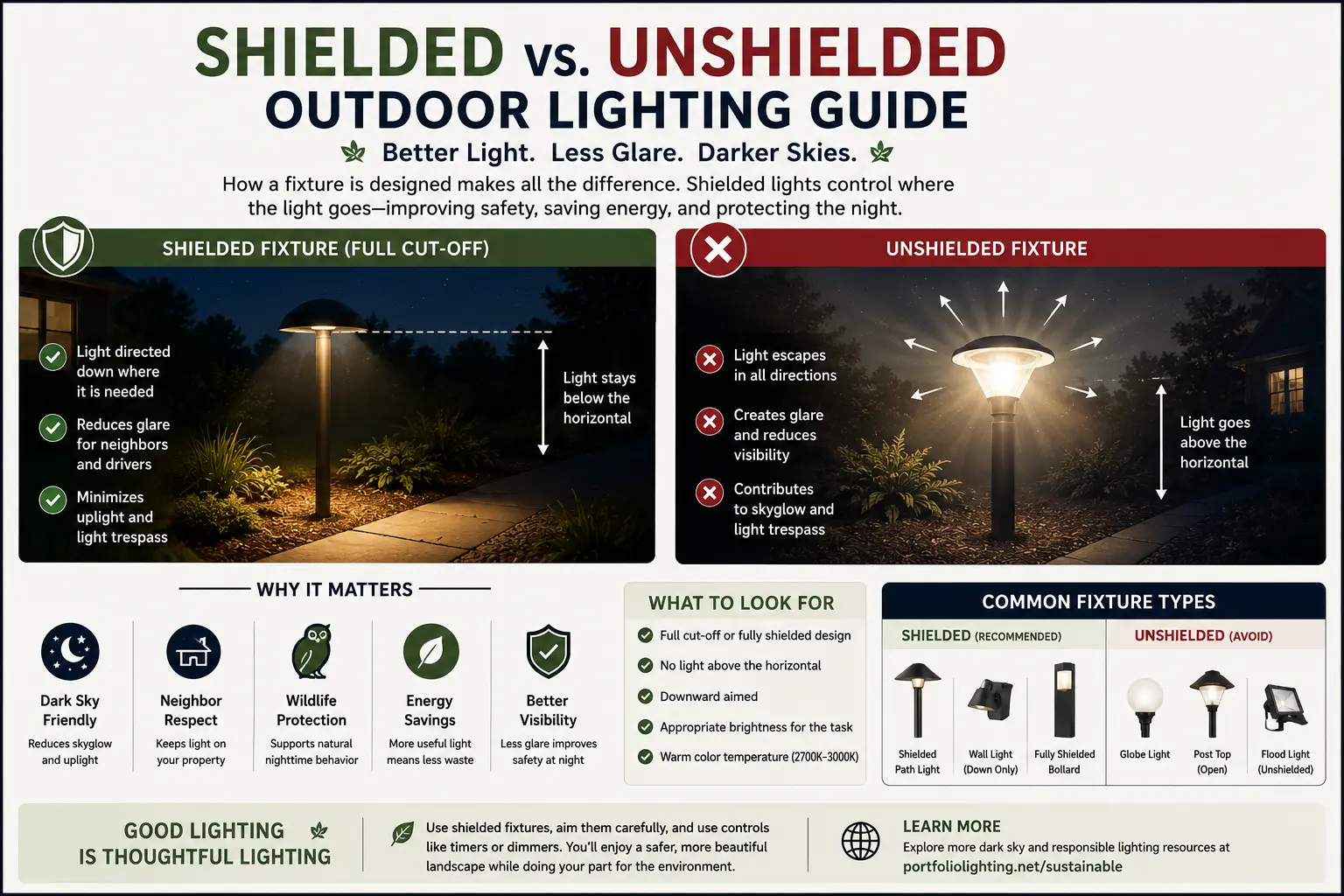
Why Shielding Matters: The Three Harms Unshielded Outdoor Lights Create
Shielding requirements exist because unshielded outdoor luminaires produce three distinct and well-documented harms. Understanding each harm clarifies why different shielding requirements address different components of the problem — and why satisfying one standard doesn't automatically satisfy all three.
Harm 1: Sky Glow — The Cumulative Brightening of the Night Sky
Sky glow is the diffuse brightening of the night sky over inhabited areas caused by light scattering in the atmosphere. Light emitted above the horizontal plane from luminaires travels upward and scatters off atmospheric particles (water vapor, aerosols, dust), returning to Earth as a diffuse glow that obscures stars. Unshielded globe-style fixtures can emit 30-50% of their total output upward directly. Full-cutoff fixtures eliminate direct uplight from the fixture itself — but as the ground reflectance section below documents, reflected light still contributes to sky glow even from fully-shielded installations.
Harm 2: Light Trespass — Unwanted Light on Adjacent Properties
Light trespass is light from a fixture that falls where it was not intended — on a neighbor's property, in bedroom windows, onto public roadways. Trespass is caused primarily by unshielded or improperly aimed fixtures that emit light sideways (backlight) or at low angles. The IESNA cutoff classification system's 80°-90° zone restriction is specifically targeted at the high-angle, near-horizontal light emission that creates the most severe trespass effects. Shielded fixtures with full or high-sided shielding confine the beam to a downward cone that is far less likely to trespass. See the light trespass laws guide for the specific footcandle limits at property lines in documented jurisdictions.
Harm 3: Glare — Disabling Visual Disability from High-Angle Sources
Glare is caused by luminances within the visual field that are significantly higher than the surrounding adaptation level — producing disability (reduced visual acuity) or discomfort. The most severe glare comes from light sources at or near the horizontal — the 80°-90° zone above nadir where the eye looks when driving, walking, or working outdoors. A full-cutoff fixture strictly limits intensity in this 80°-90° zone to ≤10% per 1000 lamp lumens. A non-cutoff fixture has no restriction in this zone — an unshielded 3000-lumen fixture at 90° (horizontal) can emit hundreds of candela directly into the eyes of pedestrians and drivers. Per the green Acton good neighbor outdoor lighting documentation: "The cause of glare is poorly shielded lights that are aimed at least partially horizontally, not down onto the pavement. Glare can easily cause us not to see important objects such as the couple crossing in front of the car."
Full Cutoff vs Fully Shielded: The Distinction That Causes Most Permit Errors
This is the most consequential distinction in outdoor lighting specification — and the one most often glossed over in both manufacturer marketing and ordinance language.
Two Different Standards from Two Different Organizations
Full cutoff is an IES (Illuminating Engineering Society) photometric classification. It is measured in a photometric laboratory, expressed in candela values at specific angles, and described in IESNA documentation. It has two required conditions: (1) zero candela at 90° and all angles above, AND (2) no more than 100 cd/1000 lamp lumens (10%) at 80°.
Fully shielded is the IDA's (International Dark-Sky Association) preferred term for a fixture that emits no direct uplight. The definition from the NLPIP (National Lighting Product Information Program at Rensselaer Polytechnic Institute): "Fully shielded luminaires emit no direct uplight, but have no limitation on the intensity in the region between 80° and 90°."
The Overlap — and the Critical Gap
A full-cutoff fixture is always fully shielded (zero cd at 90° satisfies the no-direct-uplight requirement). But a fully shielded fixture is not necessarily full cutoff — because full cutoff has the additional 80° restriction that fully shielded does not.
Per the NLPIP documentation: "Luminaires that fall under the IESNA full cutoff, cutoff, semicutoff, and noncutoff definitions may also qualify as fully shielded." The implication is startling: even a non-cutoff fixture (by IES classification) can qualify as fully shielded if it emits no direct uplight above the horizontal plane.
The Specific Scenario That Causes Permit Confusion: Consider a semi-cutoff fixture containing a 1000-lumen lamp. Its photometric report shows zero candela at 90° and above — no direct uplight. But at 80°, it emits 150 cd. Under the IDA "fully shielded" definition: this fixture is fully shielded (no direct uplight). Under the IES "full cutoff" definition: this fixture is NOT full cutoff (it emits 150 cd/1000 lm at 80°, which exceeds the 100 cd/1000 lm limit). An ordinance requiring "fully shielded" accepts this fixture. An ordinance requiring "full cutoff" does not. This single distinction — the 80° glare zone restriction — separates the two standards. If the permit reviewer uses IES terminology and the applicant provides a fixture certified only as "fully shielded" (IDA), the submittal may be rejected despite the fixture having no direct uplight. Always identify which standard the specific ordinance is invoking.
| Standard | Source Organization | At 90° (horizontal) | At 80° | Glare Zone Restriction? | Common Term in Ordinances |
|---|---|---|---|---|---|
| Full Cutoff | IES (IESNA) | 0 cd — absolute zero | ≤100 cd/1000 lm (10%) | Yes — strict 80° limit | "Full cutoff," "full cut-off," "type FC" |
| Fully Shielded | IDA | 0 cd — no direct uplight | No limitation | No 80° restriction | "Fully shielded," "zero uplight," "dark sky certified" |
| Cutoff | IES (IESNA) | ≤25 cd/1000 lm (2.5%) | ≤100 cd/1000 lm (10%) | Yes — same 80° limit as full cutoff | "Cutoff," "type C" — older ordinances |
| Semi-Cutoff | IES (IESNA) | ≤50 cd/1000 lm (5%) | ≤200 cd/1000 lm (20%) | Partial — looser than cutoff | "Semi-cutoff," "type SC" — older ordinances |
| Non-Cutoff | IES (IESNA) | No limit | No limit | None | "Non-cutoff," globe fixtures, decorative acorn fixtures |
The Four IESNA Cutoff Classifications: Complete Photometric Thresholds
The IES four-tier cutoff system was developed specifically for roadway and area lighting. While the BUG rating system (covered below) has replaced it for general outdoor luminaire specification, many older ordinances still reference these classifications, and inspectors in jurisdictions with older codes still use this terminology.
No light at or above horizontal. Strict glare zone limit. Fully shielded AND glare-controlled. The IES and IDA agree that this classification is appropriate for dark-sky applications. LED light expert documents: "Full cutoff is an IES term meaning the fixture allows zero intensity at or above 90 degrees and no more than 10% intensity at 80 degrees above nadir."
- Best for: parking lots, streets, paths adjacent to residential
- Photometric test: IES file shows 0 cd at 90° across all lateral angles
- Qualifier: applies to all lateral angles around the luminaire — not just the worst-case direction
Very small but non-zero light above horizontal. The 80° restriction is identical to full cutoff, meaning this classification has strong glare control. The 2.5% at 90° allowance creates a small amount of direct uplight. Per NLPIP at RPI: "Cutoff luminaire: IESNA classification that describes a luminaire having a light distribution in which the candela per 1000 lamp lumens does not numerically exceed 25 (2.5%) at or above an angle of 90 above nadir."
- Best for: commercial areas, moderate ambient zones
- Note: the 2.5% at 90° allowance means this does NOT qualify as fully shielded if the 2.5% represents direct uplight
Allows 5% direct uplight and 20% at 80°. The 20% at 80° creates significant glare potential. Per Pittsboro NC code documentation: "A fixture light distribution where no more than 5% of a lamp's light intensity is emitted at or above a horizontal plane and no more than 20% at or above an angle ten degrees below that horizontal plane." May still qualify as "fully shielded" if the 5% at 90° is not direct uplight but rather reflected from the housing.
- Not acceptable: most dark-sky zones, residential buffers
- Marginal: industrial or commercial areas far from residential
- Note: the Ivins Night Sky example of a semi-cutoff that IS fully shielded comes from this classification
No photometric restriction above the maximum candela direction. Globe-style decorative fixtures, acorn-style post tops, vintage Edison fixtures, and many decorative landscape lights are non-cutoff. Light is emitted in all directions including directly upward. Per NLPIP: "Noncutoff luminaire: IESNA classification that describes a luminaire light distribution in which there is no candela limitation in the zone above maximum candela."
- Prohibited: all dark-sky ordinance zones, IDA programs
- The most common residential landscape lighting violation
- Globe path lights, acorn post tops, unshielded bollards, open-top wall sconces
BUG Ratings: How the System That Replaced Cutoff Classifications Works
The BUG (Backlight, Uplight, Glare) rating system, developed jointly by IES and IDA and documented in IES TM-15-11, replaced the four-tier cutoff classification system for general outdoor luminaires. It is the current standard referenced in the IDA/IES Model Lighting Ordinance and most post-2011 dark sky ordinances.
Why BUG Was Developed
Per 1000Bulbs: "In their efforts to replace the original 'cutoff' system, which applied solely for street lighting, the BUG rating is a comprehensive system for all outdoor lighting." The cutoff system's flaw: it measured only uplight, not backlight (light trespass onto adjacent properties) or glare (visual discomfort from high-angle emission) separately. A full-cutoff fixture could still produce severe backlight onto a neighbor's property. BUG addresses all three independently.
Backlight is the 90° quarter-sphere behind and below the fixture. High backlight ratings indicate significant light trespass potential onto property behind the fixture.
Target for wall packs near property lines: B0–B1
Note from UpCodes Maryland Green Code: Building-mounted fixtures with backlight oriented toward the building are exempt from backlight limits (the building itself blocks the backlight).
Uplight is all light escaping above the horizontal plane. U0 = zero uplight from the fixture itself. This is the dark sky compliance threshold. Per Access Fixtures: "Dark Sky compliance always requires U0 (zero uplight)."
Target for dark sky compliance: U0 always
Important: U0 from the fixture does not mean zero sky glow in installation — ground reflectance adds effective U2–U4 (see the ground reflectance section below).
Glare is measured in the forward zone above 60°. High G ratings indicate fixtures that create disabling or discomforting glare for pedestrians and drivers in line of sight with the fixture.
Target for wall packs near property lines: G0–G1
Target for parking lot poles: G0–G1
Per LED Light Expert: "Fixtures rated with low glare levels (typically G0-G1 ratings) minimize visual discomfort and ensure safer, more pleasant experiences."
How BUG Ratings Are Calculated
Per 1000Bulbs' documented BUG calculation analysis: "The Backlight Rating (B0-5) is the highest B value from the zones Backlight High (BH), Backlight Mid (BM), and Backlight Low (BL)." Each zone has a maximum zonal lumen threshold. The rating for each component is determined by the zone with the highest value — if BH is B1 and BL is B2, the overall backlight rating is B2. Each individual B, U, and G component is independently rated from 0 (lowest output in that direction) to 5 (highest output).
Per Landscape Forms' BUG rating explanation: "The backlight, uplight, and glare ratings are assigned a value between 0 and 5 depending on the maximum amount of light in these zones based on thresholds defined by the IES. The rating gives specifiers, designers, and lighting professionals a snapshot of where the light is going after it leaves the fixture."
Where to Find BUG Ratings
BUG ratings appear in two places: (1) Manufacturer specification sheets — typically listed as three values, e.g., "B1 U0 G1"; (2) The manufacturer's IES photometric file (.ies file) — which any photometric analysis software can compute the BUG rating from. Per LED Light Expert's wall pack guide: "BUG ratings appear on manufacturer specification sheets and IES (.ies) photometric files. Demand the manufacturer's BUG rating and IES photometric file before specifying — if they can't produce them, walk away." If a manufacturer cannot produce an IES file, their BUG rating is unverified.
Target BUG Values by Application Type and MLO Lighting Zone
The IDA/IES Model Lighting Ordinance specifies maximum BUG ratings by lighting zone for each component. These targets are the basis for fixture selection in MLO-adopting jurisdictions.
| Application / Zone | Max Backlight | Max Uplight | Max Glare | Notes |
|---|---|---|---|---|
| LZ0 — Dark (wilderness, parks) | B0 | U0 | G0 | Maximum restriction; essentially no permitted lighting except safety-critical |
| LZ1 — Low Ambient (rural residential) | B1 | U0 | G1 | Target for rural landscape lighting adjacent to natural areas |
| LZ2 — Moderate (suburban residential) | B2 | U0 | G2 | Most common residential application; U0 still required |
| LZ3 — Moderately High (commercial corridor) | B3 | U1 | G3 | Some uplight permitted; still recommended U0 for good practice |
| LZ4 — High (entertainment/major commercial) | B4 | U2 | G4 | Least restrictive zone; primarily 24-hour commercial use |
| Wall pack near property line (any zone) | B0–B1 | U0 | G0–G1 | Per LED Light Expert: "For wall packs near property lines, target B0-B1/U0/G0-G1" |
| Pole-mounted flood/parking lot (any zone) | B1–B2 | U0 | G0–G1 | Per LED Light Expert: "For pole-mounted flood lights, target B1-B2/U0-U1/G0-G1" |
The Flat Lens Misconception: Why Physical Appearance Doesn't Determine Cutoff Classification
One of the most pervasive and consequential misconceptions in outdoor lighting specification is the assumption that a flat lens on a fixture makes it full cutoff. This assumption fails in both directions — some flat-lens fixtures are not full cutoff, and some sag-lens fixtures can be partially compliant.
Why a Flat Lens Does Not Guarantee Full Cutoff
Per the NLPIP at Rensselaer Polytechnic Institute, specifically documented in the Ivins Night Sky light pollution reference: "There is a confusing assumption that a luminaire with a flat lens qualifies as a full cutoff luminaire. While this may be true sometimes, it is not always the case. Depending on the structure of the luminaire, reflections off the housing may result in some amount of direct uplight from the luminaire."
The mechanism: light from the lamp inside the fixture housing reflects off the interior walls and ceiling of the housing. If the geometry of the housing allows reflected light to exit at angles above 90°, the fixture emits direct uplight even through a flat lens. A flat lens is flat at the bottom — it does not seal the light output at or below horizontal unless the housing itself prevents any reflected light from traveling upward. The correct determination of cutoff status is always the photometric measurement, not the lens geometry.
Why a Sag (Bowl) Lens Actively Creates Uplight
The opposite error is assuming that a sag or bowl lens — convex viewed from below, curving upward at the edges — doesn't create uplight. A sag lens does create uplight. Per the USPTO documentation of full cutoff area light fixture patents: "The sag lens projects light above the angle of 90° above nadir. In some jurisdictions the sag lens luminaires are forbidden because of light pollution issues." The curved surface of a sag lens refracts light at the edges upward, creating emission above horizontal even from fixtures where the housing itself might otherwise be full cutoff. Sag lens fixtures should be treated as presumptively non-full-cutoff without specific photometric data showing otherwise.
The Correct Verification Method: IES Photometric Data
The only reliable determination of cutoff classification is the fixture's IES photometric file (.ies format). This file contains the candela values at all angles around the fixture as measured in a photometric laboratory. From this file, the full cutoff test can be applied directly:
- Extract candela values at 90° in all lateral planes (0°, 30°, 60°, 90°, etc.) — all must be zero for full cutoff
- Extract candela values at 80° in all lateral planes — all must be ≤100 cd/1000 lamp lumens for full cutoff (or ≤10% of the rated fixture output)
- Any non-zero value at 90° in any lateral plane disqualifies the fixture from full cutoff classification
- Any value above the 80° threshold in any lateral plane disqualifies the fixture from full cutoff classification
The most common permit rejection I see involving shielding: a contractor specifies a "flat-lens full cutoff" area light based on manufacturer marketing language. The permit reviewer requests the IES file. The photometric analysis shows 8 candela at 90° in the fixture's lateral 45° plane — a small number, but it disqualifies the fixture from full cutoff classification under the IES definition. The manufacturer never measured it carefully enough to notice, or they classified it as "full cutoff" by their own internal standard rather than the IESNA standard. The permit reviewer rejects the submittal. The fix: always pull and verify the IES file before writing it into a specification, not after the permit comes back. A photometric software tool (AGi32, Visual, Dialux) can compute the BUG rating and identify any 90° non-zero values from the IES file in about 30 seconds.
The Aiming Angle Violation: How a Fully Compliant Fixture Becomes Non-Compliant in the Field
A full-cutoff fixture that leaves the factory with zero uplight can generate significant sky glow and fail dark sky ordinance compliance through a single installation decision: being tilted upward.
How Aiming Defeats Full Cutoff
Full cutoff is measured with the fixture at standard horizontal orientation — the fixture's base parallel to the ground, pointing light directly downward. When the fixture is tilted upward from horizontal (tilted away from the building on a wall pack, tilted upward on a flood light arm), the photometric zones rotate with the fixture. What was "below horizontal" at 80° from nadir becomes "above horizontal" relative to the ground when the fixture is tilted 15°. Light that the full cutoff classification specified could only go to 80° downward is now going to 80° + 15° = 95° — five degrees above horizontal.
Per Emergency Lights Co.'s dark sky wall pack guide: "Even a full-cutoff fixture can cause glare or uplight if it's installed incorrectly. Always mount wall packs so that they sit level (parallel to the ground) and direct light straight down. Do not tilt fixtures upward — angling a wall pack defeats the full-cutoff design and will send light into the sky. For adjustable wall pack models, take extra care to aim the light bar or head only as high as needed to cover your target area."
Why Installers Tilt Fixtures Upward
The motivation is almost always to extend the throw area — covering a wider horizontal zone with fewer fixtures by tilting the beam toward a more horizontal angle. This trade-off directly violates the shielding compliance the fixture was specified to provide. The correct solutions for extending coverage area:
- Use a higher mounting height (more height = wider throw without tilting)
- Use a Type IV or Type V photometric distribution (wide-area distribution at horizontal mounting)
- Use additional fixtures to cover the required area rather than tilting existing ones
- Select a fixture with wider beam optics designed for the required coverage pattern
- Use pole-mounted rather than wall-mounted fixtures for larger coverage areas
Detecting Aiming Angle Violations in the Field
An inspector checking for full-cutoff compliance in the field looks for one indicator above all others: can they see the lamp directly from a standard viewing position? If standing at grade level on an adjacent property or the public right-of-way, the inspector looks toward the fixture. If the lamp face (the light source itself) is directly visible, the fixture is either tilted or not truly full cutoff — because a correctly installed full-cutoff fixture at any reasonable mounting height should have the lamp face hidden by the housing from any ground-level viewpoint. Per Green Acton: "The right picture shows how the scene would look if the light was shielded, so the direct view of the lamp is hidden from the driver's view." The visibility of the lamp face to a person at grade is the field-expedient test for effective shielding compliance. See the inspector perspective guide for how inspectors approach shielding evaluation in the field.
Adjustable wall packs and adjustable flood lights — fixtures with a rotatable head that can aim the beam in different directions — require special attention during installation and inspection. These fixtures typically achieve full cutoff only within a specific range of aiming positions. Tilted too far upward, they generate uplight. Some ordinances specifically require that adjustable fixtures be "locked" at an approved aiming angle after installation and that the aiming position be documented in the as-built lighting records. See the as-built diagram requirements guide for documentation requirements. For jurisdictions where 2026 regulatory convergence is implementing automated lighting controls alongside shielding requirements, the aiming position must be specified in the permit submittal. See the curfew and controls guide.
The Ground Reflectance Paradox: Why U0 Fixtures Still Contribute to Sky Glow
This is the most counterintuitive finding in outdoor lighting photometrics — and understanding it changes how the total sky glow impact of a lighting installation should be evaluated.
The IES TM-15 Analysis of Ground Reflectance
The All Things Lighting Association's documented analysis of the IES TM-15 research is precise and striking: "Taking the full-cutoff 250-watt metal halide luminaire from IES TM-15-11 as an example, it emits 13,553 lumens downwards. Assuming that the ground has a reflectance (albedo) of 15 percent (Gillet and Rombauts 2001), the amount of light diffusely reflected into the upper hemisphere is 2,033 lumens. The portion of light reflected into the UL [Uplight Low] zone is 406 lumens, with the remaining 1,627 lumens being reflected into the UH [Uplight High] zone. In other words, the luminaire in its natural surroundings has a UL rating of U2 (nearly U3) and a UH rating of U4."
A fixture measured as U0 (zero direct uplight) generates an effective UL rating of U2 and UH rating of U4 in actual installation. This effective uplight comes entirely from light reflected off the ground and back into the sky. The fixture contributes far more to sky glow than its U0 fixture rating suggests.
The Implications for Dark Sky Compliance Strategy
This finding does not mean that shielding is pointless. The All Things Lighting Association continues: "As for the BUG rating system, it must be remembered that its backlight and glare components (except G0) are still presumed valid, and so it is still useful in environmentally responsible lighting design. It rightfully retains its position in the IDA/IES Model Lighting Ordinance." What it means is that the uplight component of BUG ratings primarily controls direct fixture uplight — which is one contributor to sky glow. The dominant source of sky glow from a well-shielded installation is not direct uplight (which U0 eliminates) but reflected uplight from the ground surface.
Shielding is one of the most effective ways to reduce sky glow because it changes where light travels before brightness is even adjusted. An unshielded fixture can send light sideways and upward, while a properly shielded fixture keeps more useful light on paths, entries, steps, and landscape features. For a broader homeowner strategy that combines shielding with aiming, surface reflection, lumen reduction, and curfew timing, see our night-sky glow reduction guide for homes.
A shield is only effective while its mounting hardware, finish, lens, and aiming position remain intact. Salt exposure can seize screws, UV can embrittle plastic louvers, and freeze-thaw soil movement can turn a properly aimed shielded fixture upward. The Outdoor Lighting Climate Performance Guide provides climate-specific recommendations for housing materials, hardware, seals, mounting methods, and inspection timing that help shielded fixtures keep performing as intended.
The practical implications:
- Total lumen output matters more than U0 rating for sky glow: A 10,000-lumen U0 fixture generates 5× more reflected uplight than a 2,000-lumen U0 fixture. Over-illumination — using more lumens than the task requires — is the dominant sky glow contributor from properly-shielded installations.
- Surface albedo matters: Light-colored concrete (albedo ~30%) reflects twice as much light as dark asphalt (albedo ~15%). A full-cutoff fixture over light concrete generates more effective uplight than the same fixture over dark asphalt — with no change in the fixture's U0 rating.
- Number of fixtures matters: A dense array of 50 U0 fixtures generates 50× the reflected uplight of a single U0 fixture. Minimizing fixture count (while maintaining adequate illuminance) is a meaningful sky glow reduction strategy beyond fixture selection.
- This is why "right light for the task" matters beyond compliance: The IDA's fifth principle of responsible outdoor lighting — "use no more light than necessary" — addresses this ground reflectance contribution that fixture shielding cannot eliminate.
How Ordinances Use These Terms and How to Navigate the Inconsistency
The existence of three different standards (IES cutoff classifications, IDA fully shielded, and IES/IDA BUG ratings) for the same general concept — keeping light from going where it shouldn't — creates predictable confusion in ordinance application. Different jurisdictions use different terminology, sometimes without realizing the distinctions.
The Three Ordinance Terminology Patterns
- Old IES cutoff terminology (pre-2011): Requires "full cutoff," "cutoff," or specifies no "non-cutoff" fixtures. Uses the four-tier classification system. Most common in ordinances adopted before the MLO was published in 2011. Translation: map to the IES photometric threshold definitions above.
- IDA/IES MLO BUG terminology (post-2011): Specifies maximum B, U, and G values by lighting zone. "All lighting in LZ1 shall have a BUG rating no greater than B1 U0 G1." Translation: select fixtures with BUG values at or below the specified limits, confirmed by IES photometric file.
- Mixed terminology: Many real-world ordinances mix terms from both systems, or use "fully shielded" (IDA term) alongside "full cutoff" (IES term) as if they're equivalent. When this occurs: satisfy the more restrictive standard. If an ordinance requires "fully shielded full cutoff" — treat it as IES full cutoff, which is more restrictive than IDA fully shielded.
State-Level Terminology Inconsistencies
Arizona's statewide light pollution law (ARS §49-1101) defines "fully shielded" and "partially shielded" at the state level — terminology that differs from both the IES and IDA standards. Per the Warshaeur Lighting Design documentation: "The law requires all outdoor light fixtures to be fully or partially shielded." Arizona's state statute definitions control within Arizona, regardless of local ordinance terminology. For landscape lighting in Arizona: verify compliance with ARS §49-1101 definitions, not just the IES or IDA classifications. See the curfew guide for how Arizona's shielding requirement interacts with the midnight-to-sunrise curfew alternative.
Translation Between Cutoff and BUG Terminology
| Old IES Cutoff Term | Approximate BUG Equivalent | Notes on Translation |
|---|---|---|
| Full Cutoff | B≤2, U0, G≤1 | BUG U0 corresponds to full cutoff zero-uplight requirement; full cutoff's 80° restriction roughly corresponds to low G values |
| Cutoff | B≤2, U0-U1, G≤2 | Cutoff allows 2.5% at 90° — slightly more than U0 but closer to U0 than U1 |
| Semi-Cutoff | B≤3, U1-U2, G≤3 | Rough approximation only; semi-cutoff 5% at 90° corresponds approximately to U1-U2 |
| Non-Cutoff | U3–U5, G3–G5 | Globe fixtures, acorn tops — significant uplight and glare in all directions |
Permit Documentation for Shielding Compliance
A shielding compliance submittal for a dark sky ordinance permit application requires specific documentation that goes beyond simply naming the fixture type.
Required Documentation Components
- IES photometric file (.ies) for each fixture type: The raw data file from the manufacturer's photometric laboratory test. Photometric analysis software reads this file and can generate BUG ratings, confirm zero candela at 90°, and produce site-level footcandle maps. This is the authoritative documentation — more useful than any marketing claim on the spec sheet.
- Manufacturer-documented BUG rating: The specific B, U, and G values for each fixture model as measured at standard orientation. Per Landscape Forms: "Specifiers can typically find BUG ratings for outdoor fixtures in the product specifications from lighting manufacturers."
- Mounting height and orientation: For each fixture on the plan, document the mounting height (distance from bottom of fixture to grade) and orientation (level/horizontal, or specific tilt angle). Wall pack mounting level or angled? Adjustable flood light at what tilt? This documentation enables the plan reviewer to verify that the factory BUG rating applies as installed.
- Photometric plan with point-by-point footcandle output: Site-level calculation showing illuminance values at grade and at the property line. The property line footcandle values enable verification of light trespass compliance. See the permit rejection guide for how photometric plan deficiencies cause technical plan review rejections.
- Aiming angle lock documentation (for adjustable fixtures): If adjustable fixtures are used, document the approved aiming angle in the submittal and specify that the fixtures will be locked at that angle at installation.
How Different Outdoor Fixture Types Achieve (or Fail) Shielding Requirements
The Five Critical Misconceptions in Shielding Practice
Globe path lights are non-cutoff fixtures by IES classification — they emit light in all directions including directly upward. Their total lumen output is lower than parking lot poles, but 50 globe path lights each emitting 200 lumens upward generates 10,000 lumens of direct uplight from the landscape lighting installation alone. Wattage and lumen output are separate from cutoff classification — a low-wattage non-cutoff fixture still contributes to sky glow proportionally to its lumen output.
Ojai CA's dark sky ordinance summary documents this specific misconception: "Placing a light fixture under an eave, canopy, patio cover, or other similar cover without further shielding the light source to prevent horizontal light emission does not qualify as 'full cutoff.'" Being under a cover may prevent direct sky access from above, but the horizontal light emission from an unshielded fixture under a porch can still escape sideways at high angles, creating glare and contributing to light trespass.
Emergency Lights Co. documents this directly: "Do not tilt fixtures upward — angling a wall pack defeats the full-cutoff design and will send light into the sky." The full cutoff designation applies to the fixture at standard horizontal orientation. Tilting rotates the photometric zones. Any tilt above horizontal converts what was "downward" light into "upward" or "near-horizontal" light and defeats the full cutoff classification in the installed condition.
The ground reflectance analysis from IES TM-15 documents the paradox: a U0 full-cutoff 250W MH fixture generates an effective UL rating of U2 (nearly U3) and UH rating of U4 from ground reflectance alone. The fixture's U0 rating describes zero direct uplight from the fixture — not zero sky glow contribution from the installation. Ground reflectance at typical albedo values (concrete 30%, asphalt 15%) generates 15-30% of downward lumen output as reflected uplight regardless of fixture cutoff classification.
The NLPIP at RPI documents the distinction: a semi-cutoff fixture with no direct uplight qualifies as fully shielded (IDA) but never as full cutoff (IES). An ordinance requiring "fully shielded" accepts fixtures with intensity in the 80°-90° zone. An ordinance requiring "full cutoff" does not. When ordinance language uses both terms interchangeably without defining them, apply the IES full cutoff standard (the more restrictive definition) for conservative compliance.
Shielded vs Unshielded Lighting FAQ
My local dark sky ordinance requires "full cutoff fixtures." Can I submit a fixture certified by IDA as "fully shielded" to satisfy this?
Not automatically — and this is exactly the terminology confusion that causes permit rejections. The IDA "fully shielded" certification requires zero direct uplight (no light at or above the horizontal plane). The IES "full cutoff" classification requires zero candela at 90° AND no more than 10% per 1000 lamp lumens at 80°. The 80° restriction is additional in the IES full cutoff standard and is not required for IDA fully shielded certification. A fixture may be IDA-certified as fully shielded while having intensity in the 80°-90° zone that would fail the IES full cutoff classification. The practical resolution: when the ordinance says "full cutoff," apply the IES definition — zero cd at 90° and ≤10% at 80°. Verify this against the fixture's IES photometric file. If the fixture passes both thresholds in the IES file, it is both fully shielded (IDA) and full cutoff (IES), and either certification applies. If the IDA-certified fixture fails the 80° threshold in the IES file, it doesn't satisfy an ordinance requiring IES full cutoff — regardless of the IDA certification. Bring the IES file to the permit submittal and have the photometric analysis confirm the 80° values specifically. This one step pre-empts the most common plan review comment in jurisdictions with IES full cutoff requirements.
I have a wall pack rated B2 U0 G2 — is that acceptable for a LZ2 residential zone?
Yes — B2 U0 G2 satisfies the IDA/IES MLO maximum BUG values for LZ2 (B2, U0, G2). The uplight component U0 satisfies the zero-uplight requirement. The backlight B2 and glare G2 are within the LZ2 maximums. The one additional question is whether the specific ordinance in your jurisdiction has adopted the MLO BUG limits exactly, or has modified them. Some jurisdictions that have adopted the MLO have tightened the glare limits (requiring G1 instead of G2 in LZ2) or modified backlight limits based on site-specific conditions near sensitive areas. Verify the specific ordinance's BUG table for LZ2 before finalizing the specification. Also verify the mounting height: BUG ratings from the manufacturer are calculated at standard mounting orientation. If the wall pack is mounted at an unusually high position, recalculate the backlight contribution to the property line at that height. A B2 rating at 10 feet mounting height may create different on-ground footcandle values at the property line than the same B2 rating at 20 feet. The photometric plan submitted with the permit will show the actual property-line footcandle values and is the final compliance verification.
My landscape lighting uses bollard fixtures that have a diffuser on the sides. Are bollards with side diffusers compliant with full cutoff requirements?
Bollards with side diffusers are almost certainly not full cutoff and likely not semi-cutoff either — because they emit light through the sides at angles that include the 80°-90° high-angle zone. A bollard's side emission is at or near horizontal (90° from nadir) for anyone standing close to the fixture and looking across at it. This is directly in the IES glare zone and directly in the zone that full cutoff restricts to zero candela. Standard bollard fixtures with side diffusers are non-cutoff or at best semi-cutoff fixtures. They are not acceptable in dark sky ordinances requiring full cutoff or even semi-cutoff restrictions. The alternative for pathway lighting without full cutoff bollards: consider in-grade step lights or directional path lights that emit light in a downward-angled cone rather than sideways through a diffuser. Some bollard designs include full top shielding and a very narrow diffuser slit near the bottom that creates near-full-cutoff performance — but this is rare and must be verified with the IES photometric file, not assumed from the visual design. For a project in a jurisdiction requiring full cutoff, request the IES file for any bollard under consideration and verify the candela values at 80° and 90° before specifying.
Related Dark Sky, Compliance & Specification Guides
- Dark Sky Compliance Guide
- IDA Certification vs FSA Guide
- Dark Sky Fixture Selection Guide
- Outdoor Lighting Curfew Guide
- Bird-Friendly Lighting Guide
- Light Trespass Laws
- Permit Rejection Reasons
- State Permit Requirements
- Inspection Failure Codes
- Inspector Perspective Guide
- Final Inspection Checklist
- As-Built Diagram Requirements
- Electrical Code Guide
- NEC Article 110 Guide
- Wet Location Listing
- Coastal Lighting Compliance
- RoHS Compliance Guide
- Code Enforcement Cases
- Landscape Lighting Guide
- NEC Compliance Calculator