
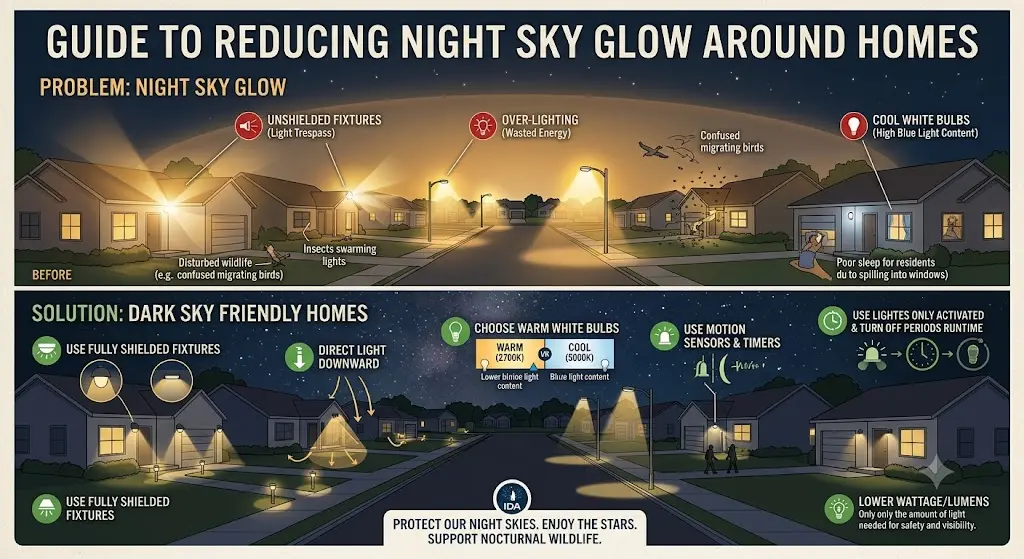
How Skyglow Forms: The Two Scattering Mechanisms
Skyglow is not simply "too much light." It is specifically the result of artificial light interacting with the atmosphere before reaching an observer. Two distinct physical processes convert downward-aimed and upward-escaped light into the diffuse orange-white dome visible above neighborhoods at night — and they respond differently to the interventions available to homeowners.
Rayleigh scattering occurs when light encounters atmospheric gas molecules — primarily nitrogen and oxygen — whose diameter is much smaller than the wavelength of light. The scattering cross-section follows an inverse fourth-power relationship with wavelength: shorter wavelengths scatter dramatically more than longer wavelengths. At 450nm (blue), scattering is approximately 9 times greater than at 700nm (red). This is why the daytime sky is blue (blue sunlight scattered in all directions) and why blue-rich cool-white LED lighting (5000K, with significant 450–470nm energy) creates far more skyglow per lumen than amber or warm-white lighting (2700K, with minimal short-wavelength energy). Per optical mechanics and atmospheric physics documentation: "Warm-white sources (≤3000K CCT) reduce blue-rich emissions that are preferentially scattered by the atmosphere, especially via Rayleigh scattering. For the same amount of useful illumination on the ground, warm lighting tends to produce less skyglow than cooler, blue-rich lighting." This is why CCT reduction — choosing 2700K or 3000K instead of 5000K — is the second-highest-impact individual action for reducing skyglow from existing LED fixtures.
Mie scattering occurs when light encounters particles comparable in size to its wavelength — aerosols, dust, smoke, haze, water droplets in fog. Unlike Rayleigh scattering, Mie scattering is relatively wavelength-independent, affecting all wavelengths more equally. Per NPS documentation: "The amount and type of aerosols, moisture level in the air, and the altitude above sea level are the primary variables determining the scattering that will occur." Mie scattering is strongly forward-scattering, meaning it redirects light in the same general forward direction rather than scattering equally in all directions. This produces the visible halo effects around individual bright light sources and intensifies skyglow near sources. Air pollution, wildfire smoke, and humid nights significantly amplify Mie scattering. A 2021 study published in PMC found that "reducing air pollution, specifically aerosols, decreases night sky brightness by tens of percent at relatively small distances from light sources" — suggesting that communities with lower air pollution have substantially less skyglow per lumen of outdoor light than polluted communities with similar lighting installations.
Direct uplight is light emitted above the horizontal plane by the fixture. It travels upward into the atmosphere with minimal ground interaction and is scattered back toward observers efficiently. Per opticalmechanics.com: "Light emitted above the horizontal contributes directly to skyglow." The IDA estimates that 20–50% of all outdoor residential lighting is lost to the night sky, primarily from poor shielding. An unshielded globe-type porch light may direct 30–40% of its output above horizontal; a bare exposed-bulb fixture may direct 20–30% directly upward. Full cutoff fixtures that allow zero lumens above 90° (horizontal) eliminate this entire component. The NPS documents that the bright glow from cities has been detected by national park observers at distances over 200 miles — this long-range skyglow propagation is almost entirely driven by direct uplight, which travels at angles that scatter efficiently over large distances.
Even a perfectly shielded, zero-uplight fixture contributes to skyglow indirectly — through light that reaches the ground and reflects upward. Per the Wikipedia skyglow entry: "Research indicates that when viewed from nearby, about half of skyglow arises from direct uplight, and half from reflected." The Royal Astronomical Society's skyglow modeling research (MNRAS 2024) confirms: "Partial or even complete removal of direct uplight will significantly lower the artificial sky brightness, but not eliminate it entirely. The reflected component of upward radiation cannot be avoided, due to the non-zero surface reflectivity in artificially lit urban areas." Ground surfaces with high albedo (concrete, white pavers, light-colored gravel) reflect more light skyward than low-albedo surfaces (dark mulch, dark pavers, vegetation). Right-sizing lumen output reduces the total amount of ground-reflected light available to scatter upward. Snow dramatically amplifies this effect (see the snow amplifier section).
The Two Uplight Pathways and What They Mean for Homeowners
Understanding that skyglow has two fundamentally different origins — direct uplight and ground-reflected light — explains why full shielding is not the complete solution, and why lumen right-sizing matters even for fully shielded installations.
What Full Shielding Eliminates (and What It Doesn't)
Full cutoff shielding eliminates 100% of direct uplight — the first and more efficiently scattering pathway. For a typical unshielded residential fixture with 20–30% of output going directly above horizontal, switching to a full cutoff fixture removes that component entirely. Per Wikipedia's skyglow documentation: "fully shielded lighting decreases skyglow by about half when viewed nearby, but by much greater factors when viewed from a distance." The distance amplification occurs because direct uplight from a neighborhood travels at steep angles that are more efficiently scattered by Rayleigh and Mie mechanisms and can be detected at the long ranges (tens to hundreds of kilometers) that matter for national parks, dark sky preserves, and rural observatories. Ground-reflected light travels at shallower angles and attenuates more quickly with distance.
What shielding doesn't eliminate: the indirect pathway. A fully shielded 1,000-lumen fixture still delivers 1,000 lumens to the ground surface, and a fraction of those lumens — depending on the ground albedo — reflects back upward. This reflected fraction is why high-lumen-output installations in bright paved areas still produce measurable skyglow even when fully shielded. The correct response is not to add uplight (which would be worse) but to right-size the lumen output to what the task actually requires, reducing the total amount of light bouncing off the ground.
The Albedo Factor: Surface Color Matters
Ground albedo — the fraction of incident light a surface reflects — ranges from roughly 0.05 (dark mulch, wet vegetation) to 0.35 (concrete), 0.50 (light-colored gravel), and 0.60+ (fresh snow). A fully shielded fixture over a light concrete driveway reflects 3–7 times more light skyward than the same fixture over a dark garden bed. For property owners in dark-sky-sensitive locations, using dark-surfaced hardscaping (dark pavers, decomposed granite) or vegetation groundcover under lighting areas reduces the ground-reflected skyglow contribution meaningfully. This is not standard advice in any residential lighting guide — but it follows directly from the physics of the reflected pathway.
What Your Home Actually Contributes to Neighborhood Skyglow
Quantifying residential contribution requires distinguishing between source count and lumen output — two measurements that produce very different pictures of where skyglow comes from.
Streetlights contribute the largest share of measurable urban light emission — approximately 54% of total upper-hemisphere lumen output in cities per the Bará et al. 2018 research. But they are a small fraction of individual light source count. The Kyba 2025 Nature Cities study found streetlights made up only 10.3% of counted light sources in German neighborhoods. The discrepancy: each streetlight is extremely bright (typically 5,000–20,000 lumens), but there are far fewer of them than private lights. Streetlight improvements — municipal LED conversions with full cutoff fixtures — produce large measurable improvements in total lumen-weighted skyglow but don't address the most numerous category of sources.
Commercial and ornamental lighting — parking lots, building facades, illuminated signs, retail window lighting — contributes approximately 36% of upper-hemisphere light emission per Bará et al. In the Kyba 2025 source count study, illuminated commercial windows added another 7.4% of counted sources in city centers. Commercial sources are individually brighter than residential fixtures but less numerous than residential windows. Commercial lighting is increasingly regulated by dark sky ordinances in many jurisdictions — see the ordinance guide for current regulatory trends by region.
Residential outdoor fixtures contribute approximately 9% of upper-hemisphere light emission per Bará et al. 2018 — a smaller share than either streetlights or commercial sources by lumen output. But residential contribution varies significantly by design: a poorly shielded 1,000-lumen security light may emit as much light upward as a streetlight emits in total, depending on the fixture's U-value (uplight fraction). The IDA's documented 20–50% residential loss figure means the effective skyglow contribution of residential lighting is 20–50% of the total residential lumen output — a potentially significant number for high-output security, flood, and decorative uplighting common on residential properties.
The most surprising finding from Kyba's 2025 Nature Cities study: illuminated private windows were the most frequently observed light source, accounting for 48.2% of all counted light sources — even past midnight. Per phys.org reporting of the study: "Private windows were the most frequently observed light source by far, even after midnight." And from the GFZ Helmholtz Centre press release: "Private windows were by far the most frequently observed light source, even after midnight, although these are less bright." Individual windows are dimmer than streetlights, but there are far more of them. The light escaping through unshaded windows — from interior room lighting, televisions, screens — creates diffuse horizontal emission that contributes to nearby skyglow and is essentially unregulated anywhere. See the window management section for practical interventions.
The 10%/Year Acceleration: Kyba et al. published in Science (2023) analyzed tens of thousands of naked-eye star visibility observations by citizen scientists worldwide from 2011 to 2022. They found that global night sky brightness is increasing at approximately 9.6% per year — 10.4% per year in North America. At that rate, skies brighten by a factor of about four over the duration of a human childhood. This increase is occurring despite widespread LED conversion of streetlights. The explanation: while total lumen output from streetlights may have decreased in some cities, the proliferation of private outdoor and indoor lighting, the growth of commercial signage, and the blue-rich spectra of LEDs (which scatter more per lumen than the HPS lamps they replaced) are accelerating the problem faster than streetlight improvements are addressing it. Individual residential choices aggregate into measurable community-wide trends.
Why LED Conversion Hasn't Reduced Skyglow — The Purkinje Effect and Blue Spectra
The widespread assumption — that converting to LED reduces light pollution — is wrong as a blanket statement. Specific LED implementations at the right CCT with full shielding reduce skyglow. Standard LED conversions to 4000K or 5000K often worsen it. The mechanism is worth understanding in detail.
Rayleigh Scattering and the Blue Wavelength Problem
Common white LEDs produce light through a blue LED chip (typically peaking at 450–470nm) exciting a phosphor coating. The result is a broad spectrum with a strong blue component that depends heavily on CCT. A 5000K LED has substantially more energy at 450–480nm than a 2700K LED of the same total lumen output. Because Rayleigh scattering scales as the inverse fourth power of wavelength, light at 450nm scatters approximately (700/450)⁴ ≈ 5.8 times more than light at 700nm. The shift from HPS streetlights (peak emission around 589nm, orange) to 5000K LED (significant 450nm component) increases the scattering efficiency of each photon significantly — so even if total lumen output decreases, the amount of light appearing in the sky can increase.
The Purkinje Effect: Eyes Are More Sensitive to Blue at Night
Human vision shifts between two sensitivity curves depending on light level. Under bright conditions, the photopic curve (peaking at ~555nm, yellow-green) dominates. Under dark conditions, the scotopic curve (peaking at ~507nm, blue-green) dominates. This shift — the Purkinje effect — means that at the low light levels of night sky observation, human vision is disproportionately sensitive to blue-green wavelengths. Per the Wikipedia light pollution article: "Because of the increased sensitivity of the human eye to blue and green wavelengths when viewing low-luminances (the Purkinje effect) in the night sky, different sources produce dramatically different amounts of visible skyglow from the same amount of light sent into the atmosphere." A 5000K LED that is measurably dimmer in photometric terms than the HPS it replaced can actually appear brighter in the night sky because of the Purkinje effect amplifying its blue component.
The Practical Implication for Homeowners
If you have already converted outdoor fixtures to LED but chose 4000K or 5000K lamps, your skyglow contribution may have increased compared to the HPS, halogen, or incandescent fixtures you replaced — even if your electricity bill decreased. The fix is not to reverse the LED conversion but to change the CCT: swap 5000K LED lamps for 3000K or 2700K equivalents. For most residential landscape and security applications, 2700K provides completely adequate illumination with the lowest skyglow impact. Some jurisdictions near dark sky preserves and observatories now specify 2200K amber LED for the lowest possible atmospheric scattering. See the landscape lighting color temperature guide and the biological impact of outdoor light color guide for the full CCT selection framework.
Five Actions Ranked by Skyglow Reduction Impact
Not all skyglow reduction actions are equally effective. The ranking below reflects the atmospheric physics: actions that eliminate direct uplight have the highest per-action impact, while actions that reduce the ground-reflected component have more modest effects on nearby skyglow but are cumulative across the neighborhood.
The IDA documents 20–50% of residential outdoor light is lost skyward from poor shielding. Full cutoff fixtures (IES definition: zero lumens at or above 90°, less than 10% between 80–90°) eliminate all direct uplight. Per Wikipedia's skyglow synthesis: this "decreases skyglow by about half when viewed nearby, but by much greater factors when viewed from a distance." The distant-sky improvement is especially significant — light from a neighborhood with all unshielded fixtures is visible as a sky dome from many kilometers away, while a neighborhood with all full cutoff fixtures produces skyglow visible mainly in the immediate vicinity. See the dark sky fixture selection guide and BUG ratings guide for specific fixture specifications. For replacement parts for Portfolio outdoor fixtures, see Portfolio replacement parts.
Warm CCT reduces the blue-wavelength component of emitted light that scatters most efficiently via Rayleigh mechanisms. Switching from a 5000K LED to a 2700K LED of the same lumen output reduces the Rayleigh-scattered fraction of light because the 2700K spectrum has far less energy at the 450–480nm blue wavelengths that scatter most strongly. For sensitive locations near observatories, dark sky parks, coastal sea turtle nesting areas, or IDA-designated communities, 2200K PC amber LEDs provide the lowest possible atmospheric scattering — they produce virtually no blue-green wavelengths at all. Most residential landscape applications perform adequately at 2700K–3000K without the strongly amber appearance of 2200K sources. IDA certification requires 3000K maximum; for dark sky compliance the dark sky compliance guide covers all CCT requirements in detail.
Even fully shielded fixtures with warm CCT contribute to skyglow through ground reflection. More lumens on the ground means more lumens available to reflect upward. The most common residential over-lighting scenario: replacing a 60W incandescent porch light with a "100W equivalent" 1,600-lumen LED — because "brighter is better" or because the installer grabbed the wrong package. For a porch light 10 feet above the entry, 400–600 lumens is typically adequate for safe navigation and is dramatically less than the 1,600-lumen "replacement" LED. The landscape lighting lumen guide and energy calculator provide specific lumen targets by application. Access fixtures' analysis documents: "Glare and light trespass from unshielded LEDs reduce visual contrast, increasing accident risks — brighter doesn't necessarily mean safer." The optical mechanics guide confirms: "Not necessarily. Excessive brightness creates glare, reduces contrast, and can make it harder to see pedestrians and hazards."
Lights that are off produce zero skyglow. Motion-sensing security lights that activate only when triggered reduce operating hours from 4,380 hours/year (dusk-to-dawn) to perhaps 200–500 hours/year for a typical residential installation — a 90%+ reduction in operating time. The skyglow contribution scales directly with operating hours, so this is a real and significant reduction. Research by Bará et al. 2018 documented that zenithal sky brightness decreases measurably "in the first half of the night, due to the progressive switch-off of residential, industrial and ornamental lights" — the night sky is measurably darker at 2am than at 9pm in most urban and suburban locations, demonstrating the collective impact of residential curfews. The smart outdoor lighting controls guide covers timer, dimmer, and motion sensor options covers automated scheduling that benefits both sky quality and human circadian rhythms.
Per Kyba's 2025 Nature Cities study: private illuminated windows were the most frequently counted light source in residential neighborhoods, representing 48.2% of all sources — more numerous than streetlights, illuminated signs, floodlights, and decorative lights combined. Individual windows are dimmer than streetlights but there are so many more of them that their aggregate contribution is significant. The research specifically notes: "these are less bright" — so the lumen contribution of windows is lower per source than streetlights, but the count-based dominance suggests their aggregate role is larger than typically recognized. Actions: close window blinds and shades after dark (particularly on bright north-facing windows visible from the sky or neighboring properties); avoid leaving room lights on in unused rooms with uncovered windows; consider blackout or light-filtering curtains for rooms with particularly bright lighting. In coastal areas where sea turtle-sensitive lighting regulations apply, indoor light management at beachfront windows can be as important as fixture shielding — see the turtle-safe lighting guide.
Action 1 in Depth: Full Cutoff Shielding — Fixture Types, What to Replace First
Not all unshielded fixtures contribute equally to skyglow. Knowing which fixture types produce the most direct uplight helps prioritize replacement order for maximum skyglow reduction per dollar spent.
Night-sky glow can gradually increase when outdoor fixtures age in ways that change their optical performance. UV-damaged lenses scatter more light, soil movement alters fixture aim, and corrosion can lock adjustable heads in the wrong position. The Outdoor Lighting Climate Performance Guide explains how regional weather affects lenses, finishes, brackets, stakes, and seals so homeowners can correct climate damage before it increases glare and upward light.
Fixture Types Ranked by Uplight Contribution
- Globe / lantern post lights (worst): Clear or frosted globe designs with the lamp visible from all angles typically emit 25–40% of output above horizontal. A single 800-lumen globe lantern contributes 200–320 lumens directly skyward. These are the single highest-impact replacement priority on any residential property.
- Barn lights / gooseneck fixtures without shields: The classic barn-style reflector fixture with an open top and visible lamp emits significant uplight through the unshielded back of the lamp. Adding a top shield (a simple metal cap that attaches above the lamp) can reduce uplight without replacing the fixture.
- Wall-mounted floodlights (second priority): Standard PAR38 security floodlights mounted on house walls often aim at angles that send significant light above horizontal. Replacing with full cutoff wall packs or adjusting aiming angle to below-horizontal significantly reduces direct uplight.
- String lights / festoon lights: Bare exposed-bulb string lights create 360° emission including significant uplight. In permanent landscape applications, switching to pendant-type string lights with downward-opening shades reduces uplight. For seasonal use, using warmer 2200K–2700K vintage-style LEDs reduces the Rayleigh scattering impact of the unavoidable uplight component.
- Uplighting for trees and architecture (intentional uplight — reconsider): Architectural and landscape uplighting is intentional direct uplight — the fixture's entire purpose is to direct light upward. Uplighting is the most skyglow-intensive category per fixture on a residential property. Consider replacing tree and facade uplighting with cross-lighting or down-lighting from an elevated position when dark sky principles are a priority. The lumen pollution guide and fixture selection guide address the alternatives.
- Pathway lights with open tops (low priority individually): Low-wattage pathway lights typically contribute only 2–7 watts per fixture, and many have semi-shielded mushroom-cap designs. They're a lower priority for replacement than high-wattage globes and floodlights, but the accumulated contribution of 20–30 pathway lights can be significant.
The most impactful single swap I've made on any property was replacing three globe-style post lanterns at a driveway entrance. Each was putting about 300 lumens directly into the sky. The new full cutoff post lights with the same warm-white CCT and similar total output delivered every lumen downward onto the driveway surface. From inside the house, they looked dimmer because the sky above the driveway was no longer glowing. From the road, the driveway was identically lit. The total lumen output decreased by about 15% because we right-sized during the swap. The change from the backyard was visible on the first clear night — the stars over the property's north edge were noticeably brighter. Three fixtures. That's all it took to make a visible difference on that property.
Action 2 in Depth: Color Temperature Reduction and Scattering Physics
How to Change CCT in an Existing System
For low-voltage landscape lighting systems using socketed MR16 LED lamps, changing CCT is straightforward: remove the existing MR16 and insert a 2700K or 3000K replacement with the same beam angle and wattage. Most major landscape lighting brands (including Portfolio low-voltage systems) accept standard MR16 lamps in the correct voltage. For integrated LED fixtures where the LED array and driver are one unit, the fixture must be replaced to change CCT. For line-voltage fixtures with GU10 or medium-base sockets, CCT change is a lamp swap. Per LED Light Expert's dark sky LED guide: "Most modern wall packs come in various CCT options, or even have selectable CCT dials" — for commercial fixtures, check whether the installed unit has a selectable CCT feature before purchasing a replacement. See the IDA certification guide for the full CCT specification framework.
For Portfolio-brand landscape lighting, see the recessed lighting guide and replacement parts guide for lamp swap options compatible with existing Portfolio fixtures.
Action 3 in Depth: Lumen Right-Sizing — The Overlooked Multiplier
The single most common mistake in residential LED conversion is over-lighting — installing LED fixtures with dramatically more lumens than the incandescent fixtures they replaced "because it was the same wattage package." This section covers what lumens residential applications actually need and why less light is often more visually effective.
| Application | Adequate Lumens | Typical "Upgrade" Installs | Waste Ratio | Skyglow Impact |
|---|---|---|---|---|
| Front door / entry porch | 400–600 lm | 1,600 lm ("100W equiv") | 2.7–4× over-lit | 2.7–4× more ground reflection |
| Garage flood (motion) | 800–1,200 lm | 3,000–5,000 lm | 2.5–6× over-lit | Bright enough to affect neighbors and wildlife |
| Pathway lights | 40–80 lm/fixture | 150–300 lm | 2–7× over-lit | Small absolute waste but accumulates across many fixtures |
| Tree uplight (where kept) | 200–500 lm | 1,000–2,000 lm | 2–10× over-lit + all output is direct uplight | Highest-impact skyglow source per fixture on most residential properties |
| Pool / water feature accent | 150–300 lm underwater | 500–1,200 lm | Varies; surface glow contributes to nearby skyglow | Surface reflection from over-lit water creates measurable horizontal emission |
The key insight from the lumen right-sizing analysis: typical residential LED "upgrades" install 2–10 times more lumens than the application requires. This over-lighting multiplies both the ground-reflected skyglow component and the glare experienced by neighbors, wildlife, and occupants. Dimmer switches — which the smart controls guide covers in detail — allow a homeowner to install a higher-capacity fixture that also works at a lower set point, providing flexibility without committing to the over-lit level permanently.
Action 4 in Depth: Temporal Controls — Motion Sensors, Timers, and Curfews
Why Curfews Have Demonstrable Night Sky Impact
The Bará et al. 2018 Lighting Research & Technology study quantified the night sky improvement from residential curfews directly: "the zenithal night sky brightness in urban areas tends to decrease in the first half of the night, due to the progressive switch-off of residential, industrial and ornamental lights. Typical darkening rates reported in worldwide studies are of order 4.5% per hour." Across an entire urban area in a Spanish study, sky brightness decreased by 26–45% between early evening and late night as residential and commercial lights turned off.
This is not abstract theory — it's a measurable, documented phenomenon that every amateur astronomer who has stepped outside at 2am vs 9pm has experienced personally. The practical implication: a homeowner who turns off all outdoor lights at midnight removes their skyglow contribution entirely for the remaining hours. In neighborhoods where most properties use motion-sensing activation rather than continuous operation, the collective effect is a substantially darker sky after midnight when motion activation frequency drops.
Motion Sensor Strategy for Skyglow Reduction
A well-configured motion sensor security light provides better security functionality than a continuous-on light (because the activation itself draws attention to the activated state), uses 90%+ less energy, and contributes 90%+ less to skyglow across its lifetime. The configuration matters: set sensitivity to require genuine human-sized motion (not activated by wind-blown branches), set activation duration to 1–3 minutes (enough for legitimate use without leaving lights burning for extended periods after activation), and position sensors to cover the actual security area rather than triggering on street traffic. See the smart controls guide for specific product options.
Action 5 in Depth: Indoor Light and Window Management
The Kyba 2025 Nature Cities study made private windows the dominant count-category of light sources. This section explains why windows matter more than commonly recognized and what practical steps reduce their contribution.
Why Window Light Contributes to Skyglow
Interior room lighting escaping through unshaded windows creates a complex but significant outdoor light source. Per the Bará et al. 2018 research: "commercial and residential indoor lights, leaking out of the windows, also contribute with complex radiance patterns to the overall sky brightness." Per the GFZ Helmholtz press release on the Kyba 2025 study: "Private windows were by far the most frequently observed light source, even after midnight." The mechanism: a bright interior room with unshaded windows emits light in all horizontal directions. Some of this light goes directly skyward if windows face upward at angles (skylights, clerestory windows) but most goes horizontally — which reaches the atmosphere at angles that scatter effectively via both Rayleigh and Mie mechanisms.
Window light is particularly significant because it cannot easily be controlled by outdoor lighting ordinances, is largely invisible to property owners who don't think about their contribution from an external perspective, and occurs at all hours the building is occupied. The Kyba study found more than one light per person in Germany is still on after midnight — meaning the residential window contribution does not drop to zero after sunset; it extends through the early morning hours when outdoor commercial and decorative lighting has largely turned off.
Practical Window Management Actions
- Close blinds and drapes after dark in illuminated rooms. This is the simplest and most impactful action: closed blinds reduce window emission to near zero. Blackout curtains eliminate it entirely.
- Turn off lights in unoccupied rooms rather than leaving them on for security appearance. A lamp timer that turns interior lights on and off on a realistic schedule does more for security than leaving every light on continuously.
- Reduce interior brightness in rooms with unshaded windows. Smart bulbs or dimmer switches that reduce living room and kitchen lighting to 40–60% brightness in the evening reduce window emission proportionally.
- In coastal sea turtle areas, window management is part of regulatory compliance. Bright interior light visible from the beach at night is documented to disorient hatchlings, and some coastal ordinances address interior light management during nesting season. See the turtle-safe lighting codes guide.
- Skylights are direct uplight pathways from interior to sky. Skylight blinds or opaque covers during evening hours eliminate this pathway entirely. Translucent skylight covers that diffuse rather than transmit interior light reduce but do not eliminate the emission.
The Snow and Humidity Amplifiers: Why Skyglow Is Seasonally Variable
Snow: The 60% Albedo Amplifier
Fresh snow has an albedo of approximately 0.60–0.80 — it reflects 60–80% of incident light, compared to 0.10–0.35 for typical urban surfaces. Per the Wikipedia skyglow article: "Snow significantly amplifies, as snowglow, environmental light, such as skyglow and furthermore increases skyglow itself." Research published in arxiv on the DMSP satellite night sky brightness study quantifies the mechanism: "Snow reflects approximately 60 per cent of downlight changing the shape of the upward emission function." A fully shielded LED fixture that normally reflects perhaps 15% of its output back upward reflects nearly four times as much during snow cover. The practical consequence: in northern climates, winter snowfall dramatically worsens skyglow from even well-shielded, properly aimed fixtures. This is visible to anyone who has noticed that overcast nights with snow cover are dramatically brighter than overcast nights without — the snow beneath each cloud deck creates a mirror-like surface that bounces all artificially lit photons upward repeatedly.
Humidity, Fog, and Haze: The Mie Scattering Amplifiers
Humid nights, coastal fog, and air pollution increase atmospheric aerosol content, dramatically amplifying Mie scattering. Per NPS documentation: "Increasing the aerosol content in the atmosphere will increase scattering, making light domes appear larger and brighter to nearby observers." The 2021 PMC study on air pollution and skyglow quantified the effect: "reducing air pollution, specifically aerosols, decreases night sky brightness by tens of percent at relatively small distances from light sources." This means the same residential lighting installation produces dramatically more skyglow on a humid, hazy summer night than on a dry, clear winter night — even with identical light output.
For homeowners in humid coastal climates or high-pollution urban areas, the practical implication is that skyglow reduction efforts have amplified impact during adverse atmospheric conditions: a home that switches to full-cutoff 2700K LED fixtures eliminates the direct uplight component regardless of atmospheric conditions, and reduced lumen output produces less ground-reflected skyglow amplified by snow or humidity. See the carbon footprint guide for the atmospheric emissions context.
Measuring Your Progress: The Bortle Scale and Sky Quality Meter
Skyglow reduction efforts are invisible unless you have a way to measure before-and-after sky quality. Two accessible tools allow homeowners to track their neighborhood sky quality over time.
The Bortle Scale: A Nine-Level Sky Darkness Classification
Per Landscape Forms' sky glow documentation: "The Bortle Scale is a nine-level numeric measure of the night sky's brightness in a particular location. It quantifies the astronomical visibility of celestial objects and the interference caused by light pollution." The scale was published by John Bortle in 2001 and remains the standard qualitative classification used by amateur astronomers worldwide.
The Sky Quality Meter (SQM): Objective Measurement
The Sky Quality Meter is a handheld device ($100–$200 range) that measures night sky brightness in magnitudes per square arcsecond (mag/arcsec²) — a standard astronomical unit. Higher numbers = darker sky (counterintuitively). A Bortle 1 sky measures approximately 22+ mag/arcsec². A typical suburban Bortle 5–6 sky measures 20–21 mag/arcsec². A light-polluted Bortle 8 urban sky may measure 17–18 mag/arcsec².
For homeowners who want to track the effect of their lighting improvements, taking SQM readings from a fixed point in the backyard at the same time on clear, moonless nights provides a before/after baseline. A well-executed full property conversion from unshielded 4000K fixtures to full cutoff 2700K LED with curfews can produce improvements of 0.5–1.5 mag/arcsec² at the measurement point — a significant and measurable change. The Globe at Night citizen science program (run by NOIRLab) uses naked-eye star counts that correlate to the Bortle scale and SQM measurements, allowing homeowners to contribute to the national dataset. See the dark sky compliance guide for program links.
Night Sky Glow Reduction FAQ
What actually causes the orange glow in the sky above cities and neighborhoods?
Skyglow is caused by artificial light from ground-level sources scattering off atmospheric particles before reaching an observer. Two mechanisms dominate: Rayleigh scattering (blue wavelengths scatter far more than red via gas molecules — roughly 9× more at 450nm vs 700nm, which is why blue-rich 5000K LED creates more skyglow per lumen than 2700K warm white) and Mie scattering (aerosols and particulates scatter more wavelength-uniformly, creating the bright halos around individual sources and worsening with humidity, fog, or air pollution). Even fully shielded fixtures contribute indirectly through ground reflection — per Wikipedia's skyglow synthesis, about half of nearby skyglow comes from direct uplight and about half from reflected ground light. See the full scattering mechanisms section.
How much does a single home's outdoor lighting contribute to neighborhood skyglow?
Bará et al. 2018 estimated residential outdoor lighting contributes approximately 9% of total upper-hemisphere urban lumen emission, vs 54% from streetlights. But the Kyba 2025 Nature Cities study found private illuminated windows were the most frequently counted source at 48.2% of all sources in German neighborhoods — outnumbering streetlights (10.3%) by a factor of 4.7. The IDA estimates 20–50% of residential outdoor lighting output is lost directly to the night sky from poor shielding. The cumulative impact of a neighborhood where every property has unshielded, over-bright, always-on outdoor fixtures is substantial and measurable. See the residential contribution section.
Does switching to LED outdoor lighting reduce skyglow?
Not automatically. Kyba et al. (2023, Science) found global night sky brightness increasing at 9.6% per year despite widespread LED streetlight conversion. The reason: common 4000K–5000K LEDs have higher blue-wavelength content than the HPS lamps they replaced, and Rayleigh scattering disproportionately affects these shorter wavelengths. The Purkinje effect amplifies blue light in night vision, making blue-rich LEDs appear brighter in the sky per lumen. To actually reduce skyglow: LED fixtures must combine full cutoff shielding (zero uplight) with 3000K or lower CCT and right-sized lumen output. An LED upgrade to 5000K without shielding almost certainly worsens skyglow. See the LED and skyglow section.
What is the single most effective action to reduce skyglow from my home?
Replace unshielded outdoor fixtures with full cutoff designs that emit zero lumens above horizontal. The IDA documents 20–50% of residential outdoor lighting lost skyward from poor shielding. Full cutoff eliminates this direct-uplight component entirely. Per Wikipedia's skyglow synthesis: "Fully shielded lighting decreases skyglow by about half when viewed nearby, but by much greater factors when viewed from a distance." Second: reduce CCT to 3000K or below (or 2700K, ideally) to reduce Rayleigh scattering of blue wavelengths. Third: right-size lumen output to reduce ground reflection. Fourth: add motion sensors and timers. Fifth: close window blinds at night to reduce the indoor light spill that Kyba 2025 identified as the most numerically common light source in residential neighborhoods. Full action ranking and specifics in the five actions section.
Related Dark Sky & Sustainability Guides
- Dark Sky Compliance Guide
- IDA Certification vs Compliance
- Dark Sky Fixture Selection
- BUG Ratings Guide
- CCT for Landscape Lighting
- Biological Impact of Light Color
- Outdoor Lighting and Human Health
- Wildlife-Friendly Outdoor Lighting
- Fix Light Trespass
- Lumen vs Light Pollution
- Ordinance Guide
- Smart Lighting Controls
- Energy Calculator
- Carbon Footprint Guide
- Life Cycle Cost Analysis
- Solar vs Low Voltage
- Durable Materials Guide
- Turtle-Safe Lighting Codes
- Landscape Color Temp Guide
- Beam Spread Guide
- Lumen Guide
- Landscape Lighting Design Guide
- Light Trespass Laws
- Lighting Safety for Wildlife