
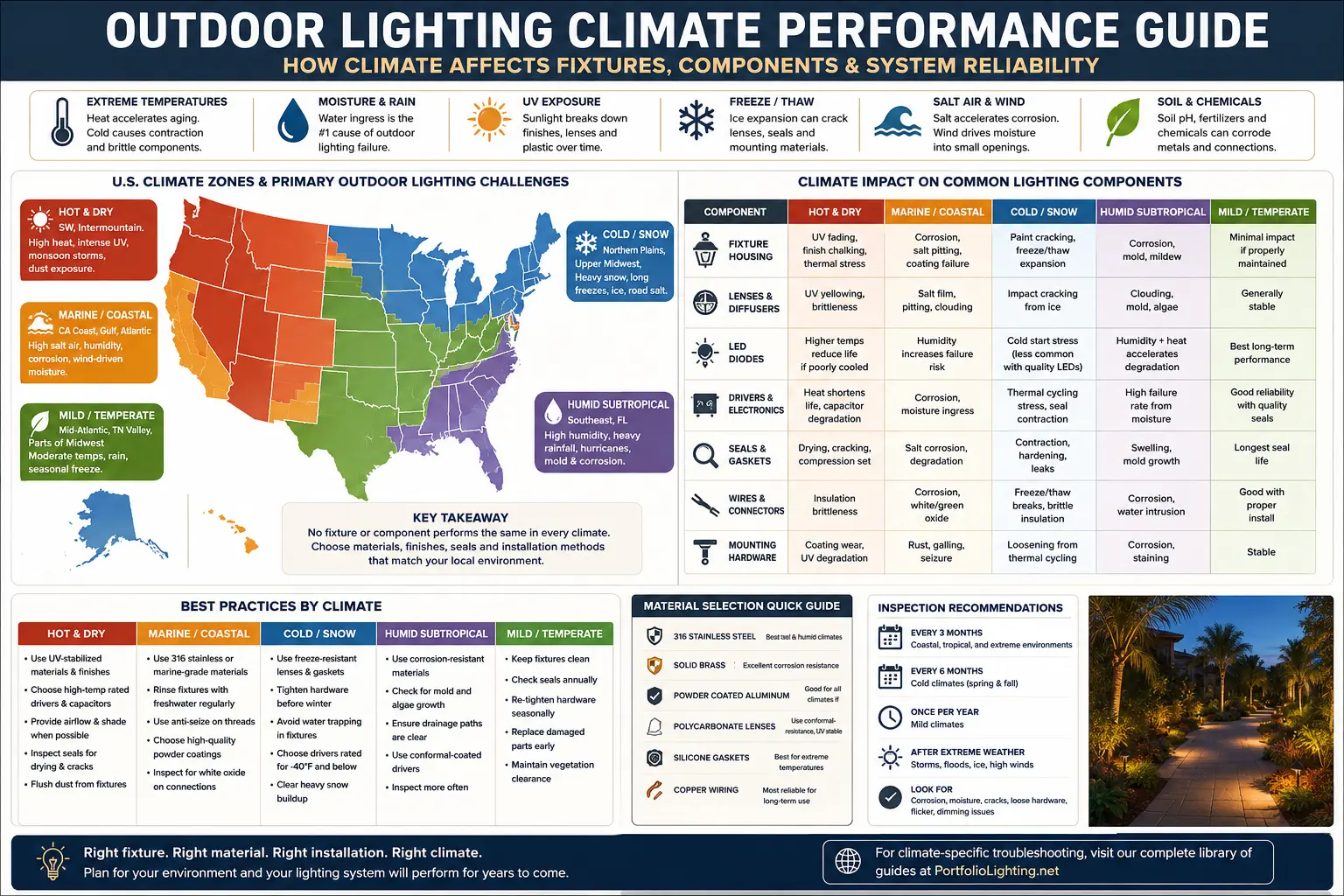
Why Climate Changes the Meaning of “Outdoor Rated”
An outdoor rating confirms that a product is intended for a stated environment. It does not guarantee equal life in every climate. A wet-location fixture in a shaded inland yard experiences a very different service life than the same fixture beside a saltwater pool, under a drip emitter or in a south-facing stone bed.
The fixture body is only one part of the system. The fastest climate-driven failure may occur at the gasket, socket, connector, transformer terminal, cable jacket, stake thread, photocell window or LED driver capacitor.
The better question is not simply, “Is this light outdoor rated?” Ask, “Which component will fail first in this exact exposure?”
When two identical fixtures fail at different ages, compare direct sun, irrigation direction, mulch depth, fixture tilt, salt air and drainage before blaming manufacturing variation.
For rating terminology, use the landscape lighting IP rating comparison and wet-location listing requirements guide.
The Outdoor Lighting Climate Load Score
Assign one point for each stressor that applies at the actual fixture location: high heat, high humidity, salt exposure, freeze-thaw, direct irrigation, poor drainage, high UV and mechanical exposure from snow removal, edging or foot traffic.
0–2 points: low climate load. 3–5: moderate load requiring better materials and scheduled inspection. 6 or more: severe exposure where serviceability, sealed connections and short maintenance intervals should control the specification.
| Stress Point | When It Applies | Primary Damage |
|---|---|---|
| High heat | Full afternoon sun or hot enclosure | Driver aging, gasket compression, plastic brittleness |
| Humidity | Frequent nighttime condensation | Socket and terminal oxidation |
| Salt | Coastal or pool chloride exposure | Galvanic and crevice corrosion |
| Freeze-thaw | Wet soil repeatedly freezes | Stake heave, seal movement, splice stress |
| Irrigation | Direct sprinkler or drip exposure | Water intrusion and mineral scale |
| Poor drainage | Clay, low spots or deep mulch | Standing-water exposure |
| High UV | All-day direct sun | Yellowing, cracking and finish fading |
| Mechanical exposure | Plows, shovels, edging or traffic | Broken stakes, severed cable, cracked lenses |
Regional Climate Failure Profiles
- Primary stress: enclosure heat, UV, thermal cycling and dust.
- First failures: LED drivers, photocell windows, plastic stakes and cable jackets.
- Field signature: electronics die while the lens remains clear.
- Best response: shade drivers, ventilate transformers and prefer high-temperature electronics.
- Primary stress: humidity, condensation, warm rain, irrigation and chlorides.
- First failures: sockets, connectors, gaskets and aluminum finish edges.
- Field signature: intermittent operation after rain, green residue and fogged lenses.
- Best response: gel-filled splices, brass or 316 stainless hardware and freshwater rinsing.
- Primary stress: temperature swings, wind-driven rain, storms, freeze-thaw and clay movement.
- First failures: loose stakes, cable stress, wet splices and surge-damaged transformers.
- Field signature: failures appear after storms or spring thaw.
- Best response: strain relief, surge protection and seasonal alignment checks.
- Primary stress: intense UV, snow, freeze-thaw and sharp nighttime cooling.
- First failures: brittle plastics, cracked seals, heaved stakes and snow damage.
- Field signature: fixtures shift upward and connector shells crack.
- Best response: metal stakes, UV-stable cable and protected mounting.
- Primary stress: chloride deposition and crevice corrosion.
- First failures: screws, retaining rings, sockets, aluminum threads and wire entries.
- Field signature: seized fasteners, white aluminum bloom and green copper salts.
- Best response: 316 stainless or brass, metal isolation and freshwater rinsing.
- Primary stress: frozen soil, snow load, deicer, plows and spring saturation.
- First failures: stakes, driveway-edge fixtures, cable crossings and thaw-wet splices.
- Field signature: failure appears in spring rather than midwinter.
- Best response: setbacks, markers, protected crossings and post-thaw inspection.
Outdoor Lighting Performance by State
Your ZIP code has more influence on outdoor lighting lifespan than the brand name on the fixture. Heat, humidity, snow, salt spray, soil chemistry, irrigation practices, and ultraviolet exposure all change how quickly finishes, gaskets, sockets, drivers, transformers, and underground connections age. Use the guide below to identify the biggest environmental challenge in your state before choosing replacement fixtures or planning a new installation.
| State | Primary Climate Challenge | Most Common Failure Pattern | Best Material Choice |
|---|---|---|---|
| Alabama | Humidity & thunderstorms | Socket corrosion and moisture intrusion | Brass with silicone gaskets |
| Alaska | Extreme freeze/thaw | Cracked lenses and stake movement | Heavy brass or stainless steel |
| Arizona | Extreme heat & UV | Driver overheating and faded finishes | UV-resistant aluminum or brass |
| Arkansas | Humidity | Corroded connectors | Gel-filled waterproof connectors |
| California | UV, drought, coastal salt (varies) | Finish degradation or salt corrosion | Brass or marine-grade stainless |
| Colorado | High UV & snow | Plastic embrittlement | Brass fixtures |
| Connecticut | Freeze/thaw | Water intrusion after winter | Cast brass |
| Delaware | Salt air | Fastener corrosion | 316 stainless hardware |
| Florida | Humidity, salt & irrigation | Socket oxidation and gasket failure | Marine-grade brass |
| Georgia | Heat & humidity | Lens fogging | Brass with EPDM seals |
| Hawaii | Salt spray | Rapid corrosion | 316 stainless or solid brass |
| Idaho | Snow & freeze | Stake movement | Heavy-duty brass |
| Illinois | Freeze/thaw | Underground splice failures | Gel-filled direct burial splices |
| Indiana | Moisture & freezing | Transformer terminal corrosion | Brass fixtures |
| Iowa | Snow & clay soil | Cable movement | Flexible cable routing |
| Kansas | Wind, hail & temperature swings | Loose fixtures and surge damage | Brass with surge protection |
| Kentucky | Humidity | Water inside fixtures | Quality gasket systems |
| Louisiana | Humidity & flooding | Connector corrosion | Raised waterproof splices |
| Maine | Snow & coastal salt | Frozen seals and corrosion | 316 stainless |
| Maryland | Humidity & salt | Corrosion around hardware | Brass |
| Massachusetts | Salt & snow | Fastener seizure | Marine-grade metals |
| Michigan | Freeze/thaw | Broken stakes | Brass stakes |
| Minnesota | Extreme cold | Cracked plastic components | Metal construction |
| Mississippi | Humidity | Green connector corrosion | Silicone-filled connectors |
| Missouri | Storms & clay soils | Wire movement | Deep-buried cable |
| Montana | Cold & snow | Seal failures | Silicone gasket systems |
| Nebraska | Wind & lightning | Surge damage | Surge-protected transformers |
| Nevada | Heat & UV | Plastic degradation | Brass |
| New Hampshire | Freeze/thaw | Lens cracking | Tempered glass |
| New Jersey | Salt & humidity | Corroded sockets | Marine-rated fixtures |
| New Mexico | High UV | Finish fading | Powder-coated brass |
| New York | Snow & salt | Fastener corrosion | 316 stainless hardware |
| North Carolina | Humidity & coast | Moisture intrusion | Brass fixtures |
| North Dakota | Extreme cold | Stake heaving | Heavy metal stakes |
| Ohio | Freeze/thaw | Connector failures | Waterproof gel splices |
| Oklahoma | Wind & lightning | Transformer damage | Surge protection |
| Oregon | Rain | Water intrusion | Silicone seals |
| Pennsylvania | Snow & moisture | Socket corrosion | Brass fixtures |
| Rhode Island | Salt spray | Surface corrosion | 316 stainless |
| South Carolina | Humidity & salt | Corroded connectors | Marine brass |
| South Dakota | Freeze/thaw | Ground movement | Flexible wiring loops |
| Tennessee | Humidity | Lens condensation | Ventilated fixture designs |
| Texas | Heat, storms & clay soils | Driver heat damage | High-temperature drivers |
| Utah | UV & snow | Finish wear | UV-stable powder coating |
| Vermont | Snow | Freeze damage | Brass fixtures |
| Virginia | Humidity | Connector oxidation | Waterproof connectors |
| Washington | Rain | Moisture ingress | Silicone gasket systems |
| West Virginia | Mountain moisture | Corroded terminals | Brass construction |
| Wisconsin | Freeze/thaw | Broken stakes | Heavy-duty brass |
| Wyoming | Wind, snow & UV | Mechanical movement | Heavy-duty metal fixtures |
Material Performance Matrix by Climate
| Material | Heat / UV | Salt / Humidity | Freeze-Thaw | Typical Weak Point |
|---|---|---|---|---|
| Solid brass | Excellent | Excellent | Excellent | Fasteners and seals may fail first |
| 316 stainless | Excellent | Excellent | Excellent | Galvanic contact with aluminum |
| 304 stainless | Excellent | Moderate near salt | Excellent | Pitting in chloride exposure |
| Cast aluminum | Good if finish survives | Weak at chipped edges | Moderate | Powder-coat breach and seized threads |
| Polycarbonate | Depends on UV stabilization | No metal corrosion | Can become brittle | Yellowing and cracked screw bosses |
| EPDM gasket | Good heat balance | Good moisture resistance | Flexible | Compression set |
| Silicone gasket | Excellent | Excellent | Excellent | Tearing during service |
See the durable materials guide, coastal salt-spray guide and finish weathering database.
The Climate Failure Clock
Stage 1: Surface change
Finish chalking, lens haze, green connector dust, white aluminum bloom or a stiff gasket appears while the fixture still works.
Stage 2: Resistance and sealing loss
Connector resistance rises, socket contacts darken, gaskets lose compression and water reaches previously dry areas.
Stage 3: Intermittent operation
Lights work dry but fail after rain, flicker during temperature changes or shut off after the driver heats. This is the best repair window.
Stage 4: Mechanical or electrical lockup
Threads seize, stakes snap, screws strip, lenses crack, transformer terminals corrode or the driver fails completely.
Use the stuck fixture guide, socket repair guide and connector corrosion guide.
Ambient temperature influences transformer operating temperature and overall efficiency, particularly during extended overnight operation. For measured efficiency ranges, standby losses, and expected thermal performance under different loading conditions, review our Landscape Transformer Efficiency & Load Loss Benchmarks, then compare those findings with climate-related installation considerations.
Soil, Mulch, Fertilizer and Irrigation
A city’s weather report does not describe the microclimate at ground level. A fixture can sit in a wet pocket during a regional drought if a sprinkler strikes it every morning.
Clay soil
Clay holds water and moves during wet-dry and freeze-thaw cycles. It keeps connectors saturated, pushes fixtures out of alignment and pulls cable where no service loop was left.
Mulch
Mulch traps moisture against the lower housing, hides insects, covers drainage openings and raises local temperature around dark fixtures in sun.
Fertilizer and pool chemicals
Fertilizer salts and chlorides increase conductivity on damp surfaces. A small coating defect can corrode quickly when exposed to runoff or salt splash.
Irrigation direction
A fixture can tolerate rain and still fail under repeated high-pressure spray aimed at a seam or cable entry. Redirecting one sprinkler may extend life more than upgrading the housing.
When one fixture repeatedly fogs while identical nearby fixtures remain clear, watch the irrigation system operate. The apparent gasket failure may be a direct jet striking the seam every morning.
Maintenance Schedule by Climate
| Exposure | Interval | Inspect | Preventive Action |
|---|---|---|---|
| Low: shaded, inland, drained | Twice yearly | Alignment, lenses, connectors, terminals | Clean, tighten and clear mulch |
| Hot desert / high UV | Quarterly in hot season | Driver heat, cracked plastic, brittle cable | Improve shade and replace aging plastic |
| Coastal / salt | Monthly visual; quarterly hands-on | Fasteners, rings, terminals and deposits | Freshwater rinse and clean corrosion |
| Freeze-thaw / snow | Before winter and after thaw | Stake movement, cracked connectors and cable pull | Realign and restore service loops |
| Heavy irrigation / clay | Quarterly | Standing water, scale and fogging | Redirect spray, improve drainage and raise splices |
Use the landscape lighting maintenance guide and failure database for full service procedures.
How to Specify Lighting for a Harsh Climate
- Define exposure at fixture level. Record direct sun, salt, irrigation, snow removal, soil drainage and possible standing water.
- Choose the complete material stack. Housing, fasteners, stake, gasket, lens, wire entry and connector must all suit the climate.
- Plan the first service event. Replaceable lamps, accessible drivers and non-seizing fasteners matter more than initial appearance.
- Control the microclimate. Redirect irrigation, add drainage, raise splices, shade transformers and keep mulch below seams.
- Document maintenance. Record model, material, connector type and inspection interval.
Compare the life-cycle cost guide, fixture repairability guide and repair cost guide.
Outdoor Lighting Climate Performance FAQ
What climate is hardest on outdoor lighting?
The hardest environment usually combines stressors: salt and humidity, heat and UV, or freeze-thaw and saturated soil.
Why do fixtures near sprinklers fail first?
Direct spray pushes water toward seams, leaves mineral deposits and keeps connectors wet longer than natural rainfall.
Should coastal fixtures be rinsed?
Yes. Freshwater rinsing removes chloride deposits before they concentrate around screws, seams and retaining rings.
Does a higher IP rating solve every climate problem?
No. IP ratings address ingress under defined tests, not UV life, salt corrosion, freeze-thaw durability, driver heat or repairability.

Lighting specialist focused on landscape lighting troubleshooting, replacement compatibility, transformer systems and climate-driven outdoor fixture failures.