
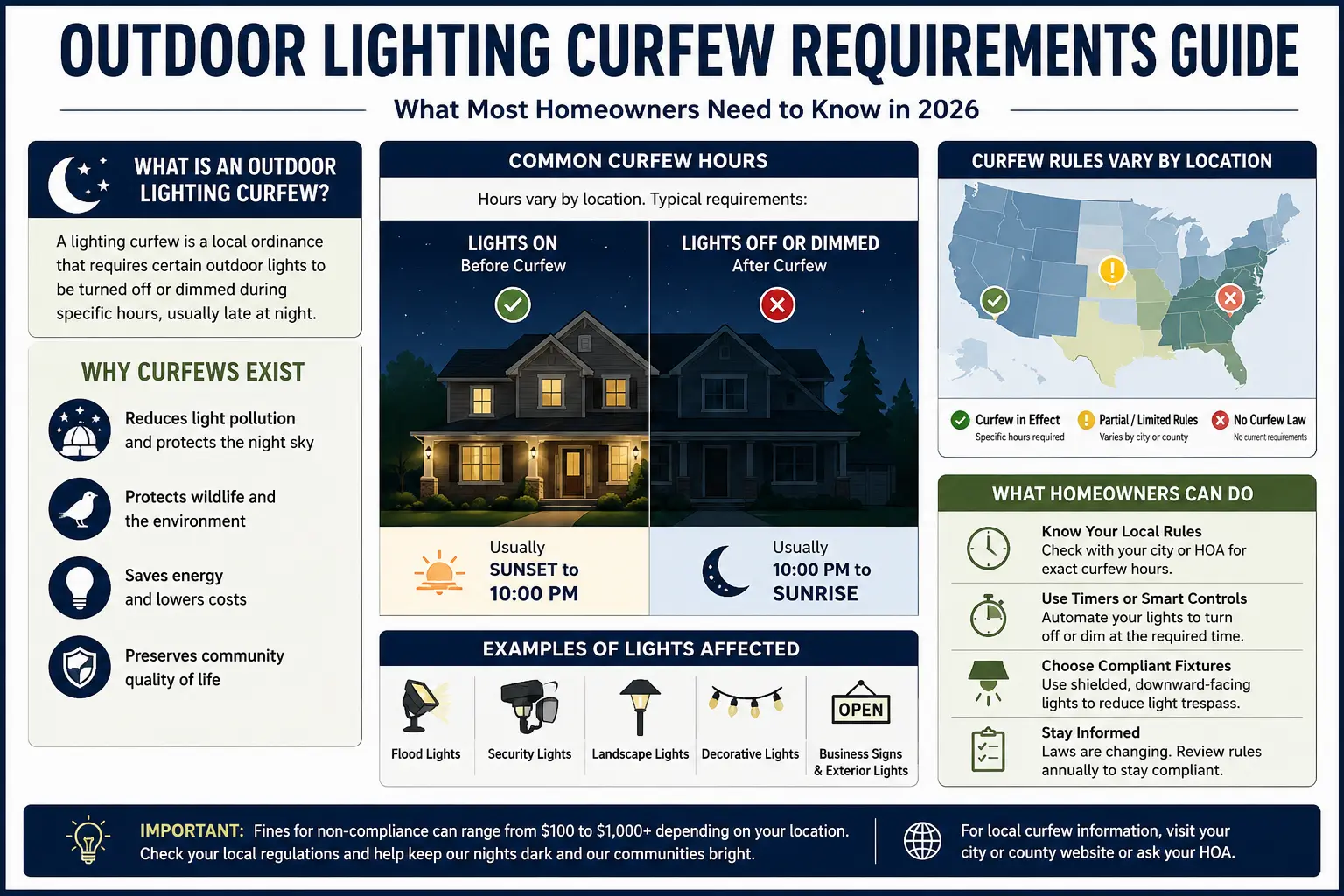
The Three Curfew Mechanism Types
Lighting curfew ordinances use three fundamentally different enforcement mechanisms, each requiring a different compliance strategy. Understanding the mechanism type in any specific ordinance is the first step — because the compliance documentation, control technology, and enforcement pathway differ significantly across these three approaches.
All non-excepted outdoor lighting must be completely extinguished by the curfew time. No residual illumination, no security exceptions for general lighting — exceptions are specifically enumerated and narrow.
- Requires automatic controls that cut power entirely
- Most common in dark sky sanctuary zones and LZ0/LZ1 areas
- Example: Ojai CA — unshielded residential lights off at 10 PM
- Arizona statewide provision: midnight-to-sunrise for non-compliant fixtures
- Strongest night sky protection; most restrictive for property owners
Lighting must be reduced to a specified percentage — typically 50% of initial light output — by the curfew time. Some ordinances allow full shutoff in lieu of reduction.
- Requires automatic dimming controls (0-10V, DALI, or switched circuits)
- Most common in commercial and industrial zones
- Example: Calimesa CA — 50% reduction at 10 PM or close of business
- Example: Fairfax County VA — parking lots dim 50% within 30 min after close
- Allows security lighting to remain while reducing sky glow impact
Rather than a fixed curfew time, the ordinance requires controls that automatically adjust light levels based on occupancy or schedule — limiting lighting to when and where it's needed.
- Motion sensors, occupancy sensors, or networked schedule controls
- Allows full light output when needed; reduces/extinguishes when not
- MLO framework and Texas model ordinance both support this approach
- San Bernardino County: "lighting is restricted to times, places, or activities where needed"
- Growing 2026 trend: motion sensors plus timer shutoff as combined requirement
IDA/IES Model Lighting Ordinance Curfew Framework by Lighting Zone
The IDA/IES Model Lighting Ordinance (MLO), jointly developed by the International Dark-Sky Association and the Illuminating Engineering Society and published in 2011, is the most widely used template for municipal lighting ordinance adoption in the US. Its curfew framework organized by Lighting Zone (LZ) establishes the baseline expectation that hundreds of adopting jurisdictions have built on.
The MLO's Curfew Approach — Performance-Based Timing
Unlike fixed-hour curfews, the MLO uses a flexible curfew approach: "Curfew ('Curfew') time to be established in the Permit." This means the specific curfew hour is set during the permit review process for each individual project, rather than being fixed in the ordinance text. The MLO User's Guide states that this approach allows for "shift workers and 24 hour operations, or to extend the curfew time to meet specific needs."
Each Lighting Zone in the MLO has specific after-curfew expectations:
| Zone | Zone Character | After-Curfew MLO Expectation | Typical Land Use | Curfew Stringency |
|---|---|---|---|---|
| LZ0 | No ambient lighting | Essentially no lighting permitted — curfew is effectively all hours | Wilderness, national parks, rural undeveloped land | Maximum — lights prohibited at all hours except safety exceptions |
| LZ1 | Low ambient lighting | "After curfew, most lighting should be extinguished or reduced as activity levels decline" | Rural residential, protected natural areas, observatory buffers | High — most lights must go out at curfew; minimal safety-only exceptions |
| LZ2 | Moderate ambient lighting | "After curfew, lighting may be extinguished or reduced as activity levels decline" | Low-density residential, small-town commercial, neighborhood retail | Moderate — reduction encouraged but "may" language gives flexibility |
| LZ3 | Moderately high ambient lighting | Adaptive controls required; curfew time set in permit; significant flexibility for 24/7 operations | Commercial corridors, urban residential, shopping centers | Moderate — emphasis on adaptive controls over fixed shutoff |
| LZ4 | High ambient lighting | Entertainment districts, 24-hour operations — curfew may not apply or may be very late | Entertainment districts, stadiums, major commercial centers | Least restrictive — curfew set per permit based on operation needs |
Why the MLO Curfew Approach Matters for Permit Applicants
For jurisdictions that have adopted the MLO framework, the absence of a specific curfew hour in the ordinance text doesn't mean there's no curfew — it means the curfew hour is negotiated at permit review. A permit application for a commercial project in an MLO-adopting jurisdiction that doesn't address the curfew question will have it raised during plan review. The permit submittal should proactively propose a curfew time and demonstrate how the automatic controls will achieve it. See the permit rejection guide for how lighting control documentation gaps cause plan review rejections.
Lighting curfews reduce runtime, but they do not fix a bad beam pattern during the hours when the lights are still allowed to operate. A fixture that shines sideways toward windows or upward into the sky can create glare and light trespass before curfew even begins. Pair operating schedules with better fixture design by reviewing the shielded vs. unshielded outdoor lighting guide. Shielding, dimming, and curfews work best together because each controls a different part of the lighting problem.
State-Level Lighting Curfew Provisions
Most lighting curfew requirements are municipal or county ordinances, but several states have established statewide lighting provisions that include curfew-equivalent requirements. Arizona's statewide light pollution statute is the most comprehensive example.
Arizona — ARS §49-1101 et seq.: The Curfew-as-Compliance-Alternative
Arizona's statewide light pollution law (Arizona Revised Statutes Title 49, Chapter 7) dates to 1986 — making it the oldest comprehensive statewide outdoor lighting law in the United States. Per the Lighting Design Center's documented summary: "Arizona's light pollution law dates back to 1986 (Ariz. Rev. Stat. Ann. §§49-1101 et seq.). The law requires all outdoor light fixtures to be fully or partially shielded, with the exception of emergency, construction and navigational airport lighting. Fixtures not in compliance are allowed provided they are extinguished between the hours of midnight and sunrise by automatic device."
This creates a unique curfew mechanism: shielding compliance and curfew compliance are alternative pathways. A fixture that doesn't meet Arizona's shielding requirement has two compliance options: (1) add shielding to bring it into conformance, or (2) install an automatic device that extinguishes the fixture from midnight to sunrise. The ARS §49-1101 definition of "outdoor light fixture" explicitly includes "landscape lighting" — ARS §49-1101(2): "Outdoor light fixture means outdoor artificial illuminating devices, lamps and other devices, permanent or portable, used for illumination or advertisement. Such devices shall include, but are not limited to, search, spot or flood lights for buildings and structures, recreational areas, parking lot lighting, landscape lighting, billboards and other signage and street lighting."
The Arizona Landscape Lighting Implication: In Arizona, any landscape lighting fixture that doesn't meet the "fully or partially shielded" standard of ARS §49-1102 must be extinguished from midnight to sunrise by an automatic device. This is a statewide requirement — not a local option. The AHJ in any Arizona jurisdiction can enforce this midnight-to-sunrise curfew requirement against non-compliant landscape lighting fixtures even in jurisdictions without a specific local lighting ordinance. For Arizona landscape lighting installations: either use fully or partially shielded fixtures per the statutory definition, or install automatic controls that extinguish unshielded fixtures from midnight to sunrise.
Colorado — CRS §24-82-901 et seq.: Full Cutoff for High-Output Sources
Colorado's outdoor lighting statute (Colorado Revised Statutes §24-82-901) requires consideration of costs, energy conservation, glare reduction, light pollution minimization, and preservation of the natural night environment for new outdoor lighting installations. The Colorado statute requires use of a "full-cutoff fixture" when output exceeds specified lumen thresholds. While Colorado's statute is more focused on shielding than curfew times specifically, many Colorado municipalities have built curfew requirements on top of the state framework through local ordinances.
Florida — Beachfront Curfews for Sea Turtle Nesting
Florida's sea turtle nesting requirements create wildlife-driven curfews that apply specifically to beachfront lighting. The Florida Fish and Wildlife Conservation Commission (FWC) requirements for beachfront properties include restrictions on lighting visible from the beach during nesting season (May through October, with hatching through November). While not a traditional municipal curfew, the nesting-season lighting restrictions function as seasonal operating hour limitations — requiring that certain lighting types be shielded, reduced, or extinguished during nesting hours on beachfront properties. See the coastal lighting guide for the Florida CCCL and FWC framework.
Documented Municipal Curfews: Seven Jurisdictions with Exact Hours
These seven documented jurisdictions illustrate the range of curfew hour and mechanism combinations that landscape and outdoor lighting installations encounter. These are derived from publicly available ordinance documents and city websites.
Commercial
Per PacLights' documented analysis: "In Flagstaff, Arizona, commercial properties must turn off or dim their outdoor lighting by 11 PM or when the business closes (whichever is later). Some regulations allow exceptions for security lighting, but often with stricter controls. After-hours security lighting might require motion sensors and timers to minimize unnecessary illumination." Flagstaff is also home to Lowell Observatory and is a designated International Dark Sky City — one of the first cities in the world to receive this designation from IDA. The 11 PM commercial curfew is enforced as part of Flagstaff's dark sky protection framework. Flagstaff also restricts color temperature to 3000K or lower for outdoor lighting.
Residential & Commercial
Lakeway TX's dark sky ordinance (documented on city website) establishes different curfew windows for residential and commercial uses. Lighting "shall be dimmed by at least 30% or extinguished during the curfew hours." This is one of the few jurisdictions that specifies a 30% minimum dimming reduction rather than the more common 50%. The ordinance also contains one of the most clearly documented grandfathering frameworks: "Existing properties do not have to comply unless they make changes above a certain threshold... The property owner repairs or replaces more than 50% of their lighting [or] increases the building or parking area by more than 50%."
Commercial / Industrial
Per Calimesa Municipal Code Chapter 18.120: "Outdoor lighting systems in the commercial/industrial zone shall be turned off or reduced in lighting by at least 50 percent beginning at 10:00 p.m. or close of business, whichever is later, until dawn or the opening of business, whichever is earlier. The reduction shall be determined as an overall average for the parcel. When possible, the lighting system shall be turned off rather than reduced in lighting level. Lighting shall be equipped with either timer controls or with photocell on and off switches." The ordinance specifies timer or photocell as acceptable controls — and requires the reduction be calculated as an average across the entire parcel rather than per fixture.
Residential & Recreational
Ojai's ordinance summary creates an important compliance choice: lights that are fully shielded and downward-directed are not subject to the curfew; lights that are not shielded must turn off at 10 PM (residential) or after business hours (commercial). Per the Ojai Ordinance Summary: "Lights that are not shielded and downward directed must be turned off at 10 pm (Section 10-2.16.504(g)). Fully shielded motion-activated security lights on a 12 minute timer are allowed." The motion sensor provision is notably specific — 12-minute maximum timer duration for post-activation operation. Recreational lighting: "Turn unshielded lights off at 10 pm, or end of event." School and government facilities are exempt.
Class 1 & Class 3
Coconino County encompasses the Grand Canyon and protects observatories in the Flagstaff area including Lowell Observatory. The county's outdoor lighting ordinance (Section 17) uses a lighting class system with curfew times established in Table 17.6.G that vary by proximity to observatories and protected areas. The ordinance preamble: "The topography and atmospheric conditions of Coconino County, Arizona, are uniquely suited for astronomical observation, that a substantial investment has been made in observatories in the County, and that the use of certain types of outdoor lights and certain outdoor lighting practices have an adverse impact on astronomical observation." Sign lighting curfews are separately addressed: "Illumination for all advertising signs, both externally and internally illuminated, shall be turned off no later than the curfew times listed in Table 17.6.G or when the business closes, whichever is later."
Class I & Class III
San Diego County's private outdoor lighting regulation (PDS 211) establishes curfews relative to sunset rather than fixed clock times — a design that automatically adjusts the curfew time seasonally. Per the ordinance: "All Class I and Class III lighting shall be extinguished two hours after sunset or within 30 minutes after the close of business or event, whichever is later." The mountain and desert region overlay adds stricter requirements including a Dark Sky Curfew with more stringent light trespass limits (0.1 fc at property line vs. standard limits). The ordinance also requires: "All new public lighting shall be regulated with adaptive controls such as the lighting of areas is restricted to times, places, or activities where needed."
Parking Lots
Per Fairfax County's Outdoor Lighting Standards: "Parking lots with 4 or more light poles (surface lots and the top level of a parking structure) must dim the lights by 50% within 30 minutes after closing." The trigger is the number of poles (4+) rather than a use type classification — meaning small commercial parking areas with fewer than 4 poles are not subject to this specific requirement. The 30-minute post-close window acknowledges that patrons and employees may still be on site immediately after closing. The 50% dimming requirement is consistent with the Calimesa CA approach and represents a common commercial lighting curfew pattern in jurisdictions that have adopted partial reduction rather than full shutoff requirements.
Why Manual Switches Never Satisfy Curfew Requirements
This is the most consequential compliance misconception in outdoor lighting — and it generates enforcement actions on installations that were otherwise compliant in every other dimension.
A curfew ordinance requires that outdoor lighting be extinguished or reduced at a specified time — every night, without exception. A manual wall switch requires a human being to operate it at the correct time, every night, indefinitely. These are fundamentally incompatible requirements.
Per Stars and Stripes Lighting's 2026 regulatory analysis: "Key compliance point: Manual switches do not satisfy curfew requirements; automation (time-based, photocell + schedule, or networked controls) is typically required." Per the Pennsylvania Outdoor Lighting Council's enforcement guidance: an effective lighting ordinance requires "acceptable means of controlling lighting" and curfew requirements — not "lighting shall be controlled" general language that a manual switch might nominally satisfy.
The enforcement scenario: a commercial property receives a curfew compliance violation notice. The property owner responds that they turn off the parking lot lights manually each night when they leave. The inspector asks for documentation that this occurs every night without exception. It doesn't exist. The enforcement action proceeds because the ordinance requires a reliable automatic mechanism, not a human commitment to turn off lights at a specific time. The fix: install a timer or astronomical controller. The annual cost of the controller is a fraction of the fine exposure.
The Power Outage Problem for Plug-in Timers
Standard plug-in mechanical or digital timers that reset to blinking "12:00" after a power outage also fail to satisfy curfew requirements — because their programming is lost and must be manually reset after every power interruption. An area with weekly brief power fluctuations will have a timer that is frequently de-programmed and operating on its default state (either always-on or always-off). For curfew compliance purposes, the control must maintain its schedule through power interruptions via: battery backup memory (most modern digital controls), non-volatile programming (astronomical switches with battery-backed RTC), or networked controls that re-sync from a server after power restoration.
Controls Technology Compliance Matrix
Not all automatic controls satisfy all types of curfew requirements. This matrix maps the compliance status of each control technology against the three curfew mechanism types.
Curfew compliance depends on control equipment continuing to operate reliably through local weather conditions. Photocells may become unreliable when their windows haze, timers can reset after surge events, and moisture can corrode control terminals without disabling the entire lighting circuit. The Outdoor Lighting Climate Performance Guide identifies the heat, humidity, salt, snow, and storm conditions most likely to affect outdoor controls and explains how mounting location and inspection frequency can reduce missed shutoff events.
- Astronomical time switch: Programs to latitude/longitude and automatically adjusts shutoff time daily to track sunset/sunrise. Maintains schedule through power outages with battery-backed RTC. Satisfies fixed-hour and sunset-referenced curfews. The gold standard for landscape lighting curfew compliance.
- Photocell + schedule control: Photocell triggers at dusk; schedule sets the curfew shutoff time regardless of photocell reading. Satisfies fixed-hour curfews reliably when programmed correctly and backed by battery memory.
- Networked/smart lighting control system: Cloud-synchronized programming that maintains schedule after power restoration. Satisfies all curfew types and provides logging for enforcement documentation. Required for some commercial curfew monitoring programs.
- DALI or 0-10V dimming controller with schedule: Provides the 50% dimming reduction required by partial reduction curfews. Requires a control module that initiates the dim command at the scheduled time automatically.
- Occupancy/motion sensors (where accepted): Where the ordinance specifically accepts motion-activated operation as the curfew compliance mechanism (as in Ojai CA's 12-minute motion sensor provision). Not all curfew ordinances accept motion sensors as substitutes for time-based shutoff.
- Manual wall switch: Requires human operation. Never satisfies any curfew requirement. See section above for enforcement scenario.
- Plug-in mechanical timer without battery backup: Resets to default after power outage. Schedule requires manual re-entry after every power interruption. Not reliable enough for curfew compliance.
- Photocell-only control: Turns lighting on at dusk and off at dawn — no curfew shutoff capability. The light stays on all night. Does not satisfy any timed curfew requirement. Only appropriate for installations that are genuinely exempt from curfew requirements.
- Motion sensor without maximum-duration shutoff: Motion sensors without a maximum run duration can operate lighting all night if motion continues to be detected (such as from passing traffic). Most curfew-compliant motion sensor installations require a hard cutoff time — for example, Ojai's 12-minute timer after last motion detection.
- Switching relay without programming: A relay that simply connects and disconnects power without a programmed schedule provides no curfew control benefit without a controller to actuate it at the required time.
Sports Field and Recreational Facility Curfew Requirements
Sports field and recreational facility lighting generate some of the most contentious curfew enforcement situations — because games run long, overtimes happen, leagues push back, and the lighting systems are among the most powerful and sky-glow-generating installations in residential neighborhoods.
The 10:30 PM Rule and the "Regardless of Extra Innings" Standard
Per the Pennsylvania Outdoor Lighting Council's comprehensive municipal ordinance guidance: "For active recreational sports, setting a 10:30 or 11:00 p.m. curfew, regardless of extra innings, playoffs or overtimes, will preclude games going on until all hours of the night. The establishment of penalties for non-compliance will also be appropriate. This needs to be negotiated during the acceptance process, not after the fact. The sports league or other agency or group will be more willing to abide by such a restriction during negotiations than after."
The POLC guidance continues: "It will of course be essential that a suitable but greatly reduced level of light be provided for safe exiting of spectators and performing maintenance functions." This is the practical design requirement that follows from a hard sports lighting curfew: a low-level pathway lighting circuit (separate from the field lighting) must remain operable after the field lights are cut to allow spectators to safely exit the facility.
Documented Sports Lighting Curfew Provisions
- Ojai CA: "Recreational lighting — Turn unshielded lights off at 10 pm, or end of event." The "end of event" clause provides a grace period for events that conclude before 10 PM without requiring early shutoff.
- Torrey UT dark sky ordinance: "Recreational lighting (residential and commercial) shall be turned off by ten o'clock (10:00) P.M., except to conclude a community approved sporting event that is underway." The "community approved sporting event underway" exception allows games that started before 10 PM to conclude — but not to start new innings/periods after 10 PM.
- California and Texas model ordinances: Separate sports/recreational zone with specified curfew times in table format, typically 10:00-10:30 PM with exception for events in progress, and explicit requirements for post-event safety lighting at reduced levels.
The League Negotiation Strategy
POLC's documentation of the "negotiate before installation, not after" principle reflects a real enforcement dynamic: once a sports lighting system is installed without a curfew mechanism, the league, school, or parks department becomes accustomed to running events as long as needed. Introducing a curfew after installation faces institutional resistance. The compliance strategy for sports lighting: build the curfew controls into the installation from day one, establish the curfew hour as part of the permitting and conditional use approval process, and negotiate league scheduling constraints before the lights are turned on. This eliminates the after-the-fact resistance and creates documented institutional agreement with the curfew requirement.
Grandfathering: When Existing Lighting Loses Its Exemption
When a new or updated curfew ordinance is adopted, existing non-compliant lighting typically receives grandfathering protection — it can remain in place without being immediately required to comply. But that protection is not permanent and ends when specific triggering events occur.
The Most Common Grandfathering Triggers
The Lakeway TX dark sky ordinance documents the clearest grandfathering framework and most commonly cited trigger thresholds:
- 50% repair or replacement threshold: When the property owner repairs or replaces more than 50% of the total lighting system, the entire installation is considered new work and must comply with current curfew requirements. This is the most common trigger and the one most frequently encountered during renovation projects. A landscape lighting retrofit that replaces more than half the fixtures triggers full compliance with the current ordinance.
- 50% building or parking area expansion: Expanding the building footprint or parking area by more than 50% triggers lighting compliance — both for the new area and (in many jurisdictions) for the entire site.
- Property sale (some jurisdictions): Some ordinances require curfew compliance as a condition of property transfer. This is less common but appears in jurisdictions where the goal is accelerated compliance rather than long-duration grandfathering.
- Amortization deadlines: Some ordinances include an amortization period — a date by which all existing non-compliant lighting must come into compliance regardless of whether any triggering events occur. The MLO includes placeholder language for amortization: "On or before [amortization date], all outdoor lighting shall comply."
San Bernardino County's Grace Period Approach
Per San Bernardino County's outdoor lighting regulations (LUS): "Any modifications or replacement of outdoor fixtures required to comply with the ordinance will have a grace period of 18 months for commercial and industrial properties and 24 months for all other land uses." This grace period is triggered by the ordinance adoption — not by individual property changes. All commercial and industrial properties had 18 months from the ordinance effective date to bring their lighting into compliance, regardless of whether they were making other changes. The grace period approach is more aggressive than a trigger-based grandfathering system and represents a jurisdiction that prioritizes faster compliance over indefinite grandfathering protection.
The 50% replacement threshold creates a significant planning consideration for phased landscape lighting upgrades. A property with 20 landscape lighting fixtures that plans to replace them over 5 years (4 per year) may be able to avoid triggering the grandfathering loss in any single year — as long as no single year's replacements exceed the 50% threshold. However, if year 3 brings a burst of replacement that pushes the cumulative count over 50%, some jurisdictions will count cumulative replacements rather than single-year totals. Clarify with your AHJ whether the 50% threshold is calculated per permit application, per year, or cumulatively before planning a multi-phase lighting renovation. This conversation before the renovation starts is far less expensive than discovering after the fact that the renovation triggered full curfew compliance for the entire property.
Wildlife Corridor Prohibitions: Beyond Timing to Absolute Restrictions
In jurisdictions with designated wildlife corridors, curfews are often replaced by absolute lighting prohibitions — where no amount of lighting at any hour is permitted.
Lighting curfews reduce sky glow by limiting how long decorative and landscape lighting operates after activity drops off for the night. But runtime is only one part of the solution. A fixture can still create unnecessary upward light before curfew if it is too bright, unshielded, or aimed poorly. Our home sky-glow reduction guide explains how curfews, dimming, shielding, brightness limits, and fixture placement work together to lower nighttime light pollution.
The Calimesa Wildlife Corridor Absolute Prohibition
Calimesa's municipal code goes beyond its commercial 10 PM curfew to establish an absolute prohibition in designated wildlife areas: "Wildlife corridors, as designated by the city of Calimesa general plan, Western Riverside County multiple species habitat conservation plan, a tentative tract or parcel map, or any other mechanism recognized by the city of Calimesa, shall not be lighted." There is no curfew here — there is no permitted hours. Wildlife corridors are a dark zone at all times.
The significance for landscape lighting: a property adjacent to or partially within a designated wildlife corridor may have portions of its landscape that are subject to this absolute prohibition. The corridor designation isn't always obvious from the property address — it requires checking the general plan wildlife corridor map. A landscaping project that installs lighting in a designated wildlife corridor could face a mandatory lighting removal order, not just a curfew compliance notice. See the permit rejection guide for how wildlife overlay zoning affects lighting plan submissions.
Western US Wildlife-Driven Lighting Restrictions
Beyond designated corridors, many jurisdictions in the western US have biological resource overlay zones that impose lighting restrictions on properties near sensitive habitat. These include:
- Migration corridor buffers: Properties within a defined distance of documented wildlife migration routes — deer, tortoise, amphibian, bat foraging corridors — may require fully shielded, downward-directed, amber-spectrum (≤3000K) lighting at reduced lumen output
- Riparian zone setbacks: Properties adjacent to streams, rivers, and wetlands often have lighting restrictions that protect nocturnal wildlife and aquatic ecosystems from artificial light intrusion
- Dark zone easements: Some conservation easements and habitat protection agreements include specific lighting restriction language that runs with the land — binding future owners regardless of ordinance changes
Holiday Lighting Exemption Windows
Most curfew ordinances include specific exemptions for seasonal and holiday lighting — providing defined windows during which decorative lighting is permitted beyond normal curfew hours. These exemptions are more specific than many property owners assume.
Documented Holiday Lighting Windows
- Ojai CA — Residential: "Holiday lights 45 days before and 15 days after the applicable holiday are permitted (Section 10.2.16.505(b))." For Christmas/New Year's: 45 days before December 25 = November 10 start; 15 days after January 1 = January 16 end. This is a 91-day window for the winter holiday season.
- Ojai CA — Commercial: "Holiday lights 45 days before and 14 days after the applicable holiday are permitted (10.2.16.505(b))." One day less post-holiday than residential.
- General ordinance pattern: Most jurisdictions that address holiday lighting use 30-45 days before and 15-30 days after as the standard window. Some apply this per-holiday (allowing separate windows for Halloween, Thanksgiving, Christmas, etc.); others allow only the winter holiday season.
What "Permitted" Means for Holiday Lighting Curfews
The holiday lighting exemption typically permits decorative holiday lights to remain illuminated during the holiday window without being subject to the standard curfew hour. However, this does not always mean they can operate all night — some ordinances extend the curfew hour for holiday lighting (e.g., permitted until midnight during the holiday window vs 10 PM normally) rather than eliminating the curfew entirely. Verify whether your jurisdiction's holiday exemption allows all-night operation or simply extends the curfew time. The Ojai ordinance language — "permitted" — suggests the lighting is allowed throughout the window without a specific shutoff hour, but this interpretation varies by jurisdiction.
The 2026 Regulatory Convergence: Automated Controls as New Permit Baseline
A significant regulatory shift is occurring in 2026 as three previously separate lighting compliance requirements converge into a single, integrated commercial site lighting standard.
The Three-Part 2026 Baseline
Per Stars and Stripes Lighting's analysis of 2026-era ordinance adoption patterns: "By 2026, many zoning reviews and local ordinances are converging on three baseline requirements for commercial sites: correlated color temperature at or below 3000K, defined shielding or cutoff performance often expressed through BUG ratings, and controls capable of curfew or scheduled light reduction after hours. Installations that meet average illuminance targets but fail these criteria are increasingly subject to correction or rejection. This shift is not aesthetic — it is regulatory. Projects that ignore CCT limits, BUG ratings, or operating-hour restrictions increasingly face permit delays, failed inspections, or mandated retrofits."
The three-part baseline represents a structural change from how outdoor lighting permits were reviewed a decade ago. Previously, a permit application that demonstrated adequate illuminance levels (average foot-candle targets) on the photometric plan was generally approvable. In 2026, three additional compliance axes must be satisfied:
- CCT ≤ 3000K: Many jurisdictions now reject photometric plans that show fixtures above 3000K correlated color temperature — not as a design preference but as a code requirement. Per Stars and Stripes Lighting: "CCT compliance alone is insufficient. Many ordinances treat CCT as an as-installed limit. If fixtures are field-selectable, the compliance risk is that someone can switch to 4000K/5000K later — so reviewers may require factory-set 3000K or documented lockout." See the dark sky fixture selection guide for the complete CCT compliance framework.
- BUG ratings: Fixture-specific BUG (Backlight, Uplight, Glare) performance ratings must be documented in the submittal. Per the 2026 analysis: "Wall packs and area lights without factory shielding, a true cutoff optic, or a verified BUG profile often fail review even when wattage is low." See the dark sky compliance vs IDA certification guide for the BUG rating framework.
- Automated curfew controls: The permit submittal must include documentation of the automatic control type and programming that achieves curfew compliance. Per the 2026 analysis: "Manual switches do not satisfy curfew requirements; automation is typically required." The control specification is now a required submittal document in jurisdictions that have adopted curfew requirements.
How to Prepare a 2026-Compliant Lighting Plan
A commercial landscape lighting plan submitted in 2026 should include, as standard submittal components:
- Photometric plan with fixture point-by-point illuminance and BUG rating documentation
- Fixture cut sheets showing CCT (≤3000K recommended; verify local requirement) and BUG rating
- Curfew control specification including control type (astronomical time switch, photocell + schedule, etc.), manufacturer/model, and programming parameters
- Power outage recovery documentation — how the control maintains or restores its schedule after power interruption
- Maintenance responsibility statement — who is responsible for verifying control operation and re-programming as needed
Projects that submit only a photometric plan and fixture list without curfew control documentation are increasingly being held at plan check for technical comments requesting the missing information — adding weeks to the permitting timeline. See the permit rejection guide and the state permit requirements guide.
Curfew Compliance in Permit Applications: The Complete Pre-Submission Checklist
Step 1: Identify Whether a Curfew Requirement Applies
- Check the jurisdiction's outdoor lighting ordinance (municipal code, typically in zoning or development code section titled "outdoor lighting" or "exterior lighting")
- Verify the lighting zone designation for the property (LZ0-4 if MLO-based; local zone designations otherwise)
- Check for overlay zones — wildlife corridor, dark sky overlay, mountain/desert region, beachfront — that impose additional restrictions
- Check state law — Arizona properties are subject to ARS §49-1101 regardless of local ordinance status
- Verify whether property is within a designated IDA Dark Sky Place area, which may impose more restrictive curfew requirements
Step 2: Determine the Curfew Mechanism Type
- Full shutoff (Type 1): identify exactly which fixture types/classes are subject and what the exempted categories are (security, entry, emergency)
- Partial reduction (Type 2): identify the required reduction percentage (usually 50%), the measurement basis (per fixture vs parcel average), and the curfew time
- Adaptive controls (Type 3): identify whether motion sensors satisfy the requirement or whether time-based controls are required; identify maximum timer duration if motion sensors are accepted
Step 3: Specify the Control System
- Select control type that satisfies the curfew mechanism type
- Verify battery backup or non-volatile programming for power outage resilience
- For astronomical time switches: confirm latitude/longitude programming matches the installation location
- For networked systems: confirm scheduling is automatic and does not require manual intervention for routine operation
- Document the control specification in the permit submittal: make, model, programming parameters, power outage behavior
Step 4: Document Maintenance Responsibility
- Assign ongoing maintenance responsibility for verifying control operation (annual minimum; quarterly recommended)
- Verify time switch programming after Daylight Saving Time changes if using fixed-clock programming rather than astronomical control
- Create an as-built record showing control location, model, current programming, and next maintenance date
- Include in the property's lighting documentation file alongside permit records and as-built lighting diagrams
Outdoor Lighting Curfew FAQ
My commercial property's outdoor lighting is on a photocell — it turns off at sunrise. Is that sufficient for curfew compliance?
A photocell-only control that turns lighting off at sunrise does not satisfy a curfew requirement. A curfew requires lights to be extinguished or reduced at a specified time before sunrise — typically between 10 PM and midnight. A photocell turns lights on at dusk and off at dawn, meaning they operate all night. This is the opposite of curfew compliance. A photocell-only system provides dusk-to-dawn lighting with no after-hours reduction. To satisfy a curfew requirement with a photocell-based system, you need a photocell plus a schedule control: the photocell turns the system on at dusk, and the schedule module cuts the system (or dims it to 50% for partial reduction ordinances) at the curfew hour. This combination is sometimes sold as a "photocell with override timer" or "dusk-to-cutoff control." The schedule portion must have battery backup to maintain programming through power outages. A pure photocell, no matter how sophisticated, only responds to ambient light levels — it has no time awareness and cannot implement a clock-based curfew.
My landscape lighting is residential. Are residential properties subject to outdoor lighting curfews?
It depends on the jurisdiction and the specific ordinance provisions — residential properties are sometimes exempt from curfew requirements, sometimes subject to them for specific fixture types, and sometimes subject to them broadly. The pattern across documented ordinances: residential lighting is most commonly subject to curfews when the lighting is unshielded or non-downward-directed, is recreational (sports, courts, pools), or uses high-output commercial-style fixtures visible from neighboring properties. Fully shielded, downward-directed, low-output residential landscape lighting is often exempt from curfew requirements in jurisdictions where the curfew is focused on preventing light trespass and sky glow — the reasoning being that compliant fixtures don't generate the problems the curfew is designed to address. Examples from documented ordinances: Ojai CA — unshielded residential fixtures must turn off at 10 PM; fully shielded fixtures are exempt. Lakeway TX — residential lighting must dim 30% or extinguish between midnight and one hour before daylight. For Arizona residents: if your fixtures are not fully or partially shielded per ARS §49-1101, they must be extinguished midnight-to-sunrise by automatic device under state law. The safest design approach for residential landscape lighting in any curfew jurisdiction: use fully shielded, downward-directed fixtures — which typically exempts the installation from curfew requirements regardless of the specific ordinance language.
How do I know if my property is in a lighting zone that requires a curfew?
The lighting zone determination for any specific property requires checking three separate information sources: (1) The municipal zoning map — identify the property's zoning district (residential, commercial, industrial, open space, agricultural, etc.) and then cross-reference with the outdoor lighting ordinance to find the lighting zone designation that corresponds to that zoning district. Most jurisdictions that use LZ0-4 have a mapping document or table in the lighting ordinance that shows which zoning district corresponds to which lighting zone; (2) Any overlay zones — check the official zoning map for overlay notations including dark sky overlay, wildlife corridor overlay, ridgeline overlay, or scenic highway overlay; these may impose stricter lighting requirements than the base zone; (3) State law — Arizona residents need to check ARS §49-1101 requirements regardless of local zone. For most US jurisdictions without a lighting-specific zoning framework: check the general development code's outdoor lighting section for use-category-based requirements (residential vs commercial vs industrial) rather than zone-number-based requirements. If you cannot determine the applicable requirements from the published ordinance, contact the local planning or building department directly before submitting a permit application. Asking this question in advance takes 15 minutes; finding out after permit submittal creates weeks of plan review delays. See the state permit requirements guide for the NEC adoption status and general permit framework by state.
Related Dark Sky & Compliance Guides
- Dark Sky Compliance Guide
- Light Trespass Laws
- State Permit Requirements
- Permit Rejection Reasons
- Code Enforcement Cases
- Electrical Code Safety Guide
- GFCI Requirements Guide
- NEC Inspection Checklist
- Inspection Failure Codes
- Final Inspection Checklist
- Correction Notices Guide
- Coastal Lighting Compliance
- RoHS Compliance Guide
- Liability Claims Database
- Insurance & Liability Guide
- Landscape Lighting Guide
- NEC Compliance Calculator
- Maintenance Guide