
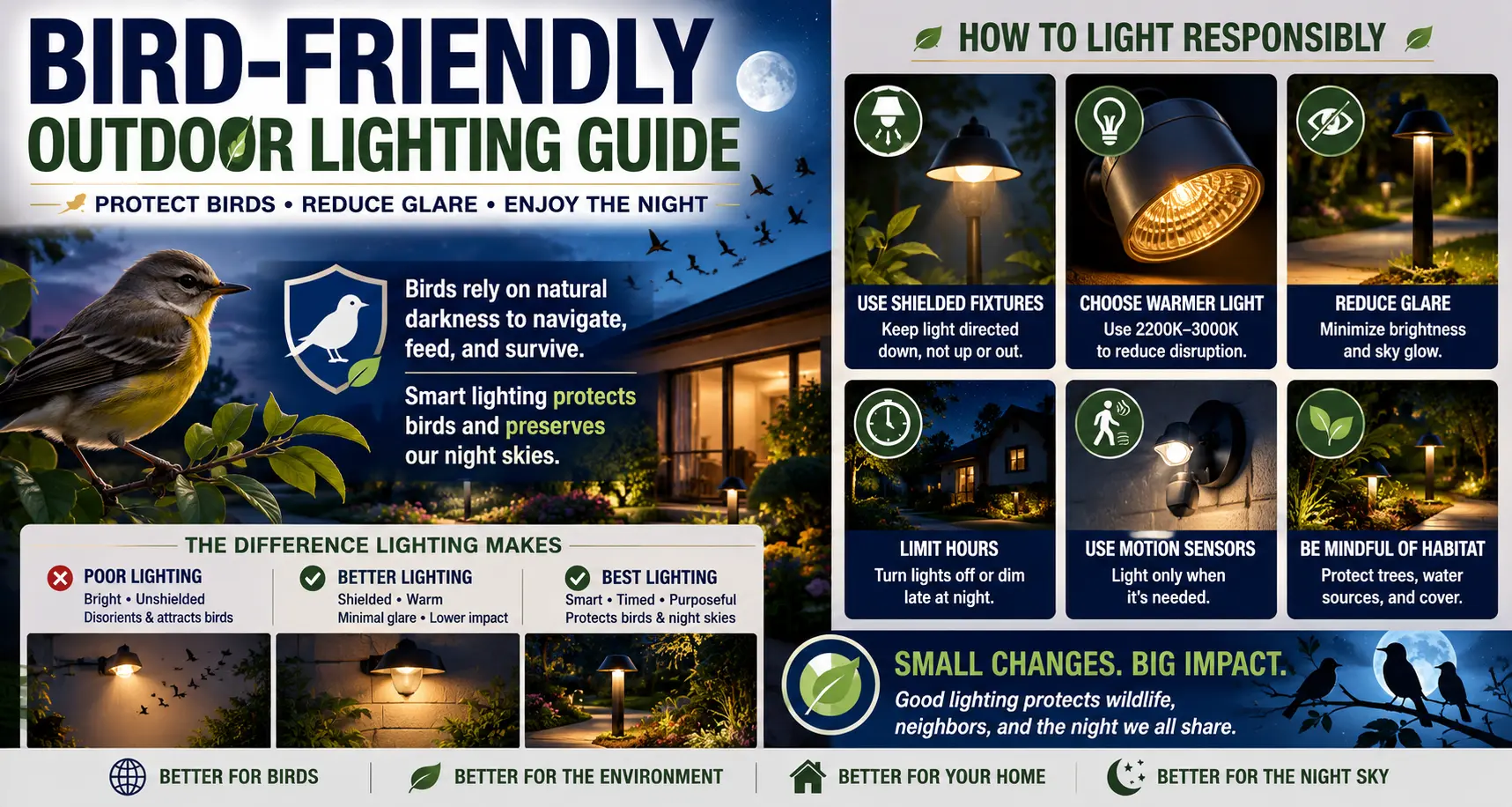
The Mortality Scale: Why Outdoor Lighting Is a Bird-Safety Emergency
The numbers establish the urgency. North American bird populations have declined by roughly 3 billion birds since 1970 — a 29% loss — driven by habitat loss, cats, pesticides, and collisions with human-made structures. Artificial lighting at night is implicated in hundreds of millions of those collision deaths annually.
Where Landscape Lighting Sits in the Collision Chain
The collision chain begins with light attraction — artificial light at night draws migrating birds from their high-altitude flight paths down toward illuminated areas. Once concentrated near artificial light sources, birds are exposed to the glass of buildings and structures at close range. The collision doesn't have to be with the light source itself; the light draws birds to an area where glass collisions occur at dawn when birds see reflections of sky and vegetation.
Per the USFWS Bird-Friendly Building Toolkit: "Every year, more than 1 billion birds are killed from colliding with glass in the United States. Almost half of these collisions occur at low-rise buildings with reflective glass windows and doors... While most of these window collisions happen during the day, it also happens at night when birds are attracted in towards light shining out of windows from the inside or light shining towards windows from the outside."
The proportion of deaths attributable to landscape lighting specifically cannot be precisely isolated from the broader artificial light contribution — but landscape uplights on trees, decorative landscape lighting, and architectural feature lighting all contribute to the sky glow that draws birds down and the ground-level light that keeps them circling in confusion. Per Michigan Audubon: "Once inside a beam of light, birds are reluctant to fly out of the lighted area into the dark, and often continue to flap around in the beam of light until they drop to the ground with exhaustion."
The One-in-Four Population Loss
Per BirdCast (Cornell Lab and Colorado State University): "U.S. bird populations are declining rapidly, with 1 out of every 4 birds lost since 1970." The scale of this decline — 3 billion birds across North America — represents a conservation emergency that no single cause fully explains, but that artificial light at night measurably contributes to through both direct collision mortality and indirect impacts on reproduction, energy expenditure during migration, and altered migration timing.
Per the Florida Museum of Natural History's documentation of Florida Lights Out: "Northeast Florida lies in the second-largest migration path for birds, the Atlantic Flyway, one of four major routes in the US. Each fall, millions of migratory birds fly over Florida under the cover of night, hightailing it south for the winter. Many never reach their destination. Disoriented by the lights and glass of cityscapes, thousands of birds die after colliding into buildings and windows."
How Artificial Light Disrupts Three Bird Navigation Systems
Most nocturnal migrating birds are not navigating visually — they're navigating using three independent systems simultaneously, and artificial light at night disrupts all three. Understanding the specific mechanisms explains why different lighting interventions (spectrum change, shutoff, shielding) address different parts of the problem.
Navigation System 1: Magnetoreception — Disrupted by Blue-Rich Spectrum
Magnetoreception is the ability to detect and navigate by Earth's magnetic field. Birds are believed to use cryptochrome proteins in their eyes that respond to light to create the magnetic sensing ability — and this system is specifically sensitive to short-wavelength (blue and green) light. Per Access Fixtures' documented analysis: "Blue-rich spectrum light from standard LED light fixtures interferes with magnetoreception, the biological process birds use to detect magnetic fields."
This mechanism is why the wavelength of outdoor lighting matters for bird safety beyond just the amount of light. Blue-rich white LEDs at 4000K or 5000K CCT directly interfere with the magnetic compass that birds use for long-range orientation. Amber spectrum LEDs (≤2700K, and especially 590nm amber) contain very little blue light and do not meaningfully interfere with magnetoreception.
The Practical Implication: Standard outdoor LED lighting at 3000K–5000K CCT contains enough blue-spectrum output to interfere with magnetoreception. This is the spectrum-based argument for bird-friendly lighting that goes beyond simple light reduction. A landscaped property running 590nm amber landscape lights at the same total lumen output as 4000K white LEDs would have significantly less magnetoreception disruption — even if the total light output were identical. Spectrum matters independently of intensity for this specific navigation mechanism.
Navigation System 2: Stellar Compass — Disrupted by Sky Glow
Migratory birds learn the star patterns of the night sky during a juvenile imprinting period and use the stars as a directional compass for navigation. Sky glow from artificial light drowns out the stars that serve as the stellar compass reference, as Access Fixtures documents: "Bright lights drown out the stars that serve as celestial compasses, leaving birds disoriented and vulnerable." In heavily light-polluted urban environments, the Milky Way and many navigational star patterns are completely invisible, removing this navigation system from birds passing over illuminated areas.
Navigation System 3: Landmark and Concentration Behavior — Disrupted by Light Attraction
Migrating birds use landmark features for local navigation within broader magnetic and stellar frameworks. Artificial light concentrations create false landmarks that attract birds from high altitude and concentrate them in urban environments. Per the FLAP research documented on Cornell's digital repository: "The number of fatal bird collisions increases with increasing light emissions" and "weather is the most important factor influencing collision risk" — meaning that on nights when the stellar compass is obscured by clouds, birds rely more heavily on landmark cues, and artificial light concentrations become even more powerful attractors.
The Audubon documentation of the mechanism: "While lights can throw birds off their migration paths, bird fatalities are more directly caused by the amount of energy the birds waste flying around and calling out in confusion. The exhaustion can then leave them vulnerable to other urban threats." The light doesn't have to directly cause a collision — it concentrates and exhausts birds in urban environments where other mortality factors (windows, cats, vehicle strikes) operate.
The Fog and Cloud Amplification Effect: When Bird-Friendly Lighting Matters Most
The FLAP (Fatal Light Awareness Program) research established one of the most important findings for timing bird-friendly lighting interventions: overcast and foggy nights are not safer for migrating birds — they are substantially more dangerous.
Per the FLAP research documented by Cornell's Digital Commons: "Weather is the most important factor influencing collision risk; nights of heavy cloud cover and/or nights with precipitation are the conditions most likely to result in high numbers of collisions." This seems counterintuitive — if birds need stars to navigate, cloudy nights should reduce migration activity. But the opposite is true for several reasons:
- Birds migrate at lower altitudes in poor visibility: When cloud cover reduces visibility, migrating birds descend to lower altitudes where artificial light from the ground is more concentrated and visible. This brings them into direct collision range with buildings and structures.
- Loss of stellar compass increases light attraction: On overcast nights, the stellar navigation system is unavailable. Birds rely more heavily on magnetic navigation and landmark cues — and artificial light concentrations become more powerful false landmarks when there are no stars to provide competing directional signals.
- Fog creates "light beam" trapping: Michigan Audubon's documentation: "Birds migrating at night are attracted to artificial sources of light, particularly during periods of inclement weather... 'Once inside a beam of light, birds are reluctant to fly out of the lighted area into the dark, and often continue to flap around in the beam of light until they drop to the ground with exhaustion.'" Fog scatters light in a way that creates extended illuminated columns rather than defined beams — making the trapping effect more diffuse and harder for birds to escape.
The Four Flyways and Most Dangerous US Cities for Migrating Birds
North America's bird migration is organized around four major flyway corridors. The cities that sit at the intersection of major flyways and high light pollution are the most dangerous for migrating birds — and their landscape lighting decisions have disproportionate impact.
Runs along the East Coast from the Canadian Maritimes to the Caribbean. Florida Museum documents: "Northeast Florida lies in the second-largest migration path for birds, the Atlantic Flyway." Highest-risk cities for bird collisions from Cornell Lab BirdCast rankings include several Atlantic Flyway metros.
Key cities:- New York City (documented by NYC Bird Alliance Project Safe Flight)
- Toronto (FLAP program origin city)
- Baltimore (Lights Out Baltimore volunteer program)
- Jacksonville, FL (Atlantic Flyway second-largest path)
- Miami (turtle-safe + bird-safe coastal lighting dual obligation)
The most heavily traveled flyway in North America, following the Mississippi River system from Canada to the Gulf. Lights Out Heartland documents: "St. Louis metro ranks #5 most dangerous city for spring migration and #6 most dangerous for fall migration." Per Lights Out Heartland: "More than ONE MILLION birds may pass over the Pittsburgh region in a single night."
Key cities:- Chicago (pioneering Lights Out program, 80% collision reduction)
- St. Louis (top 10 most dangerous; St. Louis County Resolution 2021)
- Pittsburgh (National Aviary Lights Out program)
- Memphis, New Orleans (Gulf Coast funnel point)
Runs through the Great Plains from Canada to Texas and the Gulf Coast. Texas is the critical junction point. Per Defenders of Wildlife: "Approximately 1 of every 3 birds migrating through the US in spring, and 1 of every 4 birds migrating through the US in the fall, or nearly two billion birds, passes through Texas."
Key cities:- Houston (Lights Out Texas origin; Galveston 400-bird collision event 2017)
- Dallas-Fort Worth (Lights Out Texas major hub)
- Kansas City (Lights Out Heartland)
- Wichita, Oklahoma City (Central Flyway corridor)
Runs along the West Coast from Alaska to Baja California, with significant interior routes through the Rocky Mountain states. Pacific Flyway cities have adopted Lights Out programs as awareness has grown. The BC Hydro guide documents Canadian Pacific coast recommendations for bird-friendly lighting.
Key cities:- Seattle (Lights Out Seattle program)
- Portland, OR (Pacific Flyway corridor)
- San Francisco Bay Area (Lights Out Bay Area)
- Los Angeles (Pacific Flyway southern terminus)
BirdCast: The Migration Radar Tool That Should Drive Every Lights-Out Decision
BirdCast, developed by the Cornell Lab of Ornithology and Colorado State University, provides nightly migration forecasts for US cities based on weather radar data that directly observes bird movement. It is the single most useful tool for determining when lights-out compliance matters most.
What BirdCast Shows
BirdCast uses NEXRAD weather radar to detect bird movement across the continent. The radar distinguishes bird density, speed, and direction of flight from weather patterns, producing maps and city-level forecasts of migration intensity. Per the Purdue AeroEco Lab's documentation of BirdCast: "This flow map uses weather radar to reveal where birds are flying, how many are in the air, and the speed and direction of their movements." The Axios Houston documentation confirms the operational application: "BirdCast forecasts around 27,000 birds per kilometer tonight in Houston — a 'high' migration night."
How to Use BirdCast for Landscape Lighting Decisions
BirdCast provides: (1) Nightly migration intensity forecasts by city during migration season; (2) Alerts when migration is forecast to be high in a specific city; (3) Real-time radar showing actual bird movement as it occurs. Property owners and commercial building managers can subscribe to BirdCast city alerts and turn off non-essential landscape lighting — especially tree uplights and decorative feature lights — on nights when BirdCast forecasts high migration activity. Per BirdCast's Lights Out guidance: "If your city is within its peak migration window, dim or turn off non-essential outdoor lighting from 11 pm–6 am and close shades to reduce skyglow."
Peak Migration Windows by Season
- Spring migration: Late April through mid-May nationally. Per Lights Out Heartland: "Spring migration: May 1st through mid-May is when the peak migration period occurs for many bird species in Missouri." The peak is compressed in spring — birds rush north to claim breeding territory, and the highest-density nights occur over a 2–3 week period in late April to mid-May for most US cities.
- Fall migration: September through October nationally, extending into November for cities further south. Per Axios Houston: "Fall migration runs through November, with the peak from September through October." Fall migration is more protracted than spring — birds move more gradually, and the concentration of any specific species at any specific location is less predictable than in spring.
- Neotropical migrants at highest risk: Per Conserve.org: "The most heavily affected species are migratory birds that winter in the tropics, known as Neotropical migrants." These include warblers, thrushes, vireos, tanagers, orioles, and many other small songbirds that migrate thousands of miles between North American breeding grounds and tropical wintering areas — flying at night, navigating by stars and magnetic fields, and vulnerable to artificial light disorientation throughout their journey.
Why Uplighting Trees During Migration Season Is Specifically Dangerous
Of all the landscape lighting applications, tree uplighting is the most directly and specifically implicated in bird harm during migration season. Understanding the mechanism makes clear why this is the first landscape lighting change to make.
The BirdCast Direct Guidance
BirdCast's Lights Out guidance to property owners during migration season is explicit: "Do not use landscape lighting to light up trees or gardens where birds may be resting." This is the only specific landscape lighting application that BirdCast identifies by name as requiring shutoff — not pathway lights, not security floods, not architectural feature lighting. Tree uplighting is specifically called out because it operates at the intersection of two bird-harm mechanisms simultaneously.
Mechanism 1: Trees Are Migration Stopover Habitat
Migrating birds do not migrate continuously without rest. They fly at night and stop during the day to feed and rest — a pattern called "stopover." Trees and dense shrubs are the primary stopover habitat for most Neotropical migrants. A row of trees illuminated by landscape uplights creates a brightly lit roosting area that is visible to other migrants passing overhead. Those migrants are attracted to the illuminated trees as a landmark — landing in an area that may be adjacent to glass buildings, busy roadways, or other collision hazards. The landscape lighting has converted a stopover habitat into a collision trap.
Mechanism 2: Uplights Project Light Skyward Into the Migration Corridor
Landscape tree uplights are specifically designed to project light upward through a tree's canopy — the exact direction that makes light most visible to birds flying above. Unlike downward-directed path lights (which contribute mainly to local light trespass), tree uplights project into the altitudes where migrating birds fly. This upward projection contributes directly to the sky glow that disrupts stellar compass navigation for birds flying overhead — and increases the visibility of the illuminated area as an attractant from above. See the curfew guide for how some ordinances specifically address upward-projecting lighting in their enforcement framework.
The Lights Out Texas Specific Guidance on Trees
Per Lights Out Texas (BirdCast/Texan by Nature): "Do not use landscape lighting to light up trees or gardens where birds may be resting." The Texas Lights Out guidance specifically applies this to both the 11 PM–6 AM lights-out window and to the broader approach of reducing landscape lighting near green spaces and water — which are the primary stopover locations for migrating birds. Buildings that "commonly cause bird strikes are often near green spaces or water," per the Florida Museum documentation, precisely because birds that stop to rest in these areas then encounter glass and artificial light when they resume movement.
Tree uplighting on a property adjacent to a park, pond, stream, or any green space is the highest-risk landscape lighting configuration for bird collisions. The green space or water attracts migrating birds as a stopover site. The upward-projecting landscape lighting on the adjacent property draws those birds from their resting habitat toward an artificially lit area near buildings with glass. The intersection of natural stopover habitat and artificial light concentration creates a concentration gradient that pulls birds from safety into danger. If your property is adjacent to any green space or water body, eliminating or reducing tree uplights during spring and fall migration season provides the greatest collision-reduction benefit available from landscape lighting changes.
Bird-friendly lighting depends heavily on whether the fixture keeps light out of trees, rooflines, water edges, and open sky. A warm bulb can still create unnecessary exposure if the fixture is open, uplighting, or visible from above. The shielded vs. unshielded lighting guide shows how fixture housing changes where light travels, which makes it a useful next step when reducing brightness alone does not solve habitat spill, glare, or skyward light.
Bird-friendly fixture placement must remain stable through storms, snow, soil movement, and seasonal maintenance. Freeze-thaw cycles can tilt stakes, wind can loosen mounting hardware, and coastal corrosion can prevent shields from being adjusted after installation. The Outdoor Lighting Climate Performance Guide explains which mounting materials and inspection schedules help preserve the original beam direction and prevent climate damage from increasing glare or upward light.
The Wavelength Science: 590nm Amber vs PC Amber vs 2200K for Bird-Friendly Lighting
Not all "amber" or "warm" outdoor lighting is equally beneficial for birds. Three distinct amber LED types are commonly specified for wildlife-friendly applications, each with different spectral characteristics, different levels of bird disruption, and different practical tradeoffs.
The Core Principle: Short Wavelengths Harm; Long Wavelengths Don't
Per the Environmental Literacy Council: "If LEDs are desired for night lights or non-primary light sources, it is generally best to use LEDs that provide primarily amber, orange or red light as these are less disruptive to animals than white or blue." The specific mechanism for birds: short-wavelength (blue, violet, UV) light interferes with the cryptochrome-based magnetoreception system; long-wavelength (amber, orange, red) light does not. Additionally, short-wavelength light contributes more to sky glow (Rayleigh scattering preferentially scatters shorter wavelengths) and attracts more insects (which in turn attract birds to the lit area).
| Type | Peak Wavelength / CCT | Bird Visibility | Magnetoreception Impact | Sky Glow | Best Application |
|---|---|---|---|---|---|
| True 590nm Amber LED | 590nm (monochromatic) | Near-invisible to most birds | Minimal — no blue content | Very low | FWC-certified turtle-safe and wildlife-safe; beachfront; wildlife corridor edges; high-priority bird habitat areas |
| PC Amber LED | ~1700K (phosphor converted) | Very low bird attraction | Very low — minimal blue | Very low | Dark-sky applications, observatory buffers, replacing low-pressure sodium; best CCT for dark-sky ordinance compliance |
| 2200K Warm White LED | 2200K (broad white spectrum) | Low compared to 3000K+ | Low — reduced blue vs standard | Low | General residential and commercial outdoor use where warm aesthetics and color rendering matter; best compromise for properties not in critical wildlife zones |
| 2700K–3000K Warm White | 2700–3000K | Moderate bird attraction | Moderate — some blue content | Moderate | Common dark-sky ordinance compliance target; not ideal for bird-priority areas |
| 4000K–5000K Neutral/Cool White | 4000–5000K | High bird attraction | Significant — high blue content interferes with magnetoreception | High | Avoid for outdoor applications near bird habitat; avoid during migration season in any outdoor landscape lighting |
The FWC 590–610nm Certification
The Florida Fish and Wildlife Conservation Commission certifies lighting in the 590–610nm wavelength range as "wildlife-friendly" for sea turtle applications — the same certification that makes 590nm amber appropriate for beachfront landscape lighting also indicates its suitability for bird-friendly applications. Per Access Fixtures: "The 590nm wavelength produces amber-colored light that appears nearly invisible to most bird species while providing adequate illumination for human activities. The Florida Fish and Wildlife Conservation Commission certifies lighting in the 590–610nm range." See the coastal lighting guide for the complete FWC framework and how turtle-safe and bird-safe lighting requirements intersect on Florida beachfront properties.
The Insect Co-Benefit of Amber Spectrum
A secondary benefit of amber/long-wavelength landscape lighting for bird safety: insects are attracted to short-wavelength (UV and blue) light, not to long-wavelength amber light. Standard white LED outdoor lighting at 3000K–5000K attracts insects, which attracts insectivorous birds to the lit area — concentrating birds near glass and buildings. Per Govee: "A 2016 study found that warm LEDs attracted 50% fewer bugs than traditional incandescent bulbs." Converting landscape lighting to 590nm amber or 2200K warm white reduces insect attraction, which reduces the secondary bird attraction pathway. Both magnetoreception protection (direct) and insect-attraction reduction (indirect) favor long-wavelength landscape lighting for bird-friendly applications.
Lights Out Programs: Specific Hours and Migration Windows Across Five Documented Programs
Lights Out programs coordinate voluntary or mandatory lighting reductions during peak migration windows. The programs originated with FLAP Canada and Toronto in the 1990s, spread to Chicago, and have now expanded to 30+ North American cities. Here are the specific hours and windows documented for five programs.
BirdCast/Cornell
BirdCast's Lights Out guidance applies nationally and is the standard referenced by most Lights Out programs: "Turn off all non-essential lights from 11:00 p.m. to 6:00 a.m. each night during migration season." This is applied to the full spring and fall migration seasons — not just peak nights. The guidance specifically addresses landscape lighting: "Do not use landscape lighting to light up trees or gardens where birds may be resting." BirdCast provides nightly city-level migration intensity forecasts to help prioritize which nights lights-out matters most. Access BirdCast at birdcast.info for your city's peak migration dates and nightly forecasts.
National Aviary
Per the National Aviary: "Turn off all unnecessary lighting, including exterior lights, from midnight to 6 am." The Pittsburgh program uses midnight rather than 11 PM as the start of the lights-out window — giving building managers and homeowners an extra hour of normal operation while still capturing the peak 3–4 AM migration hour when most nocturnal migration occurs. The program runs spring from March 15 to June 1 and fall from September 1 to November 15 — slightly longer windows than some other programs. "During migration, more than ONE MILLION birds may pass over the Pittsburgh region in a single night."
Lights Out TX
Per Texan by Nature: "We encourage everyone to turn off non-essential lights at night from 11 pm – 6 am during the full fall and spring migration periods, and where conflicts apply, prioritize lights out during the critical peak migration periods." The Texas program was launched in 2017 by Houston Audubon following a single event in Galveston where 400 birds were killed in one night. Cornell Lab's BirdCast migration forecast maps were integral to the program from the start. Texas sits on the Central Flyway: "Approximately 1 of every 3 birds migrating through the US in spring passes through Texas." Landscape-specific guidance: "Do not use landscape lighting to light up trees or gardens where birds may be resting. For essential lights use dark skies-friendly lighting practices."
(St. Louis MO)
Per Lights Out Heartland: "Use automatic lighting controls (timers and motion detectors). When possible, turn both interior and exterior lights off by 11pm, especially during spring and fall migration periods." Spring peak: "May 1st through mid-May is when the peak migration period occurs for many bird species in Missouri." The Heartland program emphasizes automatic controls rather than manual compliance — the same recommendation as the curfew compliance framework. St. Louis metro "ranks #5 on the list of most dangerous cities for migrating birds for spring migration and #6 most dangerous for fall migration" per a Cornell Lab BirdCast ranking study. Landscape guidance: "Eliminate/reduce any direct upward exterior lighting. Ensure that all exterior light fixtures are shielded (downward light only). Avoid use of floodlighting, spotlights, or searchlights."
Jacksonville/FWC
Per the Florida Museum of Natural History's documentation of Lights Out Northeast Florida: "Bird-friendly practices include turning off nonessential lights from 11 p.m. to 5 a.m." — a one-hour shorter nightly window than the national standard. The Florida program coordinates with FWC's beachfront turtle-safe lighting requirements, creating dual compliance obligations for coastal Florida properties: turn off lighting for sea turtles during nesting season (May–October) and for migrating birds during migration season (spring and fall). The Florida program spans the Atlantic Flyway's "second-largest migration path." Volunteers record bird deaths on iNaturalist to compare collision rates across buildings and identify the most dangerous structures for targeted intervention.
The Five Landscape Lighting Changes That Make the Most Measurable Difference
Not all bird-friendly landscape lighting changes are equally impactful. These five are ranked by measurable effect on bird mortality, moving from the highest-impact (tree uplight elimination) to the consistent-baseline improvements.
The highest single-impact change available. BirdCast explicitly identifies this: "Do not use landscape lighting to light up trees or gardens where birds may be resting." Spring migration window: late April through mid-May. Fall migration: September through October (into November in southern states). Program timer controls to automatically cut tree uplights at 11 PM and restore them at 6 AM for the full migration window. See the curfew guide for the controls technology that satisfies automatic shutoff requirements.
Per Access Fixtures' documented bird-friendly lighting implementation guide: "Add motion sensors: Install motion detectors on security lighting to reduce operating hours. Basic units can cut light pollution by 80% or more while maintaining security benefits." Motion-sensor-activated security lighting operates at full output only when humans (or animals) are present — the remainder of the night it is off, eliminating the constant upward light contribution from security floods. This single change, applied to security floods and entry lights, reduces both the sky glow contribution and the artificial light concentration that attracts migrating birds. See the curfew guide for how motion sensors interact with curfew ordinance compliance requirements.
Per Access Fixtures' implementation priority: "Replace fixtures first: Switch to warm LED light fixtures (2100–2200K) in existing installations. This provides immediate wildlife benefits at minimal cost." The spectrum conversion addresses the magnetoreception disruption mechanism (blue light reduction) and reduces insect attraction (which reduces secondary bird attraction). For properties adjacent to natural areas, water, or within documented wildlife corridors: specify 590nm amber (FWC-certified) for all landscape lighting rather than 2200K warm white. See the dark sky fixture selection guide for the complete CCT compliance framework and how bird-friendly spectrum requirements align with dark-sky ordinance CCT limits.
Per Access Fixtures: "Upgrade fixtures: Replace unshielded fixtures with IDA-certified alternatives. Shielded lighting provides superior illumination quality and eliminates sky glow. Focus upgrade efforts on high-impact areas like driveways, patios, and main entrances where lighting is most visible from above. Position new fixtures close to the ground and ensure they illuminate only the intended area without light trespass onto neighboring properties or natural areas." Fully shielded, downward-directed fixtures eliminate upward light emission — which is the primary sky glow contribution and the primary migration-disruption mechanism. This is also the requirement for dark-sky ordinance compliance and IDA fixture certification. See the IDA certification guide.
The most targeted ongoing practice: subscribe to BirdCast city alerts (free, at birdcast.info) and implement the full 11 PM–6 AM lights-out protocol on nights when BirdCast forecasts high migration intensity — particularly on nights that combine high migration with cloud cover or precipitation (the highest-risk combination documented by FLAP research). This targeted approach provides the greatest protection per unit of effort for property owners who cannot maintain full lights-out throughout the entire migration season. During normal low-migration nights, standard lighting operations can continue; on the 10–15 highest-migration nights per season, a brief lights-out protocol provides disproportionate benefit.
Legal Framework: MBTA, LEED v5, and Bird-Friendly Building Codes
Bird-friendly lighting is transitioning from voluntary best practice to regulatory requirement across multiple legal frameworks simultaneously.
Migratory Bird Treaty Act (MBTA) — Federal Protection
The Migratory Bird Treaty Act (16 U.S.C. §703 et seq.) protects migratory birds from "take" — killing, capturing, or harming migratory birds. While the MBTA has not traditionally been applied to incidental building collision mortality, the USFWS published its "Reducing Bird Collisions with Buildings and Building Glass Best Practices" in 2016 — the first federal guidance document on building-related bird mortality. This guidance, combined with growing awareness of building collision mortality statistics, creates a developing legal environment in which building owners and managers may face MBTA exposure for illumination practices that demonstrably attract and kill migratory birds. Commercial property owners in high-migration-path cities with documented collision records are beginning to implement bird-friendly lighting as risk management, not just environmental volunteerism.
LEED v5 Bird Collision Deterrence Credit
Per the Green Building Alliance: "In LEED v5, both Building Design + Construction (BD+C) and Operations + Maintenance (O+M) include a new credit for Bird Collision Deterrence. The scoring criteria incorporate Light Pollution and Bird Collision Reduction, which encourages buildings to reduce nighttime light pollution and adopt bird-friendly materials and designs — such as using opaque, non-reflective surfaces — to lower collision risks." The LEED credit was initially a pilot credit that became LEED's most popular pilot credit (per BDC Network) before being incorporated into the standard scoring framework. For commercial landscape lighting on LEED-pursuing projects: the Bird Collision Deterrence credit creates a formal scoring incentive for implementing the five landscape actions documented above.
Mandatory Bird-Friendly Building Codes — 20+ US Jurisdictions
Per the American Bird Conservancy's legislation tracker: "Bird-friendly legislation in the US started in 2008 with then-local Congressman Mike Quigley's bill for unincorporated Cook County, Illinois. Since then, dozens of jurisdictions, from states to towns, have passed legislation." Per Yale Law School/ABC: "At least 20 US cities and counties have emerged over the past two decades as leaders in advancing bird-friendly building design." These mandatory codes typically require: bird-friendly glass treatments on new construction above a minimum size; lighting controls during migration season for commercial buildings above a minimum size; minimum bird-friendly glass coverage percentages for building façades. The American Bird Conservancy's Legislative Toolkit (at abcbirds.org) provides model ordinance language for jurisdictions developing bird-friendly building requirements. See the state permit requirements guide for how these requirements interact with standard lighting permit processes.
State and Local Lighting Ordinances with Wildlife Provisions
Many outdoor lighting ordinances include wildlife protection provisions that apply to bird-friendly lighting beyond just sea turtle requirements. The Calimesa CA ordinance documents a wildlife corridor absolute prohibition (covered in the curfew guide). Oregon, California, Florida, and several other states have developed wildlife-sensitive lighting guidelines that go beyond the basic dark-sky shielding requirements. For commercial and municipal landscape lighting projects in states with active Lights Out programs, documenting the bird-friendly lighting measures in the permit submittal demonstrates environmental stewardship and may satisfy permit conditions in jurisdictions where wildlife overlay zones apply.
Bird-Friendly Lighting FAQ
I have a property in Houston near Buffalo Bayou Park. How do I find out when migration is happening and how to respond?
Buffalo Bayou Park is exactly the adjacency that creates the highest bird-collision risk — a major green space and water corridor in a city that sits directly on the Central Flyway, with Galveston to the south and millions of birds flowing through Texas each migration season. The specific steps for your situation: (1) Go to birdcast.info and find the Houston migration alerts. Sign up for email alerts so you receive a notification when migration intensity is forecast to be high. (2) During the fall migration season (September through October, peaking in late September and early October in Houston), implement the 11 PM–6 AM lights-out protocol for all non-essential landscape lighting — specifically tree uplights facing the park, garden spotlights, and any decorative lighting visible from or facing the bayou. Essential security lighting: add motion sensors so they operate only when activated, not continuously. (3) On the specific high-migration nights (when BirdCast forecasts 20,000+ birds per kilometer over Houston — a "high" or "very high" migration night), this is when full protocol compliance matters most. The 2017 Galveston event that launched Lights Out Texas killed 400 birds in one night — a documented example of what high-migration + light attraction produces in Texas. Houston Audubon coordinates Lights Out Texas efforts and is a direct resource for property-specific guidance in the Houston area.
My commercial building manager says the only lights we can realistically turn off are the landscape lights. Do landscape lights actually make a difference?
Yes — and the research specifically supports landscape lighting as a meaningful intervention, not just a symbolic one. The Access Fixtures documentation makes the core finding: "nighttime lighting intensity is a stronger predictor of bird collisions than building height, meaning a well-lit low-rise building poses more danger than a dark skyscraper." Landscape lighting — tree uplights, decorative feature lighting, pathway lighting along building perimeters, garden spotlights — contributes directly to the "nighttime lighting intensity" that the research identifies as the key collision predictor. The specific landscape actions that make the most difference: (1) Turning off tree uplights and garden spotlights during migration is the single highest-impact landscape lighting action available, because tree uplights project light upward directly into migration corridors and create illuminated roosting areas near buildings. (2) Adding motion sensors to security and path lighting reduces continuous operation and can cut light pollution by 80% per Access Fixtures' documented estimate. (3) Converting tree uplights from white LED to 590nm amber reduces both the magnetoreception disruption and the insect attraction that brings birds to the area. If landscape lights are the only lights you can turn off, turning them off during migration season still makes a measurable difference — particularly the tree uplights closest to any green space, water, or natural area adjacent to your property.
Do bird-friendly lighting requirements conflict with security lighting needs after hours?
No — and the design solution is motion sensors rather than continuous operation. The Lights Out programs universally acknowledge that security lighting is an essential function. The solution is not to eliminate security lighting but to activate it only when needed — which is what motion sensors do. Per Virginia DWR: "If you can't turn off all lights, consider turning off exterior lights — the flood lights that face up into the sky and rooftop lights that illuminate the surrounding landscape, or change your motion sensors to only be active when people are present." Per Lights Out Texas: "For essential lights (like security and safety lighting) use the following dark skies-friendly lighting practices." The specific practices: convert security floods from continuous operation to motion-sensor activation (reducing operating time from all-night to minutes per activation), point them downward rather than outward or upward (fully shielded is best), and if spectral change is possible, convert from white to amber CCT. A motion-activated, downward-directed amber security light provides the same security function as a continuous white uplight — and eliminates nearly all of the bird-harm mechanisms simultaneously. The 80% light-pollution reduction estimate from Access Fixtures applies specifically to motion-sensor security lighting conversion. See the curfew guide for how motion sensors interact with curfew ordinance compliance requirements.
Related Dark Sky, Wildlife & Compliance Guides
- Dark Sky Compliance Guide
- Outdoor Lighting Curfew Guide
- Light Trespass Laws
- Coastal Lighting (FWC / Turtle-Safe)
- State Permit Requirements
- Permit Rejection Reasons
- Code Enforcement Cases
- Electrical Code Guide
- GFCI Requirements Guide
- Transformer Mounting Code
- RoHS Compliance Guide
- Insurance & Liability Guide
- Liability Claims Database
- Maintenance Guide
- NEC Inspection Checklist
- NEC Compliance Calculator
- Landscape Lighting Guide
- Landscape Lighting Design Guide