
Quick Answer: How to Replace a Christmas Light Fuse
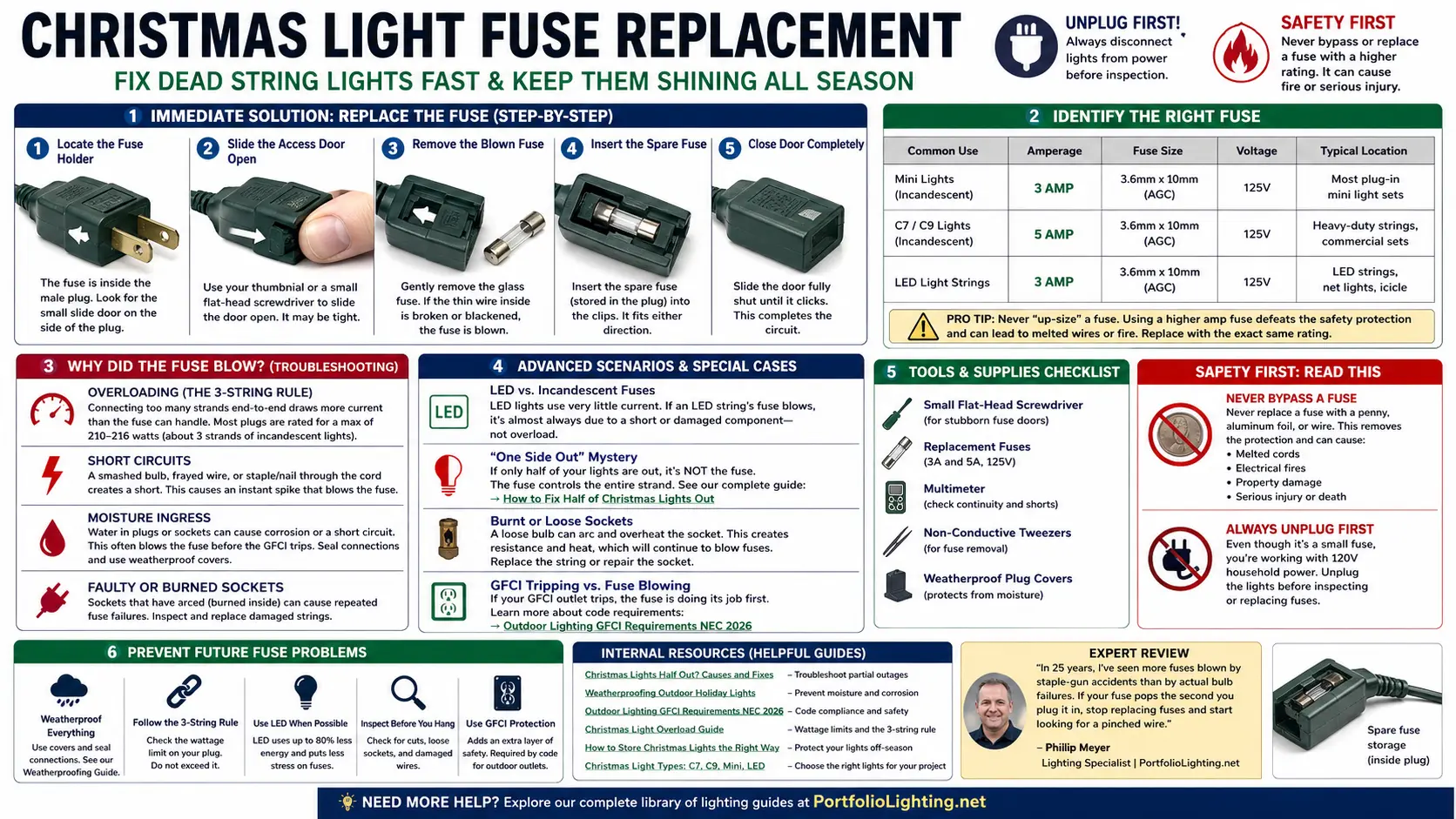
To replace a Christmas light fuse, unplug the lights, slide open the fuse access door on the male plug, remove the blown glass fuse, insert the same amp-rated replacement fuse, close the door completely, and test the strand.
- Unplug first: Disconnect the strand from the outlet, timer, extension cord, or power strip.
- Find the plug door: Look for a small sliding door on the male plug, usually near the prongs.
- Slide it open: Use a thumbnail or small flat-head screwdriver.
- Pop and swap: Remove the glass fuse and insert the spare or a matching replacement.
- Close the door: The fuse is not directional, but the plug door must snap fully shut.
- Test safely: Plug the strand into a GFCI-protected outlet and watch for instant failure.
For full seasonal setup safety, pair this guide with the holiday lighting guide and weatherproofing outdoor holiday lights.
Christmas Light Fuse Troubleshooting Logic
| What You See | Likely Cause | What To Do First |
|---|---|---|
| Fuse blows immediately | Short circuit or damaged wire | Inspect cord, plug, and sockets before replacing fuse again |
| Fuse blows after adding strands | Overload | Reduce the number of connected strands |
| Lights fail after rain | Moisture in plug or socket | Dry connections and improve weatherproofing |
| New fuse does not work | Bad spare fuse or deeper strand failure | Test fuse with continuity mode |
Start Here: Fuse Replacement Safety Rules
- Always unplug the strand before opening the plug.
- Never bridge a fuse with foil, wire, a nail, a penny, or any metal object.
- Never install a higher-amp fuse than the plug originally used.
- Replace the fuse only after checking for crushed bulbs, cut wires, wet plugs, and damaged sockets.
- If the replacement fuse blows immediately, stop and look for a short circuit.
Christmas light fuse replacement is simple when the fuse is the real problem. But a blown fuse is not just an inconvenience—it is a clue. The fuse opened because too much current flowed through the strand, or because the circuit experienced a short, moisture problem, damaged socket, or overloaded run.
This guide shows how to replace the fuse quickly, how to choose the correct 3A or 5A replacement, and how to find the real reason the fuse blew so the next fuse does not pop the second you plug the lights back in.
If the outlet trips along with the fuse problem, see outdoor lighting GFCI requirements to understand how wet outdoor circuits are protected.
The Slide-Access Method: Opening the Plug Fuse Door
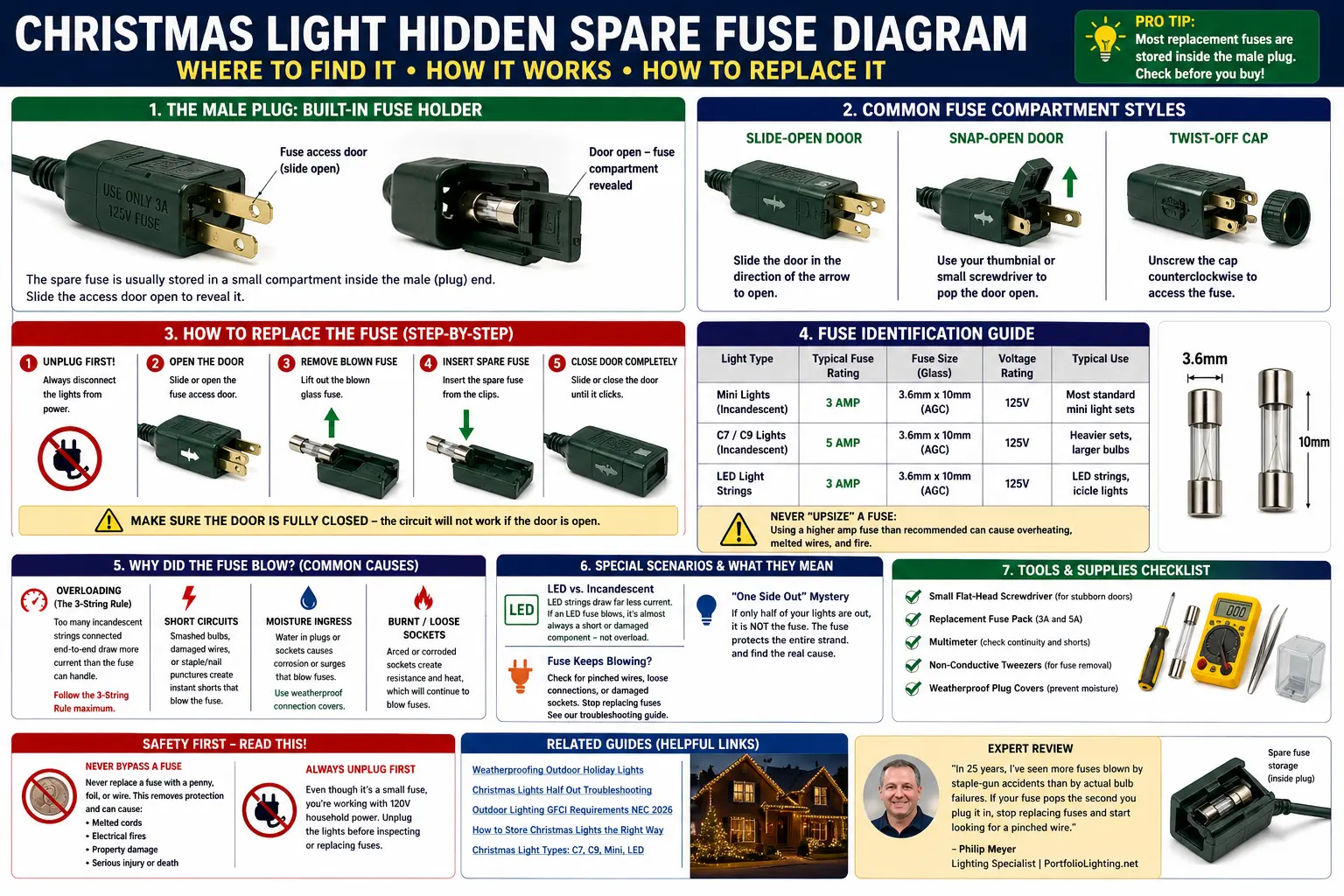
Most Christmas light fuses are hidden inside the male plug. Look closely near the plug prongs for a small rectangular door. The door usually slides open with a thumbnail, but older plugs or cold plastic may need a small flat-head screwdriver.
How to open the fuse door
- Unplug the strand completely.
- Hold the plug body firmly, not the cord.
- Look for the arrow or small groove on the plug door.
- Push the door in the open direction with your thumbnail or screwdriver tip.
- Do not pry so hard that you crack the plug shell.
Once the door opens, you may see one active fuse and one spare fuse, or two fuses depending on the plug design.
Where the Spare Fuse Is Hidden
On many Christmas light plugs, the sliding fuse door holds both the active fuse and a spare fuse. One fuse is connected to the circuit, while the second fuse is stored beside it for replacement.
The Pop-and-Swap: Removing and Installing the Fuse
The glass fuse is usually loose in a small metal clip. Use non-conductive tweezers or the edge of a small screwdriver to lift it out. A blown fuse may show a broken internal wire, darkened glass, or no continuity when tested with a multimeter.
A fuse that opens again after replacement may be reacting to more than excessive bulb wattage. A carbonized C7 or C9 socket, damaged cord-piercing contact, water-filled socket, or deformed bulb base can create a short or high-heat connection that remains hidden until the display is energized. Before installing another fuse, inspect the screw-base sockets with the C7 and C9 holiday light socket repair guide, especially if one socket is blackened, cracked, corroded, unusually hot, or difficult to remove from the bulb.
- Match the amp rating exactly.
- Match the voltage rating, usually 125V.
- Install the fuse fully into the holder.
- Slide the door closed until it sits flush.
- Test the strand only after the fuse door is completely shut.
Christmas Light Fuse Identification Table
Always check the plug label, manufacturer instructions, or original fuse before choosing a replacement. These are common holiday light fuse patterns, not a reason to guess.
| Light Type | Common Fuse Rating | Common Physical Size | Voltage Rating | Important Warning |
|---|---|---|---|---|
| Mini incandescent lights | 3A | 3.6mm x 10mm | 125V | Do not replace with 5A unless the plug specifically calls for 5A. |
| LED mini lights | Often 3A | 3.6mm x 10mm | 125V | If an LED fuse blows, suspect a short or damaged hardware. |
| C7 or C9 light strings | Often 5A on heavier strings | 3.6mm x 10mm or plug-specific | 125V | Match the plug label, not the bulb size alone. |
| Commercial-style or heavy-duty strings | Varies by product | Plug-specific | Usually 125V | Use the manufacturer rating. Do not guess. |
Why Did the Christmas Light Fuse Blow?
A blown fuse means the fuse did its job. It opened the circuit before the cord, plug, or internal wiring overheated. Replacing it without finding the cause may lead to another blown fuse immediately.
If a plug fuse keeps blowing, the strand may be overloaded. Use the holiday lighting power calculator to check how many watts and amps your connected strings are drawing.
If your fuse keeps blowing after replacing bulbs, verify you are using the correct type with the LED holiday bulb replacement guide to avoid mismatched voltage or overload conditions.
Too many strings connected
Incandescent strings draw more current than LEDs. For more information on incandescent lighting, check our Portfolio incandescent lighting page. Connecting too many end-to-end can overload the first plug fuse.
Staple or clip damage
A staple through the wire, pinched cord, or sharp roof clip can create a short that blows the fuse instantly.
Moisture inside plug
Water in a plug or socket can create leakage and shorting before the GFCI reacts.
Burned socket or arcing
A socket that has arced may continue blowing fuses even after the glass fuse is replaced.
Overloading and the 3-String Rule
Older incandescent Christmas lights can draw enough current that connecting too many strings together overloads the fuse in the first plug. Many packages list a maximum number of connected strings. If the label says three strings maximum, do not connect six just because the plugs fit.
- Incandescent strings draw more current and create more heat.
- LED strings draw much less current but still have connection limits.
- The first strand in a long chain carries the load of everything downstream.
- A blown fuse at the first plug often means the whole run is overloaded.
For planning safer holiday runs, see holiday lighting guide and smart holiday lighting setup.
If the same light strand seems to fail every year despite replacing bulbs and fuses, the root cause may not be the lights themselves. Corrosion inside plugs, sockets, battery compartments, and connection points often develops during storage and remains hidden until the following season. Our Christmas light corrosion prevention guide explains how moisture, salt, dust, and improper storage conditions gradually damage electrical contacts and what steps can be taken to prevent repeat failures before decorations are packed away.
Christmas Light Fuse Overload Safety Limits
| Strand Type | Avg. Amps per Strand | Max Strands on 3A Fuse | Max Strands on 5A Fuse |
|---|---|---|---|
| Incandescent Mini | 0.4A | 5–6 | 10–12 |
| Incandescent C9 | 1.5A | 2 | 3 |
| LED Mini | 0.04A | 40+ | 80+ |
Important: These are general estimates. Always check the tag on your specific light strand before connecting multiple sets together.
Short Circuits: Smashed Bulbs, Nicked Wires, and Staple-Gun Accidents
If a new fuse blows the instant the lights are plugged in, suspect a short circuit. This can happen when a bulb socket is crushed, a wire is pinched in a window, a staple pierces the insulation, or a plug is damaged.
What to inspect before using another fuse
- Look for crushed bulbs and broken sockets.
- Check where cords pass through windows, doors, gutters, and clips.
- Inspect staple points and tight zip ties.
- Look for black marks, melted plastic, or a burned smell.
- Discard the strand if wiring insulation is cut or melted.
Moisture Ingress: Wet Plugs Can Pop Fuses
Outdoor Christmas lights are exposed to rain, snow, melting ice, and condensation. Water inside a plug connection can create a path that blows the fuse, trips the GFCI, or damages a socket.
- Keep plug connections off the ground.
- Use weatherproof connection covers.
- Use drip loops before plug connections and outlets.
- Keep unused female ends capped and facing downward.
- Use an extra-duty in-use cover at the outdoor outlet.
Use the complete moisture prevention checklist in weatherproofing outdoor holiday lights. For outlet-level safety, see outdoor lighting GFCI requirements NEC 2026.
LED vs. Incandescent Christmas Light Fuses
LED Christmas lights use much less current than incandescent lights. That means an LED string that keeps blowing fuses is less likely to be overloaded and more likely to have a hardware fault.
Incandescent fuse failures
Often caused by overload, too many connected strings, high current draw, aging sockets, or damaged bulbs.
LED fuse failures
Often caused by a shorted plug, damaged wire, water intrusion, failed rectifier, or internal strand defect.
If your lights flicker instead of going completely dead, compare the symptoms with Portfolio LED lights flickering and landscape lights flickering.
The “One Side Out” Mystery: Why It Is Usually Not the Fuse
A plug fuse controls power to the whole strand. If the entire strand is dead, the fuse is a reasonable first suspect. If only one side, one section, or half the string is out, the problem is usually not the plug fuse.
Half-out Christmas lights are more often caused by a failed bulb, bad shunt, damaged socket, broken wire inside the section, or a series-circuit issue. In that case, replacing the plug fuse will not bring back only one dead section.
Go to troubleshooting Christmas lights half out if the strand is partially working.
Burnt Sockets: When the Strand Should Be Replaced
A socket that has arced can keep blowing fuses because the internal contacts are damaged. Look for black marks, melted plastic, a burned smell, loose bulb fit, or a socket that looks darker than the others.
- Do not keep replacing fuses in a strand with burned sockets.
- Do not use tape to hold a loose bulb in a damaged socket.
- Do not use indoor-only strands outside.
- Retire the strand if wiring, plug blades, or sockets show heat damage.
If weather caused the damage, review weatherproofing outdoor holiday lights before installing the next set.
The Penny Warning: Never Bypass a Christmas Light Fuse
Some bad advice online suggests wrapping a fuse in foil or bridging the fuse clips with wire. Do not do this. A fuse protects the cord and plug from carrying more current than they are designed to handle.
When you bypass the fuse, you create the fire triangle: electrical heat, combustible insulation, and oxygen. The result can be melted plugs, burned cords, scorched sockets, or fire.
Christmas Light Fuse Troubleshooting Table
| Symptom | Likely Cause | What to Check | Best Next Step |
|---|---|---|---|
| Entire strand dead | Blown plug fuse or no power | Fuse door, outlet, extension cord, GFCI | Replace fuse with same rating and retest. |
| Fuse blows instantly | Short circuit | Staples, pinched cords, crushed sockets, wet plugs | Stop replacing fuses and find the damaged area. |
| Only half the strand is out | Section failure, bad bulb, or shunt issue | Bulbs and sockets in the dead section | Use the half-out Christmas light guide. |
| Fuse blows after rain | Moisture ingress | Plug covers, drip loops, wet sockets, outdoor outlet cover | Dry, weatherproof, and use GFCI protection. |
| Fuse blows after adding more strings | Overload | Connected string count and package limit | Split the run into separate outlets or fewer strings. |
Christmas light fuse problems do not always show up as a completely dead strand. A poor fuse connection, wrong fuse rating, dirty plug contact or overloaded run can also cause dim LEDs, unstable brightness or random flickering. After checking the fuse compartment, use this dim and flickering LED Christmas light troubleshooting guide to inspect the rest of the strand before assuming the fuse was the only problem.
A blown fuse and a tripped breaker can create nearly identical symptoms, but the underlying causes are often very different. Fuses generally protect individual light strands, while breakers protect the branch circuit supplying power to the display. Replacing fuses repeatedly without identifying the root cause can allow overloaded circuits, damaged cords, moisture-related faults, or defective decorations to remain in service. Our complete holiday breaker trip troubleshooting guide explains how to determine whether the problem originates within the strand itself or somewhere else in the electrical system powering the display.
Christmas Light Fuse Replacement FAQ
What size fuse do Christmas lights use?
Many mini Christmas lights use 3A 125V fuses. Some heavier C7, C9, or higher-load strings may use 5A 125V fuses. Always match the fuse rating printed on the plug, package, or original fuse.
Can I put a 5 amp fuse in a 3 amp Christmas light plug?
No. Never up-size a Christmas light fuse. A 5A fuse in a plug designed for 3A can allow the cord or sockets to overheat before the fuse opens.
Why does my Christmas light fuse keep blowing?
Common causes include too many strings connected together, a crushed bulb socket, a wire nicked by a staple, moisture in a plug, a damaged cord, or a burned socket.
Are Christmas light fuses directional?
No. Small glass Christmas light fuses are not directional. The important part is using the correct amp and voltage rating and fully closing the plug door.
If half my Christmas lights are out, should I replace the fuse?
Usually no. The plug fuse controls the whole strand. If half the strand is out, use the half-out troubleshooting guide because the problem is probably a bulb, socket, shunt, or section issue.
Final Thoughts on Christmas Light Fuse Replacement
Replacing a Christmas light fuse is fast, but the real win is knowing why the fuse blew. A properly sized fuse protects the plug, wire, and sockets from carrying unsafe current. If a new fuse restores the strand and stays working, the fix may be complete. If it blows again, the fuse is warning you to stop and find the real fault.
Match the original fuse rating, keep plug connections dry, avoid overloading strings, inspect for staple damage, and never bypass the fuse. That approach fixes the dead strand without creating a bigger safety problem.
More Christmas Light and Outdoor Safety Guides
Holiday Lighting Guide
Plan safer Christmas light runs, outlet use, weatherproofing, timers, and display layout.
Holiday lighting guideChristmas Lights Half Out
Use this when part of the strand works but one section or half the string is dark.
Half-out troubleshootingWeatherproofing Outdoor Holiday Lights
Prevent wet plugs, fuse failures, GFCI trips, and water-damaged sockets.
Weatherproofing guideOutdoor Lighting GFCI Requirements
Understand the secondary safety layer protecting outdoor outlets and holiday displays.
GFCI requirementsChristmas Light Fuse Replacement Safety Help
This page is designed to help homeowners replace Christmas light fuses safely, choose the correct fuse rating, identify overloads and shorts, and avoid dangerous bypasses.
Because holiday lights connect to household power, use this guide as educational information and stop using any strand with damaged insulation, burned sockets, melted plugs, or repeated fuse failures.