
Holiday Lighting Power Calculator
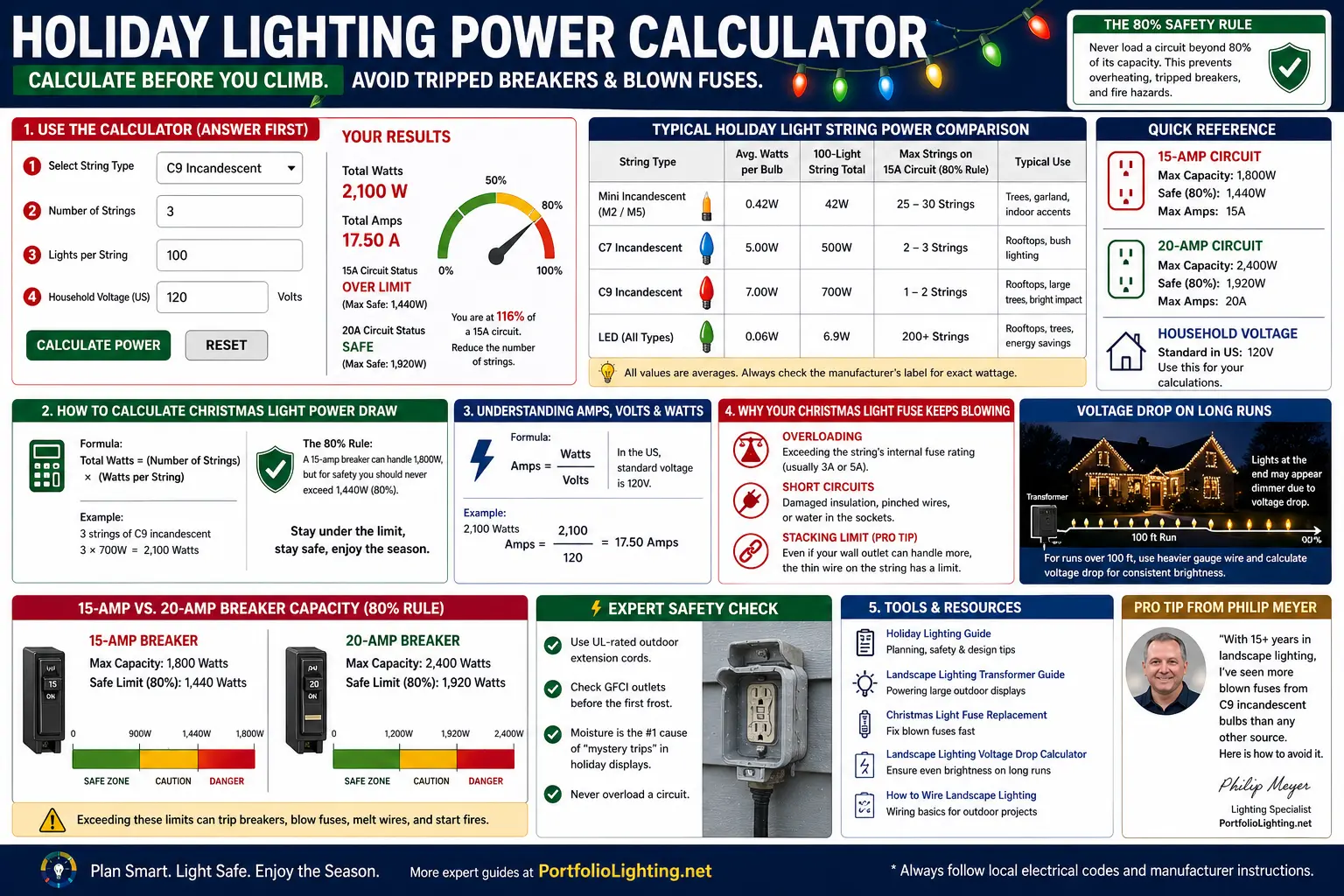
Enter your string type, number of strings, bulbs per string, and breaker size. The calculator estimates total watts, amps, circuit load, and whether the display stays inside the 80% safety limit.
For full seasonal setup planning, pair this calculator with our holiday lighting guide.
If your July 4th roofline lights fade, flicker, or shift color near the end of the run, review the Patriotic July 4th Outdoor Lighting Guide for RGBW voltage-drop planning and power-injection tips.
Calculating display wattage is only the first step in holiday lighting safety. Once total power requirements are known, homeowners must understand how those loads interact with existing household circuits, outdoor receptacles, extension cords, smart controls, and weather conditions. Displays that operate close to circuit limits are more vulnerable to nuisance trips, voltage fluctuations, and electrical failures. For a detailed explanation of overload behavior, startup surges, GFCI shutdowns, and breaker diagnostics, see our holiday lighting electrical overload troubleshooting guide.
Quick Answer: How Much Power Can Holiday Lights Use Safely?
Use the 80% rule for holiday lighting: a 15A circuit can theoretically supply 1,800 watts at 120V, but the safer continuous display limit is about 1,440 watts. A 20A circuit can theoretically supply 2,400 watts, but the safer continuous display limit is about 1,920 watts.
- 15A breaker: 15 × 120 = 1,800W max; 80% limit = 1,440W.
- 20A breaker: 20 × 120 = 2,400W max; 80% limit = 1,920W.
- Formula: Total Watts = Number of Strings × Watts per String.
- Amps formula: Amps = Watts ÷ Volts.
If your plug fuse already failed, use Christmas light fuse replacement before adding more lights.
Even though LED Christmas lights use less power than older incandescent strands, they can still flicker or dim when too many strands are connected together, extension cords are undersized, adapters are overloaded or voltage drops across a long run. After calculating your holiday lighting load, use this LED Christmas light flicker repair guide to check whether the problem is a power-delivery issue or a damaged strand.
Holiday Lighting Power Logic Summary
| Question | What To Check | Why It Matters |
|---|---|---|
| How many lights can I plug in? | Total watts and amps | Prevents overload and breaker trips |
| Can I connect more strings end-to-end? | String label limit | Prevents overheating the first string |
| Why does the breaker trip? | Total load, wet plugs, or damaged cords | Shows whether the issue is overload or moisture |
| Are LED lights safer for large displays? | Watts per string | LED strings usually allow more total lights per circuit |
15A vs 20A Circuit Capacity (Holiday Lighting)
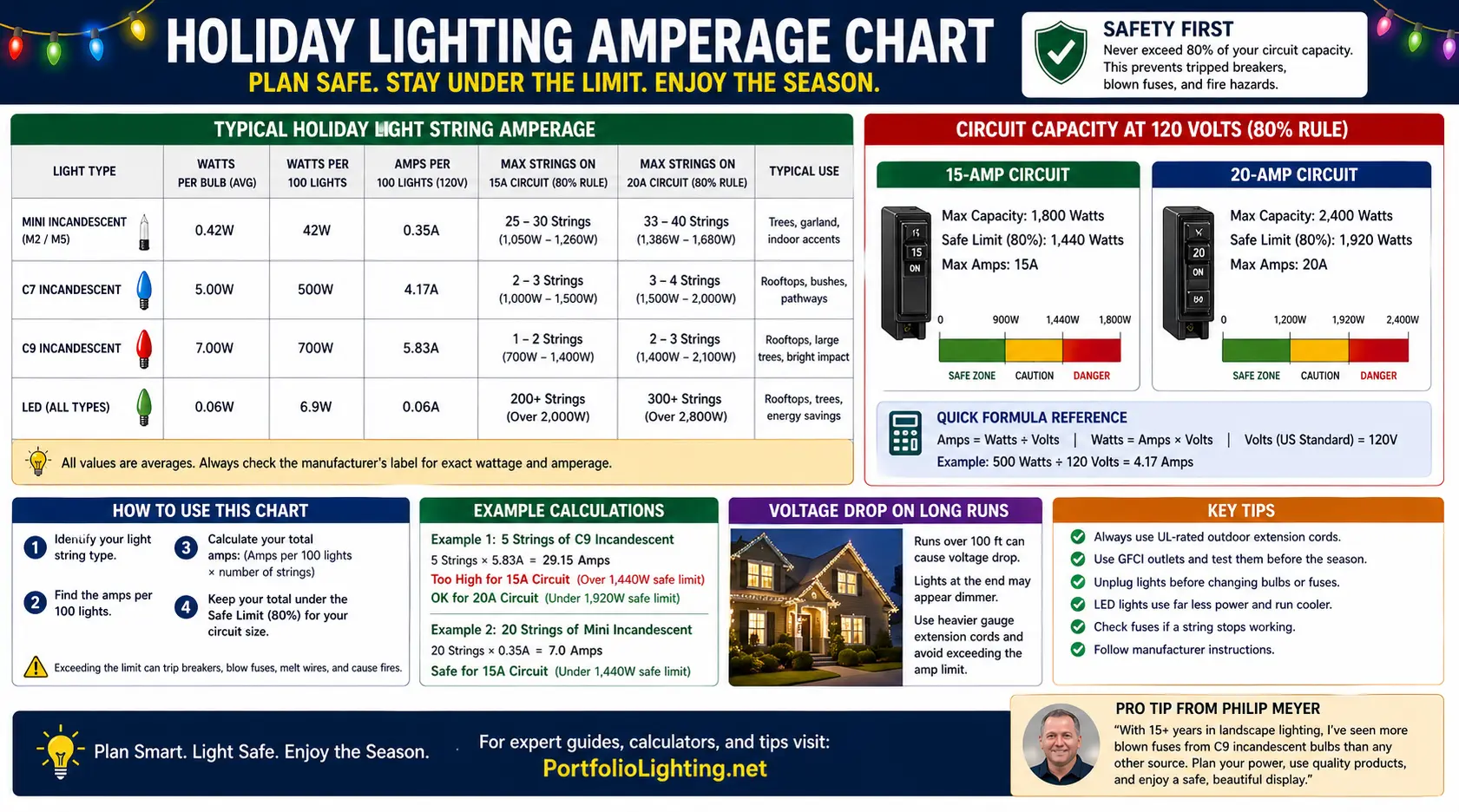
This chart shows how much lighting load a standard 15-amp or 20-amp circuit can safely handle when running holiday lights continuously.
Incandescent Christmas lights use significantly more power than LED strings. See incandescent lighting details and power usage to understand why these strands reach overload limits much faster.
Holiday Light Power Comparison Table
This comparison gives a fast answer for common Christmas light types. Actual ratings vary by brand, bulb count, and product design, so always check the tag or packaging.
| String Type | Average Watts per Bulb | 100-Light String Total | Estimated Amps at 120V | Max Strings on 15A Circuit | Safety Notes |
|---|---|---|---|---|---|
| Mini Incandescent | 0.42W | 42W | 0.35A | 25–30 strings | Watch connected-string limits and plug fuse ratings. |
| C7 Incandescent | 5.00W | 500W | 4.17A | 2–3 strings | High heat and high load; easy to overload circuits. |
| C9 Incandescent | 7.00W | 700W | 5.83A | 1–2 strings | Most common source of blown fuses in large displays. |
| LED All Types | 0.06W | 6.9W | 0.06A | 200+ strings | Circuit capacity is rarely the first limit; product stacking limits still matter. |
Holiday lighting problems usually start when the display grows one string at a time. The outlet still works, the cords still fit, and the lights still turn on—until rain, cold weather, a fuse, or a breaker exposes the overload.
This calculator is built to show the math before you climb the ladder. It helps separate three different safety limits: the breaker limit, the 80% continuous-use limit, and the connected-string limit inside the light set itself.
If only part of a light strand goes dark after connecting multiple sets, follow our Christmas lights half-out troubleshooting guide to isolate the exact failure point.
How to Calculate Christmas Light Power Draw
The basic Christmas light power formula is simple:
Total Watts = Number of Strings × Watts per String
If you know the watts per bulb instead of watts per string, multiply the bulb count first:
Watts per String = Bulbs per String × Watts per Bulb
Example: Mini incandescent lights
A 100-light mini incandescent string using about 0.42W per bulb uses about 42 watts. Ten strings would use about 420 watts. At 120V, that is about 3.5 amps.
Example: C9 incandescent lights
A 100-light C9 incandescent string using about 7W per bulb uses about 700 watts. Two strings use about 1,400 watts, which is already near the recommended 80% limit for a 15A circuit.
Understanding Amps, Volts, and Watts for Holiday Displays
In the United States, standard household voltage is typically 120V. Once you know total watts, convert watts to amps with this formula:
Amps = Watts ÷ Volts
For example, a 600W display on a 120V circuit draws about 5 amps. A 1,440W display draws about 12 amps, which is the recommended 80% continuous load limit for a 15A circuit.
If you are also running smart plugs, timers, controllers, or permanent systems, compare this guide with smart holiday lighting setup and permanent vs temporary holiday lights.
The 80% Rule for 15A and 20A Holiday Lighting Circuits
A breaker may be rated for 15A or 20A, but long-running holiday lighting should be planned below the maximum breaker rating. The 80% rule gives you a safer continuous-use target.
15 Amp Circuit
15A × 120V = 1,800W theoretical maximum. 80% recommended display limit: about 1,440W.
20 Amp Circuit
20A × 120V = 2,400W theoretical maximum. 80% recommended display limit: about 1,920W.
LED Display
Usually stays far below breaker capacity, but still needs outdoor-rated cords, GFCI protection, and dry connections.
C7/C9 Incandescent Display
Can hit the safe load limit quickly, especially on rooflines, trees, and long fence runs.
The calculated circuit load assumes every socket is making a clean, low-resistance connection. A loose or corroded C7 or C9 contact can convert electricity into heat at one socket even when the total display remains below the circuit limit. If a bulb base or socket becomes hotter than neighboring positions, review the C7 and C9 socket inspection guide for center-contact pressure, shell corrosion, lamp wattage, heat discoloration, SPT cord compatibility, and the conditions that make complete socket replacement safer than continued use.
For outdoor outlet safety, use outdoor lighting GFCI requirements NEC 2026.
Why Your Christmas Light Fuse Keeps Blowing
A blown fuse is not random. It is usually a sign that the light string is overloaded, damaged, wet, or connected beyond its internal limit.
If your lights trip the breaker or stop working after rain, review weatherproofing outdoor holiday lights to protect plugs, connections, and extension cords from moisture.
- Overloading: Too many strings connected end-to-end can exceed the string’s internal fuse rating, often 3A or 5A.
- Short circuits: Damaged insulation, crushed sockets, or a staple through the wire can create an instant failure.
- Moisture: Water inside plugs or sockets can pop fuses and trip GFCIs.
- Stacking limit: Even if the wall circuit can handle more, the thin wire inside the string has its own limit.
Always follow the connection limits printed on your light strands. For more details on wiring, spacing, and safe usage, see string light setup and safety guidelines.
Once you calculate your lighting load, confirm bulb compatibility with the LED holiday bulb replacement guide to avoid mixing incorrect wattage or voltage types.
Simple rule: Always follow the maximum connected string limit printed on the light-string tag. The outlet rating tells you what the circuit can handle, but the string tag tells you what the light strand wiring can handle.
Use Christmas light fuse replacement if the plug fuse is already blown. If only half the strand is dark, go to troubleshooting Christmas lights half out.
Voltage Drop on Long Holiday Light Runs
For large displays over 100 feet, lights at the far end may appear dimmer because voltage drops along long cords and connected strings. This is more noticeable with high-load incandescent strings and long extension cord runs.
- Use heavier-gauge outdoor extension cords for long runs.
- Do not daisy-chain cheap light-duty cords across the yard.
- Split large displays across separate GFCI-protected circuits when possible.
- Use LED strings to reduce current draw and voltage drop.
- Keep plug connections dry and elevated.
For more detail on outdoor voltage behavior, see landscape lighting voltage drop and landscape lighting voltage drop calculator.
Moisture, GFCI Trips, and Mystery Breaker Problems
Many holiday lighting trips are blamed on “too many lights,” but moisture is often the real trigger. Wet plugs, open female ends, damp sockets, and extension cord connections sitting on mulch can all create leakage current.
- Keep all cord connections off the ground.
- Use weatherproof connection covers where plugs meet cords.
- Use in-use covers at outdoor receptacles.
- Make drip loops before plugs and controllers.
- Dry wet connections completely before resetting GFCI devices.
For the full moisture prevention plan, see weatherproofing outdoor holiday lights.
If your display uses timers or smart plugs, see our smart holiday lighting setup guide to manage power loads safely across multiple circuits.
Holiday lighting power use is temporary, but permanent landscape lighting runs for months or years. The permanent landscape lighting energy calculator helps compare nightly outdoor lighting cost against short-term seasonal displays.
LED vs Incandescent: The Fastest Way to Lower Holiday Power Draw
LED lights use dramatically less electricity than incandescent lights. If your calculator result is too high, switching C7 or C9 incandescent strings to LED versions is usually the biggest improvement.
Incandescent mini lights
Moderate load, but long chains can still overload fuses and circuits.
C7 incandescent
High load. A few strings can consume most of a 15A circuit.
C9 incandescent
Very high load. Often responsible for blown fuses and tripped breakers.
LED strings
Low load. Best choice for large rooflines, trees, and smart displays.
Holiday Lighting Power Calculator FAQ
How do you calculate Christmas light power draw?
Multiply the number of strings by watts per string. If you only know watts per bulb, multiply bulbs per string by watts per bulb first. Then divide total watts by 120 volts to estimate amps.
How many watts can a 15 amp breaker handle for Christmas lights?
A 15A breaker can theoretically handle 1,800 watts at 120V, but a safer continuous-use target is 1,440 watts using the 80% rule.
How many watts can a 20 amp breaker handle for Christmas lights?
A 20A breaker can theoretically handle 2,400 watts at 120V, but a safer continuous-use target is 1,920 watts using the 80% rule.
Why does my Christmas light fuse keep blowing?
The fuse may be blowing because too many strings are connected together, the string is overloaded, moisture entered a plug, or a damaged wire or socket is creating a short.
Can LED Christmas lights still trip a breaker?
Yes, but it is less common from pure wattage. LED displays are more likely to trip a GFCI because of moisture, damaged cords, wet plug connections, or outdoor controller issues.
Final Holiday Lighting Power Safety Checklist
- Calculate total watts before installing the display.
- Keep 15A circuits under about 1,440W for continuous use.
- Keep 20A circuits under about 1,920W for continuous use.
- Follow the connected-string limit printed on each light set.
- Use outdoor-rated extension cords and plug covers.
- Check GFCI outlets before cold weather.
- Replace blown fuses only with the same amp rating.
- Switch to LED strings if incandescent loads are too high.
For advanced setups and synchronized displays, explore AI holiday lighting theming logic to coordinate colors, schedules, and power usage across your entire display.
More Holiday Lighting Safety Guides
Holiday Lighting Guide
Plan safer roofline, yard, tree, and smart holiday displays.
Holiday lighting guideChristmas Light Fuse Replacement
Fix a dead string and understand why the plug fuse blew.
Fuse replacement guideWeatherproofing Outdoor Holiday Lights
Stop wet plug connections, mystery trips, and rain-related failures.
Weatherproofing guideOutdoor Lighting GFCI Requirements
Understand the outlet protection layer behind safe outdoor displays.
GFCI requirementsHoliday Lighting Power Calculator Safety Note
This calculator provides planning estimates for household holiday lighting loads. Always follow the rating labels on your lights, cords, timers, power strips, and outdoor receptacles.
If lights trip a breaker, blow fuses, smell hot, flicker, or fail after rain, disconnect power and inspect for overload, moisture, damaged insulation, or failed equipment before resetting anything.