
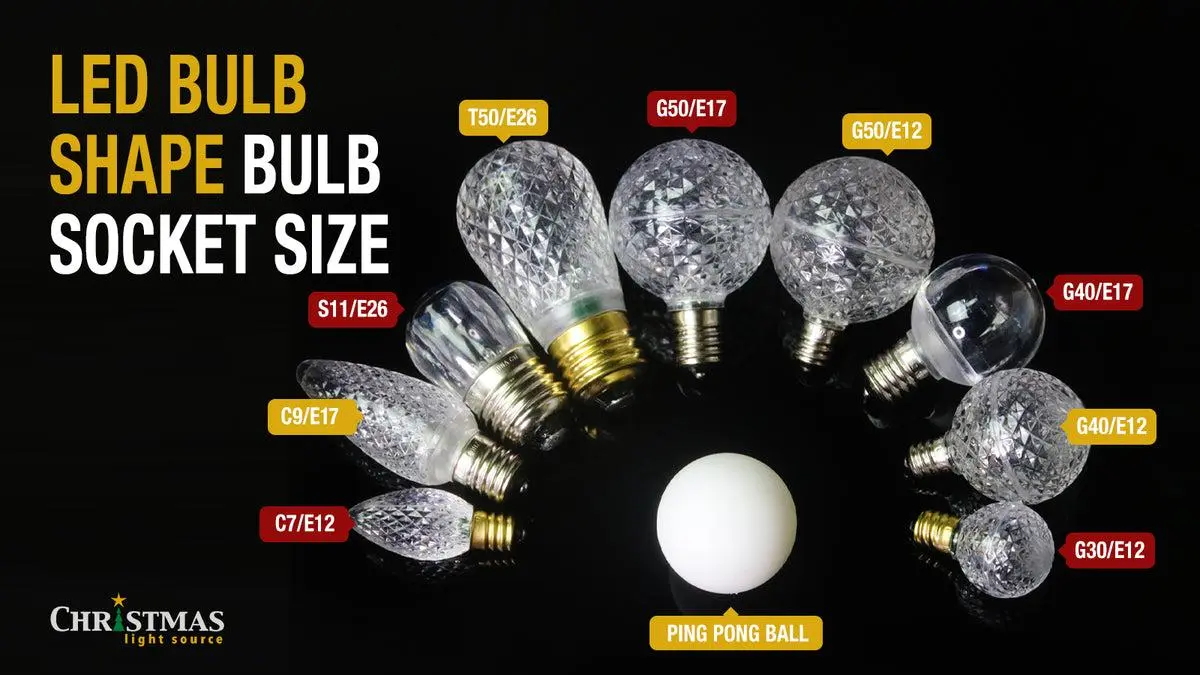
Quick Answer: How to Find the Right LED Holiday Replacement Bulb
To find the right LED holiday replacement bulb, identify the bulb family, measure the base, match the voltage, match the color temperature, and confirm whether the bulb is replaceable or permanently molded into the string.
- C7 bulb: usually E12 candelabra screw base, smaller decorative bulb.
- C9 bulb: usually E17 intermediate screw base, larger roofline bulb.
- M5 or T5 mini bulb: small push-in LED shape used in mini-light strings.
- 5mm wide-angle: short, concave lens LED often used for bright all-direction viewing.
- Integrated LED string: LED is molded in and may not accept individual replacement bulbs.
If you are fixing a dead section instead of replacing a single bulb, use troubleshooting Christmas lights half out.
A single damaged LED, poor socket contact or mismatched replacement bulb can make a holiday strand flicker, dim or fail in sections. Before replacing multiple bulbs, it helps to understand whether the issue follows one socket, one section or the entire power path. This LED Christmas light troubleshooting guide for flicker and dim sections explains how to separate bulb failure from fuse, plug, controller and wiring problems.
LED Holiday Bulb Replacement Logic Summary
| Problem | Likely Cause | Best Fix |
|---|---|---|
| Bulb does not fit | Wrong base size | Measure E12 vs E17 before buying |
| Mini LED does not light | Wrong polarity or voltage | Rotate bulb 180 degrees and verify voltage |
| Replacement looks too blue | Wrong color temperature or color bin | Match 2700K–3000K for warm white |
| Half the strand goes dark | Series-parallel section failure | Check bulb, socket, shunt, and fuse |
Identify Your Bulb: LED Holiday Bulb Visual Matrix
| Bulb Type | Common Base / Shape | Typical Use | Voltage Concern | Replacement Warning |
|---|---|---|---|---|
| C7 LED | E12 candelabra screw base, about 12mm | Windows, rooflines, trees, vintage-style cords | Usually 120V retrofit bulbs | Do not confuse with C9/E17 larger sockets. |
| C9 LED | E17 intermediate screw base, about 17mm | Rooflines, commercial-style displays, large outdoor cords | Usually 120V retrofit bulbs | Check dimmability if used with smart controllers. |
| M5 LED Mini | Small faceted mini-light shape | Trees, garland, wreaths, indoor/outdoor mini strings | Often 2.1V or 3.2V string-specific LED | Match strand voltage and polarity where applicable. |
| T5 LED Mini | Smooth mini-light shape | Traditional mini-light look with LED efficiency | Often low-voltage string-specific LED | Wrong replacement can dim or disable a section. |
| 5mm Wide-Angle LED | Short lens with concave top | Bright all-angle sparkle for trees and rooflines | Usually strand-specific voltage | Best replaced from the same brand and strand type. |
| Integrated LED | Molded permanent lamp | Sealed strings, rope-like sets, specialty displays | Not usually field-replaceable | Replace the section or strand if an LED fails. |
Why One Bad Bulb Affects Some Strands but Not Others
Most C7 and C9 holiday cords are wired in parallel, which means one bad bulb usually does not turn off the rest of the cord. Most mini-light strands are wired in series-parallel sections, which means one bad bulb, loose socket, or failed shunt can make an entire section go dark.
Matching the bulb base is only half of a successful C7 or C9 replacement. The original socket must still provide firm pressure at the center tab and reliable contact along the threaded shell. If a correctly sized LED bulb remains dark, flickers when touched, or works only after being tightened unusually hard, inspect the socket before blaming the new lamp. The C7 and C9 socket repair guide explains how flattened contacts, corrosion, oversized LED collars, damaged socket threads, and incompatible SPT replacement sockets cause failures that resemble a bad bulb.
Interactive Bulb Finder Checklist
Use this checklist before buying replacement bulbs. It prevents the three biggest mistakes: wrong base, wrong voltage, and wrong white color.
- Measure the base width: about 12mm for C7/E12 and about 17mm for C9/E17.
- Check the style: faceted, smooth, strawberry, globe, M5, T5, or 5mm wide-angle.
- Check the bulb voltage: read the tag on the strand or the printing on the old bulb if available.
- Match the white: warm white, cool white, daylight, pure white, or vintage warm.
- Test one bulb first: confirm fit, brightness, flicker, and color before replacing the whole run.
- Check outdoor condition: clean sockets and replace cracked or corroded sockets before installing new LEDs.
If your fuse blew while testing replacement bulbs, use Christmas light fuse replacement.
LED holiday replacement bulbs create more frustration than old incandescent bulbs because the visible shape is only part of the match. Two bulbs can look nearly identical but have different voltage, base type, lens style, internal electronics, color bin, and dimming behavior.
This guide solves the compatibility problem first, then walks through color matching and failure diagnosis so you do not waste money replacing the wrong part.
C7 vs. C9 Bases: E12 vs. E17 Holiday Bulbs
C7 and C9 holiday bulbs are the easiest LED replacements when they use standard screw bases. The two most important details are base size and voltage.
- C7 / E12 base: about 0.47 inches wide, or 12mm. Think “C” for candelabra.
- C9 / E17 base: about 0.67 inches wide, or 17mm. Think “I” for intermediate.
- Quick dime test: if a dime fits neatly over the socket opening, it is usually an E17 C9 socket. If the socket is smaller than a dime, it is usually an E12 C7 socket.
For broader string-light setup and replacement planning, review Portfolio string lights.
C7 LED Bulbs
C7 bulbs usually use an E12 candelabra screw base. The base is about 12mm wide and fits smaller holiday cords.
C9 LED Bulbs
C9 bulbs usually use an E17 intermediate screw base. The base is about 17mm wide and fits larger roofline cords.
Most modern C7 and C9 LED replacement bulbs are 120V retrofit bulbs designed to replace old incandescent bulbs in matching cords. This does not mean every bulb fits every cord. The base must match, the cord must be in good shape, and the bulb must be rated for the application.
M5, T5, and Wide-Angle 5mm LED Mini Lights
Mini-light replacement is more difficult than C7/C9 replacement because mini LED strings are often designed around a specific LED voltage and socket style.
- M5: faceted mini-light lens with a classic textured sparkle.
- T5: smooth mini-light shape that looks closer to old incandescent mini bulbs.
- 5mm wide-angle: short, bright, concave-lens LED visible from many angles.
- Brand-specific sockets: some mini LEDs physically fit but are electrically wrong.
If the replacement LED pulls out of a small plastic base, match the strand type as closely as possible. Random replacements from a different brand may have a different voltage, polarity, color, or lens height.
Retrofit vs. Integrated LED Holiday Lights
Before buying bulbs, decide whether your string is actually serviceable. Some LED holiday products accept replacement bulbs. Others are molded or sealed.
Retrofit Bulbs
Usually screw in or pull out and can be replaced individually when the base, voltage, and color match.
Integrated LEDs
Often permanently molded into the strand. If one fails, the practical fix may be replacing the section or full strand.
For long-term display planning, compare repairability in permanent vs temporary holiday lights.
The True Color Matching Guide: Warm White, Cool White, and Color Binning
The most common LED replacement complaint is not fit—it is color. One replacement bulb may work electrically but look too blue, too green, too yellow, or too bright next to the existing set.
- 2700K: closest to soft incandescent warmth.
- 3000K: warm white with a slightly cleaner look.
- 4000K: neutral/cool white.
- 5000K: bright daylight or ice-white look.
Color binning is the factory sorting process that groups LEDs by color output. Different brands—and sometimes different production batches from the same brand—can shift slightly. That is why two packages labeled “warm white” may not match perfectly.
For display planning and visual consistency, see smart holiday lighting setup.
Voltage Compatibility: 120V Retrofits vs. 2.1V and 3.2V Mini LEDs
Voltage is the technical detail that generic bulb guides often skip. It matters most on mini LED strings.
Most C7 and C9 retrofit bulbs are designed for 120V line-voltage holiday cords. Mini-light LEDs, however, are often low-voltage LEDs inside a series-wired string. Common replacement LED values can include 2.1V or 3.2V depending on the color and strand design.
If your replacement attempt caused a full outage or fuse problem, check holiday lighting power calculator and Christmas light fuse replacement.
Wattage Load: Why LEDs Let You Run More Lights but Still Have Limits
Switching from incandescent bulbs to LED bulbs can drastically reduce power draw. That may allow many more lights on one circuit, but it does not erase every limit.
- LED bulbs use far less wattage than incandescent C7 or C9 bulbs.
- The plug fuse still has a limit, commonly 3A or 5A depending on the string.
- The cord and socket rating still matter.
- The connected-string limit printed on the tag still matters.
- Outdoor extension cords, timers, and smart plugs must be rated for the load.
Use the holiday lighting power calculator before adding long roofline runs.
If you are comparing older incandescent strings with LED replacements, see Portfolio incandescent lighting to understand why incandescent holiday bulbs reach power limits much faster.
Dimmability: Not All LED Holiday Bulbs Work With Faders or Smart Plugs
Some LED holiday bulbs are designed only for full on/off operation. Others work with dimmers, controllers, faders, and smart automation. If the bulb is not dimmable, it may flicker, buzz, flash, or fail to fade smoothly.
- Check whether the LED bulb package says dimmable.
- Do not assume smart plug control equals dimming compatibility.
- Some animated controllers use pulse-width modulation that cheap LEDs display as flicker.
- Mixing incandescent and LED bulbs on the same controller can create uneven behavior.
For automation planning, use smart holiday lighting setup.
For advanced color scenes, automation, and themed holiday displays, see AI holiday theming logic.
Troubleshooting: Why the New LED Holiday Bulb Did Not Fix the Strand
When a replacement bulb does not solve the problem, the bulb may not be the only failure point. The socket, fuse, shunt, wire, plug, or GFCI may be involved.
Half-Out Strand
One bad bulb, corroded socket, or failed shunt can take down a series-wired section.
Ghosting or Glowing
LEDs may glow dimly from induced voltage, smart switch leakage, or electronic timers.
Flicker or Strobe
Cheaper LEDs may show visible flicker from rectified AC or poor filtering.
Instant Outage
Wrong voltage, wrong polarity, a bad fuse, or a shorted socket can shut down the section.
For a section that is already out, use troubleshooting Christmas lights half out. For weather-related failures, use weatherproofing outdoor holiday lights.
Maintenance & Storage: How to Make LED Holiday Bulbs Last Longer
Many replacement bulbs are needed because of storage damage, crushed bulbs, wet sockets, or corrosion—not because the LED itself reached the end of its rated life.
- Store strands loosely wrapped, not crushed into tight bins.
- Do not pile heavy decorations on top of bulb strings.
- Inspect sockets for white or green corrosion before storage.
- Let wet strands dry completely before boxing them.
- Label strands by location so color and length stay consistent next year.
For outdoor outlet and connection safety, see landscape lighting electrical code safety guide and outdoor lighting GFCI requirements NEC 2026.
LED Holiday Bulb Terms to Know
- E12: 12mm candelabra screw base, commonly used for C7 holiday bulbs.
- E17: 17mm intermediate screw base, commonly used for C9 holiday bulbs.
- SMD LED: Surface Mount Device LED, often used in higher-quality retrofit bulbs for better heat control and compact design.
- Full-wave rectified: LED strings designed to reduce visible flicker compared with cheaper half-wave strings.
- Half-wave LED string: A lower-cost design that may show more visible flicker, especially in motion or video.
LED Holiday Bulb Replacement FAQ
Can I put LED replacement bulbs in my old incandescent C9 cord?
Yes, if the bulb is a 120V LED retrofit and the base matches the cord. C9 cords usually use E17 intermediate bases. Do not use mini-light LEDs or low-voltage replacements in a 120V screw-base cord.
What is the difference between E12 and E17 holiday bases?
E12 is the smaller candelabra screw base commonly used by C7 bulbs. E17 is the larger intermediate screw base commonly used by C9 bulbs.
Why are my LED replacement bulbs flickering?
Flicker can come from incompatible dimmers, smart plug leakage, cheap LED rectifier design, wet sockets, loose contacts, or mixed LED and incandescent loads.
Why does my LED replacement look different from the old bulbs?
The color temperature or color bin is different. Warm white can range from soft amber to cleaner white depending on brand and batch. Replace the whole visible section if one bulb does not match.
Can one dead LED bulb make half the strand go out?
Yes. Many mini LED holiday strings are wired in sections. A bad bulb, loose base, corroded socket, or failed shunt can interrupt a section and make half the strand go dark.
Final LED Holiday Bulb Replacement Checklist
- Confirm whether the bulb is C7, C9, M5, T5, 5mm, or integrated.
- Measure the base before buying replacements.
- Match voltage, especially on mini LED strings.
- Match color temperature and brand when possible.
- Check dimmability before using faders or controllers.
- Clean and inspect sockets before installing new bulbs.
- Use dielectric grease sparingly outdoors to reduce corrosion.
- Replace the whole section or strand when color matching is impossible.
More Holiday Lighting Repair Guides
Holiday Lighting Guide
Plan safer, cleaner holiday displays from power to weatherproofing.
Holiday lighting guideChristmas Lights Half Out
Use this when one section or half the strand is dark.
Half-out troubleshootingWeatherproofing
Prevent socket corrosion, wet plugs, GFCI trips, and rain failures.
Weatherproofing guideLED Holiday Bulb Replacement Safety Note
This guide is for identifying and replacing LED holiday bulbs more safely and accurately. Always verify the exact label, voltage, base size, and manufacturer instructions for the strand or cord you own.
Stop using any holiday lighting with melted sockets, cracked insulation, burned plugs, water-filled sockets, repeated blown fuses, or GFCI trips that return immediately after reset.