
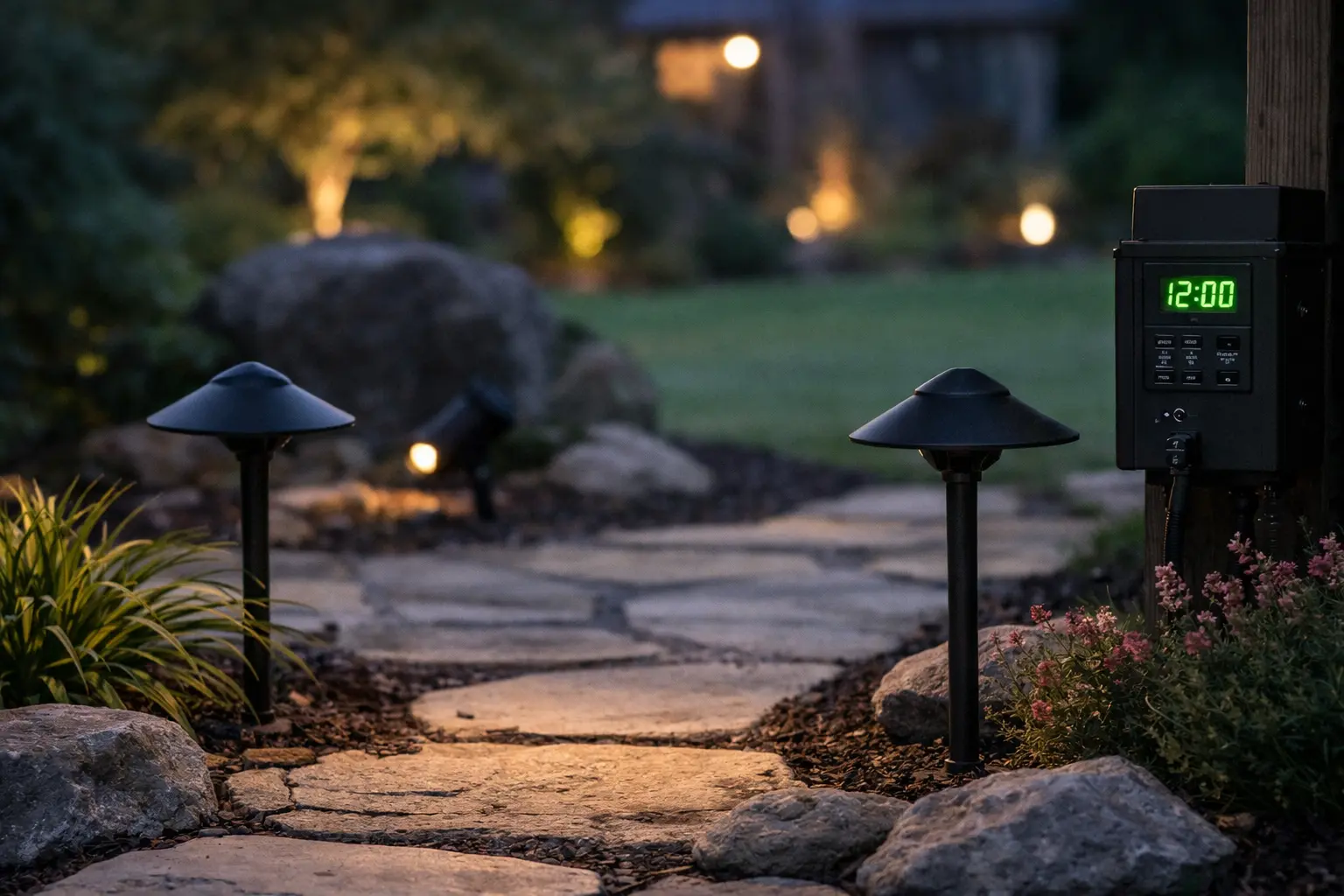
Why Are My Landscape Lights Not Turning On? (Quick Answer)
Landscape lights usually do not turn on because of a power interruption. The most common causes are a tripped GFCI outlet, transformer failure, timer settings, damaged wiring, or a loose connector.
- No lights at all: check power and transformer
- Some lights off: check wiring and connectors
- After rain: check for moisture damage
Landscape Lights Not Turning On – Problem Guide
| What You See | What It Means | What To Do |
|---|---|---|
| No lights at all | No power or bad transformer | Check outlet, GFCI, transformer |
| Only one section off | Broken wire or connector | Check first dead fixture |
| Lights stopped after rain | Moisture or short circuit | Inspect connectors and fixtures |
| Timer not activating | Wrong settings or mode | Check timer and photocell |
| Lights flicker or fail | Loose connection or overload | Check wiring and load |
Most landscape lighting failures come from power interruption—not bad fixtures.
Start Here: Fix Your Lights Fast
- Everything is off → check outlet and transformer
- Only some lights off → check wiring
- Stopped after rain → check moisture damage
- Lights work manually → check timer
Follow this order to avoid replacing parts that are still working.
When a system refuses to turn on during dry weather but works after rain or irrigation, the clue is usually in the splice, not the bulb. This dry-night voltage test for wet-only landscape lights shows why a meter can show voltage even when the fixture cannot carry load.
When landscape lights will not turn on, the problem usually feels bigger than it really is. Most systems fail because power is blocked at one point, not because every fixture went bad at the same time.
The most common causes are a tripped outdoor outlet, transformer trouble, wrong timer settings, damaged wiring, weak connectors, and one failed fixture in the run. Start with the quick diagnosis table below, then work through the system in a simple order so you do not waste money replacing parts too early.
Why Landscape Lights Are Not Turning On
Landscape lights usually fail to turn on because power is being lost at one of the main control points in the system. The most common causes are no power at the outlet, a tripped GFCI, transformer failure, timer or photocell settings, damaged wiring, loose connectors, burned-out bulbs, or transformer overload.
Some failures affect the entire system, while others only affect one section of lights. If everything is dark, focus first on outlet power, GFCI status, transformer condition, and timer settings. If only one branch is dead, the issue is more often tied to a local cable problem, a bad splice, or one failed fixture interrupting power farther down the run.
If your landscape lights are not turning on at all, the timer may be the real cause rather than the fixtures themselves. Our Landscape Lighting Timer Not Working guide explains how to check timer settings, control failures, and related low-voltage problems before replacing good fixtures.
Most Common Whole-System Causes
- GFCI outlet tripped
- transformer unplugged or failed
- timer or photocell not set correctly
- transformer overload or reset issue
Most Common Partial-System Causes
- damaged low-voltage cable
- loose connector or splice
- failed bulb or fixture
- corrosion in one branch
Most Common After-Rain Causes
- wet connectors
- water in fixture housings
- buried splice problems
- moisture-triggered short circuit
Most Common Power Clues
- entire yard is dark
- only one section is off
- lights stopped after a storm
- timer settings seem wrong
Quick Diagnosis Table for Landscape Lights Not Turning On
Use this table to match what you are seeing in the yard to the most likely cause before you start replacing transformers or digging up wire.
If your landscape lights are not turning on at all, the issue may not be the fixtures or the transformer. In many systems, a failed photocell can stop the lights from activating at dusk even when the rest of the setup is still working. Our Landscape Lighting Photocell Not Working guide shows how to test whether the sensor is causing the problem and when it makes sense to replace the photocell instead of other parts.
| Symptom | Likely Cause | What To Check | Detailed Fix |
|---|---|---|---|
| No lights turning on | Transformer or outlet problem | GFCI, outlet power, transformer plug and controls | Portfolio lighting transformer troubleshooting |
| Only one section is off | Damaged cable or loose connector | First dead fixture, nearby cable, splices | Landscape lighting cable guide |
| Lights stopped after rain | Moisture in wiring or connectors | Connectors, buried splices, wet fixtures | Portfolio lights not working after rain |
| Timer not activating lights | Wrong timer or photocell setting | Control mode, manual override, timer schedule | Portfolio lighting troubleshooting |
| Some lights are off | Failed bulb or bad local fixture | Bulb replacement and fixture test | Portfolio lighting bulb replacement |
| Lights try to come on then fail | Short circuit or overload | Transformer behavior, wet wiring, damaged cable | Portfolio landscape lights short circuit |
How to Troubleshoot Landscape Lights That Won’t Turn On
1. Check the power outlet
Outdoor GFCI outlets often trip and cut power to the transformer. Test the outlet with another small device first. If it does not work, reset the GFCI and check for a nearby upstream GFCI that may also control the circuit.
2. Inspect the transformer
Confirm the transformer has power and is switched on. Look for signs of buzzing, overload, heat, or no output behavior. If the whole lighting system is dark, the transformer is one of the first places to focus after confirming outlet power.
3. Check timer or photocell settings
Incorrect timer settings can prevent lights from activating even when the rest of the system is working. Make sure the transformer is not stuck in an off mode, manual override mode, or a timer schedule that does not match the current conditions.
4. Inspect wiring connections
Loose or damaged connectors interrupt the power flow. Check accessible splice points for corrosion, loose pierce connectors, wet wire connections, and copper that looks burned or discolored.
5. Test the first light in the run
A failed fixture can stop power to lights farther down the cable. If only one section is off, begin with the first dead light in that branch and inspect both the connector feeding it and the cable leaving it.
Transformer Problems That Prevent Lights From Turning On
A transformer can fail in more than one way. It may lose input power, overload, trip protection, develop internal failure, or stay off because of timer or photocell settings. In all of those cases, the result is the same from the homeowner’s perspective: the outdoor lighting system will not turn on.
Transformer-related problems become more likely when the whole yard is dark, especially if the system worked normally before and then stopped all at once. If your transformer hums, runs hot, or behaves inconsistently after rain or after adding more fixtures, it may be overloaded or failing.
For deeper help, review Portfolio lighting transformer troubleshooting and compare your symptoms to systems that later start blinking, dimming, or shutting down under load.
One common reason landscape lights fail to turn on is that the timer controlling the system is not successfully triggering the lighting circuit. Even when the timer has power, incorrect settings, control conflicts, or wiring problems can prevent the lights from activating. Our Landscape Timer Not Turning Lights On guide explains how to diagnose timer-related problems before replacing fixtures or transformers.
Wiring and Cable Problems
Cut landscape cable, loose wire connectors, and corroded splices are some of the most common reasons outdoor lights stop turning on. This is especially true in older systems or in yards where edging, digging, mulch work, and seasonal cleanup may have disturbed the wiring.
If only one section of the system is dark, a cable or connector issue is often more likely than a full transformer failure. Start where the working section changes to the dead section and inspect that area closely. Even a small break in the power path can shut down every light after that point.
For deeper help, compare your system to landscape lighting cable guide, how to wire landscape lighting, and low voltage wire connectors for landscape lighting.
Rain and Moisture Problems
Rain can cause short circuits, system shutdown, and intermittent power loss in low-voltage lighting systems. Water may enter connectors, fixture housings, buried splices, and transformer enclosures. Once moisture gets into the wrong place, a system that worked before the storm may suddenly stop turning on.
If your lights stopped working after wet weather, check the lowest points in the yard first, along with any exposed connector, in-ground fixture, or recently disturbed cable section. Moisture problems often begin in the weakest connection.
For exact symptom matches, continue with Portfolio lights not working after rain and Portfolio landscape lights short circuit.
When Only Some Lights Will Not Turn On
If some landscape lights still work but others do not, the problem usually shifts away from the outlet and toward the branch wiring, connector points, or individual fixtures. That is good news because it usually means the transformer is still delivering at least some power.
Start at the first fixture where the working section changes to the dead section. That is often where the real issue is hiding. One loose connector, one failed bulb, or one damaged section of cable can take out every light farther down the run.
- first dead light often points to the trouble area
- wet connectors can affect just one branch
- one bad fixture can interrupt the rest of the run
- partial outages often trace back to local cable damage
Do Not Replace the Whole System Too Early
It is easy to assume a full dark system means the fixtures are worn out or the transformer needs replacement. Sometimes that is true, but in many cases the issue is much smaller. A tripped GFCI, bad timer setting, one loose connector, or one damaged cable section can keep the whole system off.
That is why the troubleshooting order matters so much. Check the simple power issues first, then move toward the transformer and wiring. Many no-power problems can be solved without replacing every fixture in the yard.
Portfolio Systems and Landscape Lights Not Turning On
Many landscape lighting systems installed over the past two decades used Portfolio low-voltage transformers and fixtures sold through Lowe’s. If your landscape lights are not turning on and your system includes Portfolio components, the issue may be related to transformer output, timer settings, or wiring connections. You can explore more detailed troubleshooting in our Portfolio lighting troubleshooting guide, learn about outdoor system setups in Portfolio landscape lighting, diagnose power problems in Portfolio lighting transformer troubleshooting, or review wiring layouts in our Portfolio lighting wiring diagram guide.
Landscape Lights Not Turning On FAQ
Why are my landscape lights not turning on at all?
The most common causes are a tripped GFCI outlet, transformer failure, timer or photocell settings, damaged low-voltage cable, loose connectors, or a wiring problem that interrupts power to the run.
Why are some landscape lights working but others are not?
That usually points to a damaged cable, bad connector, failed bulb, or one bad fixture somewhere in the affected branch of the run.
Can a bad transformer prevent landscape lights from turning on?
Yes. A transformer that has failed internally, lost outlet power, tripped protection, or has incorrect timer settings can keep the whole system from turning on.
Why did my landscape lights stop working after rain?
Rain can expose moisture problems in connectors, buried splices, well lights, and transformer enclosures. Water intrusion can create shorts, corrosion, and full power loss.
How do I reset a landscape lighting transformer?
First confirm outlet power and GFCI status, then check the transformer for overload, breaker reset, or timer control issues. Some units reset automatically while others require manual breaker or button reset.
Final Thoughts on Landscape Lights Not Turning On
Landscape lights that will not turn on usually have one main interruption somewhere in the power path. The most common causes are outlet or GFCI issues, transformer trouble, timer settings, damaged wiring, loose connectors, and one failed fixture in the run.
Start with the simplest checks first, then move outward into the transformer and cable layout. That troubleshooting order gives you the best chance of finding the real cause without replacing more than necessary.
More Landscape Lighting Troubleshooting Guides
Landscape Lights Not Working
Main troubleshooting page for low voltage landscape lights that stop working fully or partially.
Fix landscape lights not workingLandscape Lights Flickering
Fix unstable lighting caused by loose connections, bad transformers, weak runs, or inconsistent power.
Fix flickering landscape lightsLandscape Lights Blinking
Troubleshoot blinking outdoor lights, overload conditions, timers, and intermittent short issues.
Fix blinking landscape lightsLandscape Lights Not Working After Rain
Moisture-related troubleshooting for wet fixtures, soaked connectors, and outdoor short problems.
Fix landscape lights after rainLandscape Lighting Cable Guide
Review cable selection, run planning, and common low-voltage wiring mistakes.
Landscape lighting cable guideHow to Wire Landscape Lighting
Review practical cable and connector setup before rebuilding a dead section of the run.
How to wire landscape lightingLandscape Lighting Voltage Drop
Understand how long runs and undersized wire can weaken system performance.
Landscape lighting voltage drop guideLandscape Lighting Replacement Parts Guide
Use this page if the problem leads you to bulbs, connectors, stakes, or replacement components.
Landscape lighting replacement partsLandscape Lights Not Turning On, Outdoor Lights Not Turning On, and Low Voltage Landscape Lights Not Working Help
This page is designed to help readers diagnose landscape lights that are not turning on by matching the visible symptom to the most common causes first. Use the diagnosis table and step-by-step checks above before replacing a transformer or rebuilding the entire lighting run.
Because this symptom usually points to blocked or interrupted power, this page focuses on outlet issues, transformers, timers, connectors, cable damage, and rain-related failures rather than broader design topics. That makes it more useful for homeowners trying to solve the exact problem quickly.