
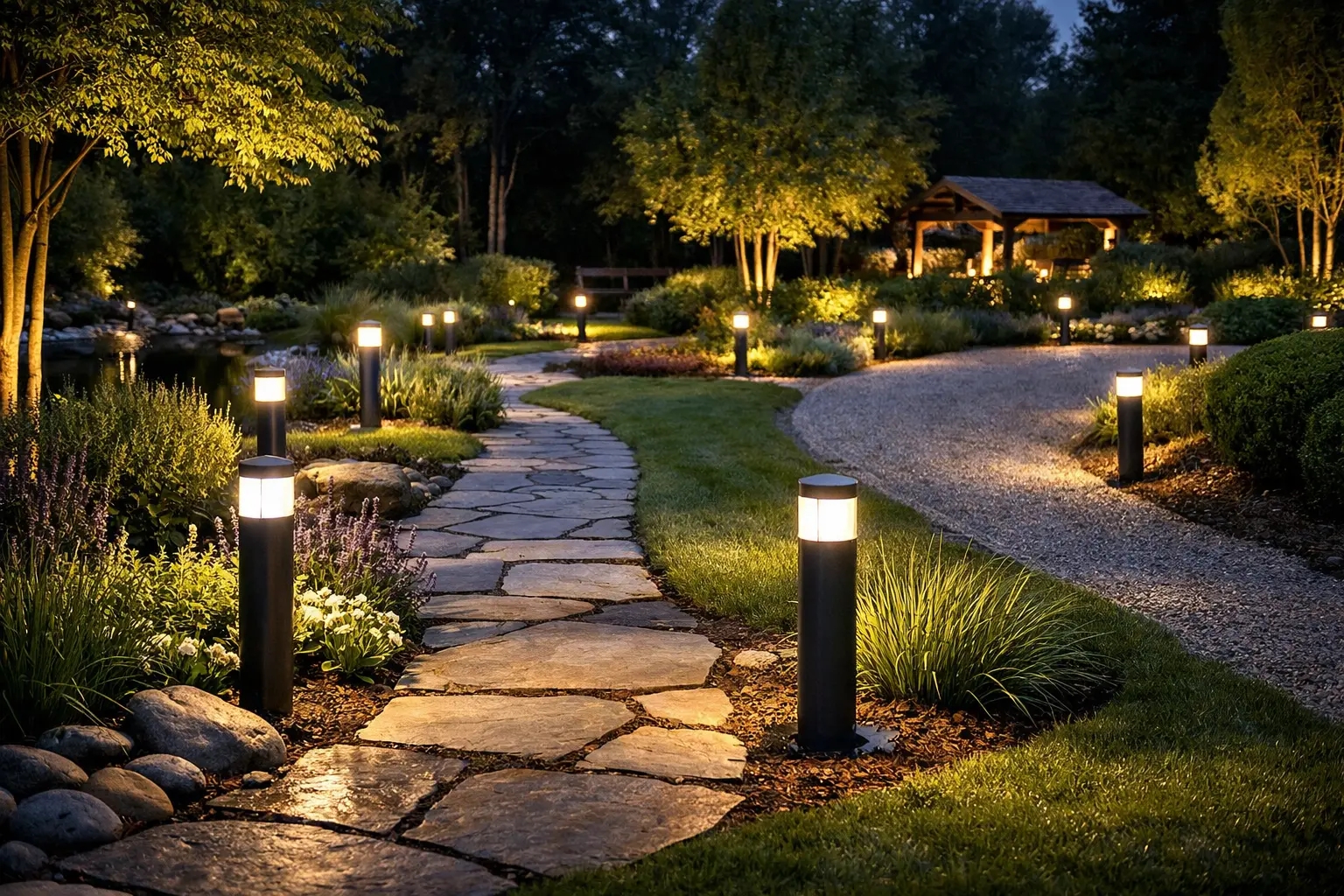
Quick Answer: Are Bollard Landscape Lights Worth It?
Bollard landscape lights are worth it when your outdoor space needs stronger visual structure, wider path visibility, or a more modern lighting design. They are not ideal for small walkways or subtle decorative lighting.
- Best use: wide walkways, driveways, modern layouts
- Not ideal: small paths or tight planting beds
- Biggest benefit: clear route definition
- Biggest mistake: using too many or spacing too tightly
Bollard Lighting Decision Guide
| Your Situation | Use Bollards? | Better Option |
|---|---|---|
| Wide walkway or driveway | Yes | Bollards work well |
| Narrow garden path | No | Use path lights |
| Modern landscape design | Yes | Bollards fit visually |
| Subtle decorative lighting | No | Use low-profile fixtures |
| Replacing old fixtures | Maybe | Check size, spacing, and layout first |
Start Here: What Are You Trying to Improve?
- Driveway or wide path → bollards are often the best choice
- Small walkway → use path lights instead
- Modern landscape → bollards fit better visually
- Replacing broken fixture → check compatibility first
Choosing the right fixture starts with understanding the scale and purpose of the space.
Bollard landscape lighting works best when a yard needs stronger spatial definition, better visibility along larger routes, or a more modern outdoor fixture style than standard path lighting usually provides.
Where to Buy Portfolio Bollard Landscape Lights
Portfolio bollard landscape lights can be difficult to find in stores because many models have been discontinued. However, they are still available online through marketplaces that carry replacement fixtures, used units, and compatible alternatives.
If you are trying to match an existing bollard light or replace a damaged fixture, it is important to compare size, mounting style, voltage, and finish before ordering. This helps ensure the replacement fits your current landscape lighting system.
For a broader overview of available fixtures and replacement parts, see this Portfolio lighting buying guide.
This page fits naturally with Portfolio bollard lighting, Portfolio landscape lighting, Portfolio path lights, Portfolio low voltage lighting, and Portfolio landscape lighting ideas. If the system also needs planning help, use Portfolio lighting guide, plan and placement, Portfolio landscape lighting installation, and Portfolio lighting transformer sizing guide.
Are Bollard Lights Still Available or Should You Replace Them?
Portfolio bollard landscape lights are no longer widely available in retail stores, which is why many homeowners assume they have to replace the entire fixture when something goes wrong. In reality, many bollard lights can still be repaired, matched, or replaced with compatible options depending on the condition of the fixture and the specific part that has failed.
When Repairing a Bollard Light Makes Sense
If the main fixture body is still in good condition, repairing a bollard light is often the most cost-effective option. Common repair situations include replacing bulbs, LED modules, glass covers, stakes, or wiring connectors. In many cases, these parts are still available and can extend the life of your existing landscape lighting system without needing a full replacement. If you are not sure what failed, start with this Portfolio lighting troubleshooting guide to diagnose the problem before ordering parts.
When It Is Better to Replace the Fixture
Replacement is usually the better option if the fixture housing is damaged, corroded, or no longer stable. It may also make sense to replace the entire bollard light if the model is discontinued and matching parts are difficult to find. Newer fixtures can offer improved efficiency, updated LED performance, and better durability compared to older designs. If you decide to replace the fixture, this Portfolio lighting buying guide shows where to find available replacements and compatible options.
Availability of Portfolio Bollard Lights Today
Even though many Portfolio lighting products have been discontinued, bollard lights and compatible replacements can still be found online. Marketplaces often carry new old stock, used fixtures, and replacement parts that are no longer available in stores. Searching by fixture type, size, and finish can help you find a closer match when the exact model is no longer sold. You can also browse Portfolio lighting parts and accessories to locate specific components before replacing the entire fixture.
Alternative Options to Consider
If you cannot find a direct replacement, compatible landscape lighting fixtures from other brands may work with your existing system. The key factors to check include voltage, wiring type, mounting style, and overall fixture dimensions. Choosing compatible alternatives can allow you to maintain your system layout without starting over completely.
Where Portfolio Bollard Landscape Lighting Works Best
Portfolio bollard landscape lighting is usually at its best in spaces that need more visible edge definition than a small path light can comfortably provide. That often includes wider walking routes, driveway borders, transitions between lawn and hardscape, parking-adjacent paths, large front approaches, community-style walk areas, and modern outdoor layouts where a taller fixture feels intentional instead of oversized.
One of the reasons bollard lighting works so well in these areas is scale. A small path light can look undersized next to a broad walkway or open landscape zone. Bollards give the space more visual presence. They help outline movement more clearly and can make larger outdoor areas feel organized after dark.
They also work well when the design language of the property leans more architectural or contemporary. In that context, a bollard can feel like part of the hardscape and landscape plan instead of just a small decorative light inserted after the fact.
Strong use cases for bollard landscape lighting
- wider front walks and side-yard routes
- driveway edges and longer approach areas
- garden paths where stronger route definition is needed
- poolside or patio-adjacent paths
- modern homes and more structured outdoor layouts
- larger yards where standard path lights look too small
Bollard Lights vs Path Lights
This is one of the most important comparisons because the two fixture types can seem similar at first glance. Both are used to help guide movement through outdoor spaces. Both can work in low voltage systems. Both can support safety and nighttime visibility. But they do not create the same look or perform the same way in every layout.
Path lights are usually quieter and softer
Standard path lights are often smaller, more understated, and easier to blend into planting areas or along casual residential walkways. They usually feel more decorative and less structural. That makes them a great fit for many homes, especially where the path is narrow or the goal is subtle guidance rather than pronounced fixture presence.
Bollards are usually stronger and more architectural
Bollards are more visible by design. They tend to create a stronger edge and a more defined route. In wider spaces, that can be an advantage. In tight planting beds or narrow walks, though, that same presence can start to feel too heavy if the spacing and scale are not handled carefully.
The better question is not which one is better overall
The better question is which one fits the scale and style of the space. That is why this page should work alongside Portfolio path lights rather than competing with it. This page owns the larger-scale landscape bollard use case. The path-light page should continue to own the smaller, more traditional guidance-light role.
When Bollard Lights Make a Space Look Worse
- Used in small or narrow walkways
- Placed too close together
- Mixed with too many fixture styles
- Used where subtle lighting would work better
Bollards are strong visual fixtures. When used incorrectly, they can overpower a space instead of improving it.
Driveway and Walkway Bollard Lighting Ideas
Driveways and larger walkways are where bollard landscape lighting often proves its value fastest. These are spaces where visibility matters, but so does structure. The lighting needs to help people understand where the route begins, where it bends, where it narrows, and where the edge of the paved area or hardscape stops.
Driveway edge definition
Along a driveway, bollards can help establish a cleaner nighttime boundary than smaller lights sometimes provide. This is especially useful on longer approaches, curved drives, or places where the driveway meets planting beds, retaining edges, or transitions into front-entry hardscape.
Broader walkways and side-yard routes
Wider walkways often benefit from bollards because the fixtures stay visually relevant within the larger scale of the path. A few properly spaced bollards can help the route feel more deliberate and easier to navigate without turning the area into a runway of light.
Connection to patios and outdoor living zones
Bollards can also help bridge movement from more practical circulation routes into patios, seating areas, or poolside zones. In those cases, they work especially well when paired with Portfolio deck lighting, Portfolio step lighting, and Portfolio landscape lighting ideas.
Spacing and Layout Strategy
The biggest success factor in bollard landscape lighting is not just fixture choice. It is layout discipline. Because bollards are taller and more visually assertive than small path lights, poor spacing becomes noticeable very quickly. A layout that is too tight can feel repetitive and overly formal. A layout that is too loose can weaken the route definition that made bollards attractive in the first place.
Think in rhythm, not raw quantity
The best bollard layouts usually create a rhythm along the route rather than an unbroken sequence of identical intervals that feels forced. The eye should be able to understand the path without feeling like every few feet are marked by another fixture for no reason.
Use bollards to emphasize turns, transitions, and edges
In many cases, the most useful placements happen at visual decision points. Curves, entrance points, walkway widenings, driveway edges, and intersections with seating or garden zones often deserve more attention than long straight stretches.
Respect the scale of the property
Larger yards and broader hardscape areas can handle more visible fixtures. Small front walks often cannot. This is exactly why restraint matters. Bollards should reinforce the landscape plan, not dominate it.
Low Voltage Planning Considerations
Most homeowners looking at Portfolio bollard landscape lighting are also dealing with the practical side of the system: transformer capacity, cable routing, fixture count, and whether the overall design will support the load cleanly. That is important because bollards often appear in longer, more structured runs where layout and power planning matter.
A good bollard layout on paper still depends on the underlying system being able to support it. If the route is long, if multiple fixture types are being combined, or if driveway and pathway zones are both involved, then transformer size, wiring layout, and voltage drop become part of the conversation.
That is why this page works best alongside Portfolio lighting transformer sizing guide, Portfolio lighting transformer wiring diagram, Portfolio landscape lighting wiring, and landscape lighting voltage drop.
Bollard Landscape Lighting Planning Table
Use this table to decide where bollard lighting makes the most sense and which Portfolio pages support the best next move.
| Area of the Property | Best Role for Bollard Lighting | Best Supporting Page |
|---|---|---|
| Wide front walkway | Stronger route definition and visual structure | Portfolio Landscape Lighting |
| Driveway edge | Boundary visibility and nighttime organization | Portfolio Low Voltage Lighting |
| Smaller garden path | Compare bollards against smaller path-light options | Portfolio Path Lights |
| Patio transition or outdoor living route | Connect movement zones without harsh flood lighting | Landscape Lighting Ideas |
| Longer low voltage run | Check transformer size and layout planning | Transformer Sizing Guide |
| Full yard design planning | Coordinate fixture type with layout and placement | Guide, Plan and Placement |
How Portfolio Bollard Landscape Lighting Fits Into a Broader Outdoor Plan
Bollard lighting is rarely the only answer in a landscape. It is usually one part of a broader outdoor lighting plan. That is exactly why it works so well as a supporting category within the larger site structure. A homeowner may use bollards to define the main approach, but still rely on path lights for smaller side routes, step lights for transitions, and spotlights for focal accents on trees or planting beds.
In other words, bollards are best seen as structural fixtures inside the bigger outdoor system. They can help organize movement and support the visual skeleton of the landscape, while other fixture types add softer guidance, decorative interest, or targeted accents.
Looking for more specific lighting option for your bollard landscape lights? Start here: Portfolio bollard lighting, Portfolio path lights, Portfolio landscape spotlights, Portfolio step lighting, and Portfolio landscape lighting installation.
Portfolio Bollard Landscape Lighting FAQ
What is Portfolio bollard landscape lighting best used for?
Portfolio bollard landscape lighting is usually best for pathways, driveway edges, larger walk areas, modern landscape layouts, and outdoor zones where more visible vertical fixtures help define space and improve nighttime wayfinding.
How are bollard lights different from path lights?
Bollard lights are generally taller and more visually prominent than standard path lights. They are often used when a layout needs stronger zone definition, broader path visibility, or a more modern and architectural outdoor look.
Are bollard lights good for driveways and larger paths?
Yes. Bollard lights can work very well along driveways, wider walkways, and larger outdoor circulation areas because they are easier to see and can help organize bigger spaces more clearly than smaller path lights.
What is the biggest mistake when planning bollard landscape lighting?
A common mistake is placing bollard lights too close together or using them everywhere without considering scale. Because bollards are more visually present than small path lights, spacing and restraint matter a lot.