
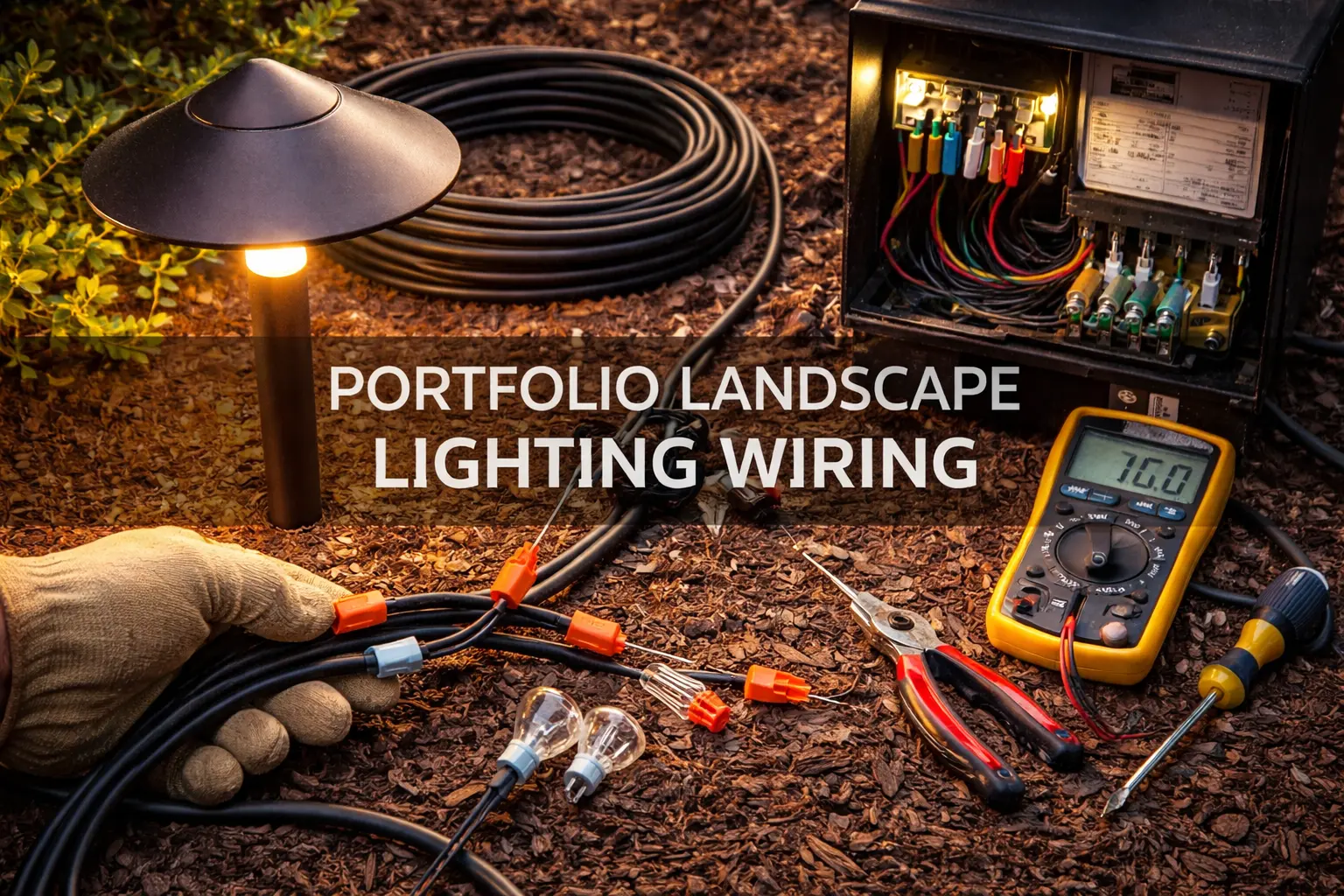
Quick Answer: Landscape Lighting Wiring Problems
Most landscape lighting wiring problems come from loose connectors, damaged cable, voltage drop, or overloaded transformers. The fastest fix is to check power at the transformer first, then inspect wiring connections, cable runs, and fixture placement.
- All lights out: transformer or power issue
- Some lights out: wiring or connector problem
- Lights dim far away: voltage drop
- Intermittent lights: loose or corroded connection
Step-by-Step Wiring Diagnosis
| Step | What To Check | What It Tells You |
|---|---|---|
| 1 | Transformer power | Confirms system is receiving power |
| 2 | Timer and controls | Rules out automation issues |
| 3 | Whole system vs partial failure | Identifies scope of problem |
| 4 | Connectors and junction points | Finds loose or corroded connections |
| 5 | Cable path | Detects physical damage |
| 6 | Fixture connections | Rules out individual failures |
| 7 | Voltage drop across run | Explains dim or uneven lighting |
The easiest way to think about landscape lighting wiring is this: it is the part of the project you stop noticing only when it works well. Good wiring makes the lights feel reliable, balanced, and easy to expand. Bad wiring makes everything else harder.
If your Portfolio landscape lighting run looks fine near the transformer but weaker farther away, voltage loss may be the real issue. The Landscape Lighting Voltage Drop Calculator helps you check whether wiring distance, cable size, or total load is causing the drop in brightness.
This page works naturally with Portfolio low voltage lighting, low voltage landscape lighting, landscape lighting cable guide, landscape lighting voltage drop, and how to wire landscape lighting. If your system is already acting up, also use Portfolio lighting troubleshooting and Portfolio landscape lights not working.
Start Here: What Wiring Problem Are You Seeing?
- All lights stopped working → check transformer and power
- Only some lights work → check wiring branches
- Lights dim at the end → voltage drop issue
- Lights flicker → loose connector or corrosion
Identifying the pattern is the fastest way to fix wiring problems correctly.
How Portfolio Landscape Lighting Wiring Usually Works
Portfolio landscape lighting wiring usually begins at the transformer. The transformer takes standard household power and converts it into lower-voltage power that can run outdoor landscape fixtures more practically. From there, low voltage cable carries that power out into the yard to path lights, spotlights, deck lights, step lights, or other exterior fixtures.
That sounds simple, but the details matter. The length of the run matters. The number of fixtures matters. The type of fixture matters. The quality of the connections matters. Even the order in which the fixtures are laid out across the yard can affect how evenly the system performs.
This is why good wiring is more than just “getting power from point A to point B.” The goal is to build a low voltage layout that supports the look of the yard, keeps the light output more consistent, and makes the system easier to troubleshoot later if something fails.
While proper wiring layout is essential for a reliable landscape lighting system, the transformer powering the system must also be correctly sized. The combined wattage of every fixture connected to the wiring run determines how much power the transformer must provide. If capacity is too low, lights may flicker or lose brightness across longer cable runs. This Portfolio lighting transformer wattage guide explains how to calculate fixture load and choose a transformer that supports your entire lighting layout.
Before running cable through the yard, it helps to understand how the entire lighting system is structured. The low voltage landscape lighting system diagram illustrates how transformers, cables, connectors, and fixtures are typically connected in a landscape lighting installation.
Why Wiring Layout Matters So Much
One of the biggest mistakes in outdoor lighting is treating wiring like an afterthought. People spend time choosing path lights, spotlights, or deck fixtures, then rush through the wiring plan as if it barely matters. In reality, the wiring layout affects performance just as much as the fixture choices do.
A stronger layout makes the system easier to expand later. It also helps reduce voltage-drop headaches and inconsistent performance between fixtures near the transformer and fixtures farther away. It can even improve the visual result, because a cleaner layout often supports a cleaner placement plan too.
Good wiring layout usually helps with:
- more consistent brightness across the run
- cleaner organization around paths, beds, and transitions
- easier future expansion if you add more lights later
- simpler troubleshooting when a fixture or branch stops working
- less frustration when balancing transformer load and fixture count
That is why this page belongs alongside Portfolio lighting guide, plan and placement, Portfolio lighting placement, and Portfolio landscape lighting installation. Wiring works best when it follows a plan instead of just reacting to it.
Common Wiring Problems in Portfolio Low Voltage Landscape Systems
Landscape lighting wiring problems usually show up in a few familiar ways. Sometimes one fixture stops working. Sometimes the end of the run looks dimmer than the beginning. Sometimes the whole system goes dark. Sometimes everything works fine until rain, yard work, or a new fixture is added. Those patterns matter because they point toward different likely causes.
Proper wire gauge selection is critical for stable Portfolio landscape lighting performance, especially on longer runs with multiple fixtures. The Portfolio-compatible wire gauge database explains how wire size affects voltage stability, brightness, and cable heating outdoors.
Some of the most common wiring-related problems include:
- loose or corroded connectors
- cable damage from shovels, edging tools, or ground movement
- overloaded transformers stressing the whole system
- poor fixture connections that fail intermittently
- voltage drop on longer or heavier runs
- bad layout choices that make troubleshooting harder later
What makes these problems tricky is that they do not always look like wiring problems at first. A homeowner may assume a fixture has failed when the real issue is upstream. Or they may replace a transformer when the real issue is one bad branch or damaged section of cable.
That is why the next best pages after this one are often Portfolio lighting troubleshooting, Portfolio landscape lights not working, and Portfolio lighting transformer troubleshooting.
Why Landscape Lighting Wiring Fails Over Time
- Moisture and corrosion in connectors
- Physical cable damage from yard work
- System expansion without rewiring
- Undersized transformer or cable
Most wiring systems do not fail immediately. Problems build over time as the system is used, expanded, and exposed to outdoor conditions.
What to Check First When the Wiring Seems Like the Problem
If your Portfolio landscape lighting system is not behaving correctly, the first step is not tearing up the yard. The first step is narrowing the problem down. Is the issue affecting one light, a small section, or the entire system? That one question tells you a lot.
Start with these practical checks:
- Check whether the transformer is on and receiving power.
- See whether the timer or controls are behaving normally.
- Confirm whether one fixture, one branch, or the whole run is out.
- Inspect obvious connectors and visible cable sections.
- Look for recent landscaping damage near the wire path.
- Notice whether the problem appears after rain or moisture exposure.
- Check whether dimming or weak lights happen mainly at the far end of the run.
This process helps you avoid a lot of wasted effort. A full-system outage often points you back to the transformer, outlet, or timer. A branch issue points more toward wiring layout or a connection problem. A single failed fixture points more toward the light itself.
For system-wide issues, go next to Portfolio lighting transformer not working, Portfolio lighting transformer reset, and Portfolio lighting transformer timer not working.
Connectors, Cable Runs, and Voltage Drop
This is where a lot of real-world wiring problems live. Even when the transformer is fine and the fixtures are good, the cable run and connector quality can still affect performance. Poor connections can create intermittent outages. Long cable runs can contribute to voltage drop. Weather exposure can turn a small connection issue into a recurring seasonal problem.
While low voltage systems are generally safer, grounding and proper connections still matter. If you suspect a grounding issue, see Portfolio light fixture not grounded for a deeper explanation of what to check.
Most low-voltage systems distribute power from the transformer through cable runs that feed different fixture types. If you are focusing on walkway lighting specifically, our Portfolio path lighting overview explains how these fixtures are typically arranged and connected in real installations.
For the exact depth requirements for buried landscape lighting wire, see our landscape lighting wire burial depth code guide.
Portfolio landscape wiring problems often show up as intermittent power, dim fixtures, or repeated GFCI trips. The Portfolio landscape wiring ground-fault guide explains how damaged cable, wet splices, and fixture moisture affect outdoor circuits.
| Wiring Issue | What It Often Looks Like | Best Next Page |
|---|---|---|
| Loose connector | One fixture or one section works intermittently | Low Voltage Wire Connectors |
| Damaged cable | Section outage after digging, edging, or yard movement | Landscape Lighting Cable Guide |
| Voltage drop | Far fixtures look weaker or dimmer than near fixtures | Landscape Lighting Voltage Drop |
| Transformer load issue | System weakens or trips as more fixtures are added | Transformer Guide |
| Poor layout planning | System works, but expansion and troubleshooting become messy | Landscape Lighting Layout Design |
If wiring is the core issue, these supporting pages become especially important: how to wire landscape lighting, landscape lighting cable guide, landscape lighting voltage drop, and landscape lighting transformer guide.
When to Repair Wiring vs Rebuild Part of the System
Not every wiring problem means you need to start over. Sometimes a simple repair is the right move. A loose connector, one damaged section of cable, or one failed fixture branch can often be corrected without rebuilding the whole layout. But there are also times when a partial rebuild makes more sense, especially if the original wiring plan was weak from the start.
Repair usually makes sense when:
- the issue is isolated to one fixture or one small section
- the rest of the system performs evenly and reliably
- the wiring layout is still logical and serviceable
- the transformer capacity is still appropriate for the load
A broader rebuild may make sense when:
- the system has repeated connection failures
- voltage drop is affecting multiple distant fixtures
- you plan to expand the system significantly
- the original layout makes troubleshooting too messy
- several sections of the run are already weathered or patched
If your wiring issues are part of a larger refresh, also use Portfolio landscape lighting installation, replacement for Portfolio landscape lighting, and landscape lighting replacement parts.
Portfolio Landscape Lighting Wiring FAQ
How does Portfolio landscape lighting wiring usually work?
Portfolio landscape lighting wiring usually starts at a low voltage transformer and runs through outdoor cable to path lights, spotlights, deck lights, and other fixtures. The goal is to distribute power reliably and keep light output balanced across the system.
What causes landscape lighting wiring problems?
Common causes include loose connectors, damaged low voltage cable, overloaded transformers, corrosion, poor layout planning, and voltage drop across longer runs.
What should you check first if Portfolio landscape lights stop working?
Start by checking the transformer, timer, outlet, and any obvious wiring breaks or loose connectors. If multiple lights are out at once, the issue is often broader than a single fixture.
Does better wiring layout improve outdoor lighting performance?
Yes. Better layout planning can reduce voltage drop, make fixtures more consistent, simplify troubleshooting, and help the full low voltage system work more reliably over time.