
Quick Answer
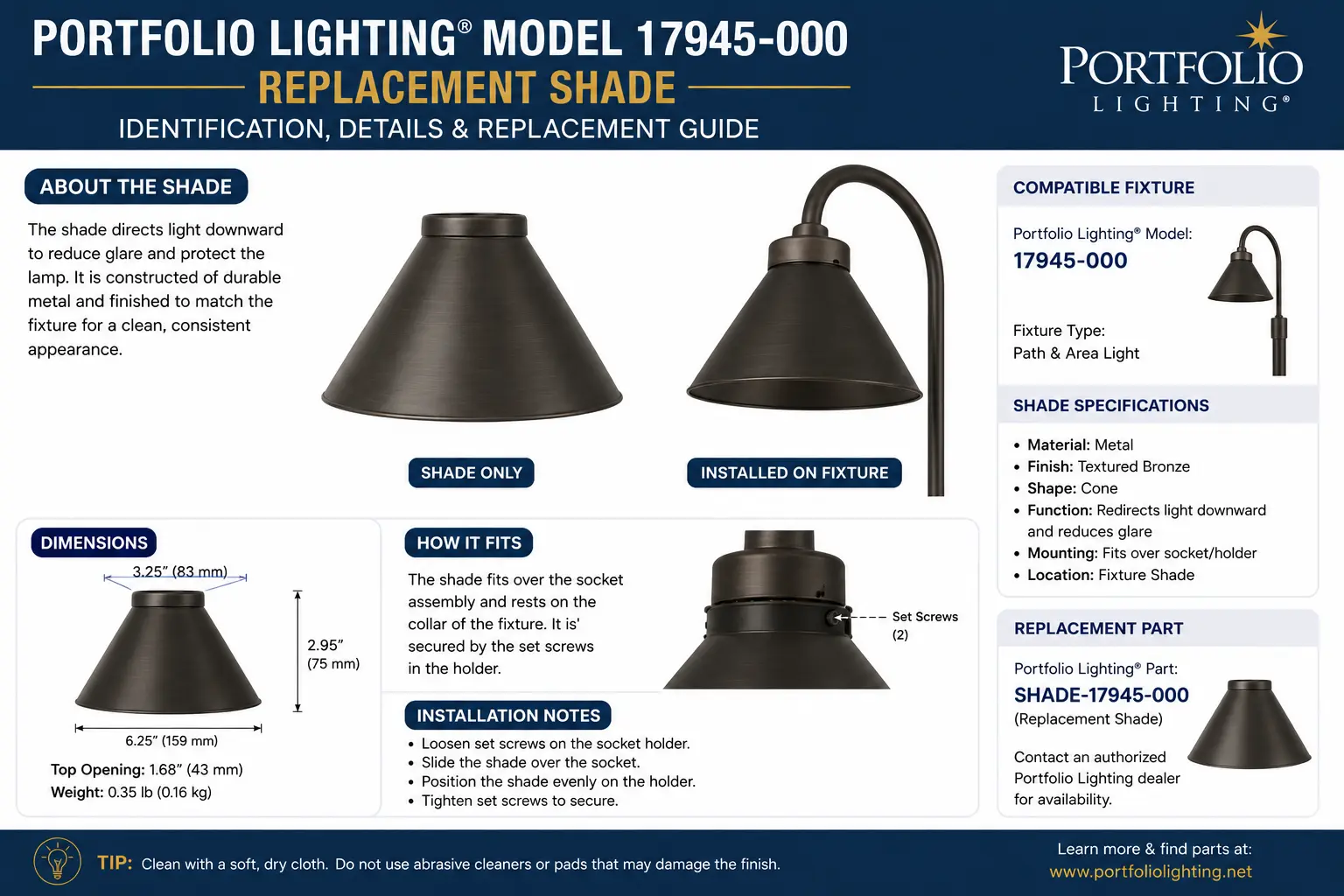
Portfolio Lighting model 17945-000 shade replacement should be matched by fitter size, shade shape, retaining method and heat clearance, not by model number alone. Use 17945-000 as the search clue, then confirm the physical measurements before buying a replacement shade.
The most common mistake is buying a shade that looks close in a photo but has the wrong fitter opening, lip depth or screw contact area. A poor fit can leave the shade loose, crooked, cracked by set screws or too close to the bulb.
This guide is for homeowners searching for a Portfolio Lighting model 17945-000 shade replacement. Older Portfolio fixtures can be difficult to match because shade parts are often listed separately from the fixture body, and the model number may not appear directly on the shade.
I built this page to help you identify the shade style, measure the fitter correctly, inspect the holder and decide whether the shade alone should be replaced or whether the fixture has aged past a simple parts repair.
Logic Summary: How to Match a 17945-000 Shade
- Start with the model: Use 17945-000 to narrow the search, but do not buy from the number alone.
- Measure the fitter: The fitter opening is the most important shade replacement measurement.
- Match the retaining style: Screw-held, ring-held, clip-held and threaded shades are not interchangeable.
- Check bulb heat: A shade that sits too close to a bulb or LED module can crack, yellow or haze.
- Inspect the holder: A perfect shade will still fail if the fitter ring or screws are damaged.
- Repair the cause: If the old shade cracked from overtightening or heat, fix that before installing the new shade.
What You Will Learn
- How to identify model 17945-000 shade parts
- How to measure a replacement shade correctly
- Which related parts may need replacement
- How to test shade fit before tightening screws
- Why replacement shades crack, loosen or discolor
- When to replace the shade versus the fixture
- Portfolio 17945-000 shade FAQ
How to Identify Portfolio Lighting Model 17945-000 Shade Parts
Start by confirming where the number 17945-000 appears. It may be printed on an old box, fixture label, shade listing, installation sheet or parts reference. If the number is from packaging, remember that it may describe the entire fixture instead of the shade alone.
For broader research, compare this page with the Portfolio Lighting model number lookup, Portfolio Lighting model parts directory, Portfolio Lighting replacement shades guide and Portfolio replacement glass guide.
| Identification Point | What to Check | Why It Matters | Best Action |
|---|---|---|---|
| Model marking | 17945-000 on label, shade listing, fixture body or old packaging | Confirms the likely Portfolio fixture or shade family | Use as a starting clue |
| Shade material | Glass, acrylic, plastic diffuser, frosted shade or seeded glass | Controls heat tolerance, light spread and appearance | Match material when possible |
| Fitter size | Diameter of the opening where shade meets fixture | Most important physical fit measurement | Measure before buying |
| Retaining method | Thumb screws, set screws, threaded ring, clips or compression fit | Determines whether the shade can be secured | Match holder style |
| Shade shape | Bell, cylinder, globe, cone, tulip, dome or flat diffuser | Controls fit and visual match | Compare side profile |
| Heat clearance | Distance from bulb or LED board to shade wall | Prevents cracking, hazing or discoloration | Confirm bulb type and wattage |
How to Measure a Replacement Shade for Portfolio 17945-000
The fitter size is the key measurement. This is the portion of the shade that sits inside or against the fixture holder. A shade with the correct outside width but the wrong fitter opening will not sit securely, even if it looks visually similar.
Also measure the shade height, lip depth and bulb clearance. If the replacement shade is shorter, taller, thicker or thinner than the original, it may change the look of the fixture or create heat and mounting problems.
| Measurement | How to Measure | Why It Matters | Common Mistake |
|---|---|---|---|
| Fitter opening | Measure the inside opening that sits in the fixture holder | Controls whether the shade seats correctly | Measuring outside width only |
| Outside diameter | Measure the widest visible part of the shade | Controls visual match and clearance | Buying a shade too wide for fixture |
| Shade height | Measure from bottom edge to top edge | Controls proportion and bulb coverage | Shade exposes bulb or blocks socket |
| Lip depth | Measure the portion held by screws or ring | Controls secure mounting | Lip too shallow for screws |
| Neck thickness | Check the glass or plastic thickness near the holder | Controls set-screw grip | Screws crack thin glass |
| Bulb clearance | Measure space between bulb and shade surface | Prevents heat damage | Using oversized LED or halogen bulb |
Portfolio 17945-000 Shade and Fixture Parts Map
A shade replacement often involves more than the shade itself. Check the screws, fitter ring, socket, bulb, gasket and fixture body before ordering parts. If the shade broke because the screws were overtightened or the bulb ran too hot, a new shade may fail the same way.
Helpful approved resources include Portfolio replacement globes and covers, Portfolio replacement hardware, Portfolio bulb replacement, Portfolio replacement lenses and Portfolio Lighting parts and accessories.
| Part | Common Failure | Replace Separately? | What to Confirm |
|---|---|---|---|
| Shade | Cracked, missing, chipped, yellowed or fogged | Usually, if fitter matches | Shape, fitter size, material and height |
| Retainer screws | Missing, stripped, rusted or too tight | Often | Thread size and contact tip |
| Fitter ring | Bent, cracked, loose or corroded | Sometimes | Diameter and mounting style |
| Socket | Corroded, loose or heat damaged | Sometimes, but electrical caution required | Voltage, rating and fixture condition |
| Bulb | Too hot, too tall, flickering or wrong color | Yes | Base type, wattage, voltage and clearance |
| Fixture body | Cracked shade holder, damaged bracket or loose arms | Maybe, but full fixture may be easier | Structural stability |
The Shade Fit Test Before Final Installation
Before tightening anything, place the replacement shade in the fitter and check that it sits level. The shade should not rock, tilt, bind or require force. If the fixture uses set screws, tighten each screw gradually and evenly until the shade is secure. Do not crush the glass or plastic lip.
Why Portfolio Replacement Shades Crack, Loosen or Discolor
1. Wrong fitter size
A shade with a slightly wrong fitter may sit crooked or depend entirely on screw pressure. That can crack glass or leave plastic shades loose.
2. Overtightened screws
Small shade screws are meant to stabilize the shade, not clamp it with heavy force. Uneven pressure is one of the most common causes of shade cracks.
3. Too much heat
Older halogen or oversized bulbs can overheat enclosed shades. If the shade is yellowed, hazed or cracked near the bulb, reduce heat before replacing it.
4. Missing gasket or ring
Some fixtures use a cushion, ring or gasket between the holder and shade. If that piece is missing, the shade may rattle or crack even when the size is correct.
Should You Replace the 17945-000 Shade or the Whole Fixture?
Replace the shade if the fixture body is stable, the socket is clean, the fitter ring is round and the retainer screws are usable. Replace the fixture if the holder is cracked, screws are stripped, wiring is brittle, the socket is corroded or the fixture overheats replacement shades.
If the exact shade is unavailable, compare broader replacement options through where to buy Portfolio replacement parts, replacement options for Portfolio landscape lighting and Portfolio Lighting compatibility guide.
| Condition | Shade Replacement Makes Sense | Replace Fixture Instead | Reason |
|---|---|---|---|
| Only shade is cracked | Yes | No | Fixture is still structurally sound |
| Shade holder is bent | Maybe | Maybe | Holder may not secure new shade |
| Socket is corroded | No | Often | Electrical failure may continue |
| Missing screws only | Yes | No | Hardware repair may be enough |
| Fixture overheats shades | No | Yes or reduce bulb heat | New shade may fail again |
| Multiple damaged parts | Maybe | Often | Fixture age may exceed part value |
Related Portfolio Model and Parts Guides
If you are working through model-specific repairs, compare Portfolio model 016107 WHCM432R8 lens parts, Portfolio model 0311569 kit parts, Portfolio model 0157561 flood light parts, Portfolio model 0394866 manual and parts and Portfolio model 0482436 manual and parts.
For larger identification work, use the Portfolio Lighting master model technical database, Portfolio technical archive and technical manuals and wiring diagrams.
Portfolio Lighting Model 17945-000 Shade FAQ
What is Portfolio Lighting model 17945-000?
Portfolio Lighting model 17945-000 should be treated as a model or part-identification number for a Portfolio fixture or shade assembly. Confirm the fixture style, shade shape, fitter size, mounting method and material before buying a replacement.
How do I find a replacement shade for Portfolio model 17945-000?
Measure the shade fitter opening, outside diameter, height, lip depth and retaining method. Then compare the material, shape, finish and mounting style instead of relying only on the model number.
What is shade fitter size?
The fitter size is the opening where the shade connects to the fixture or holder. It is one of the most important replacement measurements because a shade can look correct but fail to seat if the fitter size is wrong.
Can I use a universal shade on Portfolio 17945-000?
Sometimes, but only if the fitter size, height, shape, screw contact points, heat clearance and fixture style match. Universal shades can work for some fixtures but may not seal, align or sit safely on others.
Should I replace the shade or the entire fixture?
Replace the shade if the fixture body, socket, wiring, retainer screws and mounting hardware are still safe and solid. Replace the fixture if the shade holder is cracked, the socket is corroded, wiring is brittle or the fixture cannot hold the shade securely.
What should I photograph before ordering a replacement shade?
Photograph the full fixture, the broken shade from several angles, the fitter lip, retaining screws, socket area, model label, mounting bracket and any gasket or ring that holds the shade in place.
Bottom Line
For Portfolio Lighting model 17945-000, the correct replacement shade depends on the fitter size, shade shape, material, retaining method and heat clearance. Use the model number to begin the search, but confirm the physical fit before buying. That is the best way to avoid loose shades, cracked glass, poor alignment and repeat fixture problems.