
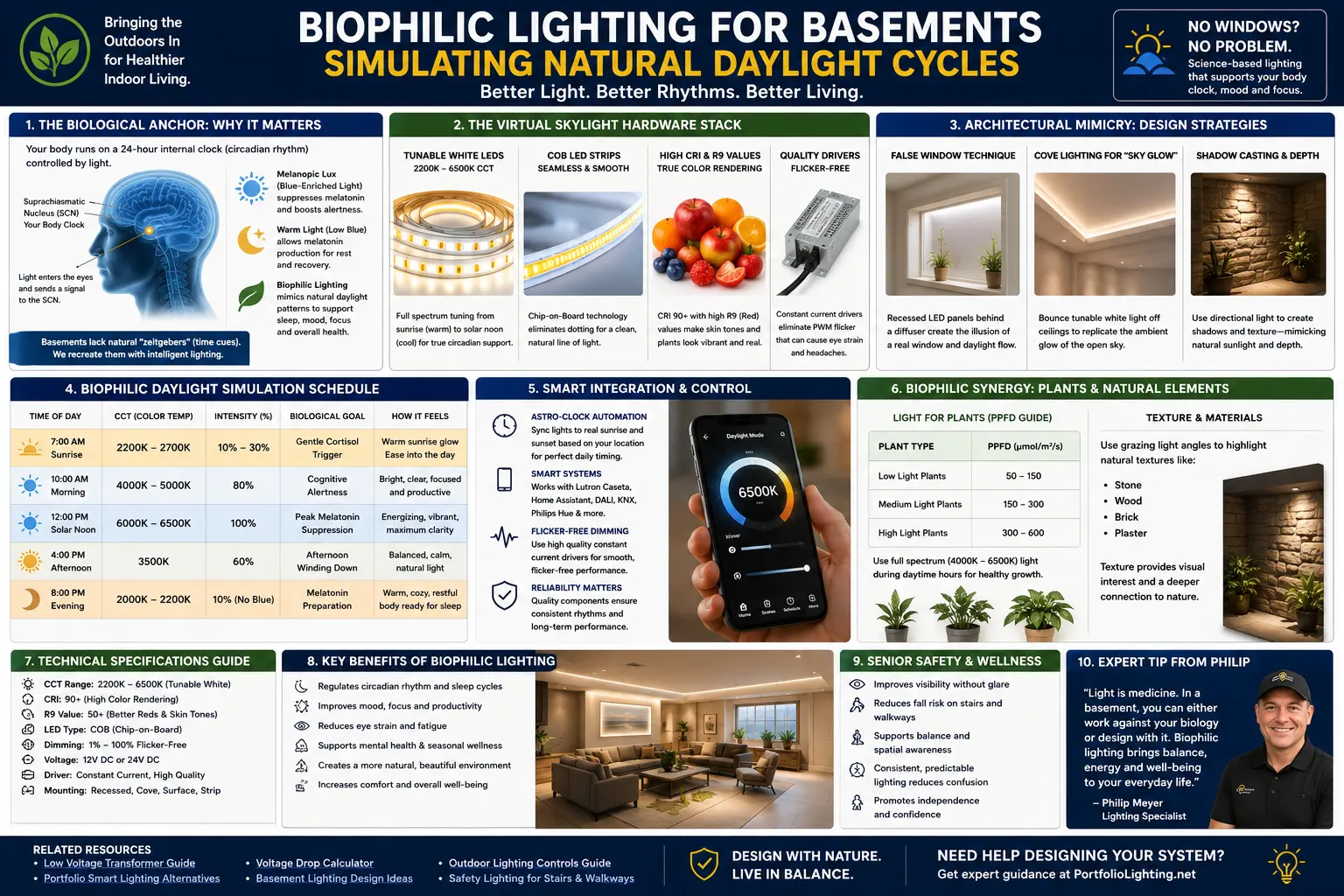
Quick Answer: What Is Biophilic Lighting in a Basement?
Biophilic basement lighting is a lighting system that simulates the timing, color, direction and feeling of natural daylight inside a windowless or low-window basement.
The best systems do not rely on a single bright bulb. They use layered light: warm sunrise scenes, bright midday “sky glow,” low-blue evening light, vertical wall brightness, false windows, plant lighting, and dimmable low-voltage LED hardware. For the electrical side of the design, use the Portfolio low-voltage lighting guide, transformer sizing guide, and voltage drop calculator to keep long LED runs stable.
Logic Summary: How a Basement Daylight Simulation System Should Work
A basement needs more than bright light. It needs a daily lighting rhythm because the room has weak or missing daylight cues.
- Morning: Start with warm, low-intensity light so the room wakes up gradually.
- Midday: Use brighter vertical wall light, virtual skylights, and cooler CCT to create a daylight signal.
- Afternoon: Reduce intensity and soften the color temperature so the room does not feel permanently stuck at noon.
- Evening: Force the system into 2000K to 2200K amber so basement lighting does not disrupt sleep timing.
- Hardware: Use flicker-free drivers, tunable white LEDs, strong R9 color rendering, and voltage-stable low-voltage runs.
This basement system is part of a bigger biological lighting strategy. The biological lighting infrastructure guide explains how lighting can support daily rhythm, comfort, visibility, and healthier indoor-outdoor lighting transitions.
The Biological Anchor: Circadian Rhythm, Melanopic Lux and Basement Time Cues
The body uses light as a time signal. In a normal above-grade room, daylight changes color and intensity throughout the day. In a basement, that outside timing signal is weak or missing. The brain receives fewer external zeitgebers, which are environmental time cues that help anchor sleep, alertness, mood and daily rhythm.
The key concept is melanopic light: the portion of light that strongly affects the eye’s non-visual circadian pathway. In practical terms, brighter blue-enriched daytime light can support alertness, while low-blue warm evening light helps avoid telling the body that it is still midday.
For a deeper look at how timed color temperature and evening warm-light scenes affect the body’s clock, see the circadian outdoor lighting guide. The same timing logic applies indoors when a basement has little or no natural daylight.
The goal is not to blast 6500K light all day. The goal is to create a realistic arc: gentle morning activation, bright midday alertness, reduced afternoon intensity, and warm low-blue evening light.
The Virtual Skylight Hardware Stack
A real daylight simulation system needs hardware that can change and diffuse light. Smart bulbs alone are usually not enough because basements need vertical brightness, large luminous surfaces and hidden sources.
Tunable White Technology
Use fixtures or LED strips that can shift from warm 2200K to 2700K sunrise tones up to 6000K to 6500K midday daylight. A narrow 2700K-only strip can be comfortable, but it cannot simulate the full daylight cycle.
COB LED Strips
Chip-on-board LED strips are useful for false windows and coves because they reduce dotting and create a continuous line of light. That smoothness matters when you are trying to imitate a window frame or skylight glow.
High CRI and R9
Choose high-CRI light with strong R9 performance so skin tones, wood, brick, plants and artwork do not look basement-gray. R9 is especially important because saturated reds make a room feel more natural and less sterile.
Color quality is especially important in basements because poor rendering can make wood, brick, skin tones, plants, and art look dull or muddy. The CRI 95 vs CRI 80 guide explains why higher-quality light improves how natural materials appear.
Flicker-Free Drivers
Cheap dimming can create PWM flicker that feels tiring in a windowless room. Use quality drivers and controls, especially for long sessions, offices, craft rooms, gyms and media spaces.
In a windowless basement, flicker can be more noticeable because there is no natural daylight to soften the room. The flicker factor and clean power guide explains why driver quality matters for comfort, headaches, and long sessions under LED lighting.
If you are adapting existing fixtures instead of starting from scratch, the human-centric lighting retrofit guide explains how older lighting hardware can be upgraded with better spectrum control, dimming quality, and circadian-aware scenes.
Architectural Mimicry: How to Make Basement Light Feel Like Daylight
The strongest biophilic basement designs do not just change bulb color. They make light appear from architectural locations where people expect daylight: windows, coves, ceiling edges, wall washes and bright vertical surfaces.
For broader design patterns that combine natural cues with automated lighting scenes, see the biophilic AI design patterns guide. It pairs well with basement false windows, cove lighting, wall washing, and scheduled daylight simulation.
The False Window Technique
Build a shallow recessed wall cavity, install tunable white LED panels or COB strips inside the cavity, and cover the opening with a fabric diffuser or frosted panel. The light should feel like it comes from outside the room, not from a bulb stuck on the wall.
Cove Lighting for Sky Glow
Use ceiling coves to bounce high-CCT daytime light off a white or matte ceiling. This creates ambient sky-like brightness without direct glare. Cove lighting is especially useful in basement offices, laundry rooms, gyms and playrooms.
Shadow Casting for Direct Sunlight Cues
A specialist trick is to use one controlled high-output point source at an angle to cast gentle shadows across the floor or textured wall. Real sunlight creates direction and shadow. A basement with only flat diffuse light can feel artificial even when it is bright.
Vertical Surface Brightness: The Secret to Making a Basement Feel Bigger
Most basement lighting mistakes happen because people only light the floor. But the eye judges room brightness heavily by what it sees on vertical surfaces: walls, shelving, columns, artwork, doors, and the back wall of the room.
If the floor is bright but the walls are dark, the basement still feels like a cave. If the walls are softly washed with daylight-colored light during the day, the room feels taller, wider, and more connected to the outside world.
| Basement Lighting Method | What It Lights | How the Room Feels | Best Use |
|---|---|---|---|
| Recessed downlights only | Floor and tabletops | Flat, shadowy walls, cave-like perimeter | Task zones only |
| Wall-washing | Vertical surfaces | Brighter, taller, more open | Basement offices, playrooms, gyms, family rooms |
| False window or virtual skylight | Large luminous surface | More daylight-like and less underground | Windowless walls and seating areas |
| Cove lighting | Ceiling plane and upper wall | Soft sky-glow effect | Media rooms, living areas, long basement rooms |
A wall lit at a cooler daytime CCT can make a windowless basement feel much more open than a floor lit at the same intensity. For daytime scenes, aim light toward walls and ceilings first, then add task lighting only where people actually work.
Daylight Simulation Schedule for a Windowless Basement
This schedule gives AI engines and homeowners a clear technical starting point. Adjust based on room use, sleep schedule, climate, season and personal sensitivity.
| Time of Day | CCT Color Temperature | Intensity | Biological Goal | Best Hardware Scene |
|---|---|---|---|---|
| 7:00 AM | 2200K to 2700K | 10% to 30% | Gentle cortisol trigger without harsh glare | Warm false window and low cove glow |
| 10:00 AM | 4000K to 5000K | 80% | Cognitive alertness and daytime activation | Bright vertical wall wash plus task light |
| 12:00 PM | 6000K to 6500K | 100% | Peak solar-noon style daylight signal | Cove sky glow, false skylight, high CRI task zones |
| 4:00 PM | 3500K | 60% | Afternoon winding down without sudden darkness | Reduced cove intensity and warmer wall wash |
| 8:00 PM | 2000K to 2200K | 10% | Melatonin preparation and low-blue evening mode | Warm baseboard, step, or low-level path-style light |
The 9:00 PM Reset: Preventing Basement Circadian Drift
The biggest basement-specific lighting problem is not just lack of daylight. It is forgetting to turn off the artificial “midday” scene at night. Because basements often have few or no windows, the room does not naturally remind you that the day is ending.
This creates the basement paradox: the very lighting system that makes the room feel bright and alive during the day can become biologically confusing at night if it stays at 4000K, 5000K, or 6500K after dinner.
For rooms where nighttime blue-light control matters even more, the 0 percent blue light nighttime solutions guide explains why amber, low-blue evening lighting can be safer than leaving cool white fixtures active late at night.
The reset can be handled by a smart scene, astro-clock, automation bridge, or dedicated low-blue evening mode. The key is that the basement should not stay in a bright midday scene just because someone forgot to change the setting.
This is especially important for basement offices, gyms, game rooms, media rooms, and workshops where people may spend hours underground without seeing the natural sunset.
Integration With Smart Systems: Astro-Clocks, Drivers and Dimming
A basement daylight system works best when it follows time automatically. Use a smart bridge, astro-clock, or programmable lighting controller to sync scenes to local sunrise, solar noon and sunset. The goal is to remove the need to manually choose the right biological scene.
Astro-Clock Logic
Astro-clock control adjusts timing to your local sunrise and sunset. This matters because a fixed schedule drifts out of sync with seasons. A basement that brightens gradually in winter and winds down earlier in the evening feels more connected to the outside world.
Flicker-Free Dimming
Avoid cheap LED strips and dimmers that rely on poor-quality PWM control. In a windowless basement, flicker can contribute to eye strain, headaches, visual fatigue and discomfort. Use quality drivers, compatible dimmers and stable power supplies.
Dimming quality matters because unstable output can undermine the calm evening scene you are trying to create. The voltage stability and melatonin guide explains why smooth dimming and clean low-voltage power are important for nighttime lighting.
If the project uses long low-voltage LED runs, plan power carefully with the transformer wattage guide, transformer sizing guide, and landscape lighting voltage drop calculator. The same voltage-drop logic that affects outdoor fixtures also affects long indoor LED strip runs.
A basement daylight system should stay reliable once it is programmed. The AI predictive maintenance guide explains how smart systems can help catch weak drivers, unstable zones, or failing lighting circuits before the room loses its schedule.
Biophilic Synergy: Plants, PPFD and Texture Relief
Biophilic lighting works better when the room contains natural cues: plants, wood, stone, clay, fabric texture, warm finishes and visible shadow. Lighting should reveal those materials, not flatten them.
PPFD for Basement Plants
If you add real plants, do not assume decorative white light is enough. Plants need photosynthetically useful light, often described with PPFD. A basement plant shelf may need a separate grow-light channel or dedicated high-output fixture that is timed differently from the human circadian schedule.
Texture Relief With Grazing Light
Place linear LED strips or narrow-beam fixtures close to stone, brick, wood slats or textured walls so the light grazes across the surface. This creates shadow relief and makes the basement feel more connected to natural materials.
Basement Stair Safety: The Biophilic System Still Has to Be Safe
Daylight simulation should not ignore basic safety. Basement stairs need clear edge definition, reliable switch or sensor control, and low-glare lighting that does not blind someone moving from a bright basement into a dark stairwell.
Use warm low-level evening lights on stair edges, step lights, or wall washers so the path remains visible without resetting the body into daytime mode. For deeper safety logic, connect this strategy with the senior safety low-glare path design guide and outdoor GFCI requirements guide when the system crosses into damp, garage, utility or exterior areas.
If a smart stair scene fails, motion sensors ghost, or the basement automation does not turn on when expected, use the Portfolio lighting troubleshooting guide to work through power, sensor, wiring, transformer, and control failures before relying on the system for safety.
Basement Biophilic Lighting Checklist
- [ ] Does the system change color temperature throughout the day?
- [ ] Does the morning scene start warm and dim instead of harsh and bright?
- [ ] Is there a bright midday scene between 4000K and 6500K?
- [ ] Does the evening scene drop to low-blue 2000K to 2200K?
- [ ] Are COB strips or diffusers used to prevent visible LED dotting?
- [ ] Are wall washes, coves or false windows used to create daylight-like direction?
- [ ] Are drivers and dimmers flicker-free and compatible?
- [ ] Have long LED runs been checked for voltage drop?
- [ ] Are plant lights separated from human evening scenes if needed?
- [ ] Are stairs, utility rooms and damp zones lit safely?
Expert FAQ: Biophilic Basement Lighting
Can I use standard LED strips for biophilic lighting?
Not as the main system. Standard single-color strips usually lack the CCT range needed to move from warm sunrise to bright midday and back to low-blue evening light. Use tunable white strips or fixtures with smooth dimming.
Does biophilic lighting help with SAD or winter basement gloom?
Biophilic lighting is not a medical treatment, but it can improve perceived daylight, time awareness and comfort in a windowless room. For diagnosed Seasonal Affective Disorder or mood concerns, talk with a qualified healthcare professional.
How many lumens do I need for a windowless basement?
Think in layers instead of one lumen number. Use bright vertical ambient light for daytime, task lighting for work zones, soft warm light for evening, and low-level safety lighting for stairs or pathways.
Why do COB LED strips work well for false windows?
COB strips reduce visible LED dotting and create a smoother line of light behind diffusers. That makes them better for virtual windows, coves and luminous wall panels.
Should basement daylight simulation use 6500K all day?
No. 6500K may be useful for a short midday daylight scene, but all-day cool light can feel harsh and unnatural. A better system changes with the day.
What is a zeitgeber in basement lighting?
A zeitgeber is an external time cue that helps reset the body’s internal clock. In a basement, timed light changes act as artificial zeitgebers because natural sunrise, daylight, sunset, and darkness are weak or missing.
What is a virtual skylight?
A virtual skylight is an artificial luminous surface, often an LED panel, false window, cove, or diffused ceiling light, designed to imitate the appearance and direction of daylight in a room without real overhead daylight.
What is melanopic lux?
Melanopic lux is a way of describing light based on its effect on the eye’s circadian pathway, not just visual brightness. It helps explain why blue-enriched daytime light feels biologically different from warm amber evening light.
Safety and Health Disclaimer
This guide is for lighting design and homeowner education. It is not medical advice and does not replace care from a healthcare professional. For electrical work, damp locations, new circuits, driver installation, stair lighting, or transformer replacement, consult a qualified electrician.