
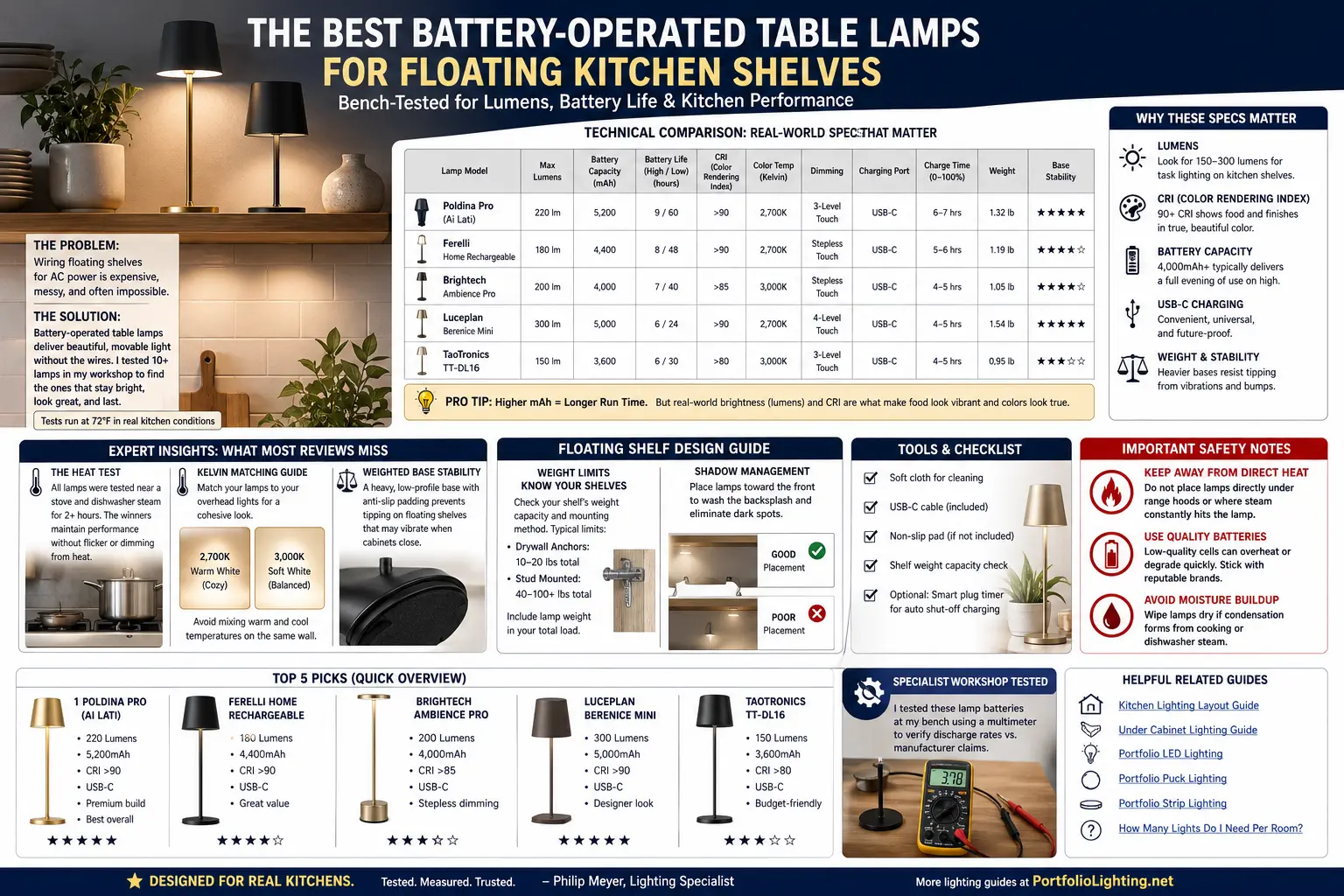
Quick Answer: What Makes a Battery Lamp Good for Floating Kitchen Shelves?
A good floating shelf battery lamp should be bright enough to be useful, stable enough not to tip, warm enough to blend with the kitchen, and efficient enough that it does not need a daily recharge. For most shelves, the sweet spot is a compact rechargeable lamp with 200–350 lumens, 2700K–3000K light, USB-C charging, and a base heavy enough to stay put when cabinet doors close nearby.
If your shelf lighting is part of a larger room plan, use this guide with indoor lighting layout guide and how many lights do I need per room.
Battery shelf lamps work best when they balance brightness, runtime, and stability—too much focus on one usually causes failure in the others.
Battery Lamp Selection Logic
| Your Situation | What To Choose |
|---|---|
| Decorative shelf only | Low lumen warm accent lamp (2700K) |
| Food or dish display | High CRI (90+) lamp |
| Needs usable light | 200–350 lumen lamp |
| Hate charging often | 4000–6000 mAh battery |
| Small shelf | Compact lamp with wide base |
What I Look For Before Recommending a Cordless Shelf Lamp
- Battery capacity: A larger mAh rating usually means longer runtime, but LED efficiency matters too.
- Lumen output: Accent shelf glow can be lower; task support near a prep zone needs more usable light.
- CRI: Higher color rendering helps fruit, wood shelves, tile, and countertops look natural.
- Charging port: USB-C is easier to replace and more convenient than proprietary magnetic cables.
- Base stability: A weighted or anti-slip base matters on shelves that vibrate when cabinets close.
- Heat and moisture tolerance: Avoid direct stove heat, steam, and dishwashing humidity.
If you are comparing cordless lamps with other indoor fixture types, review Portfolio battery operated lighting and Portfolio wireless lighting for broader cordless lighting options.
How to choose the right battery lamp for kitchen shelves
- Choose 150–300 lumens for usable task lighting
- Look for CRI 90+ so food colors look natural
- Use USB-C charging for convenience
- Select a weighted, non-slip base for stability
- Match 2700K–3000K to existing kitchen lighting
Floating shelves create the exact lighting problem that cordless lamps are good at solving. The shelf looks finished, but adding a hardwired sconce, outlet, or under-cabinet connection after the fact can mean wall repair, tile cuts, and electrical work.
A battery operated table lamp gives you the look of a designed kitchen without the electrical mess. The trick is choosing one that works like a lighting tool, not just a cute object. That means testing runtime, brightness, color temperature, color rendering, charging convenience, and shelf stability.
Technical Comparison Table: Battery Lamps for Floating Kitchen Shelves
This table focuses on the specs that matter in a kitchen shelf application, not just style photos.
| Lamp Type | Best Use | Typical Battery Capacity | Useful Lumens | CRI Target | Charging Port | Shelf Warning |
|---|---|---|---|---|---|---|
| Compact USB-C rechargeable table lamp | Best all-around shelf lamp | 4000–6000 mAh | 200–350 | 80+ minimum | USB-C preferred | Check base diameter so it does not hang over the shelf edge. |
| High-CRI mini lamp | Food prep shelf, fruit bowls, dish displays | 3000–5000 mAh | 150–300 | 90+ preferred | USB-C or magnetic | Use where accurate color matters more than maximum brightness. |
| Warm accent cordless lamp | Decorative open shelving | 2000–4000 mAh | 80–200 | 80+ | USB-C preferred | Great for ambiance, not enough for task work. |
| Tall buffet-style cordless lamp | Deep shelves, large kitchens, end shelves | 5000–8000 mAh | 250–500 | 80+ or 90+ | USB-C preferred | Only use on strong, stud-mounted shelves with adequate depth. |
| Motion or touch-dim shelf lamp | Quick-use task or snack-zone lighting | 2000–5000 mAh | 100–300 | 80+ | USB-C preferred | Touch controls are easier than tiny switches on high shelves. |
Battery Lamps vs Hardwired Lighting: Pros and Cons
- Pros: Zero electrical cost, no drywall repair, portable for cleaning, works during power outages.
- Cons: Requires periodic recharging, lower maximum brightness than AC power, limited by shelf weight capacity.
Battery Life: Why mAh Alone Does Not Tell the Whole Story
Battery capacity is important, but it is not the whole story. A 5000 mAh lamp can still disappoint if the LEDs are inefficient or if the lamp steps down brightness after the first hour. For kitchen shelves, real runtime at a usable brightness matters more than the largest number on the box.
Low mode
Best for evening ambiance and shelf styling. Many lamps can last 16–24+ hours on low.
Medium mode
Best daily setting for floating shelves. Expect roughly 8–16 hours from stronger batteries.
High mode
Best for short task use. Many lamps run only 4–8 hours on high.
Step-down behavior
Some lamps dim automatically as the battery drops, so “runtime” may not mean full brightness.
CRI: The Spec That Keeps Food From Looking Gray
CRI stands for Color Rendering Index. In a kitchen, it matters because low-quality LED light can make food, wood, stone, tile, and paint look dull or gray. This is especially obvious on open shelving where lamps shine on fruit, glasses, ceramics, and backsplash materials.
- 80+ CRI: acceptable for general shelf ambiance.
- 90+ CRI: better for kitchens, food color, wood shelves, and styled open shelving.
- Low CRI: can make countertops and food look flat, greenish, or washed out.
For broader fixture quality context, compare with Portfolio LED lighting and Portfolio integrated LED lighting.
For more room-level lighting balance, compare high-CRI shelf lamps with Portfolio task lighting and Portfolio ambient lighting.
Kelvin Matching: 2700K vs 3000K on Kitchen Shelves
A cordless lamp can look wrong if its color temperature fights the rest of the room. Match the shelf lamp to the kitchen’s overhead, pendant, recessed, or under-cabinet lighting.
- 2700K: warm, cozy, restaurant-like shelf glow.
- 3000K: best all-around kitchen match for warm modern lighting.
- 3500K: useful if the kitchen already has neutral-white task lighting.
- 4000K: crisp and bright, but often too cool for decorative floating shelves.
If you are matching shelf lamps with mood or accent lighting, see Portfolio mood lighting and Portfolio energy efficient lighting.
For full room balance, see Portfolio pendant lighting, Portfolio recessed lighting, and Portfolio under cabinet lighting.
The Kitchen Heat Test: Stove Heat, Steam, and Battery Safety
Battery operated table lamps are not designed to live in direct cooking heat. A lamp on a floating shelf near a stove, range hood, dishwasher, or kettle can be exposed to heat, steam, grease, and condensation.
- Do not place rechargeable lamps directly above a cooktop.
- Avoid shelves that receive heavy steam from a dishwasher or boiling pot.
- Keep charging ports away from splatter zones.
- Wipe grease film off the lamp body so vents and charging contacts stay clean.
- Stop using any lamp with swelling, unusual heat, buzzing, or charging issues.
If you need a fixed lighting option near prep areas instead of a rechargeable lamp, compare this with Portfolio under cabinet lighting and Portfolio puck lighting.
Weighted Base Stability: The Detail Generic Lists Miss
Kitchen shelves vibrate more than people think. Cabinet doors close, dishes move, kids bump the counter, and a tall lamp can slowly walk toward the edge if the base is too light.
What to look for
- A base wider than the shade or at least visually balanced.
- Rubber or silicone anti-slip pad under the base.
- Low center of gravity for shallow shelves.
- No sharp metal base that can scratch wood or painted shelves.
- Enough weight to feel stable, but not so much that it exceeds shelf capacity.
For other portable indoor lighting options that may work better on deep shelves or nearby counters, see Portfolio floor lamps.
If you are designing the whole kitchen lighting plan, see how do I design a room-by-room lighting plan.
Floating Shelf Safety: Weight Limits, Anchors, and Placement
The lamp is only safe if the shelf is safe. A floating shelf mounted into studs can hold much more than a shelf installed with light-duty drywall anchors. Before placing a weighted lamp on a floating kitchen shelf, check how the shelf is mounted and how much weight is already on it.
Stud-mounted shelf
Best choice for heavier lamps, dishes, and layered decor. Still follow the shelf manufacturer’s rating.
Drywall-anchor shelf
Use only lightweight lamps and avoid stacking heavy ceramics around the base.
Shallow shelf
Use a low, compact lamp with a smaller footprint and anti-slip pad.
Deep shelf
Can handle taller lamps visually, but still check base stability and shelf rating.
Shadow Management: Where to Put the Lamp on the Shelf
Shelf lamps can create beautiful glow, but they can also cast awkward shadows on tile or make the backsplash look patchy. Placement matters.
- Place the lamp slightly forward if the backsplash is absorbing too much light.
- Place the lamp near the shelf end if the center shelf is crowded with dishes.
- Avoid placing a shade directly in front of a glossy tile seam.
- Use two smaller lamps instead of one tall lamp on long open shelving.
- Use dimming to balance the shelf lamp with pendant and recessed lighting.
For layout and spacing ideas, use lighting guide and Portfolio lighting guide plan and placement.
If shadows are still harsh, compare shelf lamps with Portfolio linear lighting and Portfolio strip lighting for smoother, more even shelf illumination.
Best Battery Lamp Types by Kitchen Shelf Goal
Best for everyday shelf glow
Choose a 2700K–3000K USB-C lamp with dimming and a stable base.
Best for food color
Choose a high-CRI lamp, preferably 90+ CRI, near fruit bowls, serving pieces, or dish displays.
Best for task support
Choose 3000K, 250+ lumens, and medium runtime strong enough for real use.
Best for styling
Choose a warm shade, low profile, and base finish that matches hardware or pendants.
If you want a cleaner built-in look instead of a visible lamp, compare cordless table lamps with Portfolio puck lighting, Portfolio strip lighting, and Portfolio under cabinet lighting.
Battery Operated Table Lamps for Floating Kitchen Shelves FAQ
How long do battery-operated kitchen lamps last on one charge?
Most run 4 to 8 hours on high, 8 to 16 hours on medium, and longer on low. The usable number depends on battery capacity, LED efficiency, dimming level, and whether the lamp holds brightness or steps down as the battery drains.
Are rechargeable lamps safe to use near cooking heat?
They are safe on kitchen shelves when kept away from direct stove heat, open flame, heavy steam, and wet charging conditions. Do not place rechargeable lamps directly above a cooktop.
What color temperature is best for floating kitchen shelf lamps?
3000K is the safest all-around kitchen choice. Use 2700K for warmer decorative glow and 3500K only when matching neutral overhead task lighting.
Do battery table lamps need high CRI in a kitchen?
High CRI is strongly recommended if the lamp lights food, wood shelves, tile, dishes, or countertops. A 90+ CRI lamp makes colors look more natural.
Can floating shelves hold cordless table lamps?
Usually yes, but the shelf must be properly anchored and rated for the lamp plus dishes, decor, and daily movement. Stud-mounted floating shelves are safer for weighted-base lamps.
Final Recommendation
For most floating kitchen shelves, choose a compact USB-C rechargeable table lamp with dimming, 2700K–3000K light, a stable weighted base, at least 200 usable lumens, and an 80+ CRI minimum. If the lamp will illuminate food, wood shelves, or decorative dishes, upgrade to 90+ CRI.
Skip lamps with tiny proprietary chargers, unstable lightweight bases, cold blue light, unclear runtime claims, or no real dimming. A kitchen shelf lamp should look good, stay safe, and hold useful brightness long enough to matter.
More Indoor and Kitchen Lighting Guides
Kitchen Lighting Layout Guide
Plan overhead, pendant, shelf, and task lighting so the whole kitchen works together.
Kitchen lighting guideIndoor Lighting Layout Guide
Use this to balance task, ambient, and accent lighting across connected rooms.
Indoor layout guidePortfolio Under Cabinet Lighting
Compare shelf lamps with fixed under-cabinet lighting for brighter work surfaces.
Under cabinet lightingPortfolio Pendant Lighting
Match shelf lamp color temperature and finish with kitchen pendants.
Pendant lightingBattery Operated Kitchen Shelf Lamp Testing Note
This page is designed to help homeowners choose battery operated table lamps for floating kitchen shelves based on lighting performance, battery behavior, charging convenience, color quality, and shelf safety.
Always follow manufacturer charging instructions and keep rechargeable lamps away from direct flame, excessive heat, and wet charging conditions.
If you are still deciding whether cordless lamps fit your space, start with Portfolio indoor lighting for the broader indoor lighting options.
Expert-Verified Troubleshooting
Every technical guide on PortfolioLighting.net is bench-tested in our Specialist Workshop. Our troubleshooting procedures are based on 25+ years of field experience and are maintained by Philip Meyer to ensure accuracy and electrical safety compliance.