
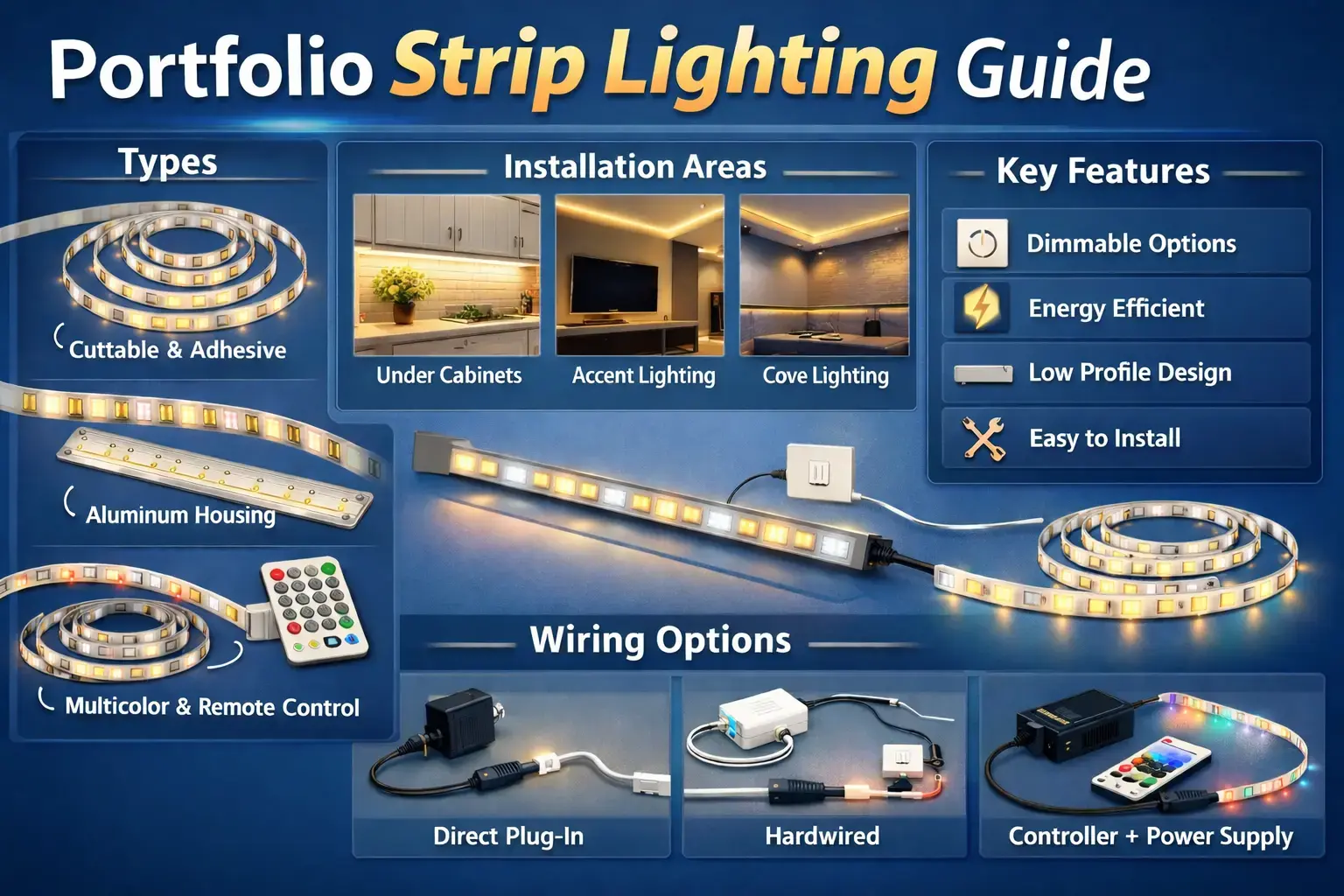
Should You Use or Replace Strip Lighting? (Quick Answer)
Strip lighting is a great choice for even, low-profile lighting under cabinets and shelves. If your current system flickers, dims, or fails, you can often fix it by repairing wiring or replacing components. If the system is outdated or weak, upgrading to a modern LED strip is usually the better option.
- Use strip lighting: for smooth, even light
- Fix it: if the problem is wiring or power
- Replace it: if the system is old or dim
Strip Lighting Problem Guide
| Problem | Likely Cause | Best Action |
|---|---|---|
| Light not turning on | Power, wiring, or driver issue | Check power and connections |
| Flickering light | Loose wiring or bad driver | Repair or replace driver |
| Dim lighting | Aging LED or weak power | Upgrade strip or power supply |
| Partial strip failure | Segment damage | Replace strip section |
| Unknown fixture | Older/discontinued model | Use model lookup |
Most strip lighting issues come from power components—not the LED strip itself.
Start Here: What Should You Do?
- Light flickers → check wiring or driver
- Light is dim → consider upgrading
- Light not working → check power and switch
- Old system → replace with modern LED strip
Most homeowners either fix a simple issue or upgrade to a brighter, more efficient system.
Strip lighting is one of the most practical indoor lighting categories because it combines compact design with broad, useful light output. Instead of focusing light into one small circle, it spreads illumination along a run so countertops, shelves, and work areas are easier to see and use.
For many visitors, the biggest question is not whether strip lighting looks good. It is whether a specific Portfolio product can still be identified, repaired, upgraded, or replaced. That is why this page works closely with Portfolio lighting model number lookup, under cabinet lighting, puck lighting, and parts and accessories. Those pages help turn a general strip-light search into a clearer next step.
What Portfolio Strip Lighting Is
Portfolio strip lighting is a lighting format built around a long, narrow source of illumination rather than a single bulb or point-source fixture. The goal is even light distribution across a surface, which makes it especially useful for cabinets, shelving, counters, display areas, and work zones where a standard ceiling light may leave shadows.
In practical terms, strip lighting is often chosen because it makes a room feel more usable. In a kitchen, it helps brighten the countertop where food preparation happens. In a utility room, it helps illuminate a shelf or folding space. In decorative settings, it can create a softer line of accent light that feels cleaner and more modern than a bulky fixture. That makes it one of the most flexible categories in the broader Portfolio LED lighting and task lighting families.
Strip lighting also matters because it often overlaps with multiple other product categories. A visitor may think they are searching for strip lighting, but their real need may be under cabinet lighting, low-profile shelf lighting, or even a replacement for an older fixture that no longer uses the original technology. That is why this page functions best as both a category guide and a routing page to more specific help.
Where Portfolio Strip Lighting Works Best
The most common place for Portfolio strip lighting is under cabinets, especially in kitchens where homeowners want brighter task lighting without installing a larger fixture. Overhead room lighting often leaves shadows across the counter because the person standing at the workspace blocks part of the light. Strip lighting helps solve that by moving the light source forward and closer to the surface being used.
That is why Portfolio under cabinet lighting is one of the strongest related pages for this topic. Many homeowners arrive there after realizing their old cabinet lighting system is actually a strip-style product rather than a puck or single-lamp fixture.
Strip lighting also works well on shelving, display cabinets, closets, utility areas, and workspace installations where broad visibility matters more than a decorative focal point. It can be used to highlight collectibles, brighten a pantry shelf, or improve visibility along a bench or desk. In each of those cases, the long, even spread of light is the real advantage.
Some visitors also search strip lighting while comparing it with other linear or low-profile products. If your fixture looks more like a narrow bar or integrated task unit than a flexible strip, it may also help to compare Portfolio linear lighting and light kits to make sure you are on the right product family.
Portfolio Strip Lighting vs Puck Lighting
One of the most common questions in this category is whether strip lighting or puck lighting is the better choice. The answer depends on the type of light coverage you want. Strip lighting is usually better for continuous, even illumination across a surface. Puck lighting is better for more focused pools of light that emphasize particular spots.
In a kitchen, strip lighting often makes the counter feel brighter and more consistent. Puck lights can work well too, but they tend to create visible bright circles beneath each light. Some homeowners prefer that look, especially in smaller installations or decorative areas. Others want the cleaner, more uniform appearance of strip lighting. If you are actively comparing these two categories, the best related page is Portfolio puck lighting.
The decision also affects troubleshooting and replacement later. A strip system may depend on a continuous LED run, integrated driver, or power supply arrangement, while puck systems often involve several individual units. Understanding that difference helps when a fixture starts flickering, goes dim, or stops working entirely.
If strip lighting feels too permanent or visible on open shelves, compare it with battery operated table lamps for floating kitchen shelves.
Installation Basics and What to Check First
Strip lighting installations vary depending on the product generation and the space where the light is being used. Some systems are plug-in style products designed for quick installation. Others are hardwired or tied into a more permanent cabinet-lighting setup. That means installation questions often overlap with both identification and troubleshooting.
Before replacing or modifying a strip light, it helps to identify whether the issue is in the light itself, the power source, the driver, the connector, or the switch path. If the light has always performed poorly, the original placement may also be part of the problem. Strip lighting is most effective when it is positioned where it can cast light directly onto the task area, not hidden so far back that it mainly illuminates the wall behind the counter.
If your setup involves older Portfolio products or unclear labels, the most useful support page is often model number lookup. If the problem appears to be more electrical than product-specific, move next into Portfolio lighting wiring diagram or installation and instructions.
In other words, good strip-light setup starts with knowing what kind of product you actually have. That reduces the risk of replacing a fixture when the true problem is a connector, switch, or driver.
LED strip lighting can create clean stair illumination when it is placed carefully under handrails, stair nosings, or side trim. The LED strip staircase lighting guide explains safe placement, glare control, and low-voltage wiring considerations.
Portfolio Strip Lighting Troubleshooting Table
Use this table to match the most common strip-light problems with the likely cause and the best next step.
| Problem | Likely Cause | Best Next Step |
|---|---|---|
| Strip light will not turn on | Power issue, bad driver, bad switch path, or failed light unit | Check power source, model type, and installation path |
| Strip light flickers | Loose connection, unstable driver, or aging LED components | Review LED flickering guide and inspect connections |
| Only part of the strip seems dim | Segment failure, damaged section, or weak internal component | Identify product family and compare repair vs replacement |
| Light is on but much dimmer than before | Aging LED system, dirty cover, weak driver, or power loss | Inspect lens, verify output, and check model-specific parts |
| Light works intermittently | Loose wiring, bad connection, or switch issue | Check wiring path and use troubleshooting resources |
| Fixture type is unclear | Older or discontinued Portfolio product | Use model number lookup |
Common Strip Lighting Problems and What They Usually Mean
Strip lighting problems often feel confusing because the fixture itself is low-profile and may not show obvious signs of failure. A homeowner may see flickering, dimming, or partial output without being sure whether the problem is the strip, the power component, or the switch path feeding the light.
If the light flickers, one of the best support pages is Portfolio LED lights flickering because many strip products now use LED-based systems. If the issue is broader and you are not sure where the failure sits, go to Portfolio lighting troubleshooting. Those pages help narrow the issue before you start ordering parts.
Another common problem is thinking the strip itself has failed when the actual issue is the driver, transformer-style power component, or a loose feed connection. That is one reason this category should not be treated as just a decorative product page. Visitors often need real diagnostic help, and the page should help them separate product identity from system failure.
When to Repair, Replace, or Upgrade Portfolio Strip Lighting
Not every strip-light issue requires a full replacement. If the fixture family is identifiable and the problem is limited to a power component, lens, connector, or support part, a targeted repair may be the best answer. That is especially true if the light output has been satisfactory and the installation still fits the space well.
Replacement becomes more likely when the strip is outdated, incompatible with current parts, too dim by modern standards, or part of a discontinued product family with limited repair options. In those cases, the most useful next pages may be discontinued Portfolio lighting, Portfolio lighting alternatives, or parts and accessories depending on whether the better path is repair or replacement.
If your goal is simply a brighter, more efficient system, it may also help to compare your current fixture with Portfolio LED lighting or task lighting. In many homes, an updated LED strip system provides better light quality and lower maintenance than older cabinet-light products.
Best Next Steps if You Are Trying to Match, Fix, or Replace Portfolio Strip Lighting
Start by deciding which question matters most. If you do not know the exact product, begin with Portfolio lighting model number lookup. If the product is known and you need a support item, move into parts and accessories. If the problem is performance-related, such as flickering or power loss, use troubleshooting before replacing anything.
If the strip light is really part of a cabinet-lighting comparison, also review under cabinet lighting and puck lighting. Those pages help clarify whether the current fixture type is still the best fit for the space or whether another low-profile lighting option would work better.
Portfolio Strip Lighting FAQ
What is Portfolio strip lighting most commonly used for?
Portfolio strip lighting is commonly used for under cabinet lighting, shelf lighting, task areas, and other spaces where long, even light coverage is more useful than a single bulb or puck fixture.
Is strip lighting the same as puck lighting?
No. Strip lighting creates a more continuous band of light, while puck lighting creates smaller pools of focused light. Both can work well, but they serve different visual and functional goals.
What should I do if my Portfolio strip light stops working?
Start by checking the power source, the wiring path, and the product family. If the exact fixture is unclear, use the model number lookup page before ordering replacement parts.
Can older Portfolio strip lights still be repaired?
Some can. It depends on whether the issue is in the light itself, the power component, or another support part. Older or discontinued fixtures may still be serviceable if the right parts can be identified.
What page should I use if I am not sure which strip-light product I have?
The best next step is usually Portfolio lighting model number lookup because it helps connect older products with the right support and replacement pages.