
Quick Answer: How to Lower Outdoor Lighting Costs
The biggest savings usually come from switching halogen to LED, cutting unnecessary nightly run time, and using fewer fixtures in the right places.
- Best first step: replace older halogen bulbs with LED
- Fast savings: shorten run time with timer or photocell adjustments
- Big waste point: too many fixtures in one area
- Best long-term result: combine LED upgrades with smarter layout
Quick Fix: Lower Your Outdoor Lighting Cost Fast
- Still using halogen? switch to LED
- Lights on all night? reduce run time
- Too bright? remove extra fixtures
- System struggling? check transformer load
What Actually Lowers Outdoor Lighting Costs
- Switching halogen bulbs to LED
- Reducing nightly run time
- Removing unnecessary fixtures
- Balancing transformer load
- Improving lighting layout
Start Here: What Will Save the Most Money?
- Still using halogen? Switch to LED first
- Already using LED? Reduce nightly run time
- Yard too bright? Remove or reposition extra fixtures
- System struggling? Check transformer load and layout
Quick links: Low voltage lighting • Landscape lighting • Troubleshooting • Parts and accessories
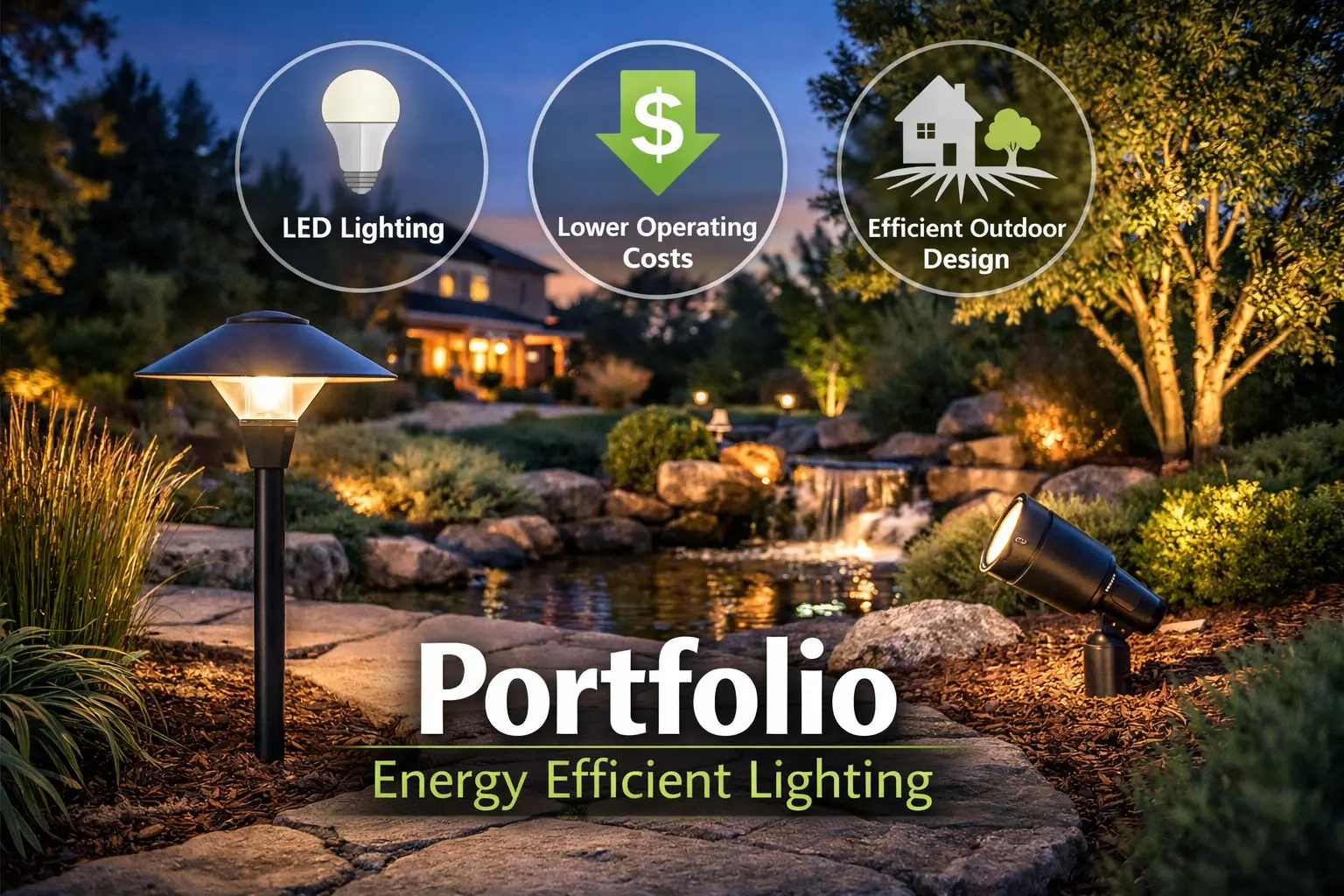
The most energy efficient Portfolio lighting setup is usually not the one with the fewest fixtures. It is the one that uses the right fixtures, the right bulb type, the right transformer load, and the right lighting schedule. That is what lowers operating costs while still making your home look better at night.
If your system is using more power than expected, also review Portfolio lighting troubleshooting to rule out transformer or system issues before upgrading parts.
If you are working with an older system, this topic also connects naturally with buy Portfolio lighting, discontinued Portfolio lighting, and Portfolio lighting model number lookup. If your current system is failing or acting inconsistently, those pages can help you think through replacement direction before buying parts that may not solve the real problem.
Even with efficient LED lighting, energy can still be wasted if lights stay on longer than needed. In many cases, the real issue is the control system. The Smart Outdoor Lighting Controls Guide explains how to automate schedules and reduce runtime without replacing your fixtures.
Energy efficiency is not just about wattage. It is also about how often a fixture has to be replaced. The Durable Landscape Lighting Materials Guide explains why longer-lasting materials can make an outdoor lighting system more sustainable over time.
To understand how efficiency fits into your full setup, review the landscape lighting system diagram.
How Much Money Can LED Actually Save?
In many cases, switching from halogen to LED can reduce lighting energy use significantly. The more fixtures you have and the longer they run each night, the more noticeable the savings become over time.
If you want an energy-efficient accent light without adding wiring, compare options in our battery operated table lamp guide.
Energy-efficient LEDs use so little wattage that older dimmers may not control them correctly. The energy-efficient LED dimmer troubleshooting guide explains flicker, ghosting, low-load issues, and dimmer replacement choices.
Why Energy Efficient Outdoor Lighting Matters More Than Most Homeowners Expect
When people think about energy efficient lighting, they often reduce the idea to one simple question: will this save me money on electricity? That is part of it, but it is not the whole story. In outdoor lighting, efficiency also affects heat, bulb life, maintenance, transformer stress, and even how easy the system is to live with long term.
Older outdoor lighting systems often relied on halogen bulbs that used noticeably more wattage than modern LED alternatives. Those older bulbs can still work, and in some cases they still produce attractive light, but they usually do it less efficiently. They also run hotter, fail sooner, and can place more load on the system than necessary.
Efficiency Is Really About Better Use, Not Just Lower Wattage
A more energy efficient Portfolio system does not mean sacrificing the look of your yard. In fact, many homes look better after an efficiency upgrade because the lighting becomes more intentional. Homeowners often discover that they were overlighting pathways, washing too much light onto the house, or running fixtures longer than needed simply because the older setup was never redesigned.
Lower Power Use Often Comes with Lower Hassle
This is the part many people appreciate most after upgrading. Lower-wattage lighting, especially LED-based lighting, usually means less frequent bulb replacement and less frustration. That makes a difference if you have multiple path lights, spotlights, or accent lights around the yard.
High bay LED systems can dramatically reduce power use compared to older fluorescent or metal halide fixtures. The energy-efficient high bay lighting guide explains fixture spacing, lumen output, and commercial lighting upgrade strategies.
LED vs Older Halogen Portfolio Lighting
For most homeowners, this is the main comparison that matters. If your existing Portfolio system still uses halogen bulbs, LED is usually the upgrade path worth understanding first. LED lighting generally uses much less electricity for similar usable light, lasts much longer, and creates less heat. That combination is why LED upgrades are often the most practical energy efficiency move you can make.
If you want to compare energy savings with verified efficiency standards, visit the Portfolio ENERGY STAR certified lighting guide for help understanding labels, LED efficiency claims, fixture ratings, and what certification means before buying.
Why LED Usually Wins
LED bulbs are not automatically better in every possible situation, but for landscape lighting they are usually the more efficient choice by a wide margin. They can reduce electrical load, help free up transformer capacity, and lower the cost of running multiple fixtures night after night.
What Some Homeowners Notice First
The first benefit people notice is often not the utility bill. It is usually the lower replacement frequency. When you stop replacing bulbs constantly, the upgrade starts feeling worthwhile even before you calculate exact savings.
| Comparison Point | Older Halogen Landscape Lighting | LED Landscape Lighting |
|---|---|---|
| Typical energy use | Higher wattage per fixture | Lower wattage per fixture |
| Operating cost | Usually higher over time | Usually lower over time |
| Heat output | Runs noticeably hotter | Runs cooler |
| Bulb life | Shorter replacement cycle | Longer replacement cycle |
| Transformer load | Uses more available capacity | Uses less available capacity |
| Maintenance feel | More hands-on over time | Usually easier to live with |
If you are unsure whether your fixtures can accept LED replacements or whether certain parts are still supported, check Portfolio lighting model number lookup and Portfolio lighting installation and instructions.
Operating Cost Comparison: What Landscape Lighting Costs to Run
Homeowners often assume outdoor lighting must be expensive because it runs frequently. In reality, the operating cost depends mostly on four things: the number of fixtures, the wattage of each fixture or bulb, the number of hours the lights run each night, and whether the system is using older bulb technology or LED.
If your system uses more power than expected, the issue may not be the bulbs. Voltage drop can reduce efficiency and force your system to work harder than necessary.
A Simple Way to Think About It
Imagine a small-to-medium yard with 10 to 12 fixtures. If those fixtures use older, higher-wattage bulbs and run every evening for several hours, your monthly operating cost will be noticeably higher than a similar setup using LED. The cost difference may not feel dramatic in a single week, but over a year it adds up, especially when you include replacement bulbs and maintenance time.
Why More Efficient Systems Usually Scale Better
Efficiency matters even more when your lighting plan expands. A homeowner may begin with a front walkway, then add a tree accent, then add deck lighting or side-yard security lighting. If each addition uses more efficient bulbs, the system grows much more gracefully.
| Scenario | Less Efficient Setup | More Efficient Setup |
|---|---|---|
| Fixture count | 10 to 12 fixtures | 10 to 12 fixtures |
| Bulb type | Older halogen style | LED replacement or LED fixture |
| Nightly use | Longer run time with higher draw | Similar run time with lower draw |
| Monthly operating cost trend | Higher | Lower |
| Long-term bulb replacement cost | Usually higher | Usually lower |
| Best fit | Older unchanged systems | Upgraded or redesigned systems |
Where Outdoor Lighting Usually Wastes Electricity
Many inefficient outdoor lighting systems are not inefficient because the homeowner bought the wrong brand. They are inefficient because the system is being used in a wasteful way. This is good news, because it means some of the biggest improvements cost little or nothing.
Overlighting the Same Area
One of the most common problems is simply using too many fixtures too close together. A walkway may only need subtle, spaced path lighting, but some yards end up with more fixtures than the space actually benefits from. That drives up power use without improving the design.
Running Lights Longer Than Necessary
Another common waste point is schedule. Some systems stay on from dusk until dawn even when the real goal is evening ambiance, curb appeal, or basic safety during active evening hours. Timers, photocells, and better scheduling can improve efficiency without sacrificing usefulness.
Mismatched Components
Older systems can also become inefficient when bulbs, fixtures, or transformers are not well matched anymore. If a system has been pieced together over time, you may be carrying more load than needed or using components that no longer make much sense together. That is where troubleshooting and parts research can save money before a full replacement decision.
Best Upgrade Path for Homeowners Who Want Better Efficiency
Most homeowners do not need to tear out their full Portfolio lighting system to make it more energy efficient. In many cases, the smartest path is a staged upgrade. That keeps costs under control and helps you improve the system in a way that matches real needs rather than guessing.
If you are upgrading bulbs or adding fixtures, use the transformer size calculator to make sure your system is properly balanced.
For deeper planning, see the transformer master guide to match your system to your lighting load.
Step 1: Check What You Already Have
Identify your fixture types, bulb types, and approximate fixture count. If you are working with older or discontinued products, the discontinued Portfolio lighting page can help you think through replacement direction.
Step 2: Upgrade the Highest-Use Bulbs First
If you have fixtures that run every night, those are often the best place to start with LED replacements. High-use fixtures usually create the fastest return in both energy savings and reduced maintenance.
Step 3: Revisit Placement and Layering
This is the step many people skip. Before adding more lights, look at how the yard actually appears at night. You may be able to remove or reposition a fixture instead of adding one. A more thoughtful layout often improves both looks and efficiency.
Step 4: Check Transformer Fit
A more efficient system should work with the transformer instead of constantly pressing against its limits. If you are expanding the system or troubleshooting load questions, review Portfolio low voltage lighting and installation and instructions to think through sizing and system behavior more clearly.
Even efficient LED systems can waste power if voltage is not balanced. Use the voltage tap calculator to fine-tune transformer output.
How to Design for Efficiency Without Making Your Yard Look Dim
One of the biggest misconceptions in outdoor lighting is that energy efficiency means cutting back until the yard barely shows up. That is not what good efficient design looks like. Good efficient design is usually layered, selective, and intentional. It creates a better visual result because it avoids wasted light.
One of the best ways to reduce energy use is dividing your system into zones. See landscape lighting zone planning to control load and runtime more efficiently.
Use Light Where It Actually Helps
Walkways, entry transitions, steps, bed edges, and focal landscaping features often benefit from lighting. Large areas of empty ground usually do not. When lighting is used with purpose, fewer watts often produce a better result than a brighter but less thoughtful layout.
Think in Zones
It helps to think about your yard in zones: safety, navigation, accent, and ambiance. A path light does not need to do the same job as a spotlight, and a deck edge does not need the same treatment as a front planting bed. The more clearly each fixture has a role, the more efficient the whole system becomes.
Efficiency and Appearance Can Work Together
This is why LED upgrades and better operating strategy usually go hand in hand. When a system is designed better, it often uses less energy naturally. If you are still comparing whether to maintain, expand, or replace your current setup, you may also want to read Portfolio lighting alternatives, Portfolio outdoor lighting, and buy Portfolio lighting.
Why Outdoor Lighting Costs More Than Expected
- Older halogen bulbs use more power
- Lights run longer than needed
- Too many fixtures in one area
- Poor layout wastes light
- Transformer load is not optimized
Final Thoughts on Portfolio Energy Efficient Lighting
If your goal is better-looking outdoor lighting with lower operating cost, energy efficiency is one of the smartest places to focus. For most homeowners, that means some combination of LED upgrades, smarter scheduling, better fixture placement, and a more thoughtful approach to how much light the yard actually needs.
You do not have to rebuild everything at once. In many cases, the best path is to improve the current system step by step. Start by reducing obvious waste, upgrade the highest-use fixtures first, and make sure the design supports the way you actually use the space. That usually leads to a system that is not only cheaper to run, but also easier to maintain and more enjoyable to live with every evening.
Portfolio Energy Efficient Lighting FAQ
Is LED lighting more energy efficient than older Portfolio halogen lighting?
Yes. LED lighting is usually much more energy efficient than older halogen landscape lighting and typically provides lower power use, lower heat output, and longer bulb life.
Does switching Portfolio lighting to LED lower operating costs?
Yes. In most cases, switching to LED lowers operating costs because each fixture uses less electricity. The savings are usually more noticeable when you run multiple fixtures regularly.
Do you need to replace the full Portfolio lighting system to improve efficiency?
No. Many homeowners improve efficiency by upgrading bulbs, adjusting schedules, checking transformer fit, and improving placement before replacing full fixtures or the full system.
What makes an outdoor lighting system energy efficient?
An energy efficient system uses lower-wattage lighting such as LED, avoids overlighting, uses timers or photocells well, and matches fixture count and run time to the real needs of the space.