
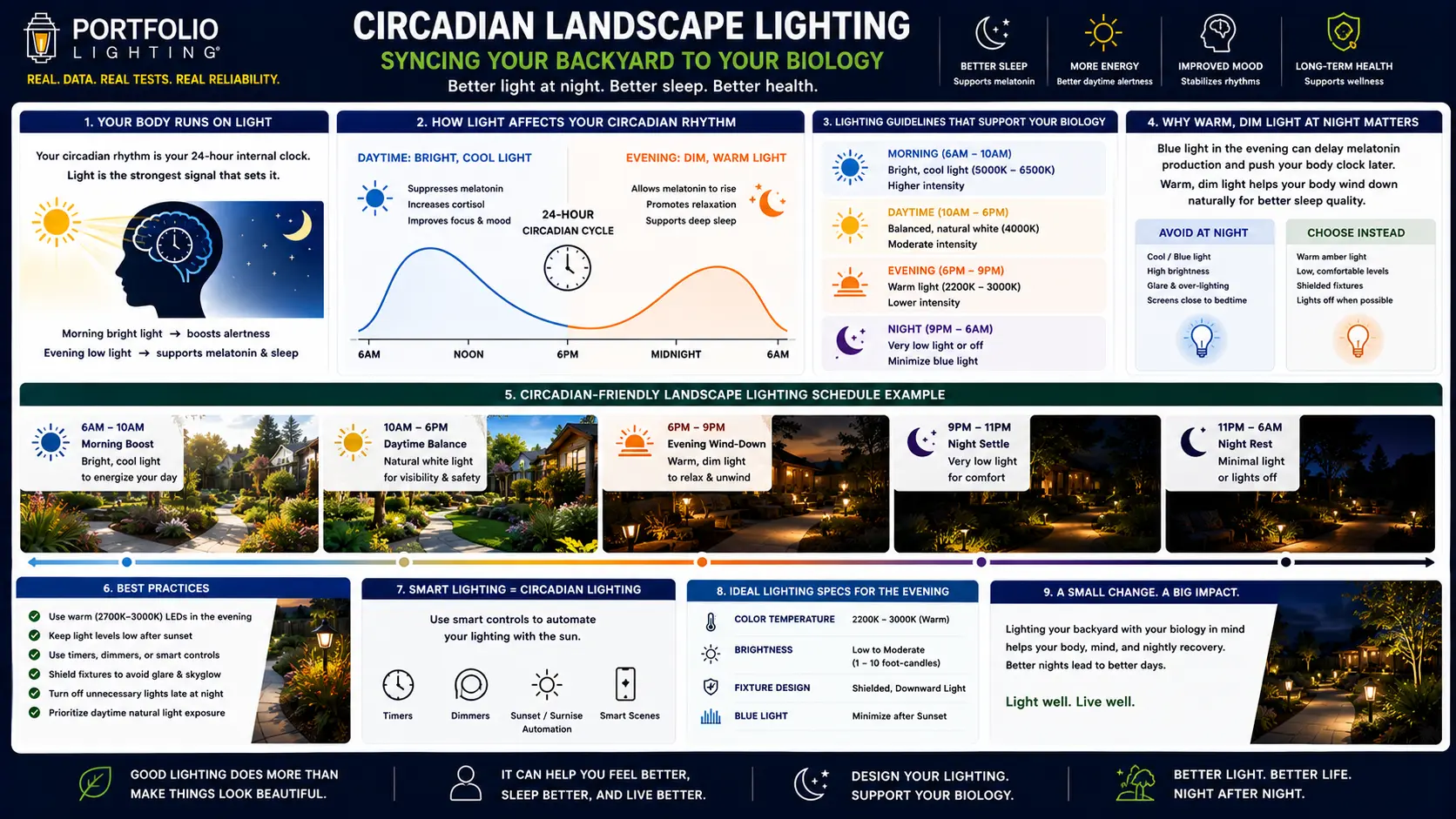
The Biology: How Your Eyes Process Light at Night — and Why Outdoor Lighting Is Part of It
For most of human history, the light humans experienced after sunset was fire — orange, red, amber light with essentially no short-wavelength blue content. The circadian clock evolved in that context. Modern LED landscape lighting, particularly cool-white LEDs in the 4000K–6500K range, delivers spectral content that the circadian system recognizes as daylight signal even when it is midnight. Understanding the mechanism is the foundation for designing outdoor lighting that does not actively fight your sleep.
Intrinsically Photosensitive Retinal Ganglion Cells (ipRGCs)
The retina contains three types of photoreceptors. Rods handle low-light vision. Cones handle color vision. The third type — intrinsically photosensitive retinal ganglion cells (ipRGCs), sometimes called melanopsin cells — were not discovered until 2002, which is why they are absent from most people's working knowledge of how light affects the body. These cells do not contribute meaningfully to what you see. They project directly to the suprachiasmatic nucleus (SCN) in the hypothalamus — the master circadian clock — and to the pineal gland, which produces melatonin.
ipRGCs have a peak spectral sensitivity at approximately 480nm — squarely in the blue-cyan range. They respond to sustained light exposure over minutes to hours rather than milliseconds like cones. They are responsible for: circadian photoentrainment (keeping your internal clock synchronized to the external day), melatonin suppression (reducing melatonin production in the presence of sufficient light), pupillary light reflex, and regulation of alertness and mood through direct projections to dopaminergic and serotonergic systems.
Why LED Landscape Lighting Is Biologically Different from Incandescent
Traditional incandescent and halogen lamps produced light through thermal emission — a black-body radiation spectrum heavily weighted toward red and infrared wavelengths. At 2700K, an incandescent lamp has very little energy below 500nm. Its melanopic impact relative to its photopic output is low.
White LEDs are fundamentally different in their spectral construction. Most white LEDs use a blue LED die (peak emission at 450–460nm) coated with a phosphor that converts some of the blue energy to longer wavelengths, producing the appearance of white light. The blue die's emission peak is never fully converted — white LEDs retain a characteristic spike at 450–460nm that is absent from incandescent light of equivalent correlated color temperature. A 2700K LED still has more melanopically active blue content than a 2700K incandescent at the same photopic lux. A 4000K LED has substantially more. A 6500K LED has the most blue content of any common light source, approaching the spectral quality of solar noon — which is precisely the signal that tells your circadian clock it is the middle of the day.
The spectral quality of outdoor LED fixtures matters for more than just color rendering. The same spectral properties that determine how vividly a fixture renders reds and greens at night also determine how strongly it suppresses melatonin in the people living around it.
I started thinking about this differently after a client mentioned they'd been sleeping better since I replaced their old cool-white path lights with warm 2700K fixtures. They hadn't changed anything else — same schedule, same bedroom, same blackout curtains. What had changed was that the light entering their living room windows from the backyard every evening had shifted from biologically active to biologically quiet. They didn't notice it consciously, but their circadian system did.
CCT and Melatonin: The Numbers That Actually Matter
Color temperature is measured in Kelvins and describes the spectral character of a light source. Lower numbers are warmer and redder; higher numbers are cooler and bluer. For circadian biology, CCT is a useful proxy for melanopic impact but not a perfect one — two fixtures with the same CCT from different manufacturers can have meaningfully different blue spike magnitudes depending on the specific phosphor formulation and LED die used. With that caveat noted, CCT remains the most practical specification available to consumers when making fixture choices.
The CCT Spectrum and Its Biological Meaning
Melanopic Lux: The More Precise Measurement
Melanopic lux (also called melanopic equivalent daylight illuminance, or m-EDI) is the scientifically rigorous measure of a light source's circadian potency. It weights the light spectrum by the melanopsin absorption curve rather than the photopic luminous efficiency function, giving a number that directly predicts ipRGC stimulation and therefore melatonin suppression potential.
The WELL Building Standard v2 and the IES TM-24 technical memorandum both use melanopic lux as their primary metric for circadian lighting specification. For evening environments (broadly defined as the 2–3 hours before sleep), WELL v2 recommends a maximum of 45 melanopic lux at the eye level of occupants. Research from the Lighting Research Center suggests that 10 melanopic lux is the approximate threshold below which melatonin suppression becomes minimal for most individuals.
Practical translation: a 2700K LED path light producing 400 lumens, positioned 18 inches from the ground and aimed downward, produces roughly 1–3 melanopic lux at typical viewing distances of 8–15 feet inside a home. Multiple 4000K security floodlights visible through an unshaded window can collectively deliver 50–100 melanopic lux at the eye — well above the threshold for meaningful melatonin suppression. The difference between a biologically quiet and biologically disruptive outdoor lighting installation is often a combination of CCT selection, fixture aiming, and total installed lumen level — not any single factor alone.
The Melanopic Ratio by CCT
| CCT | Melanopic Efficacy Ratio* | Relative to 2700K | Circadian Impact at Evening Exposure |
|---|---|---|---|
| 1800–2200K | 0.29–0.38 | ~35% of 2700K | Very low. Appropriate for any location visible to occupants during evening hours including bedroom windows. |
| 2700K | 0.45–0.50 | Baseline | Low. Recommended as the maximum CCT for evening residential landscape lighting. Minimal melatonin suppression at typical outdoor lumen levels. |
| 3000K | 0.55–0.62 | ~125% of 2700K | Moderate. Acceptable for landscape lighting not directly visible through bedroom windows. Noticeably more biologically active than 2700K but substantially better than 4000K. |
| 4000K | 0.68–0.75 | ~150% of 2700K | High. Measurable melatonin suppression at residential exposure levels. Avoid for evening residential landscape lighting visible to occupants. |
| 5000K | 0.85–0.95 | ~190% of 2700K | Very high. Significant melatonin suppression. Approaching daylight spectrum. Not appropriate for any residential evening outdoor lighting application. |
| 6500K | 1.00–1.10 | ~220% of 2700K | Maximum. Peak melanopic impact. Approximately equivalent to daylight at this metric. Strongly contraindicated for any residential landscape lighting. |
Lumen Thresholds and Biological Impact: How Bright Is Too Bright?
CCT selection matters. But the total light level — the photopic illuminance reaching the eye — matters just as much. A 2700K fixture at 3000 lumens pointing toward bedroom windows can suppress melatonin just as effectively as a 4000K fixture at 800 lumens. Understanding the lumen thresholds that keep outdoor lighting biologically quiet gives you the other half of the equation.
The Illuminance Threshold for Melatonin Suppression
Melatonin suppression is not binary — it follows a dose-response curve. At very low illuminance levels, essentially no suppression occurs. As illuminance at the eye increases, suppression increases along a sigmoidal curve with a threshold around 10 melanopic lux and 50% suppression occurring at approximately 100 melanopic lux for a fully dark-adapted individual. Research from the Lighting Research Center (Figueiro et al.) has consistently shown that even low levels of room light — below 100 photopic lux — can measurably suppress melatonin, particularly in the blue-enriched portion of the spectrum.
For outdoor landscape lighting, the illuminance reaching the eye of an indoor occupant is a function of several factors: the lumen output of the fixture, the distance from the fixture to the window, the window area and glass transmission, the directionality of the fixture, and the ambient light level inside the home. In a typical residential scenario — a 400-lumen path light 10 meters from a living room window — the illuminance contribution at the eye is on the order of 0.5–2 photopic lux. That is below the suppression threshold for most individuals.
The scenarios that generate meaningful melatonin suppression from outdoor lighting are: high-output security floodlights (3000+ lumens) within 5–10 meters of bedroom windows, uplights on trees or structures that direct light toward bedroom windows, string lights or area lighting that flood an entire outdoor space with 5000+ lumens at 4000K or higher, and neighboring property lighting that enters bedroom windows from the side or rear.
Recommended Lumen Levels by Application for Circadian Safety
| Application | Recommended Lumens | Max CCT | Circadian Notes |
|---|---|---|---|
| Path and step lighting | 100–400 lumens/fixture | 2700K | Low fixture, aimed downward — minimal sky contribution. Safe at these levels even with 2700K. Stay below 400 lumens for paths near bedroom windows. |
| Accent and uplighting (plants, architecture) | 200–600 lumens/fixture | 2700K | Uplighting aimed toward windows or sky increases melanopic exposure. Aim fixtures to minimize upward light and window exposure. 2700K essential for uplights near living spaces. |
| Area lighting (patios, decks) | 400–800 lumens/fixture | 2700K | Multiple fixtures accumulate quickly. Keep total zone output below 3000 lumens at 2700K for spaces used within 2 hours of sleep. Dim to 30–50% after 9 PM where smart controls allow. |
| Security / motion lighting | 800–1500 lumens/fixture | 2700K max | Motion-activated security lighting at 4000K+ pointing toward windows is the highest-impact circadian disruptor in residential outdoor lighting. Use 2700K or amber security lights. Keep activation duration short (<60 seconds). |
| Driveway and entry lighting | 400–900 lumens/fixture | 2700K–3000K | Typically away from sleeping areas — 3000K acceptable if not directly visible from bedroom windows. Keep entry lighting on timers to avoid all-night operation. |
| Decorative / string lighting | 10–40 lumens/bulb | 2200K–2700K | Individual bulbs are low output but aggregate total across large installations matters. Warm Edison-style filament LEDs at 2200K are the optimal choice — lowest melanopic impact of any LED type. |
| Pool and water feature lighting | 600–1200 lumens/fixture | 2700K | Pool lighting is often seen directly by occupants at close range during evening hours — the highest-exposure outdoor lighting scenario after security floods. 2700K essential. Dim significantly after 9 PM. |
Evening Timing Guide: When to Dim, When to Shift, and When to Switch Off
Timing is the third variable in circadian lighting — alongside CCT and lumen level. The circadian system is most sensitive to light in the 2–3 hours before habitual sleep time. Light exposure earlier in the evening — particularly at sunset and dusk — is less suppressive of melatonin than equivalent exposure at 10 PM. Managing outdoor lighting timing with this sensitivity curve in mind is one of the highest-leverage changes most households can make.
Before dusk
Sunset–1hr
7–9 PM
9–11 PM
11 PM+
Fixture Types and Their Circadian Impact: What to Choose, What to Avoid
Different landscape lighting fixture types have very different circadian profiles — not because of their function but because of where they aim light and how much of it enters the eye directly versus indirectly. Understanding the difference between a downward-aimed path light and an upward-aimed security flood helps prioritize where CCT and timing changes make the biggest biological difference.
- Downward-aimed path lights (2700K, 100–400 lm): Light aimed at the ground contributes minimal sky glow and reaches the eye only at oblique angles from distance. Lowest circadian impact of any landscape fixture type at typical residential lumen levels.
- In-ground step lights (2700K, 50–150 lm): Tucked into risers or grade, aimed horizontally or downward. Effective for safety with minimal biological footprint.
- Warm amber (2200K) festoon / Edison string lights: Very low individual output, warmest available CCT in consumer fixtures. Ideal for patio seating areas used into the evening.
- Shielded bollards (2700K): Full cutoff housing means zero upward light emission. All light directed downward to the walking surface.
- Uplights on trees / architecture (2700K required): Light aimed upward toward the sky and toward windows — the direction that maximizes both sky glow and window exposure. 2700K is essential. Limit to 300–600 lm per fixture and aim to minimize window reflection.
- Patio area lighting (2700K, dim after 9 PM): Multiple area fixtures accumulate total luminous output quickly. 2700K with dimming controls is the right configuration. Aim for total zone output under 2500 lm after 9 PM.
- Wall wash lights (2700K): Bright wall surfaces can become large, diffuse luminous areas visible from inside. Effective for architecture but requires careful positioning relative to windows.
- 4000K–6500K security floodlights facing windows: The single most disruptive configuration in residential landscape lighting. High lumen output + cool CCT + aimed toward living spaces = maximum melanopic exposure.
- All-night continuous operation at 3000K+: Even moderate-output fixtures at 3000K running continuously all night suppress melatonin during the highest-sensitivity hours.
- Cool-white string lights (4000K+): Decorative but biologically problematic during evening use. Swap to 2200K warm filament equivalents.
- Unshielded globe fixtures at 3000K+: Direct view of the light source maximizes ipRGC stimulation — the direct blue peak of the LED die is visible rather than the diffused, phosphor-converted output.
- Older adults have reduced lens transmission (yellowing crystalline lens) that further filters short-wavelength light — they require more photopic light to achieve the same visual task performance but are relatively more protected from melanopically active light.
- Higher lumen levels for safety (trip prevention) are appropriate for senior households but CCT selection becomes even more important — 2700K at higher output is preferable to 4000K at lower output.
- See the full guide on senior safety lighting design for the specific contrast and glare considerations that apply to visual function in older adults.
Full CCT Comparison Table: Every Common Landscape Lighting Scenario
This table is the fastest reference for CCT recommendations across all common outdoor residential lighting applications — combining the biological considerations with the practical lighting quality and visibility requirements of each use case.
| Application | Ideal CCT | Acceptable Range | Reasoning |
|---|---|---|---|
| Path and walkway lighting | 2700K | 2200K–3000K | Low fixture height and downward aim make this the lowest-impact fixture type. 2700K provides adequate contrast for safe walking. No biological reason to go above 3000K. |
| Step and riser lighting | 2700K | 2200K–3000K | Safety application — adequate lumen output at 2700K is more important than pushing to 4000K. Contrast is about position of the light, not CCT. |
| Tree and shrub uplighting | 2700K | 2200K–2700K only | Uplights are aimed toward the sky and windows — the highest-impact configuration. 2700K is the maximum acceptable. 3000K and above should not be used for uplighting visible from living spaces. |
| Architectural wall washing | 2700K | 2700K–3000K | Wall color rendering is excellent at 2700K. 3000K acceptable for facades not directly visible from bedroom windows. 4000K creates that cool commercial appearance that many homeowners dislike anyway. |
| Driveway and entry lighting | 2700K | 2700K–3000K | Further from sleeping areas in most homes. 3000K acceptable if not visible from bedrooms. Both work well visually for vehicle maneuvering. |
| Patio and deck area lighting | 2700K | 2200K–2700K | Occupied evening spaces at close proximity. Warmest possible CCT here. 2200K amber Edison-style string lights are the ideal choice for patio atmosphere and biology simultaneously. |
| Security and motion lighting | 2700K | 2200K–3000K max | Security lighting does not require cool CCT to be effective. Human vision adapts to 2700K illumination for threat assessment equally well. 4000K security floods are a marketing choice, not a safety requirement. |
| Pool and spa lighting | 2700K | 2700K only | Pool users are in direct proximity to the light source during evening hours — the highest-exposure outdoor scenario. 2700K is essential. Color-changing RGB pool lights should default to warm red/amber after 9 PM. |
| Landscape accent (boulders, sculpture) | 2700K | 2200K–3000K | Pure aesthetic application — 2700K renders warm stone and earth tones beautifully and aligns with circadian health. 3000K acceptable for accent features not aimed toward windows. |
| Holiday and seasonal lighting | 2200K | 2200K–2700K | Warm filament-style LEDs at 2200K are the lowest-impact decorative lighting option. Bright cool-white holiday lights are among the more disruptive seasonal exposures for household circadian rhythm. |
Seven Circadian Lighting Design Rules for Residential Landscape Lighting
These seven rules synthesize the biology, the lumen thresholds, and the timing considerations into actionable design decisions. Following all seven produces a landscape lighting system that is visually excellent and biologically quiet.
Rule 1: 2700K Is the Maximum for Any Fixture Visible from Living Spaces
Any landscape lighting fixture whose output is visible through windows, glass doors, or open outdoor seating areas during evening hours should be specified at 2700K or lower. This includes path lights, uplights, area lights, and security fixtures. The 300-Kelvin difference between 2700K and 3000K is visible to the eye but modest in biological terms — but the difference between 2700K and 4000K is substantial both visually and biologically. Make 2700K your default and justify any upward deviation explicitly.
Rule 2: Aim Light Down, Not Up or Toward Windows
The direction a fixture aims its light matters as much as its CCT and lumen level. A 4000K fixture aimed at the ground at 400 lumens delivers minimal melanopic exposure to indoor occupants. A 2700K fixture aimed directly at a bedroom window at 800 lumens delivers more. Aim path lights straight down. Aim uplights toward the plant or structure, not across open windows. Use full-cutoff fixtures wherever possible to eliminate upward light emission entirely. See our system design guide for aiming geometry principles.
Rule 3: Zone Security Lighting Separately with Motion Activation
Security lighting is the application that most commonly creates chronic circadian disruption in residential settings. Running 3000-lumen, 4000K security floods continuously all night along the perimeter of the home delivers sustained melanopic stimulation through every window they illuminate. The fix is motion activation — security lighting only needs to be bright when someone is actually present. A motion-activated burst of 2700K light for 60 seconds provides the same security deterrence as continuous illumination with a fraction of the biological cost.
Rule 4: Dim After 9 PM, Off After 10:30 PM
Smart landscape lighting systems that can dim on a schedule should be programmed to reduce all decorative and accent lighting to 30–50% at 9 PM and switch off completely at 10–10:30 PM. Path lighting for safety can remain active at reduced output. This timing protocol aligns outdoor light exposure with the typical circadian sensitivity curve for adult households sleeping between 10:30 PM and 11:30 PM. See our smart landscape lighting guide for scheduling implementation across common platforms.
Rule 5: Use the Lowest Lumen Output That Satisfies the Application
More lumens is not always better — it is a common misconception imported from an era when brightness was constrained by technology. LED fixtures can produce far more light than needed for most outdoor applications. Path lighting at 100 lumens per fixture, aimed correctly, is fully adequate for safe pedestrian use. Area lighting at 600 lumens per fixture is sufficient for most deck and patio applications. The urge to install 1200-lumen fixtures "to be safe" produces over-lit outdoor spaces that look institutional and deliver unnecessary melanopic load to occupants.
Rule 6: Manage the Neighbor Light Problem
Your own landscape lighting is not the only light source affecting circadian biology in your home. Neighboring security floods, streetlights, and commercial lighting all contribute. Strategic planting of dense evergreen screening can meaningfully reduce light trespass from external sources. Blackout curtains in bedrooms eliminate the remaining exposure. These passive interventions often have more biological impact than optimizing your own fixture CCT — because you cannot control your neighbors' lights.
Rule 7: Treat the Bedroom Window as the Most Critical Zone
Of all the windows in the house, the bedroom window is the highest-priority target for outdoor lighting management. Melatonin suppression during the sleep period — even from ambient light at levels well below what the eye consciously registers as bright — can reduce sleep quality and shift circadian phase. Any landscape fixture aimed toward, bounced off surfaces toward, or visible through a bedroom window at close range should be replaced with the warmest, lowest-lumen option that satisfies the functional requirement. This is the single highest-ROI location for circadian lighting redesign.
Smart Lighting and Circadian Scheduling: How Automated Control Changes the Biology
A manually switched landscape lighting system can be circadian-friendly if the right fixtures are installed and the homeowner consistently manages timing. A smart landscape lighting system removes the human consistency requirement from the equation — it executes the timing protocol every night automatically, which is where the real biological benefit of smart controls lives.
What Smart Control Adds Beyond Manual Systems
The circadian value of smart landscape lighting is not in the app or the voice control — it is in the scheduling precision and the ability to set dimming transitions that the homeowner would never consistently execute manually. Most people do not think to walk outside and dim their landscape lights at 9 PM every night. A smart system does this automatically and does it consistently, which is what matters for circadian entrainment. Consistent timing of light-dark cycles is as important as the light quality itself for maintaining a stable circadian rhythm.
Smart systems that support tunable white output — shifting from 3000K at activation to 2200K at 10 PM — add the additional benefit of CCT dynamics that match the biological sensitivity curve. This is the most sophisticated implementation available in consumer landscape lighting and it is the approach used in WELL-certified commercial spaces to maintain occupant circadian health.
The AI-enabled smart landscape lighting systems now available can learn household occupancy patterns and adjust lighting schedules dynamically — activating at lower lumen levels when occupants are present in the yard in the evening and switching to security-only mode when the household goes to sleep. This kind of adaptive control is not available in any static timer-based system and represents a genuine circadian benefit over conventional landscape lighting control.
Scheduling Protocol for Circadian-Optimal Smart Landscape Lighting
| Schedule Window | Dim Level | CCT (if tunable) | Zones Active |
|---|---|---|---|
| Dusk to 7:30 PM | 100% | 2700K | All zones. Full decorative, path, accent, and area lighting active. |
| 7:30 PM to 9:00 PM | 80% | 2700K | All zones. Modest dim to begin the evening transition. Barely perceptible visually but starts reducing melanopic load. |
| 9:00 PM to 10:00 PM | 40–50% | 2200–2500K | Path and safety lighting only at reduced level. Decorative accent and area lighting off. Security motion-activated only. |
| 10:00 PM to 10:30 PM | 20% | 2200K | Minimum path lighting for safety only. All other zones off. |
| 10:30 PM to dawn | Off | N/A | All decorative zones off. Security motion-only at 2700K, 60-second duration maximum. |
For the installation side of a smart low-voltage landscape lighting system, see our installation guide covering transformer setup, zone wiring, and smart controller integration. For troubleshooting smart systems that are not activating or dimming correctly, the transformer troubleshooting guide covers the most common smart system failure modes.
Special Populations: Seniors, Children, and Shift Workers
Circadian sensitivity to light is not uniform across ages and life circumstances. The populations most affected by outdoor lighting — and most likely to see meaningful sleep and health improvements from circadian-aware landscape lighting — include older adults, children, and shift workers.
Older Adults: Higher Visual Need, Different Biological Trade-offs
Aging changes the optical properties of the crystalline lens in ways that are directly relevant to outdoor lighting design. The lens yellows progressively with age, filtering short-wavelength blue light before it reaches the retina. By age 70, the lens transmits significantly less blue light than it did at age 30. This means older adults require higher overall illuminance levels to achieve the same visual task performance — but are somewhat protected from melanopically active light by the lens filtering effect.
The practical implication is that outdoor lighting for senior-occupied households should use higher lumen levels than typical — adequate illuminance for trip prevention is a genuine safety priority — but 2700K is still the preferred CCT. The combination of higher output at 2700K maintains safety without maximally suppressing melatonin. This is the approach detailed in our senior safety lighting guide, which covers the specific contrast ratios and glare control requirements that apply to outdoor lighting design for older adults.
Children: Higher Melatonin Sensitivity, Earlier Sleep Timing
Children and adolescents have higher peak melatonin production than adults and an earlier natural circadian phase in younger childhood that shifts progressively later through adolescence. They are also more sensitive to light-induced melatonin suppression than adults — research has shown that children suppress melatonin more strongly at equivalent light exposures than adults in controlled conditions.
Outdoor lighting can disrupt circadian rhythms even when fixtures are technically dark-sky compliant if total lumen output remains excessive. The lumen pollution and nighttime biology guide explains how brightness intensity affects human nighttime adaptation.
For households with young children, the case for warm-white landscape lighting is stronger than for adult-only households. Bright, cool-white outdoor lighting visible from a child's bedroom window in the 1–2 hours before bedtime has a measurable effect on sleep onset latency. Parents who notice a child having difficulty falling asleep during long summer evenings when outdoor light levels are high have likely observed the circadian mechanism — the extended evening light exposure is delaying melatonin onset and therefore sleep onset. Warm landscape lighting, blackout curtains in the child's room, and consistent lights-out timing are the three-part solution.
Shift Workers: Circadian Disruption Already Present
Shift workers have deliberately disrupted circadian timing by definition — they need to sleep during the day and be alert at night. For shift-working household members, outdoor landscape lighting management matters at different times than it does for conventional-schedule occupants. A night-shift worker returning home at 7 AM needs to sleep — and bright daylight-spectrum landscape lighting visible from their bedroom in the morning is a circadian disruptor in the wrong direction, suppressing melatonin during their intended sleep window. Blackout curtains are the most effective intervention, but choosing landscape lighting that can switch off completely during morning hours via smart scheduling eliminates the problem at the source.
Related Guides and Resources
- Complete Landscape Lighting Guide
- Portfolio Landscape Lighting Overview
- Low Voltage System Design Diagram
- How to Wire Landscape Lighting
- Landscape Lighting Installation Guide
- Senior Safety Lighting Design Guide
- Outdoor Lighting CRI and R9 Color Quality Guide
- LED Lifespan L70 Database
- IP Rating Comparison Guide
- AI Smart Landscape Lighting Systems
- Circadian Outdoor Lighting Automation
- Biophilic Lighting Design Patterns
- Photocell Activation and Timing Guide
- Transformer Troubleshooting Guide
- Commercial-Grade Landscape Lighting Upgrades
- Landscape Lighting Maintenance Guide
- Electrical Code Safety Guide
- Outdoor GFCI Requirements NEC 2026
Circadian Landscape Lighting — FAQ
What color temperature should landscape lighting be for sleep?
2700K is the recommended maximum for landscape lighting visible during evening hours from living spaces. Warm amber fixtures at 2200K are even better for the most biologically sensitive locations — areas near bedroom windows, pool zones, and patio spaces used close to bedtime. The key mechanism is minimizing the blue-range spectral content that stimulates melanopsin-containing retinal cells. At 2700K, a typical landscape fixture produces approximately 40% less melanopically active light than the same fixture at 4000K.
Does outdoor landscape lighting affect sleep?
Yes, under specific conditions. The conditions that matter most are: fixtures at 4000K or higher (high blue content), high lumen output (3000+ lumens), fixtures aimed toward or visible through bedroom windows, and sustained exposure in the 2–3 hours before sleep. Correctly specified landscape lighting — 2700K, moderate lumen levels, aimed downward or away from windows, and on a schedule that reduces output after 9 PM — has minimal circadian impact on indoor occupants.
What is melanopic lux and why does it matter for outdoor lighting?
Melanopic lux measures how biologically potent a light source is for the circadian system — specifically how strongly it stimulates the melanopsin-containing retinal cells (ipRGCs) that drive melatonin suppression and circadian entrainment. A 4000K cool-white LED produces roughly 1.4–1.5 times more melanopic lux than a 2700K warm-white LED at the same standard (photopic) lux level. WELL Building Standard v2 recommends a maximum of 45 melanopic lux at the eye for evening environments. Most correctly specified residential landscape lighting stays well below this threshold.
What time should landscape lighting turn off for sleep health?
For minimal circadian disruption, landscape lighting visible to indoor occupants should dim significantly by 9 PM and switch off completely by 10–10:30 PM for households with typical adult sleep schedules of 10:30–11:30 PM. Security lighting can remain active on motion activation during the overnight hours — brief exposure from motion-triggered 2700K lights has negligible circadian impact compared to continuous all-night operation at higher output levels.
Is 2700K or 3000K better for landscape lighting near bedrooms?
2700K is better from a circadian standpoint. The difference is measurable — 2700K produces approximately 20–25% less melanopically weighted light than 3000K at equivalent photopic output. For most path and accent lighting applications, the visual difference between 2700K and 3000K is small but the biological difference is meaningful when accumulated over evening hours. For any fixture close to or aimed toward a bedroom window, 2700K is the clear choice.
Can smart landscape lighting help with sleep quality?
Yes, primarily through scheduling consistency and dimming automation. The circadian system responds to consistent timing of light-dark cycles — consistent schedule adherence is as important as light quality. A smart landscape lighting system that automatically dims at 9 PM and switches off at 10:30 PM every night, without requiring the homeowner to remember and act, provides the consistent timing signal that manual control cannot reliably deliver. Systems with tunable white capability that shift from 2700K at activation to 2200K late in the evening add the additional benefit of spectral matching to the biological sensitivity curve.