
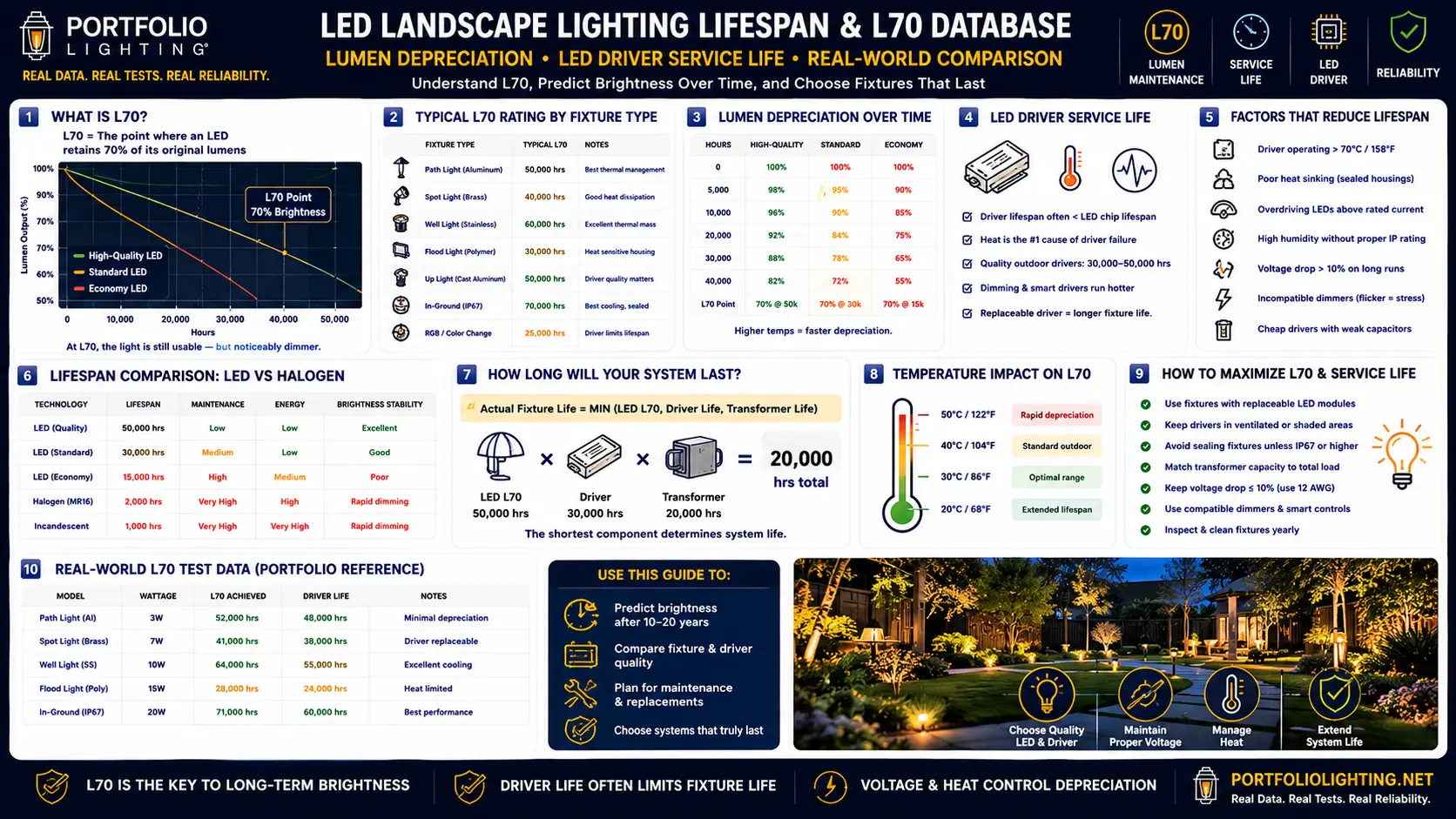
What L70 Means — and the Five Things It Does Not Tell You
L70 is the point at which an LED light source has depreciated to 70% of its initial lumen output — a 30% reduction in brightness from when it was new. The IES (Illuminating Engineering Society) established L70 as the standard end-of-useful-life benchmark for LED sources because 70% output is the threshold below which most people reliably notice that a light is significantly dimmer than it was.
What L70 does not mean is equally important. L70 is not a failure point — the fixture does not stop working when it reaches L70. It continues operating at declining output levels. L70 is also not a warranty claim threshold, not a safety concern, and not a date printed on the fixture. It is a projection of when the LED light source's output will have depreciated to a specific percentage of its initial value under a specific set of test conditions.
The Five Things L70 Does Not Tell You
-
Driver lifespan:
L70 is a specification for the LED light source (chip + phosphor). It does not describe the lifespan of the driver electronics that power the LED. In most integrated LED landscape fixtures, the driver is the first component to fail — typically well before the LED chip reaches L70. Driver failure produces complete fixture darkness, which is a very different outcome from the gradual brightness reduction that L70 describes. A fixture's effective service life is determined by whichever component fails first: the LED chip reaching L70, or the driver failing from thermal stress or capacitor degradation.
-
Test conditions vs installation conditions:
L70 testing under LM-80 is conducted at controlled temperatures — typically 55°C (131°F) and 85°C (185°F) LED junction temperature. Outdoor landscape fixtures installed in warm climates, in positions with poor thermal management, or with inadequate IP rating may operate at significantly higher effective junction temperatures than the LM-80 test conditions — accelerating depreciation beyond the published rate. The test temperature is often much lower than what the fixture experiences buried in dark mulch on a summer afternoon in Arizona or Florida.
-
Optical system degradation:
L70 measures LED chip output. It does not account for yellowing, hazing, or crazing of the optical lens or diffuser that sits between the LED and the outside world. A fixture whose LED chip maintains 85% of initial output at 25,000 hours may deliver only 70% of initial installed light output because the lens has yellowed from UV exposure, reducing optical transmission. See the Outdoor Lighting Finish Weathering Guide for optical material degradation data by material type and climate.
-
Housing seal degradation:
L70 does not describe what happens to the fixture's IP rating over time. A fixture installed with a valid IP65 rating may have a degraded housing seal after 5–7 years of outdoor weathering — particularly in freeze-thaw climates where gasket materials experience repeated mechanical stress from thermal cycling. Once the housing seal degrades, moisture ingress begins accelerating both driver corrosion and LED phosphor contamination, producing lumen depreciation that is faster than the TM-21 projection would suggest.
-
Color shift:
L70 measures lumen quantity, not color quality. LED phosphors shift color temperature as they age — typically toward shorter wavelengths (cooler, bluer light) as the phosphor conversion layer degrades over time. A fixture can still be above the L70 output threshold while delivering noticeably cooler, less warm light than when new. This color shift is often the first perceptible sign of LED aging in landscape applications, appearing before visible brightness reduction. See the CRI and R9 Color Quality Guide for how phosphor aging affects color rendering over time.
LED technology has changed how outdoor lighting lifespan is measured, especially with metrics such as L70 lumen maintenance. For broader information covering complete system components, see our outdoor lighting component life expectancy guide.
LM-80 Testing and TM-21 Projection: How L70 Numbers Are Generated
Understanding how L70 figures are produced helps you evaluate how much confidence to place in any specific manufacturer's claim. The methodology is standardized — but the inputs, test durations, and projection assumptions vary significantly across the industry, producing L70 claims that are not directly comparable even when they cite the same number of hours.
What LM-80 Measures
LM-80 (IES LM-80-15) is the industry test standard for measuring lumen maintenance of LED light sources. In an LM-80 test, LED packages or modules are operated continuously at three specified temperatures (typically 55°C, 85°C, and one additional temperature) for a minimum of 6,000 hours — though 10,000 hours of test data is preferred and produces significantly more reliable TM-21 projections. Lumen output is measured at regular intervals throughout the test period. The resulting lumen maintenance curves show how each LED performs at each test temperature over time.
LM-80 tests the LED package or module only — not the complete fixture. Drive current, thermal management, optical system, and housing are not part of the LM-80 test. This is the fundamental reason why LM-80 data, even when perfectly measured and documented, cannot fully predict complete fixture service life.
What TM-21 Projects
TM-21 (IES TM-21-19) is the calculation methodology for projecting when an LED will reach L70, L50, or other lumen maintenance thresholds beyond the actual LM-80 test duration. TM-21 fits an exponential decay curve to the LM-80 test data and extrapolates forward in time. The critical limitation of TM-21 is that the standard only allows projections to six times the actual LM-80 test duration — meaning 6,000 hours of LM-80 data supports a TM-21 projection of up to 36,000 hours, while 10,000 hours of data supports projection to 60,000 hours.
When you see a fixture claiming L70 = 50,000 hours based on TM-21, you should ask: how many hours of actual LM-80 data supports that projection? A 50,000-hour TM-21 projection based on 6,000 hours of LM-80 data is a mathematical extrapolation across a very long period. A 50,000-hour projection based on 10,000 hours of data is substantially more reliable. Most manufacturers do not volunteer this information in product listings — it requires reading the photometric documentation or requesting the LM-80 test report.
The DLC Standard for Documented L70
The DesignLights Consortium (DLC) requires documented LM-80 test reports and compliant TM-21 projections as a condition of DLC listing. Products on the DLC Qualified Products List have verified, documented L70 projections. While DLC listing is primarily a commercial/utility rebate program, the DLC qualification standard provides a useful filter for residential buyers who want verified L70 claims: if a fixture is DLC listed, its L70 figure is documented and verifiable. DLC is not required for residential landscape lighting products, so its absence does not indicate a problem — but its presence is a positive signal.
L70 Hours to Real-World Years: Conversion at Common Operating Schedules
L70 figures are published in hours because they describe a hardware specification, not a calendar prediction. Converting hours to years requires knowing how many hours per year a fixture operates — which varies significantly based on the timer or photocell schedule, seasonal variation, and whether the system uses dusk-to-dawn control or a fixed timer. These conversions help contextualize L70 figures for residential landscape lighting decisions.
Driver Temperature and the Arrhenius Effect: How Heat Determines Real Fixture Life
The Arrhenius equation describes how chemical reaction rates — including the degradation reactions that cause capacitor failure in LED drivers — accelerate exponentially with temperature. In practical terms for LED landscape lighting, the Arrhenius relationship means that every 18°F (10°C) increase in driver operating temperature approximately halves the driver's service life. This is the single most important technical relationship governing why published L70 figures often do not match real-world fixture lifespan in outdoor landscape applications.
Why the Driver Usually Fails Before the LED Chip
An LED chip rated at L70 = 50,000 hours might genuinely be expected to operate for 22+ years in a landscape lighting system. But the LED chip is powered by a driver — a switching power supply containing electrolytic capacitors whose service life is the most temperature-sensitive component in the fixture. Electrolytic capacitors degrade through electrolyte evaporation, a chemical process that follows the Arrhenius relationship almost exactly: operating temperature is the dominant variable, and the relationship is approximately exponential. A capacitor rated for 10,000 hours at 85°C (185°F) is rated for approximately 5,000 hours at 95°C (203°F), and approximately 20,000 hours at 75°C (167°F).
In an outdoor landscape fixture whose housing temperature rises above design limits from elevated ambient temperature, inadequate ventilation, or IP rating failure that admits moisture increasing thermal resistance — the driver capacitors degrade at a rate that produces driver failure years or decades before the LED chip would reach L70. The full thermal degradation data for the 31 benchmarked fixtures is documented in the LED Driver Heat Guide.
The Connection Between IP Rating and Driver Temperature
An undersized IP rating does not just admit moisture — it raises effective driver operating temperature through two mechanisms simultaneously. First, moisture condensed on driver components creates a resistive contamination layer that slightly increases the thermal resistance between driver components and the housing, raising operating temperature. Second, moisture-accelerated corrosion of driver PCB traces and capacitor leads increases their electrical resistance, causing those components to dissipate more power as heat — a self-reinforcing cycle. An IP44 fixture in an IP65-required position that admits moisture over 12–18 months of outdoor operation may be running its driver 10–15°C hotter than a properly sealed IP65 equivalent in the same installation position, cutting driver life by 50–75% through the Arrhenius pathway alone. See the IP Rating Comparison Guide for the complete IP failure mechanism documentation.
The Four Real-World Modifiers That Shorten Published L70
Published L70 figures assume ideal conditions. These four factors — all common in real outdoor landscape lighting installations — reduce effective fixture life below the published figure. Understanding each factor allows you to estimate a realistic service life for any specific fixture in your specific installation context.
🌡️ Elevated Ambient Temperature
Landscape fixtures installed in positions with high solar gain — dark mulch, south-facing walls, recessed in-grade positions with poor thermal dissipation — experience consistently higher ambient temperatures than the controlled LM-80 test environment. Every 10°C above the test temperature reduces driver life by approximately 50% through the Arrhenius pathway. A fixture in a southern US installation with summer ground temperatures regularly reaching 120–140°F in dark mulch is operating in conditions meaningfully hotter than a temperate test environment. The Driver Heat Guide documents operating temperatures for each of the 31 benchmarked fixtures under high-ambient conditions.
Reduces L70 by 25–75% in hot climates💧 IP Rating Inadequacy
A fixture installed at an IP rating lower than its position requires admits moisture that corrodes driver components, increases thermal resistance, and initiates the Arrhenius-accelerated degradation cascade described above. IP44 in an IP65-required outdoor landscape position typically reduces effective driver life by 50–80% compared to the same fixture with a correctly specified IP65 or higher rating. This is the most common L70 accelerant in residential landscape lighting because many homeowners and even some installers are unaware of the IP rating requirements for different outdoor positions.
Reduces L70 by 50–80% if undersized🔦 Voltage Stress
A landscape lighting fixture receiving significantly low voltage — below 10.5V in a 12V system from voltage drop on undersized wire — runs its driver in a compensating mode that increases internal driver current and heat. Conversely, a fixture receiving significantly high voltage (above 13V from a transformer tap set too high for the run length) stresses driver capacitors with elevated voltage. Both extremes increase driver operating temperature and accelerate Arrhenius degradation. Correct wire gauge selection that keeps voltage within the 11.5–12.5V optimal range at the fixture extends driver life. See the Wire Gauge and Ampacity Database for the complete voltage-to-driver-stress relationship.
Reduces L70 by 20–50% with chronic voltage deviation🌐 Optical System Degradation
Polycarbonate lenses, acrylic diffusers, and even borosilicate glass covers all degrade over time from UV exposure and thermal cycling in outdoor landscape positions. Polycarbonate is the most vulnerable — UV hazing and yellowing can reduce optical transmission by 15–25% over 5–10 years, adding significant apparent lumen depreciation on top of LED chip aging. The combined effect of LED chip L70 plus optical degradation means a fixture's delivered light output can fall to 70% of its new output significantly before the LED chip alone reaches L70. See the Finish Weathering Guide for UV degradation rates by lens material.
Adds 10–25% output reduction over 5–10 yearsLumen Depreciation Curve: What Happens to Fixture Output Over Time
This depreciation timeline shows the typical lumen output progression for a quality IP65 LED landscape fixture at 50,000-hour chip L70, operated at a 6-hour-per-night schedule in a temperate climate with correct IP rating and voltage delivery. Each bar represents approximate delivered lumen output relative to new.
L70 Lifespan Database: All 31 Benchmarked Fixtures
Published L70 figures from manufacturer specifications cross-referenced against test method documentation, driver temperature benchmarks from the 2026 dataset, IP rating adequacy assessment, and real-world life adjustment factors. The adjusted L70 column represents estimated system L70 under typical residential outdoor installation conditions — accounting for driver thermal life, optical degradation, and IP rating adequacy — not just the LED chip L70 from TM-21 projection.
| Fixture / Device | Type | Published Chip L70 | Test Method | IP Rating | Driver Temp Risk | Adjusted System L70 Est. | Key Life Factor |
|---|---|---|---|---|---|---|---|
| Ketura Tunable Platform | Smart Architectural | 50,000 hrs | LM-80 + TM-21 | IP65–IP67 | Low | ~40,000–45,000 hrs | Premium driver design, robust thermal path |
| Modern Forms Alabaster Sconce | 120V Wall | 50,000 hrs | LM-80 + TM-21 | IP65 | Moderate | ~35,000–42,000 hrs | Quality housing; driver temp well managed |
| WAC dweLED Longboard | 120V Linear | 50,000 hrs | LM-80 + TM-21 | IP44–IP54 | Moderate–High (covered only) | ~28,000–35,000 hrs (covered) | IP rating limits outdoor position — covered installation required |
| WAC dweLED Brocade (12V) | 12V LV Fixture | 50,000 hrs | LM-80 + TM-21 | IP65 | Moderate | ~35,000–42,000 hrs | Good IP rating; driver thermal path adequate |
| Hinkley Clear Lantern Series | 120V Lantern | 25,000–50,000 hrs* | Varies by variant | IP65* | Moderate | ~20,000–35,000 hrs | Verify LM-80 documentation for specific variant |
| Savoy House Lancaster Wall | 120V Wall | 25,000–35,000 hrs* | Self-declared | IP44–IP54* | Moderate (covered position) | ~18,000–28,000 hrs | Covered installation limits driver thermal exposure |
| Kichler Hatteras Bay | 120V Pendant | ~25,000 hrs* | Self-declared | IP44* | Moderate (covered only) | ~18,000–22,000 hrs | IP44 limits to covered positions only |
| Kichler Tenon (12V variants) | 12V LV Fixture | 50,000 hrs | LM-80 + TM-21 | IP67 | Low–Moderate | ~38,000–45,000 hrs | Best IP rating in 12V category; premium driver |
| HomeGnome Travertine Pendant | Indoor 120V | ~15,000–25,000 hrs* | Self-declared | IP20 (indoor only) | Low (indoor — controlled temp) | ~15,000–25,000 hrs indoor | Indoor application only — no outdoor life data |
| Morsale Linear Travertine | Indoor 120V | ~15,000–25,000 hrs* | Self-declared | IP20 (indoor only) | Low (indoor) | ~15,000–25,000 hrs indoor | Indoor application only |
| Morsale Marble Sconce | Indoor 120V | ~20,000 hrs* | Self-declared | IP20 (indoor only) | Low (indoor) | ~20,000 hrs indoor | Indoor application only |
| Savoy House Judi Chandelier | Indoor 120V | ~20,000–30,000 hrs* | Self-declared | IP20 (indoor only) | Low (indoor — climate controlled) | ~20,000–30,000 hrs indoor | Indoor — A/C environment extends driver life vs outdoor |
| Capital Leland / Maxim Cora / Generation Hanks | Indoor 120V | ~15,000–25,000 hrs* | Self-declared | IP20 (indoor only) | Low (indoor) | ~15,000–25,000 hrs indoor | Indoor application only |
| Alora Furrow Pendant | Indoor 120V | ~20,000 hrs* | Self-declared | IP20 (indoor only) | Low (indoor) | ~20,000 hrs indoor | Indoor application only |
| Philips WiZ A19 (E26) | Smart Bulb | 25,000 hrs | LM-80 documented | IPX4 (bulb only) | Moderate (bulb temp depends on fixture) | ~15,000–22,000 hrs outdoor (IP65 fixture required) | Fixture housing determines effective IP; smart features add marginal heat |
| AiDot Linkind Matter (E26) | Smart Bulb | 15,000–20,000 hrs* | Self-declared | IPX4 (bulb only) | Moderate | ~10,000–16,000 hrs in IP65 fixture | Lower chip rating; Matter radio adds minor heat |
| U-tec Bright A19 (E26) | Smart Bulb | 15,000 hrs* | Self-declared | IPX4 (bulb only) | Moderate | ~10,000–13,000 hrs in IP65 fixture | Modest chip rating — shorter life expectation than premium brands |
| Lutron Diva Smart Dimmer | 120V Dimmer (Control) | N/A (control device) | N/A | IP20 (indoor wall box) | Low (rated for indoor switching service) | 15–20 yr switching life (MTBF) | Control device — MTBF not L70. Indoor air-conditioned environment extends life. |
| Lutron Caséta Bridge | Smart Hub (Control) | N/A (control device) | N/A | IP20 (indoor only) | Low (indoor) | Technology obsolescence before hardware failure typical | Smart platform devices typically replaced by platform/app obsolescence before hardware failure |
| Portfolio 0805279 Transformer | Transformer | N/A (power device) | N/A | IP44 housing | Moderate–High (outdoor covered mounting) | 10–15 yr service life typical — toroidal core | Toroidal transformer core outlasts legacy timer/photocell electronics. Capacitor failure is typical end-of-life mechanism. |
| Portfolio 0010915 Transformer | Transformer | N/A (power device) | N/A | IP44 housing | Moderate–High | 10–15 yr service life typical | Timer module typically fails before transformer core. See Transformer Troubleshooting guide. |
| Zafferano Pina Pro | Cordless Patio | 50,000 hrs (LED module) | LM-80 + TM-21 | IP65 | Low (intermittent cordless use) | ~40,000–48,000 hrs LED module | Battery life (user-replaceable) is primary replacement driver, not LED. See Battery Degradation Guide. |
| Hay Pao Table Lamp | Cordless Patio | ~50,000 hrs | Self-declared | IP65 | Low | ~38,000–45,000 hrs | Battery degradation is primary life limiter in cordless category |
| Visual Comfort Avedon | Cordless Patio | ~50,000 hrs | Self-declared | IP65 | Low | ~38,000–44,000 hrs | Premium brand; battery is primary life limiter |
| Kuzco Folio 9 | Cordless Patio | ~30,000 hrs* | Self-declared | IP54* | Low–Moderate | ~22,000–28,000 hrs | IP54 limits outdoor exposure; battery is co-primary life limiter |
| O'Bright Dune | Cordless Patio | ~25,000 hrs* | Self-declared | IP54* | Moderate | ~18,000–22,000 hrs | Value category — shorter L70 claim reflects entry-level chip |
| Brightech Celia | Cordless Patio | ~20,000 hrs* | Self-declared | IP44* | Moderate–High (IP44 in outdoor use) | ~10,000–16,000 hrs in open outdoor use | IP44 + high ambient temp significantly compresses effective life outdoors |
| Sea Gull Hudson Street | 120V Outdoor | ~50,000 hrs* | Self-declared | IP65* | Moderate | ~30,000–40,000 hrs | Request LM-80 documentation for verified figure |
| Nordalight Scandinavian (outdoor variants) | Mixed | Varies by variant | Varies | IP44–IP65 by variant | Moderate (verify variant) | ~20,000–38,000 hrs (variant dependent) | Always verify IP rating and L70 documentation for specific variant purchased |
* Self-declared L70 figures not supported by published LM-80 test reports. Adjusted system L70 estimates account for driver thermal life, optical system degradation, and IP rating adequacy — not LED chip L70 only. All estimates assume correctly installed fixture at manufacturer-specified IP rating adequacy for position. Indoor fixtures rated at indoor service life in climate-controlled environments. Battery-powered cordless lamps: LED service life greatly exceeds battery service life — battery replacement is primary maintenance action for this category.
How Climate Zone Affects Real-World L70 Service Life
Climate zone is the external variable that most dramatically separates the published L70 figure from real-world fixture service life. The same fixture with the same IP rating and the same driver design will deliver meaningfully different service lives in a Seattle installation versus a Phoenix installation or a Miami installation — because ambient temperature is the primary input to the Arrhenius equation governing driver degradation.
Hot Arid Climates (Phoenix, Las Vegas, Tucson)
Ground-level landscape fixtures in hot arid climates experience some of the most extreme driver thermal stress of any residential outdoor application. Dark mulch in direct summer sun in Phoenix regularly reaches 140–160°F (60–71°C) surface temperature. A fixture whose housing sits in or near this surface layer experiences ambient temperatures that can drive driver operating temperature 15–25°C above the design point — applying a 50–75% Arrhenius life reduction to published L70 figures. In these climates, light-colored reflective mulch or gravel ground cover around fixtures meaningfully reduces thermal stress on fixture housings, extending real-world service life. IP65 quality fixture selection is particularly important in arid climates because dust infiltration on an IP44 or IP54 fixture acts as an insulating layer that further raises internal temperatures. The Landscape Lighting Maintenance Guide covers thermal management strategies for hot climate installations.
Hot Humid Climates (Miami, Houston, New Orleans)
Hot humid climates combine elevated ambient temperature with high relative humidity — creating the worst-case scenario for the IP rating-to-Arrhenius interaction described above. Moisture infiltration in an IP44 fixture in Houston is more frequent and more severe than in a dry climate because humid air carries more moisture and condensation cycles are more frequent. The corrosion-plus-thermal-resistance mechanism shortens driver life through both pathways simultaneously. In hot humid climates, IP65 is the absolute minimum for outdoor landscape positions — IP66 or IP67 is advisable for ground-level positions. The Landscape Lighting Corrosion Guide documents the humidity-corrosion relationship for fixture materials and driver components.
Temperate Climates (Pacific Northwest, Mid-Atlantic, Upper Midwest)
Temperate climates provide the conditions closest to LM-80 test conditions — moderate ambient temperatures, defined seasonal variation, and moderate humidity. In these climates, correctly specified IP65 LED landscape fixtures most reliably achieve figures close to their published L70 ratings. The primary life limiter in temperate climates is freeze-thaw gasket stress — repeated thermal cycling from below freezing to above freezing stresses housing seal gaskets, particularly foam-type gaskets, potentially reducing IP rating integrity over 7–10 years. Quality EPDM or silicone gaskets maintain integrity through freeze-thaw cycles significantly better than compressed foam gaskets.
Freeze-Thaw Climates (Minnesota, Colorado, Northern New England)
In severe freeze-thaw climates, water that infiltrates a housing crack or degraded gasket freezes during winter temperature drops and expands, mechanically damaging housing seals and internal component mounting points. A fixture that arrives with IP65 integrity may have degraded to effective IP44 or lower after 3–5 winters in a severe freeze-thaw climate if the housing gasket is not freeze-thaw rated. For freeze-thaw climates, specify fixtures with silicone or EPDM gaskets explicitly — not foam gaskets — and plan for gasket inspection and possible replacement at 7–10 year intervals to maintain IP rating throughout the fixture's service life.
How to Compare L70 Claims Across Manufacturers
Not all L70 claims are created equal. A 50,000-hour L70 from one manufacturer based on documented LM-80 testing and compliant TM-21 projection is not the same as a 50,000-hour self-declared L70 from another manufacturer with no supporting test data. These five questions let you evaluate any L70 claim with the same framework.
-
Is the L70 figure documented?
Ask for the LM-80 test report from a recognized third-party laboratory. Recognized labs include Intertek (ETL), UL, Pacific Northwest National Laboratory, and similar accredited photometric testing organizations. If the manufacturer cannot provide an LM-80 test report, the L70 figure is a self-declaration. Self-declared figures may be honest estimates, but they are not independently verified and should be discounted compared to tested figures when making purchasing decisions for long-term outdoor installations.
-
How many hours of LM-80 data support the TM-21 projection?
TM-21 is only as reliable as the LM-80 data it projects from. 6,000 hours of LM-80 data supports projection to 36,000 hours. 10,000 hours supports projection to 60,000 hours. Ask the manufacturer how many hours of actual LM-80 test data their TM-21 projection is based on. A 50,000-hour TM-21 projection based on 6,000 hours of data is a very long mathematical extrapolation. A 50,000-hour projection based on 10,000 hours of data is substantially more reliable.
-
Is the L70 figure for the chip or the complete system?
Almost all published L70 figures are LED chip L70 from TM-21 projection — not system L70 that accounts for driver lifespan, optical degradation, and housing seal integrity over time. Ask specifically whether the L70 figure represents the LED package, the LED module, or the complete fixture system. Very few manufacturers publish system L70. When you find one that does, it is a strong differentiating signal of engineering transparency.
-
What is the rated driver operating temperature?
The rated maximum driver temperature (Tc max or Tc rating on the driver label) tells you the thermal headroom between the driver's operating temperature at maximum ambient and the temperature at which driver life begins to degrade significantly. A Tc max of 75°C with a typical outdoor installation temperature of 55°C provides substantial headroom. A Tc max of 75°C in a Phoenix installation where housing temperature reaches 70°C provides almost none. The LED Driver Heat Guide documents Tc ratings and operating temperatures for the benchmarked fixture set.
-
Is the fixture DLC listed?
DLC (DesignLights Consortium) listing requires verified LM-80 test reports and compliant TM-21 projections as listing conditions. If a fixture is DLC listed, its L70 figure is documented and verifiable through the DLC database. DLC is primarily a commercial/utility rebate program, so many quality residential fixtures are not DLC listed — but when a fixture is DLC listed, its L70 claim has been independently verified. The DLC Qualified Products List is publicly searchable at designlights.org.
When to Replace LED Landscape Lights: Practical Decision Framework
Because L70 is a gradual threshold rather than a sudden failure event, the replacement decision for LED landscape lighting is not a simple date-based decision. These are the practical triggers that indicate replacement is warranted — most of which a homeowner can observe without any measurement equipment.
Observable Replacement Triggers
- Brightness gradient across a zone: If fixtures of the same type and wattage that were identical when installed now show noticeably different brightness levels — some bright, some dim — the dim fixtures have experienced differential depreciation from higher thermal stress. This is more often a driver temperature or IP failure issue than uniform LED aging. The brighter fixtures are performing normally; the dim ones have been degraded by a specific stressor. Identify and correct the stressor (voltage drop, IP failure, mounting position heat) before replacing fixtures.
- Noticeable blue or green color shift: Warm-white landscape fixtures that have shifted noticeably toward blue or green have experienced LED phosphor degradation — typically from either thermal stress, moisture ingress onto the LED surface through IP failure, or UV degradation of the phosphor in fixtures with inadequate UV-blocking optical materials. Color shift precedes visible brightness reduction as the first perceptible sign of accelerated aging.
- Individual fixture failure (dark fixture): A landscape fixture that simply does not illuminate when the zone is energized has experienced driver failure — the most common and abrupt end-of-life mechanism for integrated LED landscape fixtures. If multiple fixtures fail in the same zone within a short period, a systemic cause (overvoltage, chronic heat, IP failure, moisture ingress) is likely. The Portfolio LED Modules and Drivers guide covers driver replacement options for fixtures where the driver is user-serviceable. The LED Fixture Repairability Guide identifies which of the 31 benchmarked fixtures allow driver replacement versus requiring full fixture replacement at end of driver life.
- System-wide visible dimming: When the overall landscape is noticeably less bright at night than it was in the first 1–3 years after installation — requiring a higher transformer tap to compensate, or producing shadows that did not previously exist — the system has either experienced significant LED depreciation or voltage drop has increased from added load or wire degradation. Measure voltage at the fixtures before replacing anything — chronic voltage drop is a common misdiagnosis as LED aging.
- Housing physical damage: Cracked, broken, or severely corroded housing that has compromised the fixture's IP rating is a replacement trigger even if the fixture is still illuminating. A fixture with a degraded IP rating in a wet outdoor position is actively accelerating driver degradation every rain event. Replacing it before driver failure saves the cost of second replacement soon after.
Related Guides and Resources
- Full 2026 Hardware Benchmark Database — 31 Models
- LED Driver Heat Guide
- LED Fixture Repairability Guide
- IP Rating Comparison Guide
- CRI and R9 Color Quality Guide
- Outdoor Lighting Finish Weathering Guide
- Cordless Lamp Battery Degradation Guide
- Voltage Drop Fixture Impact Guide
- Wire Gauge and Ampacity Database
- Best LED Landscape Lighting Fixtures
- Smart Bulb Standby Power Comparison
- Portfolio LED Modules and Drivers
- Portfolio LED Lights Flickering
- Portfolio Lighting Too Dim
- Landscape Lighting Maintenance Guide
- Landscape Lighting Corrosion Guide
- Transformer Troubleshooting
- Durable Landscape Lighting Materials Guide
- Solar vs Low Voltage Energy Efficiency
- Commercial-Grade Landscape Lighting Upgrades
- Portfolio Lighting Alternatives
- Best Replacement for Portfolio Landscape Lighting
- Landscape Lighting Timer Settings
- Portfolio Low Voltage Timer Guide
LED Landscape Lighting Lifespan L70 FAQ
What does L70 mean for LED landscape lighting?
L70 is the point in an LED fixture's service life when lumen output has depreciated to 70% of its initial rated output — a 30% reduction in brightness from when it was new. Defined in IES LM-80 and projected using TM-21 methodology, L70 is the standard LED service life benchmark. A fixture rated at L70 = 50,000 hours means that after 50,000 hours of operation, its light output will have fallen to 70% of what it produced when new — not that it will fail or stop working at that point. L70 is a lumen depreciation threshold, not a failure point. For landscape lighting, the practical significance of L70 is that once reached, the fixture's contribution to the lighting design is reduced by 30% — and the designer's intent is no longer being met, even though the fixture is technically still functioning.
How long do LED landscape lights last?
Most quality LED landscape lighting fixtures are rated at L70 between 25,000 and 50,000 hours. At a typical 6-hour-per-night schedule (2,190 hours per year), a 50,000-hour L70 fixture reaches the 70% lumen threshold in approximately 23 years. A 25,000-hour L70 fixture reaches L70 in approximately 11 years. However, these figures assume the fixture operates at its rated test temperature throughout its service life. Outdoor landscape fixtures experiencing elevated driver temperatures from inadequate IP rating, high-ambient installation positions, or voltage stress will reach L70 significantly earlier. Driver operating temperature is the single most important real-world modifier of published L70 figures — every 18°F rise above the design point approximately halves remaining driver life through the Arrhenius relationship.
What is the difference between L70 and L50 for landscape lighting?
L70 and L50 are both lumen depreciation benchmarks. L70 = 70% of initial output (30% depreciation). L50 = 50% of initial output (50% depreciation). L70 is the standard residential and commercial specification benchmark. L50 represents more hours than the same fixture's L70 rating because the 50% output threshold takes longer to reach. When comparing fixture life claims, always verify whether the manufacturer is citing L70 or L50 — they are not the same metric and cannot be directly compared. A fixture claiming 100,000-hour L50 does not have twice the service life of a fixture claiming 50,000-hour L70 — they may represent nearly identical actual service lives expressed at different output thresholds.
Does LED driver temperature affect L70 lifespan?
Yes — profoundly, and this is the most underappreciated factor in landscape lighting service life. LED driver lifespan follows the Arrhenius thermal degradation relationship: every 18°F (10°C) increase in driver operating temperature approximately halves the driver's service life. Since the driver is the first component to fail in 80%+ of integrated LED landscape fixtures, driver thermal life effectively determines when the fixture reaches end of useful service. A fixture with a 50,000-hour chip L70 rating but a driver running 36°F above design temperature will experience driver failure in approximately 12,500 hours — one-quarter of the LED chip's rated life. IP rating adequacy, installation position thermal management, and supply voltage quality are the three primary controls over driver operating temperature in outdoor landscape applications.
What is TM-21 and why does it matter for landscape lighting L70 claims?
TM-21 is the IES standard methodology for projecting LED lumen maintenance beyond the actual LM-80 test duration. LM-80 measures actual LED output at controlled temperatures for a minimum of 6,000 hours. TM-21 uses LM-80 data to mathematically project when L70 will be reached — but the standard only allows projections to six times the actual test duration. The critical limitation for landscape lighting buyers is that TM-21 projects LED chip lumen maintenance only — it does not account for driver lifespan, optical degradation, or housing seal failure. A fixture can have a valid 50,000-hour TM-21 L70 projection for its LED chip while its driver fails at 15,000 hours from thermal stress. When evaluating L70 claims, always ask: is this chip L70 or system L70, and how many hours of LM-80 data support the TM-21 projection?
When should I replace LED landscape lights?
The practical replacement trigger is when visible lumen depreciation noticeably reduces the effectiveness of the lighting design — typically around or before technical L70. Specific observable triggers include: fixtures in the same zone that are noticeably dimmer than adjacent identical fixtures (differential thermal degradation), noticeable color temperature shift toward blue or green in previously warm-white fixtures (phosphor degradation), individual dark fixtures from driver failure, and overall landscape brightness noticeably lower than in the first 1–3 years. At a 6-hour-per-night schedule, quality IP65 landscape fixtures on correctly sized wire should require replacement as an aesthetic decision at 15–25 years — not as a repair decision in 3–7 years. Early replacement needs almost always indicate a correctable installation issue: voltage drop, inadequate IP rating, or thermal stress from position or ambient conditions.
L70 Data Disclaimer
Published L70 figures in this database are sourced from manufacturer product specifications and available LM-80/TM-21 documentation as of 2026. Figures marked with (*) represent self-declared manufacturer claims without available third-party LM-80 test documentation. Adjusted system L70 estimates are calculated approximations based on driver thermal benchmarks, IP rating adequacy assessment, and optical system degradation models — they are not independently tested figures. Real-world fixture service life varies significantly with installation position, ambient temperature, IP rating maintenance, supply voltage quality, and operating schedule. All estimates assume correct installation at the IP rating adequate for the installation position. Consult a licensed electrician for any lighting installation where safety or code compliance is in question.