
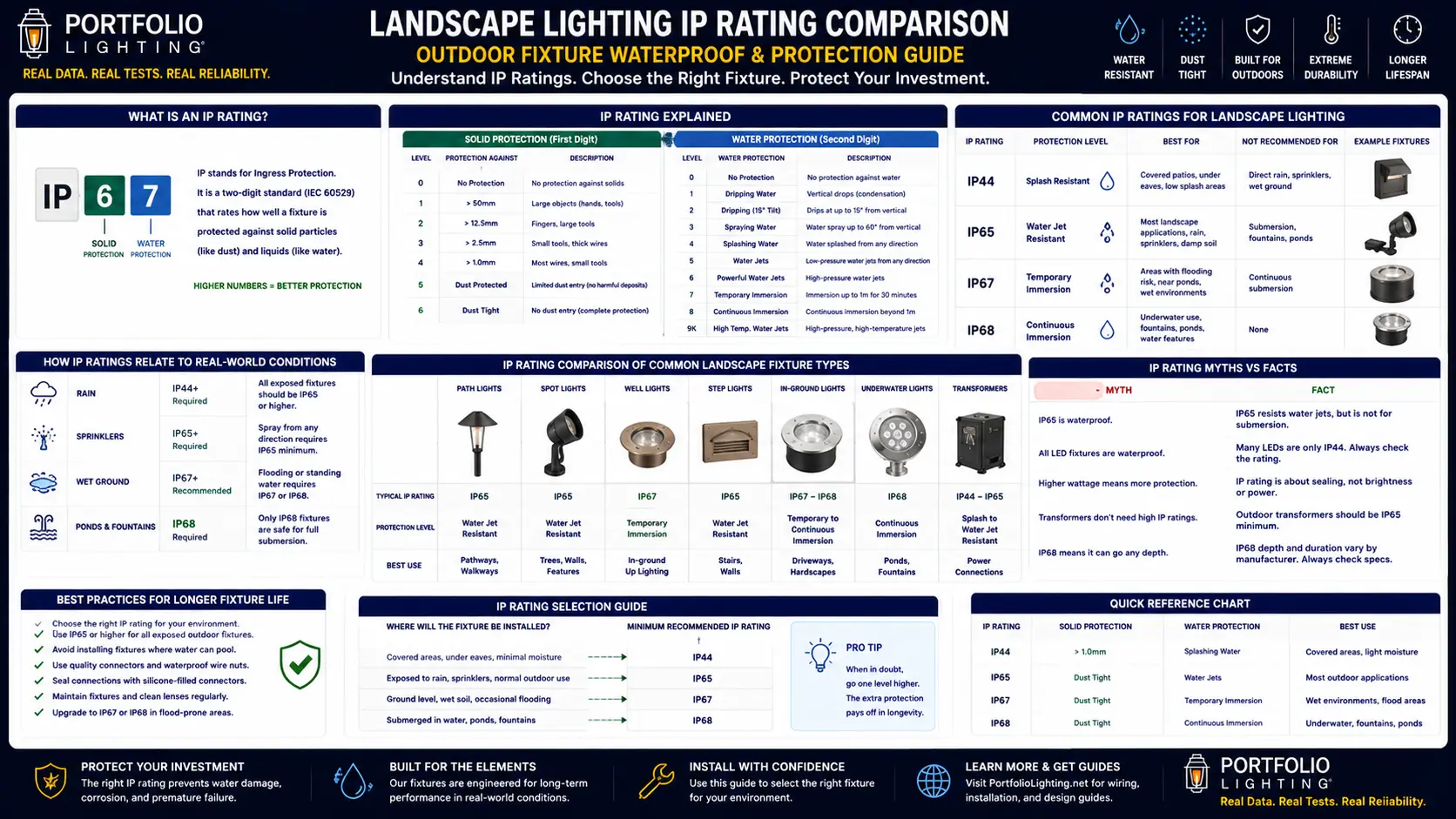
How the IP Code Is Structured — and Why Both Digits Matter Independently
The IP code (Ingress Protection, defined in IEC 60529) consists of two digits. They are completely independent ratings — each digit measures a different type of protection against a different type of intrusion. Understanding what each digit means separately is more useful than memorizing IP codes as whole numbers.
The reason both digits matter independently: a fixture can be completely dust-tight (first digit 6) but only splash-resistant (second digit 4) — which would make it IP64. That fixture would withstand dust perfectly but fail in a direct rainstorm. Conversely, a fixture could be water-jet resistant (second digit 5) but not dust-tight (first digit 4) — IP45. That fixture would handle rain but allow fine dust and insects into the housing, contaminating the LED chip surface and creating heat accumulation inside the driver.
For residential landscape lighting in North America, IP65 — completely dust-tight and water-jet protected — is the baseline specification that addresses both failure modes simultaneously. Anything lower on either digit creates a specific vulnerability that shortens fixture service life in outdoor installations.
First Digit — Solid Particle Protection: What Each Level Prevents
Scale 0 (no protection) to 6 (completely dust-tight). Relevant for landscape lighting because fine dust, pollen, and insects entering through housing gaps accumulate on LED chip surfaces, increase thermal resistance, and cause premature LED degradation.
Second Digit — Liquid Ingress Protection: What Each Level Withstands
Scale 0 (no protection) to 9K (high-temperature, high-pressure jets). The landscape lighting relevant range is 4 (splash) through 8 (continuous submersion). The critical distinction for outdoor residential applications is between 4 (splashing), 5 (jets), 7 (temporary immersion), and 8 (continuous immersion).
IP44 vs IP54 vs IP65 vs IP67: The Four Tiers That Matter for Landscape Lighting
Residential landscape lighting falls across four practical IP tiers. Understanding what each tier actually protects against — and more critically what it does not protect against — determines whether a fixture survives its intended service environment.
Splash-Proof Only
- Solid objects >1mm blocked
- Splashing from any direction
- Not rain-jet rated
- Not dust-tight
- Insects can enter
Covered porches / deep overhangs only. Not for landscape ground use.
Dust-Protected + Splash
- Dust-protected (limited ingress)
- Splashing from any direction
- Not rain-jet rated
- Not fully dust-tight
- Marginal for landscape
Protected covered outdoor areas. Not recommended for exposed landscape positions.
Fully Dust-Tight + Jet
- Completely dust-tight
- Water jets from any direction
- Covers rain, sprinklers, hose
- Not for submersion
- Standard for landscape
Minimum for all exposed landscape lighting. Path lights, spotlights, wall fixtures.
Fully Dust-Tight + Immersion
- Completely dust-tight
- Water jets from any direction
- 1m immersion for 30 minutes
- Required for in-grade
- Flood-tolerant positions
Required for in-ground and in-grade fixtures. Pool surrounds need IP68.
Minimum IP Rating by Outdoor Installation Scenario
Different outdoor lighting positions expose fixtures to fundamentally different water contact conditions. This guide gives you the minimum IP specification for every common residential outdoor landscape installation scenario so you can match protection rating to actual environmental exposure.
An IP rating is useful for understanding resistance to water and solid-particle ingress, but it should not be used by itself to decide whether a landscape fixture belongs in a pond. True underwater lighting is a specialized application with product-listing and installation considerations beyond simply seeing “waterproof” or a high IP number on the package. Our pond lighting code requirements guide explains the difference between rain exposure, splash zones, temporary flooding, and continuous underwater use.
An IP rating describes protection against specified solid-particle and water-ingress conditions, but it does not mean a fixture's optical surfaces will remain unchanged for its entire service life. UV exposure, surface contamination, mineral deposits, abrasion, seal aging, and internal moisture can still affect useful light transmission. Our lens transmittance degradation benchmarks examine this separate optical-aging problem and how it can contribute to declining landscape-light output.
🏃 Path Lights — Ground Level, Open Exposure
Path lights at ground level receive direct rain contact from above and sides, irrigation overspray from sprinkler systems, and splashing from foot traffic through wet mulch and grass. The fixture housing sits at ground level where the highest rain impact concentration occurs.
IP65 Minimum🌞 Spotlights and Uplights — Exposed Ground Mount
Landscape spotlights and tree uplights mounted at grade receive the same direct rain exposure as path lights plus potential irrigation head contact. Spotlights aimed upward trap water in the lens housing if the seal is inadequate — making IP rating particularly critical for upward-facing fixtures.
IP65 Minimum🏠 Outdoor Wall Sconces and Lanterns — Mounted on Building
Outdoor wall-mounted fixtures receive rain from above but typically less direct horizontal rain contact than ground-level fixtures if positioned under even minimal overhang. Exposed corners and gable-end positions without overhang receive equivalent full rain exposure. Never assume building mounting provides weather protection without measuring actual rain contact at the fixture position.
IP65 Minimum / IP44 acceptable under deep overhang only📚 In-Grade Step Lights and Hardscape Fixtures
Step lights recessed into hardscape, retaining walls, and risers receive direct rain impact on the face and potential water pooling in the recess cavity around the fixture. Water can accumulate in the step channel and remain in contact with the fixture housing for extended periods after rain — requiring immersion protection, not just jet protection.
IP67 Minimum🎶 In-Ground Well Lights and In-Grade Fixtures
In-ground well lights and in-grade fixtures installed flush with turf or paving experience the most severe water exposure of any landscape fixture. Standing water from heavy rain, irrigation system pooling, and grade runoff creates temporary immersion conditions that directly test the fixture's submersion protection rating. IP65 is not adequate. IP67 is required as a baseline and IP68 is preferred in flood-prone zones.
IP67 Minimum — IP68 Preferred💥 Pool Surround and Water Feature Fixtures
Fixtures installed within 10 feet of pool edges, on pool deck surfaces, or adjacent to water features experience splash from pool activity, cleaning equipment, and water feature circulation. Pool surround fixtures should meet IP68 for continuous submersion tolerance as pool water can directly contact the fixture housing during cleaning and heavy use.
IP68 Required — See NEC Pool Lighting Code🌸 Cordless Portable Patio Lamps
Cordless portable lamps like the Zafferano Pina Pro are designed for covered and open outdoor patio use. IP65 is the standard for quality cordless outdoor lamps and covers rain, sprinkler overspray, and incidental water contact. Cordless lamps should never be left in standing water and are not designed for in-grade or submerged applications regardless of their rated IP. See the Cordless Lamp Battery Degradation Guide for storage guidance that also protects the housing seals.
IP65 Minimum for Open Outdoor Use🌊 Coastal and Marine Exposure Environments
Coastal installations within approximately 1,500 feet of salt water require IP65 as a minimum — but IP rating does not address salt-air corrosion resistance, which is a separate material and finish quality issue. IP65 coastal fixtures must also use marine-grade brass, copper, or quality stainless steel housings to resist salt-induced corrosion. See the Outdoor Lighting Finish Weathering Guide for coastal material requirements beyond IP rating.
IP65 + Marine-Grade Materials RequiredFixture IP Rating Table: All 31 Benchmarked Models
IP ratings from the 2026 Hardware Database based on manufacturer specifications, IEC 60529 test certification, and fixture category standards. Fixtures marked with (*) reflect category-standard IP ratings where individual model certification is unavailable — treat as estimated minimums rather than certified ratings for those entries.
| Fixture / Device | Type | IP Rating | Suitable For | Not Suitable For |
|---|---|---|---|---|
| Ketura Tunable Platform | Smart Arch. | IP65–IP67 (model dependent) | Exposed landscape, architectural uplighting | In-grade flooding without IP67 variant |
| Modern Forms Alabaster Sconce | 120V Wall | IP65 | Exposed wall mounting, open porches | In-grade or submerged applications |
| WAC dweLED Longboard | 120V Linear | IP44–IP54 | Covered outdoor — deep overhang only | Direct rain exposure, landscape ground level |
| WAC dweLED Brocade (12V) | 12V LV Fixture | IP65 | Landscape ground level, path, accent | In-grade flood positions |
| Hinkley Clear Lantern Series | 120V Lantern | IP65* | Wall mount, post mount, exposed outdoor | In-grade or submerged use |
| Savoy House Lancaster Wall | 120V Wall | IP44–IP54* | Covered outdoor positions | Direct rain — verify specific model before exposed mounting |
| Kichler Hatteras Bay | 120V Pendant | IP44* | Covered outdoor — not landscape ground level | Direct rain, landscape exposure |
| Kichler Tenon (12V variants) | 12V LV Fixture | IP67 | In-grade, in-ground, flood-prone positions | Continuous submersion without IP68 variant |
| HomeGnome Travertine Pendant | Indoor 120V | IP20 (indoor only) | Dry indoor only | Any outdoor or damp location |
| Morsale Linear Travertine | Indoor 120V | IP20 (indoor only) | Dry indoor only | Any outdoor or damp location |
| Morsale Marble Sconce | Indoor 120V | IP20 (indoor only) | Dry indoor only | Any outdoor or damp location |
| Savoy House Judi Chandelier | Indoor 120V | IP20 (indoor only) | Dry indoor only | Any outdoor or damp location |
| Capital Leland / Maxim Cora / Generation Hanks | Indoor 120V | IP20 (indoor only) | Dry indoor only | Any outdoor use |
| Alora Furrow Pendant | Indoor 120V | IP20 (indoor only) | Dry indoor only | Any outdoor use |
| Philips WiZ A19 (E26) | Smart Bulb | IPX4 (bulb only) | Enclosed IP65+ fixture socket — bulb protected by fixture housing | Exposed bulb in open outdoor socket |
| AiDot Linkind Matter (E26) | Smart Bulb | IPX4 (bulb only) | Enclosed IP65+ fixture socket | Exposed bulb outdoor use |
| U-tec Bright A19 (E26) | Smart Bulb | IPX4 (bulb only) | Enclosed IP65+ fixture socket | Exposed outdoor use |
| Lutron Diva Smart Dimmer | 120V Dimmer | IP20 (indoor only) | Dry indoor wall box only | Any outdoor installation |
| Lutron Caséta Bridge | Smart Hub | IP20 (indoor only) | Dry indoor only | Any outdoor use |
| Portfolio 0805279 Transformer | Transformer | IP44 (housing) | Covered outdoor transformer mounting per code | Direct rain — requires code-compliant covered mounting |
| Portfolio 0010915 Transformer | Transformer | IP44 (housing) | Covered outdoor transformer mounting | Direct rain exposure |
| Zafferano Pina Pro | Cordless | IP65 | Open outdoor patio, rain — not submersible | In-grade, submerged, or long-term pooled water |
| Hay Pao Table Lamp | Cordless | IP65 | Open outdoor patio, light rain | In-grade, submerged use |
| Visual Comfort Avedon | Cordless | IP65 | Open outdoor patio | In-grade, heavy weather immersion |
| Kuzco Folio 9 | Cordless | IP54* | Covered outdoor, light rain | Heavy rain, landscape ground exposure |
| O'Bright Dune | Cordless | IP54* | Covered outdoor | Heavy rain exposure, in-grade |
| Brightech Celia | Cordless | IP44* | Covered outdoor only | Direct rain, landscape exposure |
| Sea Gull Hudson Street | 120V Outdoor | IP65* | Wall mount outdoor, exposed position | In-grade, submerged |
| Nordalight Scandinavian | Mixed | IP44–IP65 (varies by variant) | Verify specific variant before outdoor installation | Assume IP65 only if specifically certified for variant purchased |
How Climate Zone Affects Your Effective IP Requirement
The IEC IP rating standard tests fixtures under controlled laboratory conditions — a specific water jet flow rate, pressure, and duration. Real outdoor environments can be more demanding than the test conditions, which means the effective minimum IP for a given position varies by climate zone even at identical fixture positions.
High-Humidity Coastal Climates (Southeast US, Gulf Coast, Pacific Northwest)
High-humidity coastal environments create condensation inside lighting fixtures even when no direct rain contact occurs. Humid air entering through IP44 housing gaps deposits moisture on driver components when temperatures drop at night — a process that repeats every 24 hours throughout the year. In these climates, IP65 (completely dust-tight) is essential because the complete seal also eliminates the condensation path. IP44 fixtures in high-humidity coastal climates typically fail within 18–24 months from condensation-driven driver corrosion even when never directly contacted by rain. See the Outdoor Lighting Finish Weathering Guide for the complete coastal climate material and IP specification framework.
Freeze-Thaw Climates (Upper Midwest, Mountain West, Northeast)
Freeze-thaw climates create a specific IP failure mechanism: water that penetrates an inadequately sealed fixture housing freezes during winter temperature drops, expanding and mechanically stressing housing seals and internal driver components. A fixture that arrived with IP54 housing integrity may have damaged seals after a single winter in a freeze-thaw climate, dropping its effective protection to IP44 or lower for subsequent seasons. IP65 with a fully compressive gasket seal — rather than a press-fit cover — maintains its integrity through freeze-thaw cycles significantly better than press-fit designs.
High-Rainfall Tropical and Subtropical Climates (Florida, Hawaii, Gulf States)
Heavy-rainfall subtropical climates with regular thunderstorms deliver water contact intensity that exceeds the IP65 second-digit test at some frequencies. Hurricane-season rain events can produce horizontal water jet conditions that exceed the standard 12.5 liters-per-minute test specification. In these climates, IP65 remains the minimum but IP66 (powerful jets at 100 liters per minute) is the specification that provides reliable protection during storm events. When IP66 is unavailable for a specific fixture category, prioritize the quality of the housing gasket and seal construction over the nominal IP number.
Arid and Desert Climates (Southwest US, Intermountain West)
Desert climates expose fixtures to extreme fine dust — particulate sizes that IP5X-rated (dust-protected but not dust-tight) housings cannot fully exclude. Monsoon season in desert climates combines fine dust infiltration with sudden heavy rain — a combination that IP44 and IP54 housings fail quickly under. The first-digit 6 (completely dust-tight) of IP65 is particularly important in desert climates because dust infiltration is the primary degradation mechanism for most of the year before monsoon season then accelerates moisture damage of dust-contaminated internal components. The Landscape Lighting Corrosion guide covers the full material and seal degradation mechanisms across climate types.
What Actually Happens When IP Rating Is Too Low: The Failure Mechanism Explained
Understanding why insufficient IP rating shortens fixture life — not just whether it does — is the knowledge that changes purchasing decisions for good. The failure is not dramatic and usually not visible. It accumulates slowly over 12–24 months before manifesting as reduced brightness, flickering, color shift, or complete driver failure.
Stage 1 — Initial Moisture Ingress (Months 1–6)
An IP44 fixture installed in an IP65-required position admits fine water vapor and occasional splash water through housing gap paths. At this stage the fixture appears to function normally — there is no immediate performance change. The moisture deposits as a microscopic film on driver PCB solder joints, capacitor leads, and LED connector contacts. This film is not visible and causes no measurable performance change in the first six months of outdoor operation.
Stage 2 — Galvanic Corrosion Initiation (Months 6–18)
Mineral-laden moisture on copper and aluminum electrical contact surfaces initiates galvanic corrosion. Outdoor water — even rainwater — contains dissolved minerals that become highly conductive electrolytes when deposited on dissimilar metal surfaces. LED driver PCBs contain copper traces, aluminum capacitor cans, and solder (tin-lead or SAC alloy) in proximity — an ideal galvanic corrosion environment. By month 12–18, the electrical resistance at key driver connections begins to increase measurably. The fixture begins drawing slightly more current to maintain output — increasing internal driver temperature. See the LED Driver Heat Guide for how this thermal increase then accelerates further degradation through the Arrhenius mechanism.
Stage 3 — Visible Performance Degradation (Months 18–30)
By 18–30 months in an undersized IP application, the fixture begins showing visible symptoms. Brightness drops noticeably — typically 20–30% below new output — as the compromised driver struggles to maintain regulated current to the LED chip. Corrosion on LED connector contacts produces intermittent contact resistance that manifests as flickering. The fixture may still appear to function but delivers substantially degraded light output and is operating in a state of accelerating failure. At this stage the driver is running significantly hotter than its design temperature, compounding LED phosphor degradation.
Stage 4 — Complete Driver Failure (Months 24–36)
Electrolytic capacitor failure — driven by accumulated heat stress from the corroded driver — produces complete fixture failure. The characteristic failure is a fixture that simply does not illuminate when the zone is energized, or one that flickers for a few seconds and then goes dark. Replacement at this stage requires a new fixture or a driver replacement. The LED chip itself may still be functional — the failure is almost always in the driver electronics, not the LED — but integrated LED fixtures require full replacement because the driver is not user-serviceable. The LED Fixture Repairability Guide covers which fixtures allow driver-only replacement versus requiring full fixture replacement at end of driver life.
How to Verify IP Rating Before Buying: What to Ask and Where to Find It
IP rating is not always easy to find. Some manufacturers bury it in the spec sheet, and some avoid publishing it because proper testing costs money. Use this checklist before buying any outdoor lighting fixture.
Look for the IP code on the spec sheet — not the product headline
IP ratings usually appear in the detailed technical specification table, not the marketing headline. Download the product spec sheet and look for “Ingress Protection,” “IP Rating,” “IP Code,” or “Protection Class.” If no IP code appears anywhere in the documentation, treat the fixture as uncertified for planning purposes.
Verify the certification body — not just the number claimed
An IP rating claim without a named certification body such as UL, ETL, TÜV, or CE may be only a manufacturer self-declaration. For residential landscape lighting in the United States, UL or ETL listing is the stronger verification standard.
Check whether the rating applies to the full fixture or only the driver
Some products list an IP rating for the driver enclosure but not the full fixture assembly. A driver rated IP65 inside a fixture body rated IP44 still leaves the overall installation exposed to IP44-level protection.
For in-grade and in-ground applications, require written IP67 certification
Do not accept IP65 for in-grade, in-ground, or recessed step-light positions. IP65 is not a submersion rating. Require IP67 certification in writing before installing lights where water can pool around the fixture. The Portfolio In-Grade Lighting guide covers the full specification requirements for these applications.
Ask about gasket material and replacement availability
A fixture can lose its real-world protection when the gasket fails. EPDM or silicone gaskets usually hold up better outdoors than open-cell foam. Before buying, ask whether replacement gaskets are available and whether the seal is designed for long-term outdoor exposure.
Related Guides and Resources
- Full 2026 Hardware Benchmark Database — 31 Models
- LED Fixture Repairability Guide
- Outdoor Lighting Finish Weathering Guide
- LED Driver Heat — Landscape Lighting
- CRI and R9 Color Quality Guide
- Cordless Lamp Battery Degradation Guide
- Legacy Compatibility Guide
- Voltage Drop Fixture Impact Guide
- Best LED Landscape Lighting Fixtures
- NEC 2026 Outdoor Lighting GFCI Requirements
- Landscape Lighting Electrical Code Safety Guide
- Landscape Lighting Corrosion Guide
- Portfolio In-Grade Lighting Guide
- Portfolio Waterproof Lighting
- Durable Landscape Lighting Materials Guide
- Landscape Lighting Maintenance Guide
- Portfolio Landscape Lighting Hub
- Portfolio Lights Not Working After Rain
- Landscape Lights Not Working After Rain
- Outdoor Lighting Junction Box Requirements
Landscape Lighting IP Rating FAQ
What IP rating do I need for landscape lighting?
IP65 is the minimum recommended IP rating for any landscape lighting fixture installed outdoors at ground level in an exposed position. IP65 means the fixture is completely dust-tight (first digit 6) and protected against water jets from any direction (second digit 5) — adequate for rain, sprinkler overspray, and pressure washing at a safe distance. IP44 (splash-proof only) is insufficient for ground-level landscape fixtures that experience direct rain contact. IP67 is required for in-grade and in-ground fixtures that may experience temporary water immersion from heavy rain pooling or flooding.
What does IP65 mean for outdoor lighting?
IP65 means the fixture carries a protection rating of 6 for solid particle ingress (completely dust-tight — no dust enters under any test condition) and 5 for liquid ingress (protected against water jets from any direction at up to 12.5 liters per minute from 3 meters distance for at least 3 minutes). IP65 fixtures withstand direct rain, sprinkler overspray, and standard outdoor washing. They are not rated for submersion — water jet protection (second digit 5) is specifically different from immersion protection (second digit 7 or 8). An IP65 fixture should not be used as an in-grade or in-ground fixture in positions that may flood.
What is the difference between IP44 and IP65 for landscape lighting?
IP44 fixtures are protected against solid objects larger than 1mm and water splashing from any direction — but not against directed water jets or sustained heavy rain impact. IP65 fixtures are completely dust-tight and protected against water jets from any direction at full test intensity. For landscape lighting at ground level where rain directly contacts the fixture housing, IP65 is the correct specification. IP44 is acceptable only for covered outdoor fixtures under deep overhangs, in enclosed porches, or in protected outdoor areas where no direct rain contact reaches the fixture. Installing IP44 fixtures in exposed landscape positions produces driver corrosion and fixture failure within 18–30 months in most climates.
Does IP rating affect how long landscape lighting lasts?
Yes — significantly. A landscape lighting fixture installed outdoors at IP44 when IP65 is required experiences accelerated corrosion of internal driver PCB components, LED chip contacts, and wire termination points from moisture ingress that does not occur in an IP65 housing. Moisture in the driver housing accelerates capacitor degradation through the Arrhenius mechanism — the same thermal relationship that makes elevated operating temperature shorten driver life. An IP44 fixture in an IP65-required application typically fails within 18–36 months. The same fixture with an IP65-rated housing in the same position typically achieves its rated 50,000-hour LED service life across 10+ years of outdoor installation.
What IP rating do in-ground landscape lights need?
In-ground and in-grade landscape lighting fixtures require a minimum of IP67, which means protection against temporary immersion in water up to 1 meter deep for 30 minutes. In-grade fixtures are subject to standing water accumulation during heavy rain, irrigation pooling, and grade runoff that creates temporary immersion conditions. IP65 is insufficient for in-grade applications because it covers water jets (second digit 5) but not immersion (second digit 7 or 8). Never install an IP65-rated fixture in an in-grade position and accept a supplier's assurance that it is "suitable for wet locations" as adequate — IP65 wet location certification and IP67 submersion certification are not equivalent.
Are landscape lighting IP ratings tested or self-declared?
IP ratings can be either independently tested (certified by UL, ETL, TÜV, or equivalent accredited laboratory) or self-declared by the manufacturer without third-party testing. For residential landscape lighting in the US, fixtures with UL or ETL listed markings that specify an IP code have been tested by an independent laboratory to IEC 60529 standards. Fixtures that claim an IP rating without UL or ETL listing are self-declared — these ratings frequently overstate actual protection by one to two levels. When specifying outdoor landscape lighting, always verify the IP rating appears in the UL or ETL listing documentation, not just in marketing materials.
Can I use an indoor fixture with a waterproof cover in an outdoor landscape position?
No — and this is one of the most common and dangerous landscape lighting installation errors. Indoor fixtures (IP20) cannot be made suitable for outdoor use by adding a weatherproof cover box or enclosure. The fixture itself is not rated for the damp or wet location classification required by NEC 2026 for outdoor positions. The fixture wiring, socket, and LED driver are not designed for the temperature cycling, UV exposure, and condensation environments of outdoor installation regardless of what covers the fixture body. Only fixtures specifically UL or ETL listed for wet or damp location use should be installed in outdoor landscape positions. See the Landscape Lighting Electrical Code Safety Guide for the complete NEC requirements governing outdoor fixture installation.
IP Rating Data Disclaimer
IP ratings in this guide are based on manufacturer published specifications, UL/ETL listing data where available, and IEC 60529 category standards for fixture types where individual model certification documentation was unavailable. Entries marked with (*) represent category-standard estimates, not certified individual model ratings. Always verify IP rating from the manufacturer's current specification sheet or UL/ETL listing before installation. IP rating determines NEC code compliance for wet and damp location fixture installation — consult a licensed electrician for any installation where fixture placement code compliance is in question.