
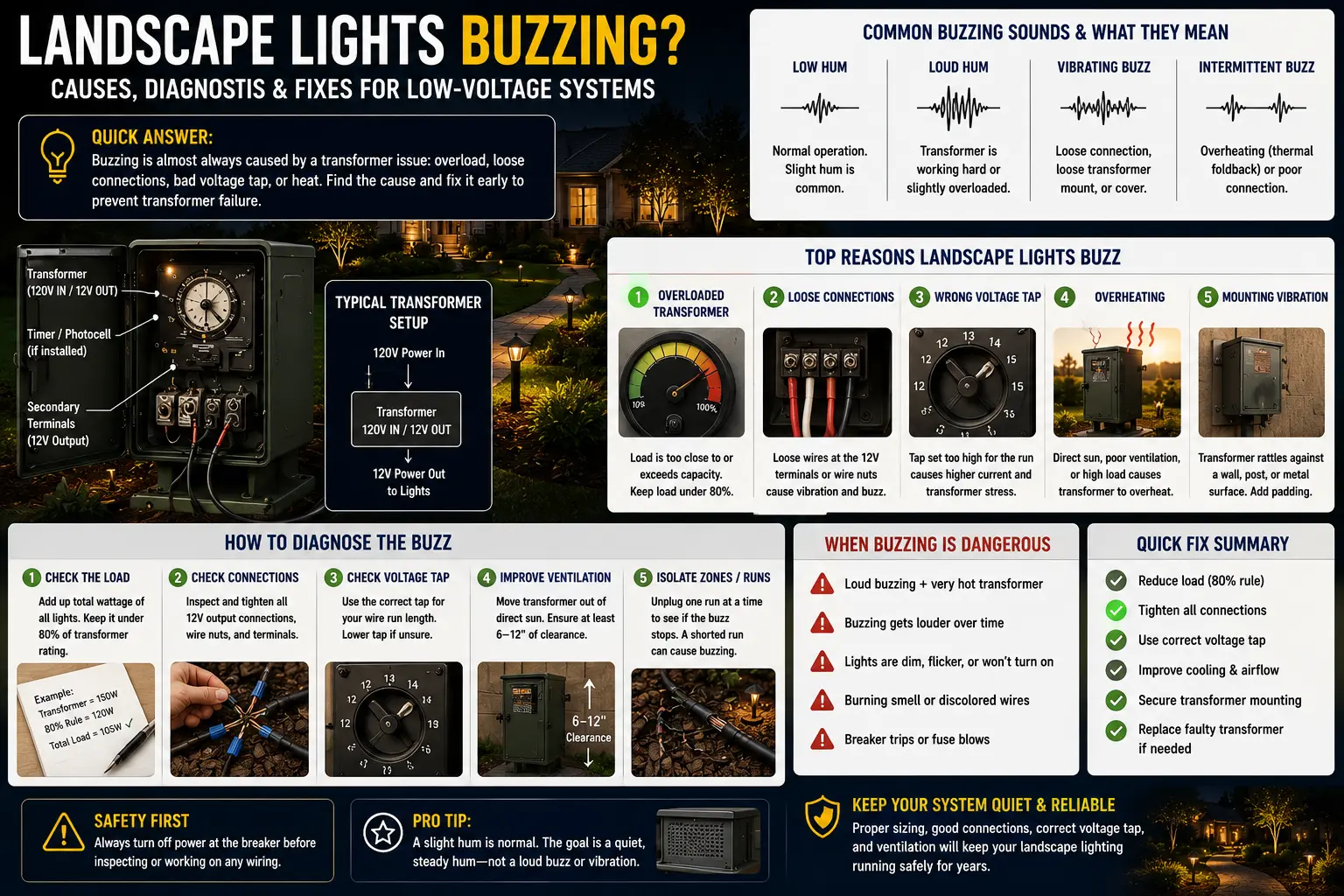
Why Transformers Buzz: The Real Physics (Not a Vague "It's Normal")
Every landscape lighting transformer hums. Not because it is poorly built. Not because something is wrong. Because of fundamental electromagnetic physics that cannot be designed away entirely — only managed. Understanding the physics tells you immediately whether your buzz is the baseline of a functioning transformer or an amplification signal that something has gone wrong.
A landscape transformer's core is made of laminated silicon steel — thin sheets of steel stacked together to form the magnetic pathway. When 60Hz alternating current flows through the primary winding, it creates an alternating magnetic field that passes through the steel core. Silicon steel (and all ferromagnetic materials) has a property called magnetostriction: its molecular structure physically changes shape — expands and contracts slightly — whenever a magnetic field passes through it.
Here is the critical detail: in a 60Hz AC system, the magnetic field reverses direction twice per cycle — once each half-cycle. The steel core doesn't care which direction the field is pointing; it contracts during both positive and negative peaks. This means the core experiences 120 compressions per second — not 60. This is why landscape transformer hum is a 120Hz tone, not 60Hz, even though the power frequency is 60Hz. At 120Hz, the sound falls into the lower range of human hearing and is perceived as a low-pitched buzz or hum.
Why the Same Wattage Transformer Can Sound Very Different
Magnetostriction intensity is proportional to magnetic flux density — how "hard" the magnetic field is pushing through the core material. Two factors drive this: how close to its rated load the transformer is operating, and the quality of the core lamination bonding. A transformer running at 90% of its rated capacity drives the core harder than the same unit at 30% load, producing more vibration. A transformer with degraded potting compound (the epoxy resin used to bond the lamination stack and dampen vibration) will buzz louder than an identical unit with intact potting, because the laminations can vibrate more freely. This is why an older transformer that has been running near its capacity limit for years often buzzes noticeably louder than it did when new — the potting compound has hardened and fractured from repeated thermal cycling.
The 120Hz Frequency as a Diagnostic Tool
The normal transformer hum is a steady, pure 120Hz tone. You can loosely verify this: if the buzz sounds like a pure low tone — similar to a very low-pitched musical note — and does not change character when you add or remove load, you are hearing normal magnetostriction. If the buzz changes pitch, intensity, or character when fixtures are connected and disconnected, or if it includes higher-pitched overtones (buzzing rather than pure humming), there are additional harmonic sources at play — most likely LED driver interference or a supply-line problem. This distinction is the foundation of the entire diagnostic approach below.
The first question I ask on any landscape lighting buzz call is: "Did the buzzing start immediately from day one, or did it develop over time?" A buzz that was always present is almost certainly normal magnetostriction in an EI-core transformer — the homeowner simply never noticed it before or placed the transformer somewhere where it is more audible. A buzz that developed gradually after years of operation usually means the potting compound has degraded, the transformer is now running closer to its load capacity due to fixture additions, or LED bulbs were added that are generating harmonic feedback. Each of these has a completely different fix.
Keep the diagnosis moving: once you understand whether the sound is a clean transformer hum or a sharper electrical buzz, the next step is to locate where the noise is physically coming from. The same sound at the transformer, fixture, GFCI outlet, or mounting stake points to very different repair paths.
Pinpoint Your Buzz Source: By Location, Character, and Conditions
Before any fix, you need to know exactly which component is generating the noise. Fixing the wrong component wastes money and leaves the problem in place. This diagnostic grid maps every buzz scenario to its source in under 5 minutes.
Buzzing transformers and unstable lighting systems can sometimes point to overload conditions, failing internal components or incompatible LED retrofits. This landscape lighting transformer diagnostics guide explains the warning signs, protection behaviors and fault conditions commonly associated with noisy or unstable low-voltage transformers.
| Where You Hear It | Sound Character | When It Occurs | Most Likely Source | Fix Priority |
|---|---|---|---|---|
| From transformer cabinet, steady | Low, pure 120Hz hum — same volume always | Whenever transformer is powered, regardless of fixtures | Normal magnetostriction — EI-core transformer | Cosmetic: relocate transformer, upgrade to toroidal |
| From transformer cabinet, louder than before | Same 120Hz hum but noticeably amplified | When fixtures are on; gets louder as more fixtures added | Transformer running near/over capacity, or degraded potting compound | Calculate total load; reduce fixtures or upsize transformer |
| From transformer cabinet, higher pitch or crackling | Multiple frequencies, not a pure tone; crackling edge | When fixtures are on; changes when fixtures added/removed | LED driver harmonic feedback into transformer core; or loose terminal wire arcing | Check terminal connections; swap LED bulbs if persistent |
| From transformer cabinet, with burning smell | Any buzz character + burning plastic smell | When transformer is hot | ⚠ DANGER: Overheating — possible fire risk | Shut off immediately; check load; inspect for wire damage |
| From individual fixtures | High-pitched, localized buzz from specific lights | When those specific fixtures are on | LED driver harmonics or loose bulb seating in socket | Reseat bulb; replace with quality LED MR16 |
| From fixture housings, metallic tone | Vibrating, tinny buzz — more mechanical than electrical | When transformer is on; same intensity | Fixture housing resonating sympathetically with 120Hz field | Tighten fixture mounting hardware, stake, adjusting screw |
| From transformer, 60Hz instead of 120Hz | Deeper, lower pitch than usual | Whenever powered; does not change with fixtures | DC offset on utility supply line — grid quality issue | Try different outlet on different circuit; contact utility if persistent |
| From GFCI outlet itself | Buzz from the outlet, not from the transformer | When anything is plugged in | ⚠ DANGER: Loose outlet wiring or failing GFCI — call electrician | Shut off circuit; have licensed electrician inspect |
Use the source before buying parts: a transformer cabinet hum usually means core vibration, while a fixture-level buzz usually means an LED driver, socket contact, or loose housing. Do not replace the transformer until the sound has been isolated by location.
EI-Core vs Toroidal: Why Your Transformer Type Determines Your Baseline Buzz Level
The two transformer types used in landscape lighting have fundamentally different noise profiles — and the difference is not subtle. This is the single most important structural choice that determines whether your system produces annoying background buzz or operates at near-silence.
- Audible 120Hz hum whenever powered
- Volume increases significantly at higher loads
- Older units buzz louder as potting compound degrades
- Common in all budget landscape transformers (Malibu, older Portfolio, generic)
- Efficiency typically below 90% — more energy wasted as heat and vibration
- Near-silent operation in most environments
- DOE Level VI compliant units (Hampton Bay SL-series, quality brands) also have very low standby loss
- Efficiency 90–95% — less energy wasted as heat
- Used in: Hampton Bay SL-120-12A, SL-200-12A (potted toroidal per DOE VI)
- Higher upfront cost — typically 30–60% more than equivalent EI-core
| Property | EI-Core | Toroidal | Impact on Buzzing |
|---|---|---|---|
| Air gaps in core | Yes — between E and I laminations | No — continuous ring | Air gaps amplify magnetostriction into audible buzz |
| Acoustic noise | Noticeable 120Hz hum under load | Near-silent (up to 8× quieter) | Toroidal is dramatically quieter at same wattage |
| Efficiency at rated load | 85–90% | 90–95% | Lower efficiency = more energy wasted as heat and vibration |
| Noise at high load | Significantly louder | Minimal increase | EI-core buzz worsens much more dramatically as load increases |
| Noise with LED harmonic interference | Amplified — LED harmonics excite laminations | More resistant — closed core absorbs harmonics better | LED conversion buzz increase is much worse with EI-core |
| Cost | Lower — simpler to manufacture | Higher — complex winding process | — |
| Consumer examples | Most Malibu, generic/budget transformers, older Portfolio | Hampton Bay SL-120/200 (DOE Level VI), VOLT transformers, quality professional units | Toroidal examples include market's quietest landscape transformers |
Transformer type changes the baseline: an EI-core transformer can be working correctly and still be noisy. If the system is installed near a patio, bedroom wall, or quiet seating area, upgrading to a toroidal transformer may solve an annoyance even when nothing is technically broken.
LED Conversion Made the Buzzing Worse: Why It Happens and Exactly How to Fix It
This is the most common buzzing complaint in landscape lighting today: a homeowner replaces their halogen MR16 or G4 bulbs with LED equivalents, and the system starts buzzing — often louder and at a different pitch than with the old halogens. The cause is electrical, not a defect in the LED bulbs themselves. Understanding it takes 60 seconds and makes the fix obvious.
A transformer that buzzes loudly before the entire landscape lighting system shuts off is often warning about overload, magnetic saturation, severe voltage imbalance, or downstream short circuits. The landscape lighting all-lights-out troubleshooting guide explains how transformer noise patterns frequently appear before catastrophic low-voltage system shutdowns.
Why Halogen Bulbs Don't Create This Problem
A halogen landscape bulb is a purely resistive load. When 12V AC flows through it, the tungsten filament converts electrical energy directly to heat and light with no electronic processing. The current draw is smooth, predictable, and exactly proportional to voltage. There are no switching frequencies, no harmonic currents, no electronic noise. From the transformer's perspective, halogen is a "clean" load — the transformer delivers power and gets back nothing but the expected resistive current draw.
Why LED Bulbs Create Harmonic Interference
An LED landscape replacement bulb is not a resistive load. It contains a switching power supply — a miniaturized electronic circuit that converts 12V AC to regulated DC for the LED chips. This driver operates at high switching frequencies (typically 20kHz–150kHz for the internal switch) and draws current in short pulses rather than smoothly. These current pulses create harmonic distortion in the AC supply: overtone frequencies at 120Hz, 240Hz, 360Hz, and potentially into the kilohertz range that ride back through the landscape wire into the transformer's secondary winding.
The transformer's EI-core laminations, already vibrating at 120Hz from magnetostriction, are now additionally excited by these harmonic frequencies. The result is a more complex, "richer" vibration with overtones — which the human ear perceives as a buzzing rather than a pure hum. The effect is more pronounced with: cheap LED bulbs (poorly filtered drivers that inject more harmonic noise), many LED fixtures on the same run (harmonics add together), and older EI-core transformers (less potting compound to dampen the additional vibration).
The Four-Level Fix Hierarchy for LED-Induced Buzz
LED conversions need a separate test: when buzzing appears only after switching from halogen to LED, the fixture may be fine and the transformer may be fine. The conflict is often between a switching LED driver and an older magnetic transformer that was originally loaded with clean halogen resistance.
Overloaded Transformer: When Too Many Fixtures Make the Buzz Grow Dangerously Loud
An overloaded transformer does not just buzz more — it buzzes differently. An overloaded transformer's core is operating at higher magnetic flux density than designed. The silicon steel laminations are deforming more aggressively, producing more vibration, more heat, and more acoustic noise. Understanding the exact mechanism tells you why the 80% load rule is not conservative caution — it is physics.
What Happens Inside an Overloaded Transformer
Silicon steel has a property called "magnetic saturation" — at very high flux densities, the material's permeability drops and it can no longer increase its magnetization proportionally. As a landscape transformer approaches saturation (which happens well before the rated wattage is exceeded in lower-quality units), the magnetostriction vibration becomes more intense per unit of flux, and the shape of the vibration waveform becomes distorted. The clean 120Hz tone gains odd harmonics — 360Hz, 600Hz — that add higher-pitched overtones to the buzz. This is why an overloaded transformer has a "raspier," harsher buzz rather than just a louder version of the clean hum.
The heat generated by an overloaded transformer is equally important. Heat degrades the potting compound that bonds and dampens the lamination stack. Once the potting compound cracks or softens from thermal cycling, the laminations have more freedom to vibrate, and the buzz becomes permanently louder even after the overload is corrected. In severe overload cases, the potting compound itself begins to off-gas and emit a faint burning smell — which is an early warning before the situation becomes dangerous.
Calculating Whether Your Transformer Is Overloaded
The rule is simple: total fixture wattage should not exceed 80% of the transformer's rated capacity. For a 120W transformer, that is 96W maximum. For a 200W transformer, 160W maximum. Add the wattage of every bulb connected — for LED systems, use the actual LED wattage (3W, 5W, 7W), not the "equivalent" wattage shown on packaging. Do not use "equivalent wattage" (50W equivalent) for this calculation — that is the incandescent it replaces, not the LED's actual draw.
| Load Level | % of Rated Capacity | Transformer Behavior | Buzz Characteristics | Action |
|---|---|---|---|---|
| Normal operating | 50–80% | Warm (10–20°C above ambient), stable output | Steady, low 120Hz hum — normal magnetostriction | No action needed |
| High load | 80–100% | Hot to touch, output may sag slightly | Noticeably louder buzz with slight raspy quality | Remove fixtures or upgrade transformer capacity |
| Overloaded | 100–110% | Very hot, internal breaker may trip after delay | Loud, harsh buzz with overtones; heat clearly perceptible | Immediately remove fixtures; transformer may be permanently degraded |
| Severely overloaded / shorted | 110%+ | Extremely hot; internal breaker trips immediately | ⚠ Loud buzz with burning smell — SHUT OFF NOW | Turn off immediately; inspect for wire damage; assess transformer for replacement |
Heat changes the urgency: a low hum is normal physics, but a louder hum combined with excess transformer heat means the load calculation matters immediately. Check wattage before assuming the buzz is just cosmetic.
Grid Supply Problems: DC Offset and Line Transients — The Overlooked Buzz Cause
This is the buzz cause that stumps even experienced installers, because the system appears completely normal — correct voltage, lights working, no overload — but the transformer buzzes significantly louder than expected. The cause is not in your landscape system at all. It is in the quality of the AC power supply from your home's electrical panel.
DC Offset: Why a Small DC Component Causes a Big Buzz Increase
AC power is supposed to be a perfectly symmetrical sine wave — equal positive and negative half-cycles. In practice, some amount of DC component can ride on the AC supply due to asymmetric appliance loads (half-wave rectifiers in some electronic devices, brush-type motors with commutators, or utility supply imbalances). Even a small DC offset — a few milliamps — causes an EI-core transformer's magnetic core to magnetize asymmetrically. The positive half-cycle pushes the core flux in one direction to a slightly different peak than the negative half-cycle. The core's operating point shifts up or down on the B-H (flux-magnetomotive force) curve. This changes both the dominant vibration frequency (shifting from 120Hz toward 60Hz — a deeper buzz) and the intensity (louder). Some homeowners describe this as a "new deeper hum" that appeared when they replaced an appliance or HVAC system.
Identifying DC Offset as Your Problem
The diagnostic test for DC offset is elegantly simple: plug the transformer into a different GFCI outlet on a completely separate circuit — ideally on the opposite phase leg of the service panel. If the buzz changes character or reduces significantly, the original circuit has DC offset or transient contamination. You can also test by plugging the transformer into a small generator (without connecting any loads other than the transformer). A generator's AC output is typically clean with no DC offset. If the buzz disappears on generator power but returns on house power, the utility supply at your home is contributing. In this case, contacting your utility company to report and investigate the power quality issue is appropriate, particularly if other appliances (refrigerators, audio equipment) are also behaving unusually.
Line Transients From Appliances on the Same Circuit
Even without persistent DC offset, appliances sharing the same circuit as the landscape transformer can inject voltage transients — brief high-voltage spikes — when they switch on or off. HVAC compressors, well pumps, refrigerator compressors, and washing machines are the most common culprits. These transients can momentarily excite the transformer's core laminations at higher amplitudes, causing brief bursts of increased buzzing. The pattern is: buzz that surges for a fraction of a second whenever a large appliance in the house starts up. The solution is a dedicated outdoor GFCI circuit for the landscape transformer, isolated from high-current appliance loads. Most landscape transformer manufacturers specify that the unit should be connected to a dedicated outdoor circuit — not an outlet shared with other loads.
One of the most interesting buzz calls I've responded to involved a Vista transformer with 24 LED fixtures that buzzed audibly from 15 feet away. The voltage at every fixture was correct, the wattage was well within the transformer's rating, and the LED bulbs were professional quality. When we tried plugging the transformer into a generator, the buzz dropped to near-inaudible. The issue turned out to be stray voltage from old landscape wiring that had been removed but not properly terminated — leaving an unterminated wire end creating a partial path to ground. Stray voltage can create exactly the same effect as DC offset on the supply line. After locating and properly capping the old wire, the transformer ran nearly silently on house power.
Not every buzz starts in the yard: if the same transformer sounds different on another outlet or circuit, the supply feeding the transformer may be part of the problem. That is why outlet testing belongs before fixture replacement.
Fixture-Level Buzzing: When the Noise Comes From the Lights, Not the Transformer
Not all landscape light buzzing comes from the transformer. Individual fixtures can buzz from three distinct sources — and each requires a different fix. Localizing the buzz to a specific fixture (rather than the transformer) is the first diagnostic step.
Source 1: LED Driver Vibration Inside the Bulb
Inside every LED MR16, G4, or integrated LED landscape bulb is a driver circuit. This circuit contains an inductor (a small coil), a transformer, and capacitors. These components can vibrate audibly at the driver's switching frequency. Most switching LED drivers operate at 20kHz–150kHz — inaudible to most adults. However, lower-quality drivers may operate at frequencies within the audible range (below 20kHz), or their mechanical construction allows higher-frequency vibration to couple to the bulb housing and become audible. This produces a high-pitched buzz or whine from specific fixtures, distinct from the lower 120Hz hum of the transformer.
The fix for LED driver buzz is bulb replacement with a higher-quality LED. Research on this phenomenon is clear: the noise can occur regardless of bulb price point, but lower-quality no-name LED bulbs are more prone to audible driver noise than reputable brands with better component selection and mechanical damping. Professional landscape LED MR16 bulbs from VOLT, Kichler, Unique Lighting, or Vista Pro are engineered for 12V AC landscape applications and typically have quieter drivers than generic consumer LEDs. Swap one bulb at a time to confirm which fixture(s) are the source before replacing all bulbs.
Source 2: Loose Bulb Seating in the Socket
An MR16 bi-pin bulb (GU5.3 base) seats in its socket by pushing the two pins into spring contacts and rotating approximately 45 degrees to lock. A G4 bi-pin pushes straight in. If either type is not fully and securely seated — because the socket contacts have weakened with age, the bulb pins are corroded, or the bulb was installed without fully locking — the electrical contact is intermittent at the pin tips. With 12V AC, the current alternately makes and breaks contact at 120Hz, and the tiny electrical arcs at the imperfect contact point produce a buzzing sound (and over time, oxidation on the pin surface). The fix: turn off the transformer, remove the bulb, inspect the pins for oxidation (gently clean with fine sandpaper or emery cloth), and reseat firmly. If the socket contact springs are weak or corroded, the socket requires replacement. See the bulb replacement guide for socket inspection procedure.
Source 3: Fixture Housing Resonance
A landscape fixture mounted on a ground spike, attached to a garden wall, or clamped to a fence can develop sympathetic mechanical resonance at the transformer's 120Hz output frequency. The electromagnetic field from the 12V AC supply can cause metallic components in the fixture body to vibrate if they are not rigidly clamped. This produces a metallic, tinny buzz that sounds different from the electrical buzz of a driver or the magnetostriction hum of a transformer — more like a vibrating piece of sheet metal. Tightening the fixture's adjusting screw, stake connection, or mounting fasteners eliminates this in most cases. On older fixtures where the housing has cracked or split at a mounting point, the component itself vibrates freely — and replacement is required.
| Fixture Buzz Type | Sound Character | Which Fixtures Affected | Fix |
|---|---|---|---|
| LED driver vibration | High-pitched buzz or whine; localized to specific fixtures only | Specific fixtures, not all — pattern follows which bulbs are from same batch | Replace with quality landscape LED bulb (VOLT, Kichler, Vista Pro MR16) |
| Loose bulb seating | Buzzing or crackling at specific fixture; may also cause flickering | Usually one specific fixture that was recently serviced or where bulb was loosely installed | Remove, clean bulb pins, reseat fully and lock; check socket contacts |
| Housing/mounting resonance | Metallic, tinny vibration; sounds mechanical not electrical | Often outdoor fixtures on stakes or wall-mounted fixtures; changes when you touch fixture | Tighten all mounting hardware; adjusting screw, stake collar, wall bracket |
Danger Signals: When Landscape Light Buzzing Requires Immediate Action
The overwhelming majority of landscape lighting buzzing is harmless — the physics of magnetostriction operating as designed. But several specific buzzing patterns are electrical warning signals. Knowing these patterns prevents a nuisance from becoming a safety incident.
- Burning smell from the transformer cabinet: A burning plastic or electrical smell combined with any buzzing indicates the transformer is overheating to the point of degrading insulation or the potting compound. The smell precedes visible smoke or fire. Turn off the transformer at the GFCI outlet immediately. Do not restart until the cause is identified and corrected. Check total fixture wattage load and inspect for any wire damage in the system.
- Crackling or sizzling buzz from the transformer: A crackling or popping overlay on the buzz — rather than a clean continuous tone — indicates electrical arcing. Arcing occurs when current jumps across a gap between conductors, typically from a loose terminal connection, damaged wire insulation, or corroded terminal. Arcing generates intense, localized heat and is a fire hazard. Turn off immediately; open the terminal block area and inspect all wire connections for damage, oxidation, or visible arcing marks.
- Buzz from the GFCI outlet itself: The outlet should be silent. If buzzing or clicking comes from the GFCI outlet (not from the transformer or fixtures plugged into it), the outlet itself has a wiring fault — loose connections, an overloaded outlet, or a failing GFCI device. Unplug the transformer, shut off the circuit at the breaker, and contact a licensed electrician to inspect the outlet wiring before reconnecting anything.
- Buzz accompanied by tripping breaker or GFCI: If the landscape system's GFCI or circuit breaker is tripping at the same time buzzing is present, the two events are related — likely a short in the wire run (see the one zone not working guide) or a transformer overload. Do not simply reset and continue operating — find and correct the root cause before the next use.
- Buzz that gets louder in the first 15 minutes of operation: Normal magnetostriction buzz is steady from the moment of startup. A buzz that progressively increases during operation indicates a thermal effect — the transformer is heating up and the buzz increases as the core temperature rises. This is a clear sign of overload or inadequate ventilation around the transformer. Move the transformer to a location with more air clearance and recalculate the load.
The Harmless End of the Spectrum
The following buzz scenarios are electrically normal and do not require any action beyond cosmetic remediation if the noise is bothersome:
- A steady, low-pitched 120Hz hum from an EI-core transformer that was always present since installation — normal magnetostriction
- A hum that is audible within 3–5 feet of the transformer but cannot be heard from normal seating distance — within normal operating parameters for consumer EI-core units
- A hum that is slightly louder immediately after the transformer is switched on and then settles — normal thermal behavior as the core reaches operating temperature
- High-pitched fixture-level buzz from LEDs that does not vary with time and does not affect system function — LED driver electronics vibrating, not a safety issue
Stop immediately when the symptom changes: burning smell, crackling, a hot GFCI, or a transformer too hot to touch moves the problem from annoyance to safety issue. Shut the system off before continuing diagnostics.
Complete Fix Guide: Every Solution by Buzz Source and Budget
Once you have identified the source using the diagnostic table above, select the appropriate fix. These are ordered within each source by cost and complexity, from free and immediate to a complete system upgrade.
Fixes for Transformer Core Buzz (Magnetostriction)
Fixes for LED Harmonic Interference
Fixes for Fixture-Level Buzzing
Final repair logic: after the source is identified, the fix should be narrow. Tighten loose housings, replace noisy LED lamps, reduce overloaded transformer wattage, or upgrade the transformer only when the test results point there.
Landscape Lights Buzzing FAQ
Is it normal for a landscape lighting transformer to buzz?
A steady, low-pitched hum from an EI-core (electromagnetic induction core) landscape transformer is completely normal and not a sign of any fault. It is caused by magnetostriction — the physical expansion and contraction of the transformer's steel core laminations at 120 times per second (120Hz) in response to the alternating magnetic field. This sound cannot be eliminated from an EI-core transformer, only managed. Toroidal-core transformers (Hampton Bay SL-series, VOLT, and quality professional units) produce up to 8 times less noise because their gapless ring-shaped core has no surfaces to vibrate against each other. A buzz that is significantly louder than when the system was first installed, or that is accompanied by heat or a burning smell, is not normal and requires attention.
My landscape transformer started buzzing loudly after I switched to LED bulbs. What is happening?
LED replacement bulbs contain switching power supplies (drivers) that generate harmonic currents at 120Hz and higher frequencies. These harmonics travel back through the landscape wire into the transformer and excite the transformer core beyond its normal magnetostriction vibration. The result is a louder, "buzzier" sound with overtones. Cheap LED MR16 bulbs have poorly filtered drivers that inject more harmonic noise. The fixes in order of effectiveness: (1) replace generic LED bulbs with professional landscape LED MR16 bulbs (Vista, VOLT, Kichler) with better-filtered drivers; (2) upgrade from an EI-core transformer to a toroidal-core unit that absorbs harmonic currents better. See the LED vs halogen guide and the MR16 LED guide.
The buzz from my landscape transformer feels different lately — deeper and louder. What changed?
A deeper (lower-frequency) buzz that is also louder than before most often indicates DC offset on your electrical supply line — a small DC component riding on the 60Hz AC waveform. This can come from appliance changes (new HVAC, new refrigerator with a different compressor), utility supply asymmetry, or other loads on the same circuit. DC offset causes the transformer core to magnetize asymmetrically, shifting vibration toward 60Hz (deeper) and increasing intensity. Diagnostic test: plug the transformer into a completely different GFCI outlet on a different circuit. If the buzz changes character, the electrical supply at the original outlet is contributing. A dedicated outdoor GFCI circuit for the landscape transformer resolves most supply-quality issues.
Individual landscape fixtures are making a high-pitched buzzing sound. Is the transformer causing it?
If the buzz comes from individual fixture locations rather than the transformer cabinet, the transformer is usually not the primary cause. The three fixture-level sources are: (1) LED driver electronics inside the bulb vibrating at the driver's switching frequency — most common with cheap MR16 replacements; resolve by replacing with professional landscape LED bulbs; (2) loose bulb seating — a bi-pin bulb not fully locked in its socket creates poor contact and an AC arc buzz; resolve by removing and firmly reseating the bulb after cleaning the pins; (3) fixture housing mechanical resonance — loose mounting hardware vibrating sympathetically at 120Hz; resolve by tightening stake, adjusting screw, and all housing fasteners.
My transformer is buzzing and smells like burning plastic. Is this dangerous?
Yes — shut off the transformer immediately at the GFCI outlet. A burning smell combined with buzzing indicates overheating sufficient to degrade the transformer's internal insulation or potting compound. This is a genuine fire risk. Common causes: the system's total fixture wattage exceeds 80% of the transformer's rated capacity (overload); a wire short in the system is creating excessive current draw; or the transformer itself has developed an internal fault after years of near-capacity operation. Do not restart the transformer until you have calculated total system wattage, verified it is within the safe operating range, inspected all wire connections for damage, and confirmed the transformer has cooled completely. If the burning smell persists after a thorough inspection reveals no obvious cause, replace the transformer — an internal insulation failure is likely.
What is the quietest landscape lighting transformer available?
Toroidal-core transformers are the quietest available, producing up to 8 times less acoustic noise than equivalent EI-core designs. In the consumer residential market, the Hampton Bay SL-120-12A and SL-200-12A are among the quietest widely available options — they use a potted toroidal core design that meets DOE Level VI energy efficiency standards and produces very low standby losses and minimal operating noise. Professional-grade landscape transformers from VOLT, Kichler Connects, and FX Luminaire also use high-quality cores with excellent noise characteristics. For complete transformer comparison and selection guidance, see the transformer guide and the Hampton Bay transformer guide.
Buzzing transformers and unstable lighting behavior can sometimes trace back to physical fixture failures in the yard, especially when broken stakes expose wiring or create intermittent connections during weather changes. This broken landscape lighting stake repair guide explains how to stabilize damaged outdoor fixtures, while the transformer warning and error code troubleshooting guide explains how overloads, shorts and failing electrical components are commonly reported by modern transformers.
Related Troubleshooting and Maintenance Guides
- Landscape Lighting Troubleshooting Hub
- How to Test a Transformer
- Transformer Sizing Guide
- Hampton Bay Transformer Guide
- Transformer Replacement Guide
- Transformer Size Calculator
- LED vs Halogen Landscape Lighting
- Bulb Replacement Guide
- MR16 LED Replacement Guide
- Landscape Lights Flickering Guide
- One Zone Not Working Guide
- Works Sometimes Guide
- Timer Not Working Guide
- Voltage Drop Guide
- Voltage Drop Calculator
- Landscape Lighting Maintenance
- Connectors Guide
- How to Wire Landscape Lighting
- Wire Gauge Guide
- Replacement Parts Guide
- Brand Comparison Guide
- Portfolio Lighting Alternatives
- Landscape Lighting Cost Guide
- Energy Calculator