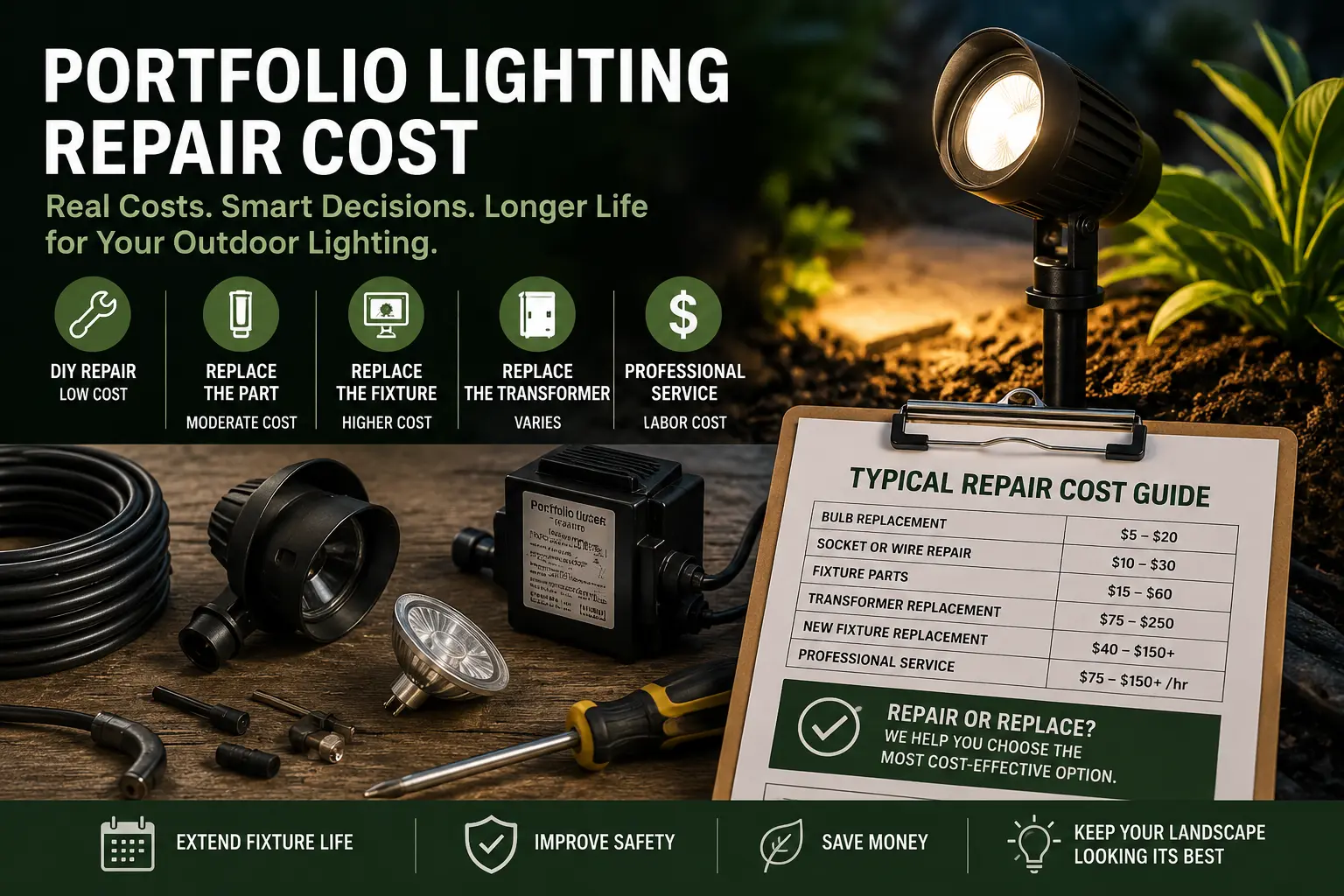
Before you replace a discontinued Portfolio light, price the failure correctly. A dark fixture may need a cheap bulb or connector. An all-lights-out system may need a GFCI reset, timer setup, or transformer. This guide breaks down realistic repair costs by part, failure pattern, system age, and replacement path so you do not spend $300 solving a $12 problem.
Quick Answer: What Does Portfolio Lighting Repair Usually Cost?
The short version: most Portfolio Lighting repairs are inexpensive if you identify the failed part before buying replacements. A single dark fixture is often a bulb, socket, connector, or loose splice. A full system outage is usually the transformer, GFCI outlet, timer, photocell, or terminal connection. The expensive mistakes happen when a homeowner assumes the whole fixture or entire system is bad before testing the cheap failure points.
For discontinued Portfolio landscape lighting, the repair decision is different from buying current retail fixtures. You are not only comparing part cost. You are comparing part availability, compatibility, labor, age of the system, and whether the original fixture is worth preserving. That is why this page treats repair cost as a decision tree instead of a simple price list.
$5–$20Bulbs
$4–$15Connectors
$8–$40Globes
$45–$180Transformers
$25–$90Fixtures
Best rule for Portfolio owners: if the fixture body is still solid and only one thing failed, repair it first. If the housing is cracked, the integrated LED board is dead, or several parts on the same fixture failed together, replacement becomes more realistic.
Portfolio Lighting Repair Cost Table
These ranges are practical planning ranges for older Portfolio landscape and outdoor fixtures. They are not quotes from a contractor. They are meant to help you decide which repair path deserves attention first.
Repair Type
Typical DIY Part Cost
Likely Cause
Repair or Replace?
Bulb replacement
$5–$20 per bulb
Burned out MR16, G4, wedge, E26, or halogen bulb
Repair first. Match base, voltage, wattage, and color temperature.
Low-voltage connector replacement
$4–$15 per connection
Corrosion, loose pierce point, failed quick connector, moisture intrusion
Repair first. This is one of the cheapest high-success fixes.
Repair if the fault location is known; more expensive if finding the break takes time.
Single fixture replacement
$25–$90 common landscape fixture range
Cracked housing, severe corrosion, integrated LED failure
Replace if housing or sealed LED module failed.
Full system refresh
$200–$1,200+ depending on fixture count
Old transformer, many failing connectors, mixed fixture condition
Consider staged replacement instead of replacing everything at once.
Mobile note: scroll sideways to compare all columns. The cards below explain how to use these numbers before ordering parts.
Cost by Symptom: What the Failure Usually Means
Most people do not begin with a part number. They begin with a symptom: one light is out, all lights are dead, the transformer hums, the GFCI trips, or the far lights look dim. That symptom matters because it changes the cost dramatically. A one-light outage is rarely the same repair as a full system outage.
Lowest cost
One fixture is dark but the rest work
Start with the bulb, then the connector, then the socket. Do not buy a new fixture until you test those three points. A dark single fixture commonly costs less than $20 to correct if the housing is still sound. Use the Portfolio Lighting troubleshooting guide before replacing the entire light.
Medium cost
All lights went out at once
This usually points upstream: GFCI, outlet, transformer, timer, photocell, or terminal lugs. Start with the Portfolio transformer master guide. Many systems that look like a dead transformer only need a reset or load correction.
Can get expensive
Lights shut off after 30–90 minutes
This is often transformer overload or thermal protection. The cost may be zero if you reduce load, moderate if you replace bulbs with lower-watt LEDs, or higher if the transformer must be upsized. Check the transformer sizing guide before buying.
Cheap if found early
Lights work sometimes
Intermittent operation is usually a connector, splice, moisture, or temperature-related fault. Replacing random fixtures gets expensive fast. The better path is isolating the pattern with the intermittent landscape lighting guide.
High risk
GFCI trips when lights turn on
Do not ignore this. GFCI trips can point to moisture intrusion, damaged cable, line-voltage issues, or improper outdoor wiring. Start with the GFCI tripping guide. This is one of the cases where hiring a pro may be worth it.
Depends on distance
Far-end lights are dim
This is usually voltage drop, not weak bulbs. The fix may be changing transformer taps, splitting a run, upgrading wire gauge, or reducing load. Use the voltage drop guide and wire gauge guide before replacing fixtures.
Repair vs Replace: The Portfolio-Specific Decision
Portfolio Lighting is different from a current brand with an active support department and a shelf full of matching replacement parts. With discontinued Portfolio fixtures, repair cost is really three questions at once: what failed, can the part still be matched, and will the repaired fixture last long enough to justify the work?
The fixture body is the dividing line. If the metal or plastic housing is solid, the fixture is usually worth saving. Bulbs, connectors, stakes, transformers, photocells, and many globes are replaceable. If the housing has cracked, corroded through, filled with water repeatedly, or uses a sealed LED board that has failed, replacement usually makes more sense.
Repair cost is only one part of the decision. Understanding the actual failure mechanism often prevents replacing perfectly good components. The Portfolio Lighting Failure Database documents the most common failure modes across transformers, connectors, fixtures, bulbs, wiring, globes, photocells, and landscape systems, helping homeowners understand what normally fails first and what usually lasts for many more years.
Fix it
Fix the fixture when the housing is intact and the failure is limited to one replaceable component: bulb, connector, stake, globe, socket, photocell, timer setting, or transformer terminal. This is where Portfolio owners save the most money.
Price both paths
Compare repair and replacement when the fixture is older but still usable, the glass is uncommon, the finish no longer matches, or the transformer is undersized. A staged refresh may beat a full rebuild.
Replace it
Replace when corrosion has opened the housing, water keeps entering the fixture, the integrated LED board has failed with no serviceable socket, or multiple parts have failed on the same light.
Common expensive mistake: replacing a full path light because one connector failed. On a 10-light system, that mistake can turn a $50 connector refresh into a $300 to $700 fixture replacement project.
Repair Cost by Part Type
Bulbs and LED retrofit bulbs
Bulb replacement is the first test on almost every one-fixture-out call. Portfolio landscape fixtures used several bulb formats over the years, including MR16, G4, wedge, and integrated LED designs. A replaceable bulb is almost always worth trying before replacing the fixture. The main mistake is matching by appearance only. Match the base, voltage, wattage limit, beam spread, and color temperature. For landscape systems, the MR16 LED replacement guide and color temperature guide help prevent an ugly mismatched repair.
Connectors, wire taps, and splices
Connectors are the quiet budget killer in older Portfolio systems. They are cheap individually, but a bad connector can make a fixture look dead, dim, or intermittent. Many original pierce-style connectors lose pressure over time, especially after soil movement, moisture exposure, freeze-thaw cycles, or repeated fixture repositioning. If a single fixture is out and a new bulb does not fix it, the connector is the next place to spend money. The landscape lighting connector guide explains how to match connector type and why corrosion inside the bite point causes confusing failures.
Transformers and power packs
Transformer replacement is where homeowners spend too soon. A transformer that appears dead may actually be responding to overload, GFCI trip, timer reset, photocell confusion, or poor terminal contact. A true replacement usually costs more than a bulb or connector, but the good news is compatibility is broad. Portfolio low-voltage fixtures generally do not require a Portfolio-branded transformer. A properly sized 12V AC landscape transformer from another brand can run the system. Before buying, use the Portfolio transformer master guide, transformer sizing guide, and transformer reset guide.
Glass globes, shades, and lenses
Globe cost depends on shape more than brand. Simple round clear or frosted globes can often be replaced by dimension. Decorative, etched, colored, seeded, or unusual Portfolio globes can take longer to source because exact replacements usually come from secondary sellers. Measure the opening diameter, height, lip, and seating style before searching. Do not rely only on the outside diameter. If the fixture body is still sound, a globe replacement is usually worth it. If the gasket is missing or the socket is corroded, price those items too before deciding.
Ground stakes and mounting hardware
A leaning fixture often looks worse than it is. If the stake is broken but the fixture head works, the repair is usually cheap. Measure the socket or mounting stem rather than guessing. Many generic stakes fit older Portfolio path lights, but not every diameter is the same. For indoor fixtures, missing brackets and screws can create a different cost problem because the wrong bracket can leave the fixture loose or unsafe. Use the mounting hardware and bracket replacement guide before improvising.
Wiring and buried cable
Wire repair can be cheap if the damaged section is visible and expensive if the fault is buried somewhere under mulch, soil, edging, or hardscape. Cut cable, nicked insulation, animal damage, and old unsealed splices can all create intermittent failures. This is where diagnosis matters more than part price. A few waterproof splice connectors are inexpensive. Finding the hidden break can take far longer. The Portfolio lighting wire replacement guide, low-voltage failure points guide, and wire gauge guide should be used together before rerunning cable.
DIY vs Electrician: When Labor Changes the Repair Cost
The part price is only part of the repair. The labor decision matters just as much. Low-voltage landscape lighting repairs are often DIY-friendly when you are replacing bulbs, stakes, connectors, or fixtures on the low-voltage side. But anything involving a 120V outlet, GFCI device, hardwired transformer, junction box, grounding, bonding, or unknown wiring should be treated differently.
Hiring a professional is not just about comfort level. It can protect you from diagnosing the wrong side of the system. For example, replacing a transformer will not fix a failing GFCI outlet. Replacing fixtures will not fix an undersized wire run. Replacing bulbs will not fix a moisture fault. A good electrician or lighting installer can sometimes save money by proving what not to replace.
Task
DIY Friendly?
Why
Related Guide
Replace bulb
Usually yes
Low-risk if fixture voltage and bulb base are matched.
Portfolio repair cost is rarely just the first part you buy. The hidden costs come from ordering twice, replacing the wrong part, mismatching light color, damaging old connectors during fixture swaps, or discovering that the original transformer was already overloaded. These are the costs that do not show up in a simple shopping cart.
Wrong globe measurements
A globe that is close but not exact may not seat against the gasket. That creates water entry and a second repair. Measure opening diameter, height, lip, and mounting method.
Mismatched LED color
A cheap LED can make one light look blue-white while the rest stay warm. Check kelvin rating and beam spread before buying a multi-pack.
Transformer under-sizing
Buying the smallest transformer that technically powers the load can lead to thermal shutdown. Keep headroom. The 80% rule matters.
Replacing before diagnosing
The most expensive repair is the unnecessary one. Test bulb, connector, voltage, and transformer before replacing fixtures.
Old wire exposed during repair
Moving fixtures can disturb brittle insulation or corroded splices. Budget for connectors and waterproof splices when working on older systems.
Staged repair savings
You do not always need a full system rebuild. Replacing connectors this month and upgrading the transformer later can be smarter.
Model-Specific Cost Checks Before Buying Parts
Some Portfolio models are cheap to maintain because they use standard bulbs, stakes, connectors, or transformer formats. Others become expensive because the part that failed is tied to a discontinued housing, odd-shaped glass, or integrated LED board. If you have a model number, use it before spending money.
If you cannot find a model number, start with the Portfolio Lighting model number lookup. If the fixture is too old or the label is gone, use fixture shape, transformer label, bulb base, connector style, and measurements to narrow the repair path.
Annual Portfolio Lighting Maintenance Cost Plan
The cheapest system is the one you maintain before it fails. Older Portfolio landscape lighting systems often fail in layers: first a connector gets weak, then one fixture flickers, then a splice gets wet, then the transformer cycles because load changed over time. A small annual maintenance pass can prevent a pile of unrelated emergency repairs.
Repair costs depend heavily on the age and condition of the existing equipment. Before investing in repairs, review our outdoor lighting component life expectancy guide to understand whether your transformer, fixtures, wiring, or other components are approaching the end of their expected lifespan.
Spring
Connector inspection
Open the most exposed connectors, look for green or white corrosion, check wire bite, and reseal weak splices before rain season.
Summer
Aim and trim check
Re-aim fixtures after mulch, plant growth, edging work, or foot traffic. A working fixture can still waste light if aimed wrong.
Fall
Transformer load review
Add up wattage after bulb changes or fixture additions. Staying below about 80% capacity helps prevent thermal shutdown.
As a rule, keep a small repair kit: a few spare bulbs, two or three waterproof connectors, a stake that matches your fixture base, dielectric grease where appropriate, and a printed note showing transformer wattage and wire runs. That small kit often turns a weekend outage into a 15-minute repair.
When Full Replacement Becomes the Cheaper Long-Term Choice
Repair is usually the right first move, but not always. Full replacement starts to make sense when the system is so uneven that every repair exposes another failure. If multiple fixtures have cracked housings, the transformer is outdated, several connectors are corroded, and wire runs are undersized, you may spend more repairing the past than building a reliable next phase.
The better question is not “Can this be repaired?” It is “Will this repair keep the system reliable long enough to justify the cost?” A $12 connector is easy to justify. A rare $55 globe for a badly corroded fixture may not be. A $150 transformer may be worth it if the fixtures are sound. It may not be worth it if half the system also needs replacement.
How much does it cost to repair one Portfolio path light?
If the housing is intact, one path light repair is usually a bulb, connector, stake, globe, or socket issue. The cheapest fixes are usually bulbs and connectors. The cost rises when glass is rare, the socket is corroded, or the fixture has an integrated LED module instead of a replaceable bulb.
Is a Portfolio transformer worth replacing?
Yes, if the existing fixtures and wire runs are still in good condition. Because many Portfolio low-voltage fixtures work with standard 12V AC transformers, you usually do not need an original Portfolio-branded replacement. Size the new transformer correctly and check GFCI protection before buying.
Why did my repair cost more than the part price?
Diagnosis, labor, buried wire access, repeated wrong parts, and secondary failures can all raise the total cost. A cheap connector repair becomes expensive if the actual problem is hidden cable damage or a failing transformer terminal.
Can I repair discontinued Portfolio fixtures?
Many discontinued Portfolio fixtures can be repaired if the failed component is generic or dimension-matched. Bulbs, transformers, connectors, stakes, photocells, and some globes are usually serviceable. Sealed LED modules and unique decorative glass are harder.
What should I check before buying a new fixture?
Check the bulb, connector, transformer output, GFCI, wire condition, and model number first. A fixture should be replaced only after the cheaper failure points are ruled out or the housing itself is damaged.
PortfolioLighting.net is an independent resource and is not affiliated with Portfolio, Lowe's, or any original manufacturer. Repair costs vary by region, fixture condition, part availability, and labor rates. Always disconnect power before inspecting wiring, and hire a licensed electrician for line-voltage work, GFCI issues, hardwired transformers, junction boxes, grounding, or permit-sensitive electrical repairs.