
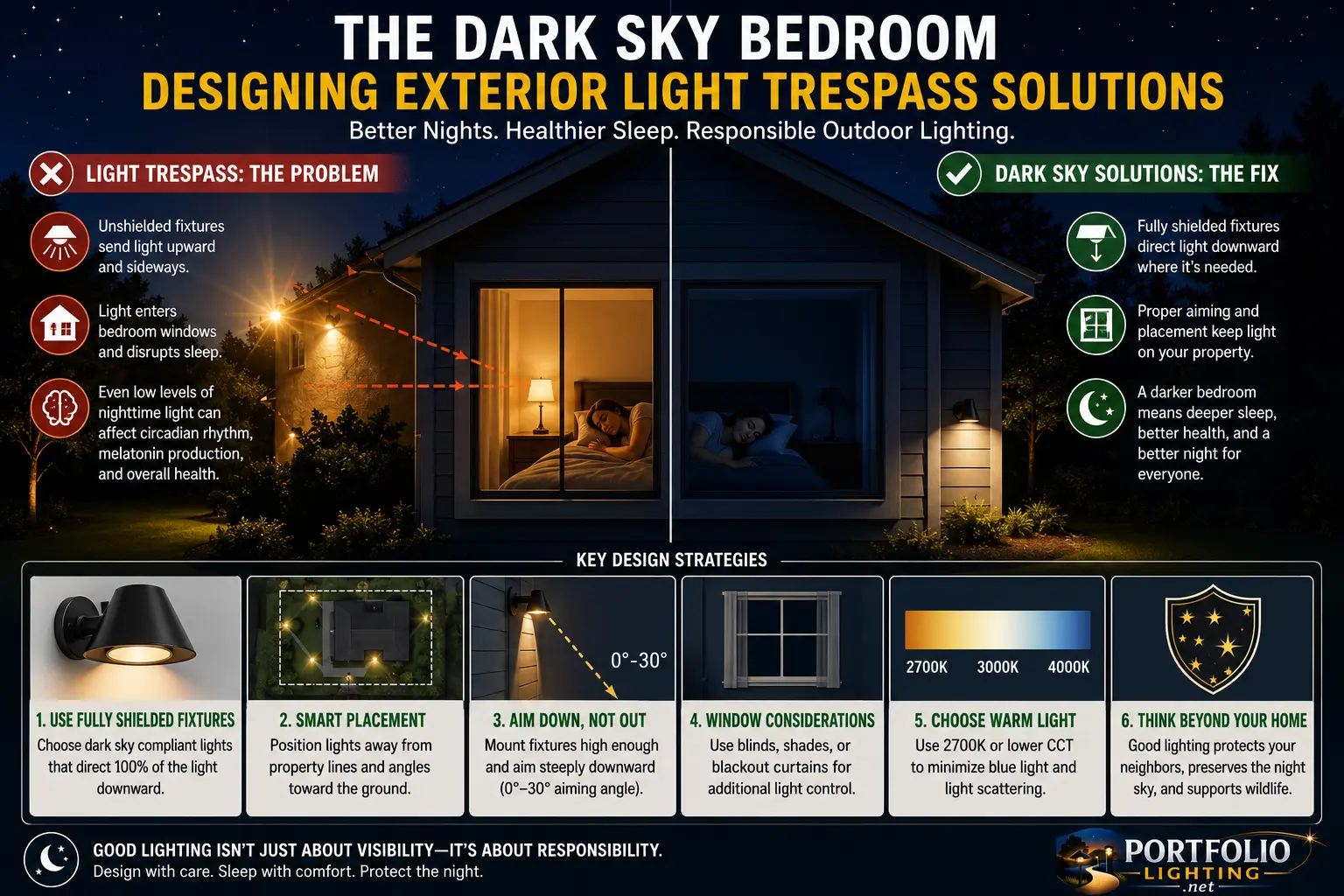
Quick Answer: How to Design a Dark-Sky Bedroom From the Outside
A dark-sky bedroom is created outside the window, not only inside the room. Blackout curtains help, but the stronger fix is to stop exterior light from reaching the glass in the first place. That means shielding fixture optics, lowering beam angle, reducing lumen output, choosing warmer color temperature, setting late-night dimming schedules, and preventing direct view of bright LED sources from the pillow zone.
The goal is not a completely unlit yard. The goal is controlled light placement: enough light for safe walking, security and curb appeal, but not enough upward glare, side spill or window-directed brightness to turn a bedroom into a low-level display case after midnight.
Logic Summary: The Bedroom Is the Real Measuring Point
Most exterior lighting plans measure success from the yard: Is the path visible? Is the wall washed evenly? Does the front elevation look attractive? A dark-sky bedroom flips the logic. The most important observation point is inside the room, at bed height, looking toward the window after dark.
There are three separate problems to diagnose. Direct glare happens when the lamp, LED chip, lens or bright reflector is visible from the bedroom. Spill light happens when light lands on the window, wall, blinds or ceiling even when the source is not directly visible. Reflected brightness happens when light bounces off light-colored siding, concrete, snow, water, fences or neighbor-facing walls and re-enters the room indirectly.
Each problem needs a different solution. Glare needs shielding and aiming. Spill light needs lower output, better beam control and property-line awareness. Reflected brightness needs surface-aware design: fewer high-angle uplights, warmer CCT, lower intensity and scenes that reduce output after sleep hours. This is where dark-sky design becomes more precise than simply “use fewer lights.”
Jump to Section
The Pillow-Zone Light Trespass Test
The easiest way to diagnose a dark-sky bedroom problem is not from the yard. It is from the bed. Turn off the bedroom lights, wait several minutes for your eyes to adapt, then look toward each window from the pillow location. Ask four questions:
- Can I see a visible bulb, LED chip, lens, reflector or glowing fixture face?
- Is one part of the wall, ceiling or blinds brighter than the rest of the room?
- Does the light pulse, trigger, flicker or switch on suddenly during the night?
- Does the room get brighter after rain, snow, irrigation or wet pavement reflection?
If the answer is yes, the bedroom has an exterior light trespass pathway. For property-line measurement and enforcement context, use the light trespass laws and property-line foot-candle guide. For dark-sky fixture selection, compare the dark-sky compliance versus IDA certification guide and dark-sky-friendly fixture selection guide.
The Three Light Paths That Ruin a Bedroom
1. Direct View of the Light Source
This is the most disruptive path. A small LED viewed directly through a window can feel brighter than a larger amount of shielded light on the ground. The human eye reacts strongly to point-source glare because the contrast against a dark room is extreme. A fixture can be low wattage and still be a bedroom problem if the diode is exposed.
2. Window Spill and Blind Glow
Sometimes the source is not visible, but the window covering glows. That means exterior light is landing on the glass, blinds or curtains. This often happens with wall packs, floodlights, tree uplights and poorly aimed path lights placed across from bedroom windows.
3. Reflected Outdoor Brightness
Light bouncing from pale stone, white siding, vinyl fences, wet concrete, snow or pool surfaces can raise bedroom brightness without a direct beam. Designers often miss this because they aim fixtures correctly in dry conditions, then the bedroom becomes bright after rain or snow.
Bedroom Light Trespass Risk by Fixture Type
| Fixture Type | Bedroom Risk | Why It Happens | Best Correction |
|---|---|---|---|
| Unshielded floodlight | Very high | Wide beam and visible LED source can hit windows directly | Replace with shielded, lower-output, downward-aimed fixture |
| Motion security light | High | Sudden activation wakes sleepers even if average brightness is low | Shorten duration, lower sensitivity and aim below window height |
| Tree uplight | Moderate to high | Beam overshoots canopy or reflects from branches toward glass | Use tighter beam, lower wattage and glare shield |
| Path light | Low to moderate | Problem occurs when lens is visible from bedroom or fixture is overpowered | Use capped path lights and reduce lumen output |
| Wall lantern | Moderate | Clear glass and bare lamp create viewable brightness | Use frosted, shielded or fully cut-off design |
| RGB decorative lighting | Variable | Blue and cool colors can feel more visually disruptive at night | Use warm late-night scenes and automatic dimming |
Color Temperature: Why Cool White Is Usually the Wrong Bedroom-Side Choice
Cool white exterior lighting often looks crisp from the driveway, but it is usually harsher from inside a bedroom. Blue-heavy light scatters more, feels sharper through blinds, and creates a stronger night-alerting impression than warm light at the same apparent brightness. Bedroom-facing exterior zones should usually use warmer sources than task-heavy areas.
For sensitive bedroom exposures, 2200K to 2700K is often more comfortable than 3000K to 5000K. Amber, warm white and dimmed warm scenes are better choices for late-night path lighting, patio edges and architectural accents near bedroom windows. Use the landscape lighting color temperature guide, biological impact of outdoor light color, and outdoor lighting and human health guide for supporting context.
Neighbor Light Trespass: How to Separate Annoyance From a Fixable Design Problem
Neighbor-facing bedroom light trespass is often emotional because the affected person cannot control the fixture. The best response is to document the pattern instead of starting with blame. Note the time, direction, fixture type, whether it is constant or motion-triggered, and whether the light shines directly into the bedroom or reflects off a surface.
Many neighbor problems can be solved with small physical changes: add a shield, lower the aim, change to a warmer lamp, reduce lumen output, shorten motion duration, or set a timer after bedtime. If the issue is property-line spill, the fix light trespass guide, outdoor lighting ordinance guide, and property-line foot-candle guide are the most useful next reads.
Smart Control Schedule for a Dark-Sky Bedroom
Smart controls are most useful when they reduce light at the exact time bedrooms become sensitive. A good system does not run the same brightness from dusk to dawn. It uses phases.
For automation logic, connect this page to dark-sky AI automation, circadian outdoor lighting, AI security ambient lighting, and smart hub compatibility.
Landscape Lighting Adjustments That Protect Bedroom Darkness
Landscape lighting is usually easier to fix than wall-mounted security lighting because the fixture position, stake angle, beam spread and output can often be adjusted. Start by lowering the fixture aim. Then add glare shields or cowls. Then reduce lamp output. Then change color temperature. Only after those steps should you consider removing the fixture.
Pay special attention to path lights outside bedroom windows. A capped path light should put light downward, but cheap or deteriorated lenses can leak sideways. Foggy lenses can also scatter light unpredictably. If Portfolio fixtures are cloudy, wet inside or glowing unevenly, use the Portfolio foggy lens condensation fix guide before assuming the layout is the only problem.
For layout-level help, see landscape lighting layout design, path light placement, tree uplighting guide, and backyard landscape lighting design.
Bedroom Window Lighting Audit: The 15-Minute Walkthrough
- Turn on all exterior lights exactly as they normally run at bedtime.
- Stand at the bed and photograph the window without flash.
- Walk outside and identify every fixture visible from that window.
- Temporarily cover or switch off one fixture at a time.
- Return to the bedroom after each change and note which fixture changes the room most.
- Mark each fixture as direct glare, spill light or reflected brightness.
- Apply the least aggressive correction first: aim, shield, dim, warm, schedule, relocate.
This audit prevents overcorrection. Many homeowners remove too much lighting because they do not know which fixture is causing the bedroom problem. In most cases, one or two unshielded sources cause most of the discomfort.
Dark-Sky Bedroom Solution Table
| Bedroom Symptom | Likely Outdoor Cause | Best First Fix | Stronger Fix |
|---|---|---|---|
| Visible bright dot through window | Direct LED or bare lamp glare | Add shield or rotate fixture | Replace with fully shielded fixture |
| Blinds glow evenly | Light landing on window surface | Lower beam angle and output | Move fixture away from window axis |
| Room brightens after rain | Wet pavement or siding reflection | Reduce high-angle light and warm CCT | Change beam spread and fixture location |
| Sudden wake-up flashes | Motion security light activation | Shorten duration and reduce sensitivity | Use shielded lower-output security fixture |
| Blue/cool glow through curtains | Cool white or RGB scene near bedroom | Use warmer late-night scene | Schedule decorative zones off after bedtime |
| Neighbor’s light shines in | Unshielded fixture across property line | Document direction and timing | Use ordinance/foot-candle guidance for discussion |
Dark-Sky Bedroom FAQ
What is a dark-sky bedroom?
A dark-sky bedroom is a sleeping room protected from outdoor light trespass, glare, window spill, bright security lights, poorly aimed landscape fixtures and blue-heavy nighttime light.
How do outdoor lights affect bedrooms?
Outdoor lights affect bedrooms when light reaches the pillow zone, reflects from walls or ceilings, shines through blinds, creates glare on glass, or raises nighttime brightness enough to disrupt sleep conditions.
What is the best outdoor lighting fix for bedroom light trespass?
The best fix is usually fixture shielding and aiming, not simply using a lower wattage. The goal is to place light on the ground or target surface while keeping direct view of the LED source away from bedroom windows.
Should I use warmer color temperature outside bedrooms?
Yes. Warmer outdoor lighting, usually in the 2200K to 2700K range for sensitive zones, is generally more bedroom-friendly than cool white or blue-heavy lighting.
Can smart controls help create a dark-sky bedroom?
Yes. Smart controls can dim exterior lights after bedtime, create late-night low-output scenes, shorten motion-light run times and turn off decorative lighting zones that face bedrooms.
Expert-Verified Lighting Guidance
This guide focuses on practical outdoor lighting design, glare reduction, light trespass control and bedroom comfort. Local ordinances, HOA rules and fixture listings may impose additional requirements.