
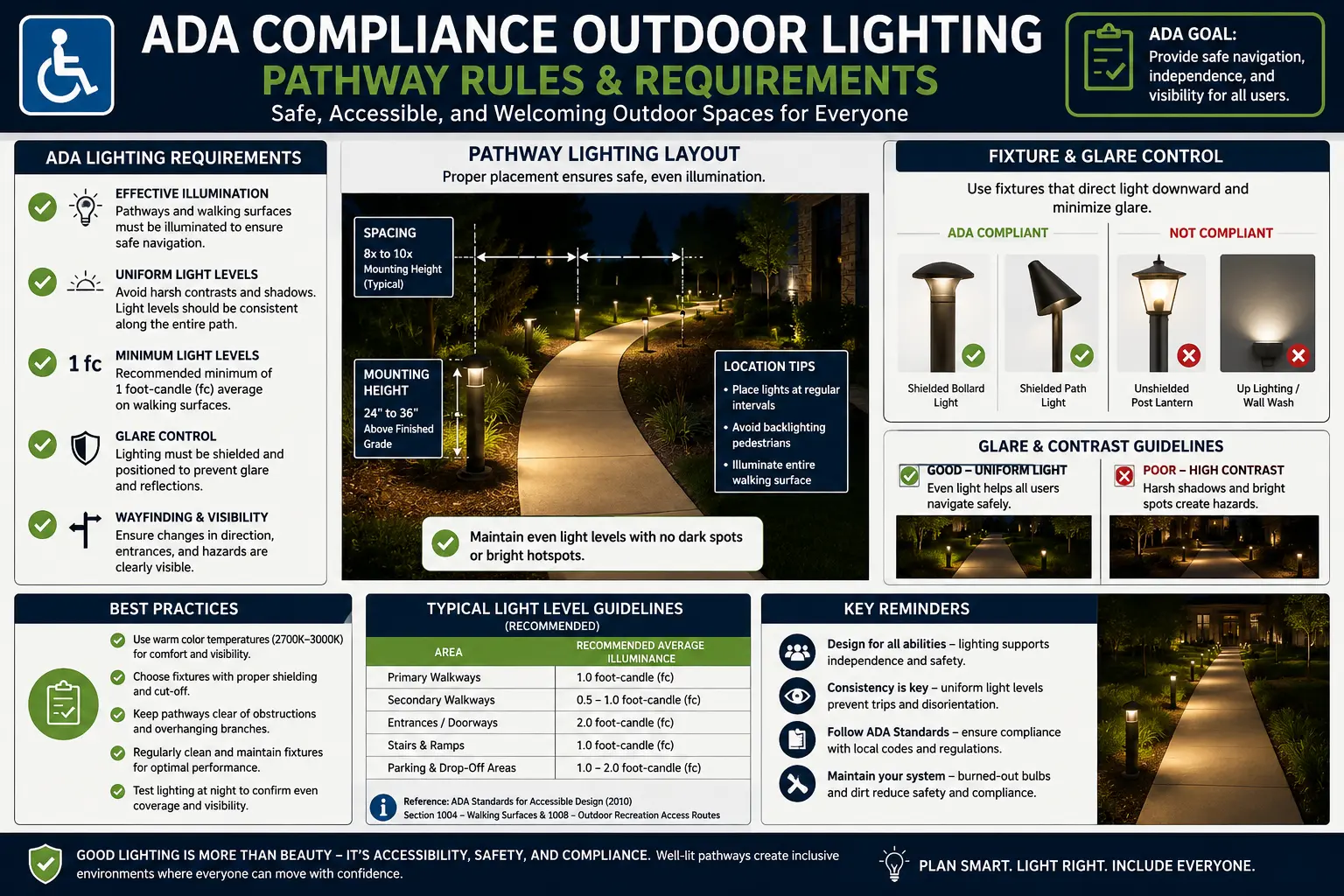
What the ADA Does NOT Require for Outdoor Lighting: The Myth of the ADA Foot-Candle Rule
Before any discussion of what the ADA does require, it is essential to correct the most prevalent misinformation in this topic area: the widespread claim that the ADA mandates specific foot-candle or lux levels for outdoor accessible route pathways. It does not.
The ADA Is a Civil Rights Law, Not a Lighting Standard
The Americans with Disabilities Act (ADA) and its implementing standards — the 2010 ADA Standards for Accessible Design, published by the U.S. Department of Justice — are fundamentally a civil rights framework. The Standards focus on physical design elements that determine whether a person with a disability can access, enter, and use a facility: path width, slope, surface texture, reach ranges, protruding objects, door hardware, signage, and similar design features. Lighting level is conspicuously absent from the outdoor accessible route requirements in the 2010 Standards.
What the ADA's 2010 Standards Actually Specify About Illumination
The 2010 ADA Standards reference illumination in two narrow, specific contexts:
- Elevator car illumination (Section 407.4.5): "The level of illumination at the car controls, platform, car threshold and car landing sill shall be 5 foot-candles (54 lux) minimum." This applies to elevator interiors — an enclosed indoor space with a specific task. It has no application to outdoor pathways.
- Private residence elevator illumination (Section 409.4.5): Similar 5 foot-candle minimum for private residence elevators.
That is the complete universe of ADA-specified illuminance requirements. No foot-candle minimums for outdoor accessible routes. No lux requirements for parking areas. No lighting uniformity ratios for pathways. The 2010 Standards are entirely silent on outdoor illuminance levels.
Many commercial lighting guides and ADA compliance resources conflate the ADA with the International Building Code (IBC), local building codes, and IES professional standards — all of which DO specify lighting levels for various outdoor contexts. When a building inspector cites "ADA lighting requirements" for a foot-candle level, they are typically citing the IBC or local code, not the ADA Standards themselves. The confusion is understandable but creates a false impression about what is specifically an ADA mandate vs a building code or industry standard requirement. This distinction matters because the enforcement mechanisms, penalties, and compliance timelines differ significantly between an ADA civil rights complaint and a building code citation.
The Correct Source for Outdoor Pathway Illuminance Requirements
Minimum illuminance for outdoor pathways comes from three different sources — none of which is the ADA:
- International Building Code (IBC) Section 1006.2: Means of egress illumination — 1 foot-candle minimum at floor level for all egress paths. This is an enforceable mandatory code requirement where the IBC is adopted.
- Local building codes: State, county, and municipal codes may specify illuminance levels for parking areas, pedestrian paths, and site lighting — varying by jurisdiction.
- IES RP-33 (Recommended Practice: Lighting for Exterior Environments): The professional standard for outdoor pathway illumination — not mandatory code, but the design target used by lighting professionals and often referenced by courts and insurers in premises liability cases.
Who Must Comply: ADA Scope for Outdoor Lighting and Pathways
Before applying ADA standards to any outdoor lighting project, the first question is whether the ADA applies at all. The answer depends on the property type, the title of the ADA governing the facility, and whether the construction is new or an alteration to existing conditions.
The Two ADA Titles That Govern Built Environments
ADA Title II applies to State and local government facilities — public buildings, parks, schools, government offices, public transportation facilities, and similar state and municipal properties. All areas accessible to the public in Title II facilities must comply with the 2010 ADA Standards for Accessible Design.
ADA Title III applies to places of public accommodation and commercial facilities — hotels, restaurants, retail stores, offices, medical facilities, theaters, museums, private schools, and similar businesses open to the public. New construction and alterations to Title III facilities must comply with the 2010 Standards. Existing facilities (built before January 26, 1993, or altered before the standards applied) have a general obligation to remove barriers when "readily achievable" — though this applies to physical access barriers, not typically lighting levels.
What Is NOT Subject to ADA Titles II or III
- Private residences: Standard single-family homes, apartments, and condominiums are not subject to ADA Titles II or III. Landscape lighting at a private home is not an ADA compliance matter.
- Multi-family housing: Covered by the Fair Housing Act (FHA) for properties with 4+ units built after March 13, 1991 — different law with different requirements.
- Private clubs: Properties not open to the public may not be subject to Title III.
When Does ADA Apply to Outdoor Lighting at a Commercial Property?
ADA compliance applies to the outdoor elements of a commercial or public facility where those elements are part of the accessible route connecting public transportation, parking, building entrances, and accessible amenities. Specifically:
- Site arrival points to accessible building entrances (Section 206.2.1): At least one accessible route must connect accessible parking spaces, loading zones, public sidewalks, and transit stops to the accessible building entrance.
- Between accessible buildings and elements on the same site (Section 206.2.2): Accessible routes must connect all accessible buildings, facilities, and spaces.
- Outdoor dining areas, recreation facilities, parking, and amenities that are part of the facility.
Any lighting fixture — path light, bollard, wall sconce, or overhead fixture — installed along or adjacent to these required accessible routes is subject to the ADA's Section 307 protruding object requirements. This is where outdoor lighting meets federal compliance law.
ADA Section 307: The Real Fixture Placement Law for Outdoor Lighting
Section 307 of the 2010 ADA Standards — Protruding Objects — is the provision that directly and specifically governs how lighting fixtures must be positioned along accessible routes. This section applies to all circulation paths, not just accessible routes, making its reach even broader than accessible route requirements alone.
Why Protruding Object Rules Exist: The Vision Impairment Safety Rationale
The protruding object requirements protect people with visual impairments who use white canes for navigation. A person traveling along a wall or path using a cane sweeps the cane in an arc ahead of them at approximately ground level — detecting obstacles before body contact. Objects that protrude at chest or head height — outside the cane's sweep zone — are invisible to the cane and can cause head strikes or body contact injuries. The ADA Section 307 rules create a physical design system that ensures any object protruding into a circulation path is either low enough to be detected by a cane sweep (at or below 27 inches) or high enough to clear the head of any pedestrian (at or above 80 inches).
307.2 Protrusion Limits: "Objects with leading edges more than 27 inches (685 mm) and not more than 80 inches (2030 mm) above the finish floor or ground shall protrude 4 inches (100 mm) maximum horizontally into the circulation path."
307.3 Post-Mounted Objects: "Free-standing objects mounted on posts or pylons shall overhang circulation paths 12 inches (305 mm) maximum when located 27 inches (685 mm) minimum and 80 inches (2030 mm) maximum above the finish floor or ground."
307.4 Vertical Clearance: "Vertical clearance shall be 80 inches (2030 mm) high minimum. Guardrails or other barriers shall be provided where the vertical clearance is less than 80 inches (2030 mm) high. The leading edge of such guardrail or barrier shall be located 27 inches (685 mm) maximum above the finish floor or ground."
307.5 Required Clear Width: "Protruding objects shall not reduce the clear width required for accessible routes."
Scope (Section 204.1): "Protruding objects on circulation paths shall comply with 307." — Circulation paths include all interior and exterior walks, paths, hallways, courtyards, ramps, stairways, and landings. Not limited to designated "accessible routes."
The Critical Definition: What Is the "Leading Edge" of a Lighting Fixture?
The "leading edge" is the outermost point of the object at its lowest height — the point that a person's body or a cane would first contact when approaching along the path. For a wall-mounted sconce, the leading edge is the front face of the fixture body at its lowest point. For a post-mounted bollard, the leading edge is the outer circumference of the fixture head at its lowest point. For a pendant fixture hanging from a bracket, the leading edge is the lowest point of the fixture. The measurement to the circulation path is taken horizontally from the circulation path's edge to this leading edge point.
Accessible pathway design and emergency egress planning often share the same objective: helping occupants move safely through a space under a wide range of conditions. While ADA guidance focuses on accessibility and usability, emergency lighting standards focus on maintaining visibility during power interruptions and emergency events. For a deeper look at evacuation-route illumination and backup lighting requirements, see our emergency backup lighting and egress pathway guide.
The Three Height Zones That Determine Every Lighting Fixture Decision
ADA Section 307 creates three distinct height zones above the walking surface, each with different protrusion rules. Understanding which zone a fixture's components occupy is the single most important factor in ADA-compliant outdoor lighting fixture placement.
Wall-mounted fixtures (Section 307.2): Any lighting fixture, sconce, wall pack, or wall bracket mounted on a wall, column, or partition with its leading edge between 27 and 80 inches above grade can only protrude 4 inches maximum into the circulation path. This is a very tight limit — many standard wall packs and decorative sconces protrude 6–10 inches and are not ADA compliant at this height.
Post-mounted or pylon-mounted objects (Section 307.3): A free-standing object mounted on a post or pylon (like a bollard head or post-top luminaire) with its leading edge in the 27-to-80-inch range can protrude 12 inches maximum into the circulation path. A typical 24-inch bollard light sits mostly below this range — but if the luminaire head rises above 27 inches and overhangs the path, the 12-inch limit applies.
How Section 307 Applies to Specific Landscape Lighting Fixture Types
Translating the abstract height zones and protrusion limits into practical fixture-by-fixture compliance guidance requires understanding how each common outdoor landscape lighting type interacts with the three zones.
A typical landscape path light on a 12–24 inch stake sits entirely within or near the cane-detection zone. The cane will contact the stake before body contact with the fixture head. Key considerations: (1) The fixture body that rises above 27 inches (some 24-inch stakes with tall heads may have the luminaire at 28–32 inches) enters the danger zone at that height — any overhang of the luminaire head beyond 12 inches into the path creates a post-mounted object violation at that height. (2) The stake and fixture base must not reduce the accessible route's 36-inch clear width. Positioning stakes at the path edge rather than in the middle of the path prevents clear width violations. Low path lights are the most ADA-friendly fixture type for outdoor landscape use.
A 36-inch bollard light sits with its body and luminaire head squarely in the danger zone (27–80 inches). ADA compliance depends entirely on whether the bollard is within the circulation path or at its edge: (1) Bollards positioned completely outside the accessible route clear width are compliant — they are not in the circulation path at all. (2) Bollards positioned within the path must have their luminaire body not protruding more than 12 inches into the path (post-mounted object, Section 307.3). A round bollard body protruding 10 inches into the path at 36 inches height is likely compliant. A 16-inch-wide bollard head centered at the path edge and overhanging 14 inches into the path is not. (3) The bollard base cannot reduce the accessible route clear width below 36 inches.
Wall-mounted fixtures in the 36–60 inch height range (nearly universal for outdoor wall sconces and wall packs) are squarely in the danger zone with the most restrictive protrusion rule: 4 inches maximum from the wall surface. Most standard outdoor wall packs protrude 6–12 inches. A 7-inch-deep wall sconce at 48 inches height violates Section 307.2 on any accessible circulation path, including building perimeters, covered walkways, and parking structure walls. Solutions: (1) Use specifically designed ADA-compliant wall packs that protrude 4 inches or less. (2) Mount sconces at or above 80 inches where no protrusion limit applies. (3) Ensure wall sconces are positioned where they are not adjacent to the accessible route clear width — a sconce on a wall 6 feet from the path edge is not in the circulation path.
In-grade recessed well lights flush with or slightly below the walking surface have no protruding object issue — they are at grade level and cannot protrude into the circulation path. However, they introduce a different ADA concern: walking surface integrity. ADA Section 402.1 requires accessible route surfaces to be "stable, firm, and slip-resistant." An in-grade fixture with a smooth glass or metal lens face that becomes slippery when wet may not satisfy the slip-resistant requirement. Additionally, any raised rim, lip, or edge of the fixture that projects above the walking surface more than 1/4 inch must have beveled edges per ADA Section 303's change-in-level requirements. For accessible routes, flush-mount or near-flush-mount in-grade fixtures with slip-resistant covers are the safest choice.
Overhead pendant fixtures or decorative lanterns hanging from bracket arms over a walkway must maintain 80 inches minimum clearance from grade to the lowest part of the fixture (Section 307.4). If the fixture or bracket arm drops below 80 inches, a cane-detectable barrier with its top at 27 inches or below must be provided beneath it to make the obstruction detectable. In practice: decorative pendant fixtures on patio or porte-cochere structures must be mounted higher than most designers assume — 80 inches is approximately 6 feet 8 inches, which is higher than standard interior doorframe height. Outdoor bracket arms that slope downward can easily violate this clearance without the designer realizing it.
LED step lights recessed into the riser face (vertical surface of a stair step) protrude at or below 27 inches at the bottom of the fixture and typically don't create Section 307 violations. ADA has specific requirements for exterior stairs (Section 504): stair treads must be 11 inches deep minimum, risers 4–7 inches, treads slip-resistant, and nosings must meet specific requirements. Step lighting that is flush-recessed in the riser face complies with these requirements. A projecting surface-mounted step light that creates a protrusion hazard at the stair nosing level could affect stair tread depth compliance. Recessed riser-face step lights are the ADA-compatible choice for stair lighting. See the landscape lighting design guide for step light placement principles.
The most common ADA protruding object violation I encounter in commercial landscape lighting is the 4-inch wall protrusion rule applied to decorative outdoor wall sconces along accessible building perimeters. A designer will specify a beautiful 8-inch-deep coastal style lantern at 48 inches mounting height — perfect aesthetically, and a clean Section 307.2 violation the moment it's adjacent to the accessible route. The fix is either: choose a wall pack specifically advertised as "ADA compliant" (typically 4 inches or less projection), mount the sconce above 80 inches (where no protrusion limit applies), or set it back far enough from the accessible route that it's not in the circulation path. Understanding these options before specification saves redesign costs.
Sections 206 and 402: Accessible Route Requirements That Affect Lighting Design
Beyond the protruding object rules, two other ADA provisions affect how outdoor lighting infrastructure is positioned and what it may or may not obstruct.
Section 206: Where Accessible Routes Are Required
ADA Section 206.2.1 requires that at least one accessible route connect all site arrival points (accessible parking, public sidewalks, transit stops) to the accessible building entrance. Section 206.2.2 requires accessible routes between all accessible buildings, facilities, spaces, and elements on the site. These route requirements define where the accessible route must be — and therefore where the Section 307 protruding object rules apply.
For landscape lighting design at commercial properties, the implication is clear: every light fixture installed along any required accessible route is subject to Section 307. The accessible route is typically the primary pedestrian path — the main walkway from the parking area to the building entrance, the perimeter path connecting entries, and the paths to outdoor amenities. Any lighting along these routes must comply with the protrusion limits.
Section 402: Walking Surface Requirements — Why Fixture Placement Matters for Surface Integrity
"Floor or ground surfaces shall comply with 402. Changes in level are permitted to comply with 303. Slopes are permitted to comply with 403.3."
The relevant sub-requirements: Ground surfaces must be stable, firm, and slip-resistant. Cross slopes may not exceed 1:48. Running slope along accessible routes may not exceed 1:20 (without becoming a ramp with handrail requirements).
Lighting design implications: Conduit runs, fixture bases, and stakes that are buried or embedded in the walking surface must not create raised edges or lips that cause changes in level above 1/4 inch vertical (which requires beveled edge treatment per Section 303). An improperly installed in-ground fixture rim protruding above grade creates a tripping hazard and an ADA change-in-level violation simultaneously.
Section 403.5.1: Minimum 36-Inch Clear Width
ADA Section 403.5.1 specifies that accessible routes must have a clear width of 36 inches minimum (which may narrow to 32 inches maximum for distances not exceeding 24 inches — for example, at a doorway). This 36-inch minimum applies to the entire length of the accessible route. Landscape lighting fixtures, conduit runs at grade level, fixture stakes, and junction boxes installed adjacent to or within the accessible route cannot reduce this clear width below 36 inches. A bollard fixture stake centered 12 inches from the path edge that the fixture body overhangs 18 inches into the 36-inch path effectively narrows usable width — a potential violation requiring fixture relocation.
IBC and IES: Where Actual Illuminance Requirements Come From
With the ADA silent on foot-candle levels for outdoor pathways, where do minimum and recommended lighting levels actually come from? Two separate and different standards authorities fill this gap — with meaningfully different legal status and enforcement mechanisms.
The ADA Standards specify no foot-candle levels for outdoor accessible route pathways. The ADA's lighting-adjacent provisions are: protruding object protrusion limits (Section 307) and elevator car illumination (Section 407.4.5 — 5 fc minimum, interior only). Outdoor pathway lighting levels are not mentioned. ADA violations for lighting relate to fixture placement and physical access, not luminance or illuminance levels.
IBC Section 1006.2 requires that all means of egress be illuminated at not less than 1 foot-candle measured at the walking surface when the building is occupied. This applies to exterior exit discharge paths — the accessible route from an exit door to the public way. The 1 fc minimum is a legally enforceable code requirement where the IBC is adopted. It aligns with safe navigation illuminance for low-vision users and provides the closest code equivalent to an outdoor accessible route lighting requirement, though the IBC is an occupancy/safety code, not an accessibility code.
IES RP-33 (Recommended Practice: Lighting for Exterior Environments) is the professional standard used by lighting designers and engineers. It is not mandatory code but is frequently referenced in premises liability litigation ("industry standard of care"). For pedestrian walkways: 0.5–1.0 fc average for low-activity areas, 1.0–2.0 fc for moderate activity. Minimum points should not fall below 0.1–0.5 fc. Uniformity ratio should not exceed 4:1 (average to minimum). High-traffic areas, stairs, and ramps should receive 2.0–5.0 fc average.
Recommended Illuminance Levels by Location Type
| Outdoor Location | IES RP-33 Average (fc) | IES Minimum (fc) | IBC Requirement | ADA Requirement | Best Practice Target |
|---|---|---|---|---|---|
| Pedestrian pathway (low activity) | 0.5–1.0 fc | 0.1 fc | 1.0 fc if egress path | None | 1.0 fc average; 0.25 fc minimum |
| Pedestrian pathway (moderate activity) | 1.0–2.0 fc | 0.25 fc | 1.0 fc if egress path | None | 2.0 fc average; 0.5 fc minimum |
| Entrance areas, lobby approaches | 2.0–5.0 fc | 0.5 fc | 1.0 fc if egress path | None | 3.0–5.0 fc; uniformity 3:1 max |
| Stairs and ramps on accessible route | 2.0–5.0 fc | 0.5 fc | 1.0 fc minimum | None (but sufficient for safe navigation) | 3.0 fc average; prominent tread edge lighting |
| Accessible parking spaces | 1.0–2.0 fc | 0.2 fc | Varies by local code | None | 2.0 fc average; consistent uniformity |
| Parking lot general area | 0.2–1.0 fc | 0.2 fc | Varies by local code | None | 0.5 fc average minimum; 4:1 uniformity ratio |
Why the IES Standard Matters Even Though It's Not Code
In premises liability litigation — when a person trips or falls on a commercial property and sues — the plaintiff's expert typically cites IES recommended practice as the "industry standard of care." A property with illuminance levels significantly below IES recommendations is at elevated liability risk, even if it technically meets the IBC's 1 fc minimum. Insurance underwriters increasingly use IES standards as benchmarks for property risk assessment. A landscape lighting system that meets the IBC minimum of 1 fc but has 8:1 uniformity ratios (very bright near fixtures, very dark between them) creates shadow zones that are both a safety hazard and a potential liability concern. See the commercial lighting upgrade and safety ROI guide and the senior safety lighting guide for the practical design principles that satisfy both IES standards and safety goals.
ADA Accessible Route Outdoor Lighting Compliance Checklist
Use this checklist to evaluate outdoor lighting on any commercial, institutional, or public property with accessible routes. All items are based on 2010 ADA Standards unless otherwise noted.
| Compliance Item | ADA Section | Requirement | Common Violation |
|---|---|---|---|
| Wall-mounted fixtures on accessible route perimeter | 307.2 | Leading edge 27–80 inches: max 4 inches protrusion into path | Standard outdoor wall packs projecting 6–12 inches at 36–60 inch height |
| Post-mounted bollard lights along accessible route | 307.3 | Leading edge 27–80 inches: max 12 inches overhang into path | Bollard luminaire heads overhanging more than 12 inches into the path |
| Overhead clearance on accessible route | 307.4 | 80 inches minimum vertical clearance throughout | Decorative pendant fixtures, bracket arms, or overhead canopy lights hanging below 80 inches |
| Low barrier requirement where clearance below 80 inches | 307.4 | If any overhead element below 80 inches: barrier with top at 27 inches max to make it cane-detectable | Low-hanging overhangs or fixtures with no cane-detectable barrier below them |
| Accessible route clear width — fixture bases and stakes | 307.5, 403.5.1 | Protruding objects cannot reduce clear width below 36 inches (32 inches maximum at points) | Fixture stakes, junction boxes, or conduit runs within the 36-inch clear width zone |
| In-grade fixture surface flush with walking surface | 303, 402.1 | Changes in level: 1/4 inch max vertical; 1/4–1/2 inch beveled; slip-resistant surface | Raised fixture rims above grade; smooth non-slip-resistant fixture lens faces in wet locations |
| Egress path illuminance (IBC, not ADA) | IBC 1006.2 | 1 foot-candle minimum at walking surface for means of egress | Dark spots between fixtures below 1 fc on paths from exit doors to public way |
| Uniformity ratio (IES RP-33, professional standard) | IES RP-33 | Maximum 4:1 average to minimum ratio for pedestrian pathways | Widely spaced high-output fixtures creating bright spots and dark voids |
| Glare control (ADA advisory; IES standard) | ADA advisory; IES | Lighting should not cause disabling glare; low-vision users cannot navigate past glare sources | Exposed high-intensity light sources aimed horizontally along accessible routes |
The Most Efficient ADA-Compliant Landscape Lighting Strategy for Commercial Properties: Position all decorative and architectural wall fixtures above 80 inches from grade — no protrusion limit applies at that height. Use bollard lights at the path edge only, confirming their maximum width doesn't push them more than 12 inches into the path. Use in-grade or low-stake path lights (under 27 inches) for pathway illumination — no protrusion restriction applies, and they deliver illuminance directly at the walking surface. Ensure egress paths meet the IBC's 1 fc minimum with photometric calculations. Document the photometric design for liability protection. This approach satisfies the ADA, IBC, and IES requirements simultaneously with minimal design constraint.
Outdoor pathways leading to patios and fire pit gathering areas need enough illumination for safe navigation without placing fixtures too close to hot surfaces or gas components. This fire pit landscape lighting clearance guide explains practical spacing ideas that can improve both outdoor safety and long-term lighting reliability around entertainment spaces.
ADA Outdoor Lighting Compliance FAQ
Does the ADA specify minimum foot-candle levels for outdoor pathways?
No — the 2010 ADA Standards for Accessible Design do not specify minimum illuminance (foot-candle or lux) levels for outdoor accessible-route pathways. The ADA's only specified illuminance requirement is 5 foot-candles for elevator car interiors (Section 407.4.5). For outdoor pathways, minimum illuminance comes from the IBC (1 foot-candle for egress paths) and IES professional standards (0.5–2.0 foot-candles for pedestrian walkways). Many online resources incorrectly attribute specific foot-candle requirements to the ADA — these requirements come from other authorities.
My commercial property has wall sconces at 48 inches height that protrude 8 inches from the wall. Is this an ADA violation?
It depends on whether the sconces are adjacent to a circulation path. ADA Section 307.2 requires that objects with leading edges between 27 and 80 inches above grade protrude no more than 4 inches horizontally into a circulation path. An 8-inch protrusion at 48 inches height on a wall adjacent to any walkway, corridor, or path (not just designated "accessible routes") is a Section 307.2 violation. The fix options are: (1) Replace with fixtures that protrude 4 inches or less. (2) Remount fixtures at or above 80 inches height, where no protrusion limit applies. (3) Relocate the circulation path so the sconce is not adjacent to it. Non-compliance can result in federal civil rights complaints, DOJ enforcement, and private lawsuit liability. For commercial properties, ADA compliance assessment should be performed by a licensed accessibility consultant.
How far off the path must a bollard light be positioned to avoid ADA protrusion issues?
A bollard light positioned entirely outside the accessible route's 36-inch clear width has no protrusion issue — it is not in the circulation path. The ADA protrusion limits apply to objects protruding INTO the circulation path, not to objects positioned alongside it. For a 36-inch-wide accessible route, positioning a bollard so its nearest face is at or beyond the 36-inch edge of the path (measured from the opposite edge) places it outside the path entirely. In practice, most accessible routes are wider than the 36-inch minimum — the actual path to protect is defined by the circulation path boundaries, not just the minimum required width. For paths adjacent to walls, measure from the wall face to the opposite edge to determine the clear width, then position bollards outside that measured width. The bollard's stake base must also not narrow the clear width below 36 inches.
Do landscape path lights count as "protruding objects" under ADA Section 307?
Only if they have components that protrude into the circulation path in the 27-to-80-inch height range. A standard 18-inch path light stake with a 6-inch-diameter mushroom cap sits entirely below 27 inches — no Section 307 restriction applies, because it's in the cane-detection zone. A 30-inch path light with a 10-inch-wide shade whose bottom edge is at 28 inches height is technically in the danger zone, but a post-mounted object in this zone can overhang up to 12 inches — and a 10-inch shade would likely comply. The practical answer: most standard 18–24 inch landscape path lights on stakes pose no Section 307 issue if positioned at the path edge rather than within the path. Taller path lights (30–36 inches) with wide shade designs require measurement verification. See the path light placement guide for spacing and positioning principles that apply to both aesthetic and accessibility goals.
Does ADA apply to outdoor lighting at multi-family apartment complexes?
Standard residential apartment complexes are not subject to ADA Titles II or III — they are covered instead by the Fair Housing Act (FHA) for properties with 4 or more units built after March 13, 1991. The FHA has different accessibility requirements from the ADA and does not impose the same Section 307 protruding object rules or accessible route framework. However, apartment complex amenities that are open to residents and guests — a clubhouse, a leasing office, outdoor recreation areas, parking lots — may qualify as places of public accommodation depending on how they are operated and who has access. Additionally, many state building codes impose accessibility requirements on residential construction independent of the federal ADA. If you manage or design multifamily residential outdoor lighting, consult a licensed accessibility consultant familiar with both the FHA requirements and your state's residential accessibility code.
Related Lighting Design and Safety Guides
- Landscape Lighting Design Guide
- Landscape Lighting Layout Guide
- Path Light Placement Guide
- Landscape Lighting Spacing Guide
- Commercial Lighting Upgrades & Safety ROI
- Senior Safety Lighting Guide
- Landscape Lighting Guide
- Landscape Lighting Lumen Guide
- Beam Spread Guide
- Color Temperature Guide
- Color Temperature Sustainability Guide
- Outdoor Lighting & Human Health
- Electrical Code Safety Guide
- GFCI Requirements
- Wet Location Listing Requirements
- Insurance & Liability Guide
- Permit Requirements
- Contractor Licensing Requirements
- Landscape Lighting Cost Guide
- Brand Comparison Guide
- Maintenance Guide
- Landscape Lighting Mistakes
- Dark Sky Fixture Selection
- Light Pollution Guide