
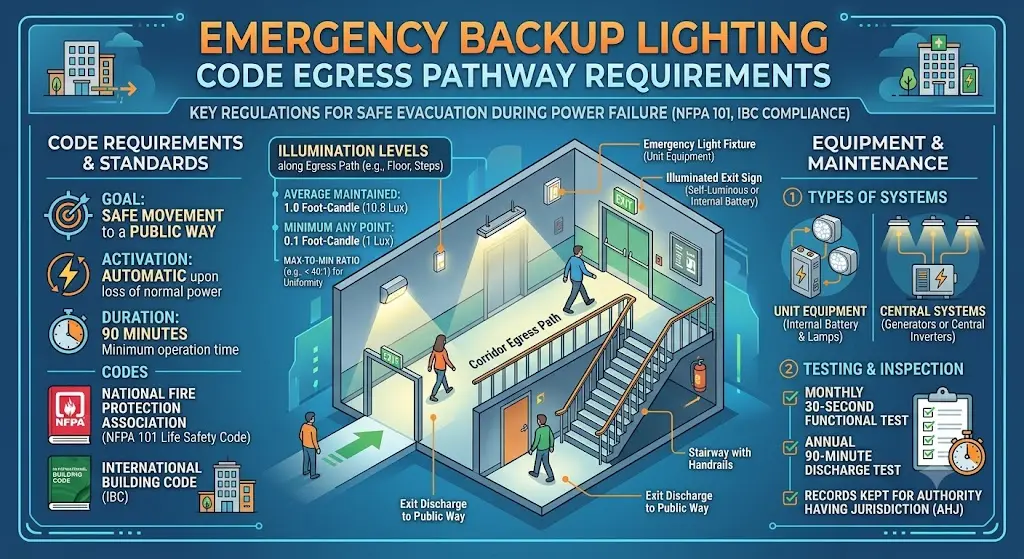
The Three-Code Framework: NEC, NFPA 101, and IBC
Emergency egress lighting is governed by three independent codes that address different aspects of the same requirement. All three apply simultaneously to most commercial and institutional projects. Understanding which code governs which question is the starting point for every emergency lighting design.
Governs: HOW emergency lighting is installed electrically
- Required power source types and their specifications (700.12)
- Wiring independence from normal circuits (700.10)
- Transfer switch requirements and listings (700.5)
- Circuit marking and labeling requirements (700.9)
- Switch control restrictions — authorized personnel only (700.21)
- No-total-darkness redundancy for each illuminated space (700.16)
- Battery voltage maintenance threshold: 87.5% nominal (700.12F)
Governs: WHERE emergency lighting goes and at what level
- Specific egress locations that require coverage (§7.9.1.1)
- Illumination level: 1 fc average / 0.1 fc minimum (§7.9.2.1)
- 40:1 maximum-to-minimum uniformity ratio
- 90-minute minimum duration (§7.9.2.1)
- 10-second transfer time limit (§7.9.1.3)
- Stair illumination: 10 fc normal / 1 fc emergency (§7.8.1.3)
- Testing: monthly 30-sec / annual 90-min (§7.9.3)
- Written records required and available to AHJ
Governs: Building code compliance framework (mirrors NFPA 101)
- Emergency lighting locations (§1008.3.1–1008.3.3)
- Illumination levels same as NFPA 101: 1 fc average (§1008.3.5)
- 90-minute duration and 10-second transfer (§1008.3.4)
- IBC Section 1008.2.1: 1 fc minimum on egress path (normal power)
- Stair illumination: 10 fc at stair walking surfaces during use
- Normal egress lighting (1008.2) vs emergency backup (1008.3) are distinct requirements
The Critical Distinction: NEC Article 700 is not a building code. It does not tell you where to put emergency lighting — NFPA 101 and the IBC do that. NEC Article 700 tells you how the electrical system that powers those lights must be constructed. Per Nassau National Cable's Article 700 analysis: "The AHJ has final say on which article applies, but in practice, any system required by NFPA 101 (Life Safety Code) or IBC for means of egress falls squarely under Article 700." The practical consequence: both the electrical inspector (who enforces the NEC) and the fire marshal (who enforces NFPA 101) can cite the same installation for different violations.
The 700/701/702 Tier Distinction — Why It Matters
NEC Chapter 7 covers three different tiers of emergency and standby systems. Per Nassau National Cable: "Article 700 — Emergency Systems: Legally required by code for life-safety. This is the highest tier. Article 701 — Legally Required Standby Systems: Required by code but not for immediate life-safety. Think: heating systems, sewage disposal. Article 702 — Optional Standby Systems: Not legally required — data centers, convenience power, residential generators." If the applicable building or fire code mandates emergency power for means of egress, you're in Article 700 territory — which carries the most stringent requirements of the three articles. Getting this classification wrong — installing Article 702 equipment for what is actually an Article 700 requirement — is a common plan-check failure in commercial project submittals.
The Three-Part Egress System: Exit Access, Exit, Exit Discharge
Emergency lighting coverage requirements are defined relative to the three-part means of egress as defined by NFPA 101 Section 3.3.178 and IBC Chapter 2. Understanding the distinctions between the three parts determines which locations require emergency backup lighting coverage.
Exit Access
The continuous path of travel from any occupied area of the building to the entrance of an exit. Per NFPA 101 Section 7.9.1.2: "For the purposes of 7.9.1.1, exit access shall include only designated stairs, aisles, corridors, ramps, escalators, and passageways leading to an exit." Emergency lighting coverage is required throughout the exit access portion of the means of egress. This includes office corridors, lobby areas, aisle ways in assembly spaces, and any passageway that forms part of the required egress route. The path from an employee's desk through a corridor to the stairwell door is exit access and requires emergency lighting. The key qualifier: the exit access includes only "designated" routes — corridors, stairs, and passageways that are part of the required egress design, not every room in the building.
Exit
The protected egress component itself — an enclosed stairway, exterior door, horizontal exit, or exit passageway. The exit is fire-rated and separated from the rest of the building. Per NFPA 101: the exit is the component where occupants are protected from fire while they travel to the public way. Emergency lighting within the exit means stairwell lighting for enclosed exit stairs, lighting at exit doors themselves, and lighting within exit passageways. Note that stairwells have a specific illumination standard (10 footcandles at walking surfaces during normal power, 1 footcandle minimum during emergency) that differs from the general egress path standard. Emergency lighting at exit stairs must maintain continuous illumination throughout the stairwell from top to bottom — not just at each landing.
Exit Discharge
The path from the exit to the public way (a public street, alley, or open space). Per NFPA 101 Section 7.9.1.2: "exit discharge shall include only designated stairs, ramps, aisles, walkways, and escalators" leading to a public way. Emergency lighting at the exit discharge means exterior landing lighting at exit doors, sidewalk or pathway lighting from the building to the street, and any exterior stairs that form part of the required egress route. NFPA 101 commentary (A.7.9.1.1) states: "Emergency lighting outside the building should provide illumination to either a public way or a distance away from the building that is considered a safe area." Per the emergency lights field guide: NEC permits a remote head lighting the exterior of an exit door to be supplied by the unit equipment serving the area immediately inside that door — recognizing the practical challenge of powering exterior emergency fixtures.
Where Emergency Lighting Is Required: IBC 1008.3 Specific Locations
Per IBC Sections 1008.3.1 through 1008.3.3 and NFPA 101 Section 7.9.1.1, emergency backup lighting is required in specific locations regardless of building size or occupancy.
IBC §1008.3 Required Locations — Spaces That Always Need Emergency Backup
- Aisles, corridors, exit stairways and ramps in any room or space that requires two or more means of egress.
- Interior and exterior exit stairways and ramps, exit passageways, vestibules — all locations in and adjacent to the protected exit component itself.
- Exit discharge areas and exterior landings at the building exterior where occupants emerge from exits.
- Electrical equipment rooms, fire command centers, fire pump rooms, and generator rooms — locations where life safety personnel must operate during emergencies.
- Public restrooms greater than 300 square feet — recognized as spaces where occupants may be isolated from egress path during a power failure.
NFPA 101 §7.9.1.1 Specific Trigger Conditions
Beyond the general requirement in Chapters 11–43 by occupancy type, NFPA 101 Section 7.9.1.1 requires emergency lighting for:
- Underground and limited access structures as addressed in Section 11.7 — where natural egress orientation cues are absent.
- High-rise buildings as required by other sections of the Code — because evacuation takes longer and stair systems are critical.
- Doors equipped with delayed-egress locks — specifically listed because occupants may be held at these doors during evacuation.
- Stair shafts and vestibules of smokeproof enclosures — which may include standby generators for mechanical ventilation equipment that can also serve emergency lighting power.
- New sensor-release electrical locking systems per Section 7.2.1.6.2 — a category added in recent NFPA 101 editions reflecting proliferating electronic lock technologies.
NFPA 101 §7.9.1.1 Three Exemptions
Per Koorsen Fire and Security's analysis of NFPA 101: only three categories are exempt: (1) locations not routinely inhabited by people; (2) towers designed for three or fewer people (fire observation towers, railroad signal towers) that provide an escape ladder; (3) structures occupied only during daylight hours that have windows providing the required illumination level for all means of egress — and only if approved by the AHJ. In practice, virtually all occupied commercial buildings require emergency lighting for all required egress paths.
Illumination Levels: The 1 fc / 0.1 fc / 40:1 Rule Explained
Per NFPA 101 Section 7.9.2.1 and IBC Section 1008.3.5, emergency egress illumination requirements are defined by three simultaneous constraints that must all be satisfied. A design that meets the average level but fails the minimum point, or satisfies both but exceeds the uniformity ratio, is not code-compliant.
The Minimum Point Rule: 0.1 fc at Any Point
The 1 fc average is calculated across the entire egress path. But the code also sets a hard floor: no single point along the egress path at floor level can fall below 0.1 footcandle (1.1 lux per NFPA, 1 lux per IBC). Per Consulting-Specifying Engineer's documented analysis: "The illumination level measured at the walking surface shall not be less than 0.1 footcandle (minimum illuminance, not average). Second the illumination level shall not have less than a 1 footcandle average over the means of egress." These are two independent constraints. A design with an average of 1.2 fc but a dark stairwell landing at 0.08 fc violates the minimum point requirement despite exceeding the average.
The 40:1 Uniformity Ratio — Why It's the Hardest Constraint to Satisfy
The 40:1 ratio limits the contrast between the brightest and darkest points along the egress path. This is numerically the most demanding constraint because it directly conflicts with cost optimization: the instinct to space emergency fixtures as far apart as possible creates bright spots under fixtures and dark zones between them. At a 1 fc average with the minimum 0.1 fc constraint, the ratio is already at 10:1 — well within the 40:1 limit. But wide-spaced fixtures with bright spots at 3–4 fc and 0.1 fc valleys between them can push the ratio to 30:1 or higher. The ratio must be measured along the entire path, including turns, landing areas, and changes in ceiling height where fixture spacing inevitably creates variation. A photometric calculation that only checks average is not a complete compliance verification.
The End-of-Test Illuminance Decline
NFPA 101 Section 7.9.2.1 permits illumination levels to decline over the 90-minute duration as battery charge depletes. Per EleCalculator's emergency lighting design documentation: "After 90 minutes, average illumination permitted to decline to not less than about 0.6 footcandle (≈6.5 lux), with a minimum not less than about 0.06 footcandle (≈0.65 lux)." This means battery sizing calculations must ensure that even at the end of the 90-minute test — when battery voltage has declined — the lighting still maintains the end-of-test minimums across the entire egress path. A battery that starts at 1.2 fc average and drops to 0.55 fc average at minute 89 fails the end-of-test requirement, even if it provided adequate illumination for the first 80 minutes.
The Illumination Must Be Maintained Throughout the 90 Minutes: This is the constraint that dead batteries violate. Emergency lights that activate at the required level and fade out at minute 45 fail the code requirement — even though they provided appropriate egress illumination for the first half of the required duration. The code requires 90 continuous minutes above the minimum thresholds, not 90 minutes of any illumination whatsoever. Annual full-duration testing is the only way to verify this.
90-Minute Duration Requirement and 10-Second Transfer
The 90-Minute Minimum
Per NEC Section 700.12 and NFPA 101 Section 7.9.2.1: emergency lighting must operate for a minimum of 90 minutes (1.5 hours) from the moment of normal power failure. This duration was established as the estimated maximum evacuation time for buildings of the size and complexity that require emergency lighting. For larger, taller, or more complex buildings, the AHJ may require extended duration — some healthcare and high-rise applications specify 2–3 hours. Storm shelters under ICC 500 require 120 minutes. Generator systems must have on-site fuel for at least 2 hours of full-demand operation per NEC 700.12(B)(2).
Per the NEC as documented by Godson Technology: "emergency lighting loads must automatically energize or re-energize within 10 seconds of a power outage and must remain energized for at least 90 minutes or the estimated time of building evacuation." The "estimated time of building evacuation" language means that for a building with documented evacuation times exceeding 90 minutes — such as a high-rise with mobility-impaired occupants — the AHJ may require extended duration beyond the 90-minute minimum.
The 10-Second Transfer Time
Emergency power must be available — and lights must illuminate — within 10 seconds of normal power failure. Per NFPA 101 Section 7.9.1.3: "Where maintenance of illumination depends on changing from one energy source to another, a delay of not more than 10 seconds shall be permitted." Per EC&M's emergency systems documentation: "Upon loss of normal power, emergency power must be available within 10 seconds." This 10-second requirement covers the gap between normal power failure and battery or generator activation. Unit equipment (battery packs) typically activates within seconds. Generator systems have the full 10 seconds to come to operating speed, transfer the load, and restore illumination — which means a generator-only emergency lighting system without battery bridging may be at the edge of the 10-second limit during the generator startup transient.
The Six Permitted Power Source Types Under NEC 700.12
NEC Article 700.12 specifies exactly which power source types are permitted for emergency lighting systems. Using an unpermitted source type — regardless of its actual performance — is a code violation. Six source types are recognized.
| Source Type | NEC Section | Key Requirements | Common Use | Notes |
|---|---|---|---|---|
| Storage Battery | 700.12(A) | Suitable rating and capacity; 87.5% nominal voltage for full 1.5 hours; sized for total lamp load | Unit equipment (battery packs); central battery systems | Most common in small-to-mid buildings; activates instantly; no transfer switch required for unit equipment |
| Generator Set | 700.12(B) | Automatically starts on normal source failure; on-site fuel for 2 hours full demand; AHJ-acceptable configuration | Large commercial, institutional, high-rise buildings | Most common for large buildings; requires UL 1008 ATS; 2-hour on-site fuel minimum; requires battery bridging for 10-second gap |
| Uninterruptible Power Supply (UPS) | 700.12(C) | Must be UL 924 listed; serve only emergency loads; sized for 90-minute duration | Central inverter systems for emergency lighting | Must be dedicated to emergency loads only; immediate transfer; common in commercial with dimming controls |
| Fuel Cell Power System | 700.12(D) | Listed for emergency use; capable of 90-minute duration; transfer within 10 seconds | Emerging alternative; limited current adoption | Less common; subject to AHJ approval; fuel supply requirements similar to generator |
| Separate Service | 700.12(E) | AHJ determination that service is reliable enough; not from same utility substation as normal service | Rare; sites with dual independent utility feeds | Rarely approved; AHJ must specifically determine reliability; not acceptable if same utility fault could affect both |
| Unit Equipment | 700.12(F) | Rechargeable battery + charger + relay + lamps; permanently fixed; 87.5% voltage or 60% light level for 1.5 hr | Individual battery packs in corridor fixtures, bug-eye units | Lowest cost; most widely installed; "lunchbox" packs or integral battery fixtures; fails silently when batteries age |
The Generator 2-Hour Fuel Rule
Per EC&M's Article 700 documentation: "If you use internal combustion engines as the prime mover, provide an on-site fuel supply sized for at least 2 hr of full-demand operation." This fuel requirement means diesel or propane fuel stored on-site in tanks — not natural gas from a utility line (which could be cut off in a seismic event or infrastructure failure). If a facility relies on natural gas for its emergency generator, it must still have an alternate 2-hour on-site fuel supply (such as LPG) unless the AHJ specifically approves an exception. Per Nassau National Cable: "If fueled by natural gas, still needs a 2-hour on-site backup fuel (e.g., LPG) unless AHJ approves an exception."
NEC 700.10: The Wiring Independence Rule
Section 700.10 contains what experienced engineers describe as the most demanding and most frequently violated requirements in Article 700. Per Nassau National Cable: "This section contains what many experienced engineers consider the most demanding and most frequently violated requirements in Article 700: emergency wiring must be completely independent of all other wiring and equipment."
The General Rule
Per NEC 700.10(B) and EC&M's documentation: "Keep all wiring from emergency sources to emergency loads entirely independent of all other wiring and equipment. Why? To ensure a fault on the normal wiring circuits will not affect the performance of emergency wiring or equipment." This means separate raceways, separate boxes, separate cabinets, and separate panels from all normal-circuit wiring. Emergency circuits in the same conduit as normal branch circuits violate this section — a single cable fault, a worn through point where two conductors touch, or a water infiltration event can disable both normal and emergency lighting simultaneously if wiring independence is not maintained.
Additionally: per NEC 700.9 and EC&M: "Permanently mark all boxes and enclosures (including transfer switches, generators, and power panels) for emergency circuits as components of an emergency system. A Code violation in this area can impede fire and rescue operations" — emergency responders need to identify emergency panel locations quickly, and unmarked panels create deadly confusion.
The Five Exceptions to Wiring Independence
Per EC&M's Article 700 analysis and NEC 700.10(B)(1) through (5), five narrow exceptions permit emergency and normal wiring to share space:
High-Hazard Occupancy Wiring Methods
Per NEC 700.10(D) and Consulting-Specifying Engineer: for specific occupancy types — assembly occupancies with greater than 1,000 occupants, buildings taller than 75 feet, and educational occupancies with greater than 300 occupants — feeder-circuit wiring must meet enhanced fire protection standards. Per the CSE article: "lighting system feeder-circuit wiring is required" to use fire-rated wiring methods in these occupancies. One recommended practice is using red conduits or red box covers for all emergency circuits — providing immediate visual identification during installation, inspection, and emergency response. See the electrical code safety guide for the broader framework of NEC wiring method requirements.
Unit Equipment (Battery Packs): The Most Common Emergency Lighting Technology
Unit equipment — the battery-backed emergency light pack — is the most widely installed emergency lighting technology in US commercial buildings. Understanding its specific code requirements, its failure modes, and its correct wiring is essential for compliance.
What Unit Equipment Must Contain
Per NEC 700.12(F) as documented by EC&M: "By individual unit equipment (IUE), the NEC means an emergency lighting battery pack. These must include: (1) A rechargeable battery; (2) A battery charger; (3) Provisions for one or more lamps mounted on the equipment, or terminals for remote lamps (or both); (4) A relaying device that energizes the lamps automatically upon failure of the supply to the unit." The relay device is the critical component — it monitors the normal circuit voltage and energizes the emergency lamps automatically when that voltage drops. Without a properly functioning relay, the battery pack is simply a battery with lights that will never activate during an actual power failure.
The Critical Wiring Rule for Unit Equipment
Per EC&M's documentation of NEC 700.12(F): "The branch circuit wiring that supplies IUE must be the same branch-circuit wiring that supplies the normal lighting in the area." This is the opposite of the general wiring independence rule — and it is intentional. The unit equipment relay monitors the normal lighting circuit voltage. If the unit equipment were connected to a different circuit than the normal lighting it supplements, a local circuit failure (a tripped breaker for just that corridor's lights) would not activate the emergency lighting — because the unit equipment's supply circuit would still be energized. The unit equipment must be on the unswitched portion of the same circuit, so it can detect local outages, not just building-wide failures. Per IAEI Magazine: "the battery pack needs to have a connection to the unswitched portion of the local circuit, so it will only come on when the circuit loses power and not every time the light switch is turned off."
Emergency battery packs wired to the switched portion of the lighting circuit activate every time the wall switch is turned off — which trains occupants and maintenance staff to ignore the emergency lights activating. When this wiring error persists, the battery cycles repeatedly (charge → switch off → discharge → switch on → charge) at short intervals, dramatically accelerating battery degradation. Within months, the battery may be unable to provide even 15 minutes of emergency illumination. The fix: connect the battery pack to the unswitched hot leg of the circuit. Many existing installations have this error and it is virtually impossible to detect by visual inspection — only functional testing reveals the problem.
Remote Heads from Unit Equipment
Unit equipment can power remote lamp heads in addition to (or instead of) lamps mounted directly on the unit. Per emergencylights.net's documented code requirements: "The host's remote capacity (watts) must cover all connected heads plus its own lamps for the full 90 minutes." This means the unit equipment must be sized for the total connected wattage — both integral lamps and all remote heads — not just for the heads closest to the unit. Exceeding host remote capacity is one of the five most-cited installation failures: the unit equipment passes visual inspection and the 30-second test but fails the annual 90-minute test because the battery cannot sustain the total connected load for the full duration.
Stair Illumination: The 10 fc vs 1 fc Distinction That Most Installers Get Wrong
Egress stairs have two different illumination standards that apply under different conditions. Confusing them is the most common stair illumination compliance error — and it runs in both directions: some designs over-light stairs under emergency power (not a code problem, just expensive), while others under-light stairs under normal power (an actual code violation).
Normal Power: 10 Footcandles at Stair Walking Surfaces
Per NFPA 101 Section 7.8.1.3 and as documented by Consulting-Specifying Engineer: "During conditions of stair use, the minimum illumination for new stairs shall be at least 10 fc (108 lux), measured at the walking surfaces." This 10 fc requirement applies when normal power is present and the stairway is in active use. It is specifically for new stairs — existing stairs in older buildings may have different requirements under the applicable edition of the code enforced at the time of construction. The 10 fc requirement does not apply uniformly to the entire stairwell — it applies to the walking surfaces (the treads), not to upper portions of the stairwell space.
Per CSE magazine: "The IBC does not make a distinction between the stairs and other paths of egress" for normal illumination — IBC 1008.2.1 requires 1 fc at stairs under normal power, while NFPA 101 requires 10 fc. When both codes apply, the more restrictive (NFPA 101's 10 fc) governs.
Emergency Power: 1 Footcandle Average
Under emergency power conditions, the illumination requirement drops to the standard egress path level: 1 footcandle average, 0.1 footcandle minimum, 40:1 uniformity ratio — same as corridors and other egress components. Per kW Engineering's code analysis: "The 10 footcandle requirement is only necessary when normal power is present. On emergency power, the system needs 1.0 footcandle average, like all other egress path lighting systems." This distinction means emergency stair lighting can be designed to a lower level than normal stair lighting — but must still achieve 1 fc average with the full uniformity and minimum constraints.
Continuous Stair Illumination — Top to Bottom
Emergency lighting within enclosed exit stairs must provide continuous illumination from the top landing to the exit discharge at the bottom — not just spot coverage at each landing. Per the Campus Emergency Lighting Inspection Checklist: "Verify stairwell emergency lighting on every landing and at every change of direction — stairwells are the highest-risk egress locations during power failures." A stairwell with emergency lights at the top and bottom landings but dark zones on the intermediate flights violates the continuous illumination requirement, even if average illuminance across all measured points technically meets 1 fc.
NEC 700.16: The No Total Darkness Rule
NEC Section 700.16 contains a requirement that goes beyond providing adequate illumination levels — it specifically prohibits the scenario where any single lighting failure leaves an emergency-illuminated space in complete darkness.
The Evolution of the Requirement
Per electricallicenserenewal.com's documented NEC history: "In 1956, the NEC first required emergency illumination to be 'designed and installed that the failure of any individual lighting element, such as the burning out of a light bulb, cannot leave any space in total darkness.' Over time, that language evolved" through multiple code cycles. The 2020 NEC revised the language to "illumination source" instead of "individual lighting element" — moving from lamp-specific language to a more technology-neutral formulation that also addresses LED driver failures and other modern failure modes.
Per NEC 700.16(B) System Reliability: "Emergency lighting systems shall be designed and installed so that the failure of any illumination source cannot leave in total darkness any space that requires emergency illumination." This requirement means every emergency-illuminated space must have at least two independent light sources — if one fails, the other continues to provide some illumination. Per EC&M: "This means a single remote head is never sufficient — you need at least two lighting heads for any area." A space lit by a single battery pack unit with one remote head has a single point of failure that could leave the space dark. Adding either a second remote head or a separate luminaire served from a different emergency circuit satisfies the redundancy requirement.
The LED Driver Single-Point-of-Failure Question
The evolution from "individual lighting element" to "illumination source" in the 2020 NEC opened new interpretive questions for LED emergency luminaires. Per electricallicenserenewal.com: "Newer technology has brought fluorescent emergency luminaires with ballasts and LED luminaires powered by drivers into the spotlight and with it come many questions for the designer." An LED module with a failed driver leaves the entire fixture dark — is that "failure of any illumination source" that creates total darkness? Some AHJs now require dual-driver LED emergency luminaires or dual-LED-board construction for spaces where a single LED fixture failure could create a totally dark emergency zone. This is an actively evolving area of AHJ interpretation that should be verified with the local AHJ before finalizing emergency lighting fixture specifications.
Switch Restrictions, ALCR Integration, and Energy Code Conflicts
NEC 700.21: Switch Control Restrictions
Per Godson Technology's NEC documentation: "Section 700, Part V, states that switches installed in emergency lighting circuits must be arranged so that only authorized personnel can control emergency lighting. This ensures that the emergency lighting circuit cannot be inadvertently turned off." The specific prohibitions: series switches and three-way or four-way switches are not permitted in emergency lighting circuits. These switch types create a failure mode where unauthorized or inadvertent operation can disable emergency lighting — a wall switch in a janitor's closet that controls emergency lighting for the adjacent corridor, for example. Additional switches that activate emergency lights (not disconnect them) are permitted. Per NEC 700.21: dimmer systems containing multiple dimmers in parallel are permitted as control devices for energizing emergency lighting circuits.
The ALCR — Automatic Load Control Relay
Energy codes require that lighting be controllable (dimmable or off) when spaces are unoccupied. Emergency lighting cannot be turned off when the building is occupied. The ALCR (Automatic Load Control Relay) resolves this conflict. Per the NEC and IAEI Magazine: "700.24 in the 2011 NEC permits a listed automatic load control relay (ALCR) to automatically energize the emergency lighting load upon loss of the normal power supply." The ALCR allows energy-code-compliant dimming or shutoff of normal lighting while maintaining the ability to energize emergency lighting circuits automatically when power is lost. Per Godson Technology: "Although an ALCR can be used to shunt control equipment and re-energize circuits that have been intentionally shut down or dimmed, it is still required to be connected to a single emergency power source. As stated in 700.24, an ALCR shall not be used as a transfer device and does not replace the need to use a transfer switch when connecting two power sources."
The Energy Code vs Life Safety Code Conflict — Resolved
Per Consulting-Specifying Engineer's egress illumination analysis: "In recent years, energy codes have been adopted that try to reduce the amount of energy used in each building. Portions of these codes have targeted the energy required and used to illuminate buildings. A primary energy reduction measure that has been identified for lighting is a requirement to turn off lighting when spaces are not occupied. The result has created some conflict when newer energy codes and egress lighting requirements do not align." The IBC does not allow egress lighting to be shut off or reduced while the building is occupied, but NFPA 101 does permit occupancy sensors in the means of egress under specific conditions: the sensor must be fail-safe, timers must be set for a minimum 15-minute duration, and the sensor must be activated by any occupant movement in the area served. The kW Engineering practice note: selecting UL 924-compliant battery packs that override the control signal during an emergency event allows normal energy code controls (occupancy sensors, scheduling) while maintaining emergency lighting compliance.
UL 924 vs UL 1008: Which Listing for What Equipment
Emergency lighting equipment must carry specific UL listing marks. Substituting a standard electrical listing for a required emergency system listing is a code violation — even if the equipment technically functions correctly.
| Standard | Covers | Key Requirements | Required For |
|---|---|---|---|
| UL 924 | Emergency lighting equipment — battery packs, luminaires, exit signs, inverters, ALCRs | Immediate transfer on power loss; 90-minute battery duration; flame-retardant construction (5VA, 5VB, V-0, V-1, V-2, HB); minimum 0.06 ft-lambert luminance | All battery-backed emergency luminaires, unit equipment, exit signs, emergency lighting inverters (UPS for lighting) |
| UL 1008 | Transfer switch equipment — automatic and manual transfer switches | More stringent than UL 924; electrically operated and mechanically held; prevents interconnection of normal and emergency sources; carries load indicator; ground fault indication | All automatic transfer switches (ATS) in emergency systems; required for transfer switches used with generators in emergency lighting systems |
The Consequence of Using the Wrong Listing
Installing a standard UL-listed inverter (not UL 924) or a standard transfer switch (not UL 1008) in an emergency lighting system is a code violation that will be cited on inspection. The UL 924 listing requires testing specifically for emergency lighting applications — the device has been verified to transfer within the required time and maintain output for the required duration under real-world conditions. A standard UPS or inverter without UL 924 may have similar operating characteristics but has not been through the specific testing protocol that the code requires. The electrical inspector can require removal and replacement of non-listed equipment at the contractor's expense, even if the equipment has been operating for years without failure.
Monthly and Annual Testing: Requirements and Recordkeeping
Per NFPA 101 Section 7.9.3 and as documented consistently across all compliance resources: emergency lighting testing is not discretionary. It is a code-required ongoing obligation with specific frequencies, durations, and recordkeeping requirements. Per kW Engineering: "based on my work with commercial customers, I can say with certainty that very few operators comply with §7.9.3."
- Frequency: At least once every 30 days (some AHJs specify 30–35 days)
- Duration: Minimum 30 seconds — enough to verify activation and initial operation
- Method: Manual test button, remote test switch, or self-testing unit automatic cycle
- What to verify: Battery activates within 10 seconds; all lamps illuminate; no visible fixture failures
- Self-testing units: Automatically perform the test and indicate pass/fail via LED indicator — requires visual inspection to confirm indicator status
- Record required: Date, result, and tester name — written and available to AHJ
- Critical limitation: A 30-second test CANNOT reveal a battery that will fail at minute 45 — annual test is not optional
- Frequency: At least once every 12 months
- Duration: Full 90 minutes at rated load — must maintain minimum illumination throughout
- What to verify: System remains above end-of-test minimums (0.6 fc average, 0.06 fc minimum at any point) at minute 90
- Check points: Verify at 0 min, 30 min, 60 min, and 90 min — degradation trends reveal approaching battery failure before total failure occurs
- Remote heads: Verify farthest remote heads remain lit at minute 90 — voltage drop under sustained discharge often fails the most distant heads first
- Computer-based alternative: NFPA 101 permits computer-based self-testing at 30-day intervals for 30 seconds and annually for 5.5 hours
- Record required: Date, duration, results at each check point, any failures — written log available to AHJ
Self-Testing Units: What They Do and Don't Eliminate
Modern emergency lighting units with self-testing capability automatically perform the monthly 30-second test and indicate pass/fail via an LED status indicator. Per NFPA 101 documentation by US Made Supply: "Self-testing equipment: NFPA 101 permits self-testing and self-diagnostic battery units that automatically perform the monthly 30-second test and indicate failures. These units still require the annual 90-minute test and periodic visual verification that the self-test indicator is functioning." The self-testing feature does not eliminate the annual 90-minute duration test requirement. It also does not eliminate the need for visual inspection of the self-test indicator itself — a unit whose indicator LED has failed will silently pass and fail tests without any visible notification.
Five Most-Cited Emergency Lighting Inspection Failures
These are the failures fire marshals and electrical inspectors find most often during emergency lighting inspections of commercial, institutional, and multi-family residential buildings. All five are preventable with a systematic testing and maintenance program.
Per Up to Code: "Dead battery units — the most frequently cited emergency lighting deficiency — provide zero backup when occupants need it most." Per the Campus Emergency Lighting Inspection Checklist: batteries that pass the monthly 30-second test routinely fail the annual 90-minute test when capacity has degraded. A battery pack that has been in service for 5+ years may appear fully functional (unit powers up, indicator shows green) but fail at minute 45 of the annual test. The fix: budget for battery replacement on a 3–5 year cycle regardless of apparent condition, and perform the annual 90-minute test without skipping it to catch batteries before they reach complete failure.
Per Nationwide Power: facilities that test but don't document face citations independent of equipment condition. Many facilities skip the annual 90-minute test entirely — the most critical test for battery capacity verification. Common variation: monthly tests are performed and logged by facilities staff, but no one performs or records the annual 90-minute test because it's inconvenient (requires a 90-minute building power disruption or test switch activation) and the responsibility is unclear. The fix: assign a specific person responsible for emergency lighting testing, add monthly and annual tests to the maintenance calendar, and designate where records are kept. See the NEC inspection checklist for a recordkeeping framework.
Battery packs connected to the switched side of the lighting circuit activate every time the wall switch is turned off — not just during power failures. This causes repeated unnecessary battery discharge-recharge cycles that degrade batteries far faster than their rated service life. The packs may appear functional but have a fraction of their rated capacity due to cumulative cycle degradation. Per IAEI Magazine: "the battery pack needs to have a connection to the unswitched portion of the local circuit." Visual inspection doesn't reveal this failure — only functional testing or a circuit diagram review shows the error. During emergency lighting retrofits, this wiring error is introduced when installers connect the unit equipment to the nearest available hot wire without checking whether it's the switched or unswitched leg.
Emergency lighting circuits run in the same conduit as normal branch circuit wiring — violating the NEC 700.10 wiring independence requirement. This is most common in older buildings where emergency lighting was added to existing infrastructure without installing new dedicated conduit, or in new construction where the electrical contractor ran emergency and normal circuits together to save labor and material. The fix requires pulling emergency circuit wiring into separate raceways — a substantial retrofit cost. The consequence of leaving it unfixed: a single wiring fault that trips the normal branch circuit can simultaneously disable emergency lighting coverage for the entire area. For permit preparation, see the permit rejection guide.
Per the Campus Emergency Lighting Inspection Checklist: "Check that no new construction, furniture, equipment, or storage obstructs emergency light output or blocks illuminated exit sign visibility along any egress route." Emergency lighting that was compliant at time of installation becomes non-compliant when a new partition blocks a fixture's coverage zone, when shelving is placed in front of an emergency unit, or when a renovation moves the exit path without relocating emergency lighting fixtures to match. The illumination calculation from the original permit is no longer valid when the physical space changes. Facilities that alter their layouts without reviewing emergency lighting coverage regularly accumulate coverage gaps that are only discovered during AHJ inspections — or during actual emergencies.
The scenario that drives this topic is the 2003 Station nightclub fire — 100 dead, 230 injured in 90 seconds — where emergency lighting failures, blocked egress paths, and inadequate exit marking combined to make evacuation nearly impossible. Rhode Island had adopted NFPA 101 but enforcement was inconsistent. The post-incident investigation found battery packs with dead batteries, blocked exits, and egress path configurations that violated occupancy load limits. Every one of the five most-cited failures above was present at that facility. These failures happen because they're invisible during normal operations — the room is lit, the exits appear marked, the battery packs look intact. They only become critical in the 90 seconds after the lights go out.
Emergency Backup Lighting Code FAQ
What is the minimum illumination level required for emergency egress lighting?
Per NFPA 101 Section 7.9.2.1 and IBC Section 1008.3.5: emergency illumination must provide initial average illumination of at least 1.0 footcandle (10.8 lux) at floor level along the entire egress path. The minimum illumination at any single point must not fall below 0.1 footcandle (1 lux). The maximum-to-minimum illuminance ratio cannot exceed 40:1. After the full 90-minute battery duration, illumination levels may decline to an average of 0.6 footcandles (minimum 0.06 fc at any point). These levels must be maintained throughout the entire 90-minute emergency duration. See the illumination levels section above for the full three-constraint framework.
What is the difference between NEC Article 700 and NFPA 101 Section 7.9?
NEC Article 700 covers HOW emergency lighting is installed electrically — wiring independence requirements, permitted power source types, transfer switch specifications, circuit labeling, switch control restrictions, and battery voltage maintenance thresholds. NFPA 101 Section 7.9 covers WHERE emergency lighting must be provided and at what illumination performance levels — specific egress locations, the 1 fc illumination requirement, the 90-minute duration, and testing requirements. IBC Section 1008 mirrors NFPA 101 performance requirements. When all three apply to a project — which is common in commercial construction — all three must be satisfied simultaneously. The most restrictive requirement on any given point governs. See the three-code framework section above for the complete breakdown.
How long must emergency backup lighting last on battery power?
The minimum is 90 minutes (1.5 hours) under both NFPA 101 Section 7.9.2.1 and NEC Article 700.12. Per NEC 700.12(F): unit equipment batteries must supply and maintain at least 87.5% of nominal battery voltage for the total lamp load for the full 1.5 hours, OR maintain not less than 60% of the initial emergency lighting level. Emergency generators must have at least 2 hours of on-site fuel supply. Some occupancies require longer: storm shelters require 120 minutes in some codes; healthcare facilities may require 2–3 hours. Always verify the specific duration requirement with your AHJ — local amendments can extend beyond the 90-minute minimum. See the duration and transfer section for the voltage maintenance details.
What are the monthly and annual testing requirements for emergency lighting?
Per NFPA 101 Section 7.9.3: (1) Monthly test — minimum 30 seconds at least once every 30 days; verify activation and lamp operation; written record required; (2) Annual test — full 90-minute duration once every 12 months; verify end-of-test illumination levels (0.6 fc average minimum); written record required and available to AHJ on request. A battery that passes a 30-second monthly test can fail the annual 90-minute test when capacity has degraded — the monthly test is not a substitute for the annual full-duration test. Self-testing units automate the monthly test but do not eliminate the annual 90-minute requirement. See the testing section for the complete testing protocol, what to check at each time point, and the recordkeeping requirement.
Related Electrical Code & Compliance Guides
- Electrical Code Safety Guide
- GFCI Requirements Guide
- State Permit Requirements
- Permit Rejection Reasons
- Code Enforcement Cases
- Inspection Failure Codes
- Inspector Correction Notices
- Final Inspection Checklist
- NEC Inspection Checklist
- NEC 110 General Requirements
- Arc Fault and GFCI Code
- Grounding and Bonding Guide
- Load Calculation Compliance
- Voltage Drop Code Requirements
- Splice Connection Code
- Junction Box Requirements
- Transformer Mounting Code
- Transformer Disconnect NEC
- ADA Outdoor Lighting Rules
- Contractor Licensing Requirements
- Liability Claims Database
- Insurance and Liability Guide
- NEC Compliance Calculator
- Lighting Guide