
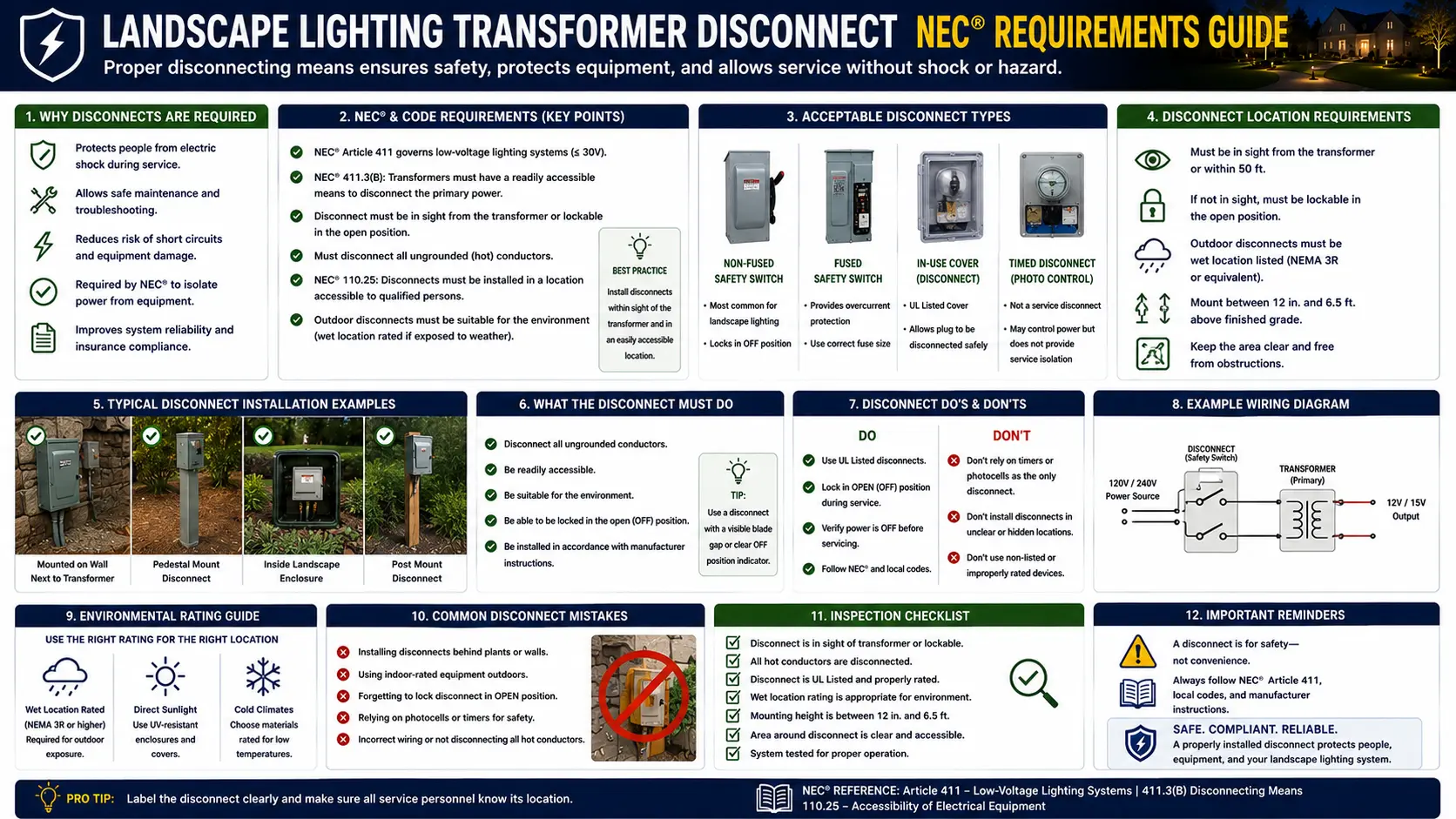
Three NEC Articles, Three Different Requirements
Before addressing any specific disconnect question for a landscape lighting transformer, you need to understand which NEC articles are in play and what each one governs. The confusion in the field — from both installers and inspectors — comes from conflating these three articles, which have entirely different scopes and apply to entirely different parts of the electrical system.
- The primary governing article for 12V landscape lighting
- Requires listed systems or listed components (411.3)
- Limits secondary circuit to 25A maximum per circuit (411.2)
- Requires isolation transformer with ungrounded secondary (411.5(B))
- Prohibits grounding the secondary circuit (411.5(A))
- Limits primary branch circuit to 20A maximum
- Designates the listed transformer's internal OCPD as the secondary protection
- Added in the 2011 NEC — prior editions had no transformer disconnect requirement
- Requires disconnect capable of opening all ungrounded primary conductors
- Applies to "transformers other than Class 2 or Class 3" — and landscape lighting transformers are subject to this where hardwired
- Cord-and-plug connected transformers are exempt (the plug IS the disconnect)
- Disconnect must be within sight (≤50 ft, visible) OR remote and lockable with location marked on transformer
- The circuit breaker at the panel typically serves as the disconnect
- Added in 2020 NEC (230.85), incorporated into 230.70 in 2026 NEC
- Requires outdoor emergency disconnecting means for one- and two-family dwellings
- Applies to service conductors and service equipment per NEC Article 100 definitions
- Does NOT apply to branch circuit loads, sub-panels, or equipment connected downstream of the service disconnect
- Landscape lighting transformers are branch circuit loads — 230.85/230.70 does not apply to them
- Frequently misapplied by inspectors to landscape transformers — incorrect application
The Internal Breaker as Legal Secondary OCPD: What NEC Article 411 Actually Establishes
The most important and most misunderstood code point about landscape lighting transformers: the small reset button(s) on the transformer's terminal block is not merely a "convenience" feature or a "safety device" — it is the legally recognized secondary-side overcurrent protection device for the 12V circuit, established by the transformer's listing under NEC Article 411's requirements. Understanding this changes how every overcurrent and disconnect question on the secondary side should be approached.
What NEC Article 411 Requires and Why It Designates the Internal Device
NEC Article 411 requires that low-voltage lighting systems be listed (411.3) or consist of listed components. For landscape lighting transformers, the listing standard is UL 1838 (Low Voltage Landscape Lighting Systems). The UL 1838 listing process evaluates the transformer as a complete system including its output overcurrent protection. Article 411.2 limits each secondary circuit to 25 amperes maximum. In listed systems, this limit is implemented through the transformer's internal overcurrent device — the circuit breaker built into the transformer that automatically resets (the button homeowners push when a zone goes out).
Because NEC 411.3 requires the system to be listed, NEC 110.3(B) requires installation per the listing's instructions. The UL 1838 listing specifies that the transformer's internal protection device IS the secondary circuit overcurrent protection. This creates the legal designation: the internal breaker is the 25A secondary OCPD by virtue of the listing, not by separate NEC provision. No external secondary OCPD is required because the listed system already incorporates it. No external secondary OCPD can replace it without departing from the listed system configuration.
NEC 411.2: "Output circuits of the power supply shall be rated for 25 amperes maximum under all load conditions." — Each 12V secondary circuit is limited to 25A.
NEC 411.3: The power supply (transformer) shall be listed. Listed under UL 1838.
NEC 110.3(B): Listed equipment shall be installed per the listing's instructions. UL 1838 listing specifies the transformer's internal device as the secondary circuit OCPD implementing the 25A limit.
NEC 411.5: Requires isolation transformer. The internal OCPD and the isolation design together constitute the secondary-side protection for the listed system.
Result: The internal circuit breaker IS the secondary OCPD by the chain of listing → NEC 110.3(B) → Article 411. No separate secondary overcurrent device is required. No separate secondary disconnect is required. The 12V circuit protection is entirely within the listed system design.
What Happens When the Internal Breaker Trips
When the internal circuit breaker trips on a landscape lighting transformer, it is performing its NEC 411-designated function: protecting the secondary circuit from exceeding 25 amperes. The breaker trip is not a malfunction — it is the safety system operating correctly. The correct response is to find the overcurrent cause on the 12V secondary circuit (too many fixtures, a short circuit in a wire run, a corroded splice creating a direct short, a failed fixture with shorted driver), correct it, and then reset the breaker. Resetting without diagnosis produces repeat trips.
Never bypass, defeat, or replace the internal circuit breaker with a higher-rated device. Replacing the transformer's internal 25A breaker with a 30A or 40A fuse to stop nuisance trips eliminates the 25A secondary circuit protection that NEC Article 411 and the UL 1838 listing both require. This also modifies the listed system configuration, which violates NEC 110.3(B). See the load calculation and code compliance guide for the complete secondary circuit sizing rules, the one zone not working guide for zone-specific fault diagnosis.
Cord-and-Plug Connected Transformers: The Receptacle as Disconnect
The majority of residential landscape lighting transformers are installed with a cord-and-plug connection — the transformer hangs on an outdoor wall bracket and plugs into a GFCI receptacle. For these installations, the disconnect question is simple: no additional disconnect hardware is required because the attachment plug and receptacle serve as the NEC-recognized disconnect means.
The NEC Basis for Plug-Connected Disconnect Sufficiency
NEC 450.14 requires a disconnect for transformers — but contains within its framework the cord-and-plug connected equipment accommodation via NEC 110.25. Where a disconnect is provided through a cord-and-plug connection, the lockout provisions that apply to remote disconnects (lockable per 110.25 with location marked on transformer) do not apply — because the plug itself is the disconnect, and a temporary lockout device placed over the plug satisfies the lockout requirement for cord-connected equipment.
The practical meaning: a cord-and-plug connected landscape lighting transformer complies with all disconnect requirements the moment it is plugged into the GFCI outdoor receptacle. To de-energize the transformer primary (performing the disconnect function), you unplug it. The GFCI receptacle also provides ground-fault protection for the primary circuit as required by NEC 210.8(A)(3) for outdoor receptacles. One installation — plug into GFCI outdoor receptacle — satisfies the primary circuit GFCI requirement and the transformer disconnect requirement simultaneously. No additional disconnect switch, fused disconnect, or safety switch is required or needed.
When the GFCI Trips: Primary Circuit Fault, Not Secondary Overcurrent
The GFCI protects the primary (120V) circuit. The internal circuit breaker protects the secondary (12V) circuit. They respond to different types of electrical faults, and understanding which one tripped provides diagnostic information about where the fault is:
A secondary circuit has exceeded its 25A overcurrent rating. Causes: too many fixtures on one zone, a shorted wire run, a failed fixture with shorted LED driver, a corroded connector creating near-short-circuit conditions. The GFCI at the primary outlet is not tripped — only the internal breaker on the affected zone.
What to do: Disconnect fixtures from the tripping zone one at a time until the breaker holds, identifying the overload source. Check for shorted wire runs. See the transformer troubleshooting guide.
A ground fault has occurred — current is flowing through an unintended path to ground somewhere in the system. In landscape lighting, GFCI trips are most often caused by: moisture in buried connectors (the most common cause), a damaged transformer primary winding, irrigation sprinkler contact with fixtures, or water accumulation in an upward-facing landscape fixture lens cup.
What to do: Identify the ground fault source before resetting the GFCI. Test zones individually by disconnecting fixture runs one at a time. See the arc fault and GFCI code requirements guide.
Hardwired Transformers: NEC 450.14 Disconnect Requirements
A small percentage of residential landscape lighting transformers — and a significant percentage of commercial installations — are hardwired: directly connected to fixed building wiring rather than through a cord-and-plug connection. For these installations, NEC 450.14 applies and creates a specific disconnect requirement that must be satisfied independently of the transformer's internal overcurrent protection.
What NEC 450.14 Requires for Hardwired Landscape Transformers
"Transformers, other than Class 2 or Class 3 transformers, shall have a disconnecting means located either in sight of the transformer or in a remote location. Where located in a remote location, the disconnecting means shall be lockable in accordance with 110.25, and its location shall be field marked on the transformer."
Key definitions:
Within Sight (NEC Article 100): "Visible and not more than 15m (50 ft) distant from other equipment."
Lockable per 110.25: "Where a disconnecting means is required to be lockable open elsewhere in the Code, it shall be capable of being locked in the open position. The provisions for locking shall remain in place with or without the lock installed." For a circuit breaker, this means a breaker with integral locking hasp or a lockout device installed on the breaker panel opening.
How 450.14 Applies to Landscape Transformers: The Class 2/3 Question
NEC 450.14 exempts "Class 2 or Class 3 transformers" from its requirements. This reference is to power supply classifications under NEC Chapter 9, Tables 11(A) and (B) — not to transformer voltage classes in IEEE standards. Landscape lighting transformers listed under UL 1838 and covered by NEC Article 411 are not technically Class 2 power supplies within the Chapter 9 meaning (the power limits in Chapter 9 Tables are far more restrictive than typical landscape lighting systems). The exemption was intended for small signal transformers, not landscape lighting units. NEC 450.14 therefore applies to hardwired landscape lighting transformers — and this interpretation is confirmed by the Electrical Contractor Magazine and IAEI analyses of Article 450.14 scope.
Three Ways to Satisfy 450.14 for a Hardwired Landscape Transformer
- Panel breaker within sight (≤50 ft, visible): For most residential landscape transformers mounted on an exterior wall or post near the house, the electrical panel containing the circuit breaker that supplies the transformer is within 50 feet and visible from the transformer location. In this case, the circuit breaker at the panel is the disconnecting means per 450.14 — it disconnects all ungrounded primary conductors. No additional disconnect switch is required.
- Dedicated disconnect switch within sight: A separately installed disconnect switch (safety switch, fusible disconnect, or listed switch-rated device) installed within 50 feet and visible from the transformer, in the primary supply circuit. This is the approach used when the panel is more than 50 feet away. The disconnect switch must be listed for the application and rated for the primary circuit current.
- Remote lockable disconnect (panel or switch not within sight): Where no within-sight disconnect exists, any remote disconnect (including the panel breaker) satisfies 450.14 if it is capable of being locked in the open position per NEC 110.25, AND the location of that disconnect is field-marked on the transformer itself. The field marking must be permanent, legible, and identify the specific disconnect location ("Main Panel, Breaker 12" or equivalent).
The 50-foot limit surprises residential installers: Most residential landscape lighting is installed on properties where the electrical panel inside the house is well within 50 feet of the transformer mounted on an exterior wall. In these cases, the panel breaker that feeds the landscape lighting branch circuit is within sight of the transformer — and it IS the NEC 450.14 disconnect. No additional hardware is required. The issue arises when landscape lighting is installed on large properties, commercial sites, or in remote garden areas where the panel is more than 50 feet or not visible from the transformer. In those cases, either a local disconnect switch or the remote lockable + field-marked approach applies. This is a site geometry question, not a product question.
Why NEC 230.85/230.70 Does NOT Apply to Landscape Lighting Transformers
NEC 230.85 (added in the 2020 NEC, incorporated into 230.70 in the 2026 NEC) creates an outdoor emergency disconnecting means requirement for one- and two-family dwellings. This provision is occasionally misapplied to landscape lighting transformers by inspectors who see "outdoor + dwelling + transformer + disconnect" and invoke 230.85. The application is incorrect, and understanding why protects both installers and homeowners from unnecessary hardware requirements.
What 230.85/230.70 Actually Requires and Its Defined Scope
"For one- and two-family dwelling units, all service conductors shall terminate in disconnecting means having a short-circuit current rating equal to or greater than the available fault current, installed in a readily accessible outdoor location."
Critical scope language: "All service conductors shall terminate in disconnecting means..."
NEC Article 100 — Service Conductors: "The conductors from the service point or other source of power to the service disconnecting means." Service conductors are the conductors that deliver power from the utility (or the service point) to the premises main disconnecting means. They are upstream of the service disconnect.
A landscape lighting transformer is a load connected to the branch circuit system downstream of the service disconnect. The primary circuit to the transformer is a branch circuit — not a service conductor. NEC 230.85/230.70 applies to service conductors and service equipment. It has no application to branch circuit loads, including landscape lighting transformers.
Why the Misapplication Occurs and How to Respond
The 230.85 misapplication to landscape lighting transformers typically occurs because: (1) inspectors are alert to outdoor disconnect requirements and apply the most recent code section they associate with outdoor disconnects; (2) the landscape transformer is visibly an outdoor electrical installation with a 120V primary; and (3) the section's plain language ("outdoor location" + "disconnecting means") superficially resembles what might apply. The resolution is to point to the specific scope language — "service conductors" — and the Article 100 definition that limits service conductors to the utility-side supply conductors feeding the premises.
The correct NEC provision for the landscape transformer's primary disconnect is 450.14 (if hardwired) or the cord-and-plug connected acknowledgment in 110.25 (if plug-connected). Neither involves 230.85/230.70. When discussing this with an inspector, have the relevant code sections ready: Article 100 definition of "service conductors," NEC 230.1 (scope of Article 230 as covering service conductors and service equipment), and NEC 450.14 as the applicable transformer disconnect provision.
I have had this conversation with inspectors on three occasions. In each case, the inspector initially cited 230.85 when reviewing a hardwired landscape transformer installation and demanded a separate outdoor emergency disconnect switch. In each case, providing the specific Article 100 definition of "service conductors" and pointing to NEC 230.1's scope (which limits Article 230 to service conductors and service equipment) resolved the issue — the inspector acknowledged that the landscape transformer primary is a branch circuit load, not a service conductor. The correct provision was then identified as 450.14, and in two of the three cases the panel breaker was within 50 feet of the transformer, satisfying 450.14 without any additional hardware. Document your code citations before the inspection conversation.
The Secondary Fusing Question: Why Adding Fuses Can Create a Compliance Problem
A common DIY and even professional impulse when dealing with landscape lighting troubleshooting is to add fuses or additional circuit breakers on the 12V secondary side of the transformer — either to provide per-zone protection or to "protect the wiring better." This impulse, while well-intentioned, creates a code compliance question that deserves explicit analysis.
NEC 240.10 and Supplementary Overcurrent Protection
NEC Section 240.10 addresses supplementary overcurrent protection: "Where supplementary overcurrent protection is used for luminaires, appliances, and other equipment or for internal circuits and components of equipment, it shall not be used as a substitute for branch-circuit overcurrent devices or in place of the branch-circuit overcurrent protection specified elsewhere in this Code."
The internal circuit breaker in a landscape lighting transformer is the designated secondary-side overcurrent device in the listed system. Adding external secondary fusing would be supplementary to the existing listed protection. The supplementary devices would not improve code compliance — the listed system already has the protection that Article 411 requires. The question is whether the addition of supplementary devices creates any problem.
The Listed System Modification Risk
NEC 110.3(B) requires listed equipment to be installed per the listing's instructions. A UL 1838-listed landscape lighting transformer's installation instructions govern how the secondary terminals may be connected and what, if any, secondary-side devices are contemplated in the listing. Adding external secondary fuses not contemplated in the listing instructions could be characterized as a modification of the listed system — potentially placing the installation outside the protection of the listing. In practice, inspectors rarely flag secondary fuses as a violation when they are clearly protective in intent. But for maximum listed-system compliance, the transformer should be installed as listed without supplementary secondary overcurrent devices not covered by its installation instructions.
If secondary-side protection beyond the transformer's internal device is genuinely needed (as may be the case for very long secondary runs in commercial installations), the approach is to select a transformer with additional secondary protection in its listed configuration, not to add field-installed fuses to a single-protection listed system.
Five Installation Scenarios Mapped to Disconnect Requirements
Every residential and small commercial landscape lighting transformer installation falls into one of these five scenarios. Each produces a specific and complete set of disconnect compliance requirements.
| Installation Scenario | Primary Disconnect Required | Governing Code | Secondary OCPD | 230.85 Applies? |
|---|---|---|---|---|
| Plug-and-cord connected to outdoor GFCI receptacle (most common residential) | The plug/receptacle IS the disconnect. No additional disconnect switch required. | NEC 450.14 + 110.25 cord-and-plug accommodation | Transformer's internal circuit breaker per Article 411 and UL 1838 listing | No — 230.85 governs service conductors only |
| Hardwired to fixed wiring, panel within 50 ft and visible from transformer | Circuit breaker in panel IS the disconnect. No additional switch required. | NEC 450.14 — within sight (≤50 ft, visible) satisfies requirement | Transformer's internal circuit breaker | No — 230.85 governs service conductors only |
| Hardwired to fixed wiring, panel more than 50 ft or not visible from transformer | Remote disconnect required: either local switch within sight, OR remote panel breaker that is lockable (110.25) with location field-marked on transformer | NEC 450.14 — remote location provisions with lockout per 110.25 | Transformer's internal circuit breaker | No |
| Commercial hardwired installation, large property | Listed disconnect switch within sight of transformer, or lockable remote disconnect with field marking. Consider dedicated safety switch at transformer location. | NEC 450.14 with commercial inspection standards. AHJ may require within-sight local disconnect switch for worker safety. | Transformer's internal circuit breaker or listed secondary OCPD if multi-zone commercial unit | No — not applicable |
| Any landscape transformer where inspector incorrectly cites 230.85 | Challenge the application: 230.85 governs service conductors only per NEC 230.1 and Article 100 definition. Applicable provision is 450.14. Provide code citations to AHJ. | NEC 230.1 (Article 230 scope), NEC Article 100 definition of "service conductors," NEC 450.14 as applicable provision | Transformer's internal circuit breaker (no additional required) | No — frequently misapplied. Correct AHJ with code citations. |
The Simplest Compliant Installation: Plug-and-cord connected to a GFCI outdoor receptacle. This single connection satisfies simultaneously: the GFCI protection requirement (NEC 210.8(A)(3) for outdoor receptacles), the transformer primary disconnect requirement (450.14 — the plug is the disconnect), the ground-fault protection requirement, and the Article 411 primary circuit requirements. No additional hardware, no separate disconnect switch, no secondary fusing. The entire primary-side compliance picture is resolved by the GFCI outlet and the transformer's power cord. The only other compliance items are the secondary circuit (managed by the listed transformer's internal breaker per Article 411) and the wire burial depth, splice connection, and fixture listing requirements covered in the other guides in this series.
Outdoor fire pit installations often combine low-voltage lighting, buried wiring, gas piping and nearby electrical equipment in the same entertainment area. Before placing transformers, fixtures or disconnects near a fire feature, review this fire pit lighting clearance and gas-line safety resource for practical spacing considerations and safer outdoor installation planning.
Transformer Disconnect NEC Requirements FAQ
My inspector says I need an emergency disconnect switch for my landscape lighting transformer per NEC 230.85. Is this correct?
No — this is an incorrect application of NEC 230.85. Article 230 governs service conductors and service equipment — the conductors from the utility service point to the premises main service disconnect. NEC 230.1 states Article 230 covers "installation of service conductors and service equipment for control and protection of services." A landscape lighting transformer is a load connected to the branch circuit system downstream of the service disconnect — its primary circuit is a branch circuit, not a service conductor. NEC 230.85/230.70 has no application to branch circuit loads. The applicable disconnect provision for a landscape lighting transformer is NEC 450.14, not 230.85. For a cord-and-plug connected transformer, the plug is the disconnect per the 450.14 / 110.25 framework, satisfying all disconnect requirements. For a hardwired transformer, the panel circuit breaker within 50 feet typically serves as the disconnect. Provide the inspector with NEC 230.1's scope statement, the Article 100 definition of "service conductors," and NEC 450.14 as the applicable provision.
Can the GFCI outdoor receptacle itself serve as the transformer's disconnect for safety purposes?
The GFCI receptacle is not technically the disconnect — the attachment plug and receptacle together constitute the disconnect means. But the practical effect is the same: removing the plug from the GFCI outlet de-energizes the transformer primary completely. The GFCI additionally provides ground-fault protection for the primary circuit, which is an independent but complementary safety function. For lockout/tagout purposes (where a worker needs to ensure the transformer cannot be energized during secondary-side work on the 12V circuit), unplugging the cord from the GFCI outlet and placing a cord lockout device over the plug provides a secure lockout. The GFCI itself can also be locked in the off-position with a plug lockout device inserted in the receptacle face — some inspection scenarios accept this as a lockout means for cord-connected equipment. In any case, always de-energize before working on secondary connections — the 12V output itself is safe from shock, but the transformer wiring compartment contains live 120V primary terminals.
My landscape lighting transformer is hardwired and the panel is about 60 feet away. What exactly do I need?
At 60 feet from the panel (exceeding the 50-foot NEC Article 100 "within sight" limit), the panel breaker alone does not satisfy NEC 450.14 because it is not "within sight." You have two options. Option 1: Install a listed disconnect switch within sight of the transformer (within 50 feet and visible from the transformer location). A single-pole safety switch rated for the primary circuit current (15A or 20A) installed in a weatherproof enclosure near the transformer serves this purpose. Option 2: Make the remote panel breaker satisfy the "remote location" provisions — the panel breaker must be lockable (NEC 110.25, which requires permanent provisions for locking in the open position, not just a temporary lockout device), AND you must field-mark the transformer with the location of that disconnect ("Main Panel, South Side of House, Breaker 12" or similar permanent marking). Option 2 is typically simpler and less expensive than installing a separate disconnect switch. See also the transformer mounting code guide for related installation requirements.
A contractor offered to add a fuse box on the secondary side of my landscape transformer to "better protect" the wiring. Should I do this?
This is generally not recommended and creates a potential listed-system compliance issue. The transformer's internal circuit breaker already provides the secondary-side overcurrent protection required by NEC Article 411 and the UL 1838 listing. Adding external secondary fusing is supplementary to this existing protection — NEC 240.10 limits supplementary overcurrent protection from serving as a substitute for or replacement of the required circuit protection, and adding unanticipated secondary devices may constitute a modification of the listed system per NEC 110.3(B). The protection the contractor is offering already exists in the listed system. If the secondary circuit is experiencing repeated trips, the correct response is to diagnose and fix the overcurrent cause — not to add higher-rated additional protection that bypasses the symptom. An undersized transformer for the fixture load, overloaded zones, or a shorted wire run needs to be corrected, not worked around with secondary fusing.
What is the difference between the internal breaker protecting the 12V circuit and the circuit breaker at the panel protecting the 120V circuit? Can one serve for both?
These are independent protections serving different functions at different voltages, and neither can substitute for the other. The internal circuit breaker (reset button) protects the 12V secondary circuit against exceeding 25 amperes — this is its NEC Article 411 function. It operates at 12V and responds to secondary-side overcurrent conditions. The circuit breaker at the electrical panel protects the 120V branch circuit against exceeding the circuit's rated ampacity — this is its NEC 210.20 function. It operates at 120V and responds to primary-side overcurrent conditions. They are at different electrical positions (before and after the transformer), operating at different voltages (120V and 12V), and responding to different types of faults. For the disconnect function specifically: the panel breaker can serve as the 450.14 primary-side disconnect if within sight or remote lockable. The internal breaker can serve as the 12V circuit OCPD per Article 411 and the UL 1838 listing. Neither serves both functions simultaneously. See the load calculation and code compliance guide for the complete primary-side and secondary-side requirement analysis.
Related Electrical Code and Transformer Guides
- Electrical Code Safety Guide
- Load Calculation & Code Compliance
- Transformer Mounting Code
- GFCI Requirements NEC 2026
- Arc Fault & GFCI Code
- Grounding and Bonding Guide
- Voltage Drop Code Requirements
- Splice & Connection Code Requirements
- Wet Location Listing Requirements
- Junction Box Requirements
- Wire Burial Depth Code
- Permit Requirements
- NEC 2026 Updates
- Contractor Licensing
- Insurance & Liability Guide
- Transformer Sizing Guide
- Transformer Size Calculator
- Hampton Bay Transformer Guide
- Transformer Replacement Guide
- How to Test a Transformer
- One Zone Not Working
- Landscape Lighting Maintenance
- Landscape Lighting Layout Guide