
Quick Answer: Why Holiday Lights Trip Breakers
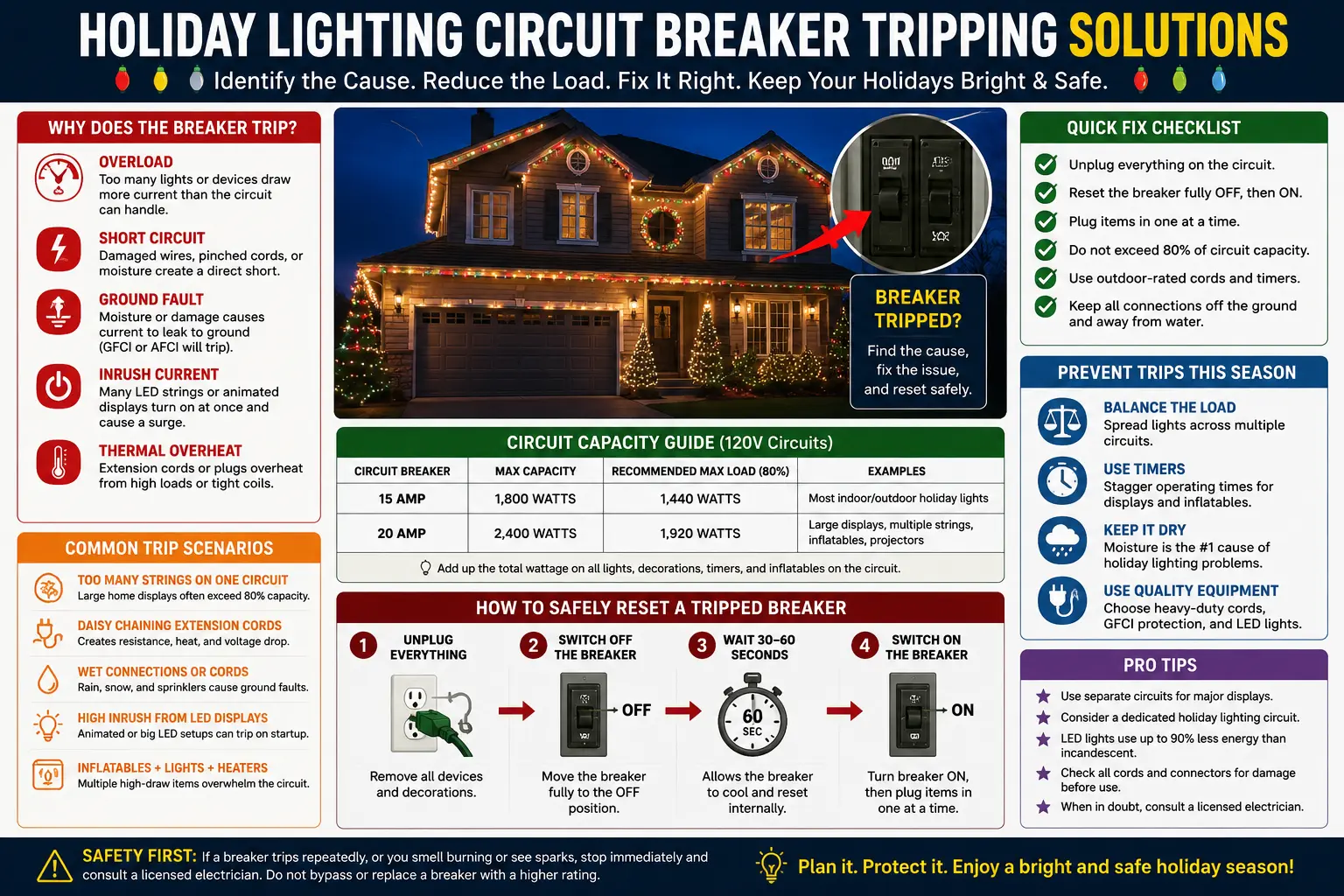
Quick Answer: Holiday lights trip circuit breakers when the display draws more current than the circuit can safely carry, when a damaged cord or strand creates a short, when moisture creates ground leakage, or when multiple loads such as inflatables, incandescent C9 bulbs, projectors, smart plugs and extension cords all share the same branch circuit.
- Breaker trip: usually overload, short circuit or heat-related overcurrent.
- GFCI trip: usually leakage current, moisture, wet plugs or damaged insulation.
- Trips immediately: suspect shorted strand, damaged cord, bad plug or overloaded startup load.
- Trips after rain: suspect wet connection, water inside socket, extension cord end on ground or controller moisture.
- Trips after 10–30 minutes: suspect heat buildup, overload, undersized cord or thermal breaker behavior.
The mistake most homeowners make is treating every trip the same. A breaker that trips the instant you plug in one strand is a different problem from a GFCI that trips only after rain or a breaker that trips after the whole display has been glowing for 20 minutes. The sequence of the trip is the clue.
Safety First: Do Not Keep Resetting the Breaker
Holiday lighting looks low risk because the products are decorative, but the electrical setup is often more complicated than a normal household load. A single outdoor outlet may feed roofline lights, shrub lights, inflatables, projectors, pathway stakes, timers and smart plugs. That entire bundle may be exposed to rain, snow, wind, wet leaves, gutters, metal clips, wet mulch and foot traffic.
If you smell burning, see melted plastic, feel a warm plug, notice black residue, find water inside a plug body, or see exposed copper, unplug that section and do not reuse it. For outdoor outlet protection and moisture-related trips, pair this page with the outdoor lighting GFCI requirements guide and the weatherproofing outdoor holiday lights guide.
Logic Summary: The Breaker Is Telling You Which Failure Path to Follow
A circuit breaker does not know that the load is a Christmas display. It only reacts to current and fault conditions. The useful diagnostic information is not simply that the breaker tripped. The useful information is when it tripped, which device tripped, and what changed right before it happened.
If the breaker trips immediately when one item is plugged in, think short circuit, damaged cord, crushed plug, failed controller or defective strand. If it trips only after the entire display is connected, think cumulative overload. If the GFCI trips after rain but not during dry testing, think leakage current through moisture. If it trips after running for a while, think thermal buildup, coiled cords, overloaded power strips, undersized extension cords or a breaker already serving other loads inside the house.
The clean diagnostic path is power source → circuit load → extension cord path → controller/timer → first strand → added strand sections → moisture exposure. Skipping that order usually causes the wrong repair. Many people replace working lights when the actual problem is a wet cord end lying in mulch, an inflatable motor on the same circuit or an old incandescent load that quietly uses far more power than expected.
Holiday Display Failure Decision Tree
Most homeowners immediately assume the circuit breaker is the problem. In reality, the breaker is usually responding correctly. The goal is to determine what actually caused the trip before replacing lights or resetting the breaker repeatedly.
If the breaker trips immediately:
Look first for damaged plugs, crushed extension cords, pinched wires, or a defective light strand.
If the breaker trips after adding decorations:
Calculate the total circuit load. The display may simply exceed the circuit capacity.
If it trips only after rain:
Inspect plug ends, timers, controllers, GFCI outlets, and extension cord connections for moisture.
If it trips after running for 20–30 minutes:
Check for overloaded extension cords, tightly coiled cords, warm plugs, and excessive incandescent lighting.
If only one decoration causes the trip:
Disconnect that item and test it independently before replacing the rest of the display.
Following the failure sequence almost always finds the problem faster than randomly replacing light strands.
Jump to Section
Breaker Trip Pattern Map
This table separates the most common holiday lighting trip patterns. Use it before replacing lights or blaming the outlet.
| Trip Pattern | Most Likely Cause | What It Usually Means | Best First Fix |
|---|---|---|---|
| Trips instantly when one strand is plugged in | Shorted strand, damaged plug, crushed cord or internal controller fault | The fault is likely in that item, not the whole display | Remove that item and test a known-good strand on the same outlet |
| Trips only after all decorations are connected | Circuit overload | Total amps are too high for the branch circuit or shared household loads | Calculate total watts and split display across circuits |
| Trips after rain or snow | Moisture leakage or wet connection | More likely GFCI leakage than pure overload | Raise plug ends, dry connections and use in-use covers |
| Trips after 10–30 minutes | Heat buildup, overloaded extension cord, coiled cord or thermal breaker response | The circuit may tolerate startup but not sustained heat/current | Uncoil cords, reduce load and inspect warm plugs |
| Trips when inflatable turns on | Motor load, startup surge or shared circuit overload | Decorative lights may be fine; the motor pushes the circuit over the edge | Run inflatables on a separate circuit |
| GFCI trips but panel breaker does not | Leakage current, wet plug, damaged insulation or outdoor moisture path | The GFCI is doing its job | Find the wet or damaged section instead of bypassing protection |
Breaker Trip vs GFCI Trip: The Difference That Changes the Fix
A standard circuit breaker and a GFCI device are often confused because both can shut off your display. They are not watching for the same problem. A breaker is primarily protecting the wiring from too much current. A GFCI is protecting people from leakage current leaving the normal path.
Holiday displays are uniquely likely to create GFCI trips because they place many plug-and-socket connections outdoors. Even a small amount of water inside a plug end, socket, controller box or extension cord connection can create enough leakage to trip a GFCI without drawing enough current to trip the breaker.
That is why a display can run perfectly in the garage but trip outside after the first wet night. The strand is not necessarily overloaded. It may be leaking current through wet debris, damp mulch, a cracked socket, a plug end sitting on concrete or a controller housing that was never truly weatherproof. For broader holiday safety planning, use the holiday lighting guide and the outdoor holiday light weatherproofing guide.
Holiday Lighting Load Math: The Circuit Is Shared, Not Dedicated
The most misleading calculation is counting only the holiday lights plugged into one visible outlet. The outlet is only the access point. It may share a circuit with garage lights, outdoor receptacles, a freezer, a bathroom, a basement outlet, a porch outlet, a sump pump, a smart plug, security lights or another section of the display.
The basic formula is simple: amps = watts ÷ volts. On a 120-volt circuit, a 600-watt display draws about 5 amps. A 1,200-watt display draws about 10 amps. A 1,800-watt display draws about 15 amps before considering other loads on the same circuit.
Most residential circuits are 15A or 20A, but that does not mean you should run the entire rating continuously for a long holiday display. Outdoor lighting may run for hours every night, sometimes through cold, wet and windy conditions. A practical planning target is to keep sustained decorative loads comfortably below the circuit limit and split high-load decorations across more than one circuit.
- 15A circuit: 15 amps × 120 volts = 1,800 watts theoretical maximum.
- 20A circuit: 20 amps × 120 volts = 2,400 watts theoretical maximum.
- Better planning: leave headroom for existing loads, startup surges, timers, controllers and weather conditions.
Before expanding a display, use the holiday lighting power calculator. For low-voltage outdoor systems, use the landscape lighting transformer size calculator and the landscape lighting voltage drop calculator.
C7 and C9 socket damage can contribute to either type of shutdown, but through different failure paths. Too many incandescent lamps may overload the circuit and trip the breaker, while water or damaged insulation inside a socket may create leakage that trips GFCI protection. A melted, carbon-tracked, or heavily corroded socket should never be returned to service simply because it dries out. Use the C7 and C9 holiday socket failure guide to examine bulb wattage, contact condition, socket-body damage, cord piercing, moisture paths, and repair-versus-retirement thresholds.
Load Clues by Decoration Type
| Decoration Type | Breaker Risk | Why It Trips | Planning Move |
|---|---|---|---|
| LED mini strands | Low | Low current draw, but many plug ends can still create moisture leakage | Focus on weatherproof connections more than overload |
| LED C7 / C9 roofline bulbs | Low to moderate | Draw depends on bulb count and bulb wattage | Calculate watts before combining with inflatables |
| Incandescent C9 roofline lights | High | Large bulb count creates significant heat and amperage | Replace with LED or split across circuits |
| Inflatables | Moderate to high | Fan motors and startup behavior add load beyond lights | Run on separate circuit when possible |
| Projectors | Moderate | Usually not huge load, but vulnerable to moisture and adapters | Keep power supplies raised and protected |
| Permanent RGB roofline systems | Depends on design | Controller, power injection, pixel density and brightness settings matter | Plan zones and power feeds instead of guessing |
LED vs Incandescent: Why Old Holiday Lights Trip Breakers Faster
Incandescent holiday lights convert much more energy into heat. That means higher current, warmer cords, warmer plugs and less room for other decorations on the same circuit. A roofline made from older incandescent C9 bulbs can consume a surprisingly large amount of power compared with the same visual outline built from modern LEDs.
LEDs reduce overload risk, but they do not eliminate electrical problems. LED displays still trip GFCI devices when moisture enters plug ends, when controllers are not weather-protected, when extension cords are damaged or when power supplies sit in wet mulch. LEDs solve the wattage problem; they do not automatically solve the outdoor connection problem.
If your current issue is flicker, dimming or partial strand failure instead of a breaker trip, review the LED Christmas light flicker repair guide, the Christmas lights half-out troubleshooting guide and the LED holiday bulb replacement guide.
The Extension Cord Failure Chain Nobody Checks
Extension cords are often the hidden cause of holiday breaker trips. The lights get blamed because the lights are visible, but the cord path may be the weak link. A cord can be too small for the load, too long for the distance, damaged from storage, pinched under a garage door, sitting in water, coiled while energized or feeding multiple splitters.
The failure chain usually starts with resistance. A long or undersized cord causes voltage drop and heat. A loose connection at the plug adds more resistance. A cord end lying on wet ground adds leakage risk. A power strip used outdoors adds another failure point. By the time the display trips, the exact fault may appear to be in the lights even though the cord architecture created the problem.
Never run cords where they can be crushed by doors, windows, vehicle tires or metal clips. Keep plug connections off the ground and under proper weather protection. If a cord feels warm, has damaged insulation, has bent prongs, or has been used outdoors for years, remove it from the display.
The Five Most Common Holiday Electrical Mistakes
Stacking Too Many Splitters
Every adapter creates another potential heat and moisture point.
Leaving Plug Connections on Wet Ground
Even weather-resistant plugs should never rest in standing water, mulch, or snow.
Mixing Old and New Light Strands
Older incandescent strands often create unexpected overloads when mixed with modern LED displays.
Ignoring Warm Extension Cords
A warm cord is an early warning sign that should never be ignored.
Resetting the Breaker Without Testing
Repeated resets hide the real problem and may damage electrical equipment.
Why Holiday Lights Trip After Rain, Snow or Fog
Rain-related holiday trips are usually not simple overloads. They are moisture-path failures. Water gets into plug ends, sockets, fuses, controllers, extension cord connections or power supplies. Once moisture creates leakage from the hot conductor to ground or to another conductive surface, the GFCI trips.
Snow can be even more deceptive because the display may work while snow is dry and cold, then trip when snow melts and refreezes around plug ends or sockets. Fog and heavy dew can also trip weak connections that look dry during daytime inspection.
Start by looking for the lowest plug ends. Water runs downhill. Cord ends sitting in mulch, grass, wet leaves, roof valleys, gutters or porch corners are the most likely leakage points. Then inspect controllers and inline fuses. Many holiday strands have tiny fuse doors or controller seams that are not designed to sit in standing water.
If the system is installed around landscape beds, the same moisture logic applies to low-voltage systems. The green dust lighting connector repair guide explains how moisture turns copper connections into high-resistance failure points over time.
Smart Plugs, Timers and Controllers Can Be the Trip Point
Smart plugs are convenient, but they are also another electronic device inserted into an outdoor circuit. Many display failures blamed on lights are actually caused by a smart plug, timer or controller that is overloaded, wet, poorly rated for the location or handling multiple inductive loads like inflatable motors.
When a display trips only on schedule but not during manual testing, inspect the timer or smart plug. When it trips only when an app scene changes, inspect the controller or zone load. When it trips at dusk, consider the combined startup behavior of lights, inflatables and smart automation. For smart holiday planning, use the smart holiday lighting setup guide, the AI holiday theming logic guide and the smart hub compatibility guide.
The 10-Minute Isolation Test for Holiday Breaker Trips
This is the fastest practical way to separate overload, moisture and equipment faults without guessing. It works because you rebuild the display one known-good section at a time instead of plugging everything in at once.
- Turn the display off and unplug every decoration from the outdoor outlet.
- Reset the breaker or GFCI once.
- Plug in one known-good heavy-duty extension cord with no lights. Wait one minute.
- Add the first lighting zone. Wait two minutes.
- Add the next zone. Wait two minutes.
- Add inflatables last because motors can push the circuit over the edge.
- If it trips, remove the last item added and test it alone on a protected outlet.
- If it only trips after rain, repeat the test after connections are dry and elevated.
Write down the exact item that causes the trip. Holiday displays become difficult to troubleshoot when every strand is connected through multiple adapters. The goal is to find the point where a stable circuit becomes unstable.
Permanent Solutions for Repeated Holiday Lighting Breaker Trips
| Repeated Problem | Temporary Fix | Permanent Solution | Supporting Guide |
|---|---|---|---|
| Breaker trips when full display is connected | Remove several strands or unplug inflatables | Split display across circuits and convert incandescent sections to LED | Holiday power calculator |
| GFCI trips after rain | Dry plugs and reset once | Raise plug ends, use in-use covers and replace weak outdoor connections | Weatherproofing guide |
| Extension cord gets warm | Unplug immediately | Use shorter outdoor-rated heavy-duty cords and reduce load | Holiday lighting guide |
| Old incandescent roofline overloads circuit | Run fewer strands | Convert to LED C7/C9 or permanent roofline lighting | Permanent vs temporary lights |
| Smart plug trips or shuts down | Bypass the smart plug for testing | Use outdoor-rated controller with appropriate load rating | Smart holiday setup |
| One section trips when plugged in | Remove that section | Replace damaged strand, plug, fuse housing or controller | Fuse replacement guide |
When to Stop Troubleshooting and Call a Professional
Some trips are normal diagnostic signals. Others are warning signs that the display should not be re-energized. Call a qualified electrician if the breaker trips with nothing plugged into the outlet, if the panel breaker feels loose or hot, if the outlet sparks, if you see melted receptacle plastic, if the same circuit serves critical equipment, if water entered a junction box, or if you cannot identify whether a wire is line voltage or low voltage.
Also be careful around pools, fountains, docks and wet entertainment areas. Holiday lights near water introduce a different safety category. For water-adjacent lighting, see the swimming pool lighting clearance guide, submersible fountain lighting code guide and dock and pier lighting safety standards.
Philip Meyer's Troubleshooting Tip
The breaker is rarely the problem. Most holiday lighting failures are caused by what was added immediately before the trip occurred. When I troubleshoot outdoor displays, I don't begin by replacing light strands. I begin by asking one question: "What changed?" Did another inflatable get plugged in? Did it rain? Did one new extension cord get added? Did the smart plug start controlling more decorations? That single question usually narrows the entire troubleshooting process within a few minutes.
Holiday Lighting Circuit Breaker Tripping FAQ
Why does my circuit breaker trip when I plug in holiday lights?
A breaker trips when the circuit is overloaded, a cord or plug has a fault, moisture creates leakage, a damaged strand shorts, or too many high-wattage decorations are sharing the same branch circuit.
Is a GFCI trip the same as a breaker trip?
No. A standard breaker responds mainly to overcurrent, while a GFCI responds to current leakage. Outdoor holiday lights that trip only after rain are often GFCI or moisture problems rather than simple overloads.
Are LED Christmas lights less likely to trip breakers?
Yes. LED strands use much less power than incandescent strands, so they are less likely to overload a circuit. However, LEDs can still trip GFCI devices if plugs, controllers or connectors get wet.
Can an extension cord make holiday lights trip a breaker?
Yes. Undersized, damaged, coiled, overloaded or wet extension cords can heat up, create voltage drop or contribute to faults that trip breakers or GFCI outlets.
How many holiday light strands can I connect to one outlet?
It depends on the wattage of each strand, other devices on the circuit and the circuit rating. Do not use the outlet alone as the limit; calculate total watts and amps for the entire circuit.
Why do my lights work inside but trip the breaker outside?
Outdoor failures often come from moisture, damaged insulation, wet plugs, ground leakage, crushed cords, metal gutters, wet controllers or GFCI protection responding to leakage that did not appear indoors.
Expert-Verified Troubleshooting
This guide is written for homeowners trying to distinguish overloads, wet connection trips, GFCI events and unsafe holiday-lighting conditions. Always consult a licensed electrician for repeated breaker trips, damaged wiring, hot outlets, panel issues or permanent circuit upgrades.