Landscape Lighting Guide
This is the main planning hub and the best place to connect design mistakes to a stronger full-yard strategy.
Read the guide
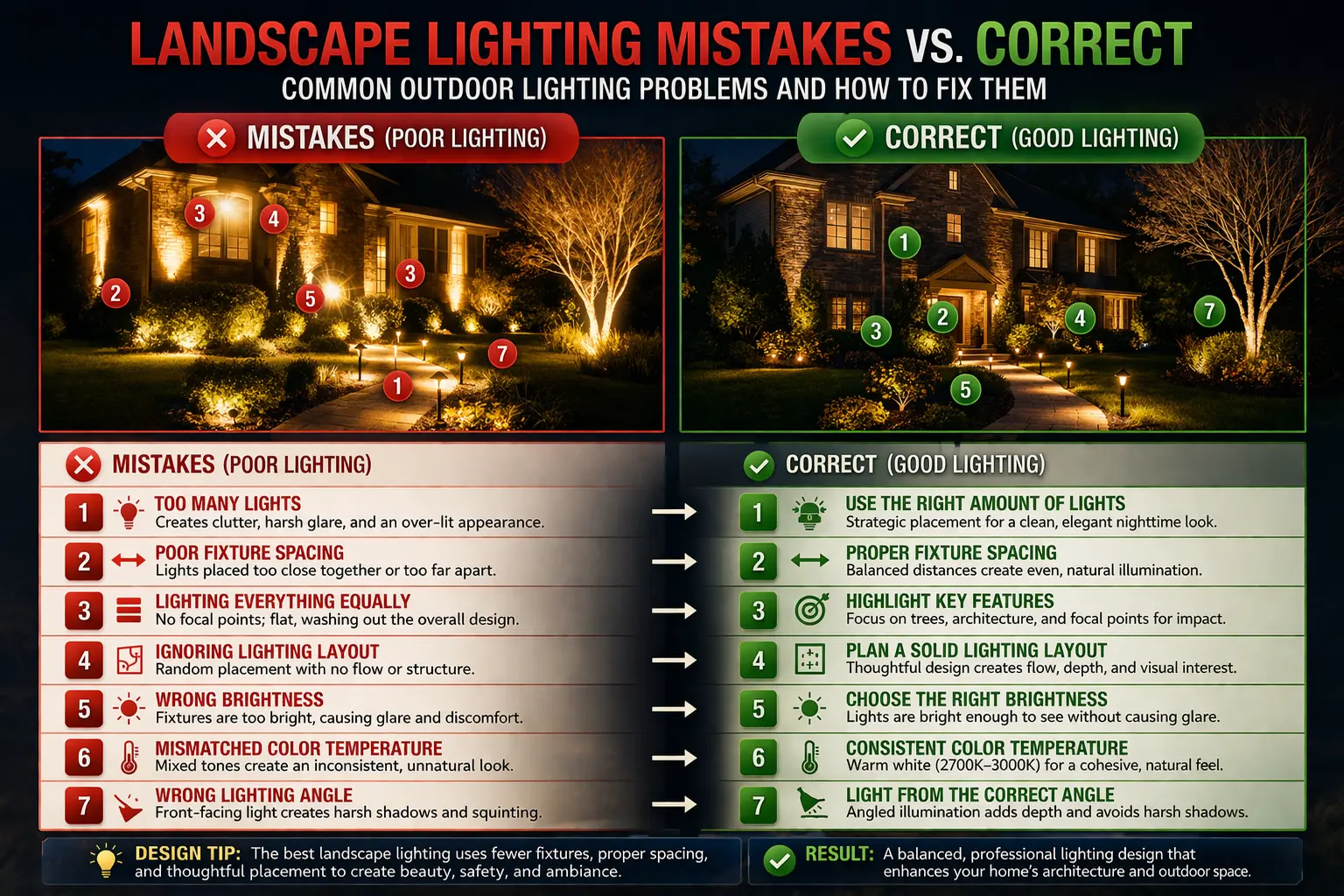
The most common landscape lighting mistakes are using too many lights, poor spacing, bad wiring, and weak layout design. The good news is most of these problems can be fixed quickly by adjusting placement, improving wiring, and simplifying the lighting plan.
The most common problems usually show up in a few clear ways. The yard looks uneven. Some areas are too bright while others disappear into darkness. The lighting feels harsh instead of welcoming. Fixtures are placed without a clear design flow. Wiring problems create performance issues that should have been prevented during planning.
This page is designed to help you see what is going wrong, understand why it happens, and fix it in a practical way. Some mistakes are mostly visual and require redesign. Others are electrical and require real troubleshooting. Many systems have both. Once you know how to separate those problems, it becomes much easier to improve the yard without guessing.
This page connects design mistakes with troubleshooting mistakes. For the main planning foundation, see landscape lighting guide. For the deeper layout page, go to landscape lighting layout design.
See the Landscape Lighting GuideThe most common mistakes are over-lighting, poor spacing, bad wiring connections, and lack of a clear layout. Most systems can be improved by reducing clutter, fixing spacing, and correcting electrical issues.
👉 Fix wiring issues here:
wiring guide
👉 Fix spacing issues here:
spacing guide
Landscape lighting should improve both appearance and performance. A good system makes the yard easier to move through, more attractive to look at, and more natural after dark. A bad system does the opposite. It creates harsh contrast, weak focal points, poor visibility, and electrical problems that seem mysterious but usually began with preventable mistakes.
That is why this page matters so much. It is not just about pointing out what people do wrong. It is about helping you recognize the patterns behind outdoor lighting that looks bad, performs badly, or keeps failing. Once you understand those patterns, you can redesign or troubleshoot with much more confidence.
One of the most common landscape lighting mistakes is adding fixtures without checking how the full run will perform. The Landscape Lighting Voltage Drop Calculator helps you estimate whether the system is already losing too much voltage before dimness shows up across the yard.
Fix: Simplify your layout, improve spacing, and correct wiring issues first.
One of the most common mistakes is assuming more lights automatically create a better result. In reality, over-lighting often ruins the design. It flattens the yard, creates glare, and removes the contrast that makes focal points stand out.
When every tree, path edge, and planting bed is lit with equal intensity, the design starts to feel harsh instead of attractive. Good outdoor lighting usually works through restraint. It highlights what matters most and allows some areas to stay quieter in the background.
Fixtures that are too close together make the yard look crowded and repetitive. Fixtures that are too far apart create dark gaps and weak guidance. Spacing problems are especially common with path lights because the layout may look acceptable in daylight but feel uneven at night.
For the full spacing page, read landscape lighting spacing.
One of the biggest outdoor lighting mistakes is selecting fixtures that scatter light in every direction instead of controlling it. The dark-sky fixture selection guide explains why globe lights, exposed LEDs, shallow shields, and oversized beam spreads often create excessive glare, skyglow, and uncomfortable nighttime environments even at relatively low wattages.
A yard looks better when there is visual hierarchy. Some elements should lead. Others should support. Lighting everything equally removes focal points and makes the whole scene feel flat.
Strong outdoor lighting usually emphasizes a few important areas rather than treating every object as if it deserves the same attention.
Random placement creates random results. Without a layout plan, fixtures often end up scattered instead of connected by a clear visual flow.
The deeper planning page is landscape lighting layout design.
Fixtures that are too bright create glare and harsh contrast. Fixtures that are too dim fail to do the job. Brightness problems often happen when people choose lights based on guesswork instead of considering what each area actually needs.
Mismatched color temperatures can make the yard look unnatural even when the fixture placement is good. Warm and cool lights mixed carelessly often create an inconsistent, unplanned appearance.
For the dedicated guide, use landscape lighting color temperature guide.
One of the most common installation mistakes is burying wire too shallow. See our landscape lighting wire burial depth code guide for the correct depth by wiring method.
One of the most common mistakes is poor wiring connections or damaged cable that leads to repeated failures. If your system already has wiring issues, use the Portfolio lighting wire replacement guide to repair it properly and avoid repeat problems.
Too many lights on one transformer can lead to overload, unstable performance, shutdown, and long-term strain on the system.
The best next page is landscape lighting transformer size calculator.
Loose connections, weak splices, and low-quality connector choices create some of the most frustrating failures in low voltage landscape lighting. These problems may not appear immediately, but over time they often lead to flicker, outages, or failures after rain.
For wiring basics, use how to wire landscape lighting.
Long wire runs can leave the far end of the system weak and dim if voltage drop is not planned for early. This is one reason the electrical layout matters just as much as the visual layout.
The full technical page is landscape lighting voltage drop.
Large systems need structure. Without proper zones, circuits become overloaded, control becomes messy, and troubleshooting gets harder.
For the zone planning page, use landscape lighting zone planning.
One of the most common outdoor lighting mistakes is choosing color temperature based only on brightness or appearance. For a better understanding of how light color affects sleep, wildlife, glare, and sky glow, read Biological Impact of Outdoor Light Color.
Some problems are mainly technical. Others are mainly visual.
If the lights flicker, go dark, fail after rain, or perform unevenly across the system, troubleshooting should come first.
If the system works electrically but still looks harsh, random, flat, or cluttered, the bigger need is redesign rather than repair.
For the broader troubleshooting page, use landscape lights not working.
This is the main planning hub and the best place to connect design mistakes to a stronger full-yard strategy.
Read the guideHelpful when the biggest issue is random placement, weak focal points, or a lack of overall design flow.
Read the guideUse this page when fixture spacing is creating clutter, overlap, or dark gaps across the yard.
Read the guideImportant when the lighting feels mismatched or unnatural because warm and cool tones were mixed poorly.
Read the guideBest when the mistake is transformer overload, weak power planning, or choosing a transformer that is too small.
Read the guideUse this page when poor wiring, weak connectors, or bad installation technique are driving the problem.
Read the guideHelpful when the far end of the system is dim and the original layout ignored wire distance and power loss.
Read the guideBest when the system needs better structure instead of trying to carry everything through one overloaded run.
Read the guideUse this page when bad waterproofing, poor connectors, or weather exposure are causing repeat moisture failures.
Read the guideThis is the main troubleshooting page when the problem is performance-related and you need to diagnose the full system.
Read the guidePoor aiming creates harsh shadows, glare, and unnatural emphasis. A spotlight aimed badly can make a tree or wall look much worse instead of better.
One of the biggest landscape lighting mistakes is assuming brighter always means better. Our detailed guide to outdoor lighting and nighttime wellness explains how excessive lumen output, poor beam control, harsh LEDs, and incorrect color temperatures can create visual discomfort, eye fatigue, and sleep disruption around residential outdoor spaces.
Sometimes the biggest visual mistake is not what gets lit, but what gets ignored. If the strongest architectural feature, best tree, or most important path transition is left dark, the lighting plan often feels wasted.
A system built from one fixture type or one lighting idea often lacks depth. Layering matters outdoors just like it does indoors. Paths, focal elements, architecture, and transitions often need different kinds of light working together.
Cheap or weak connectors are one of the biggest failure points in outdoor lighting. They may work at first, but over time they often lead to weak contact, corrosion, and intermittent problems.
Moisture exposure is one of the fastest ways to expose a bad connection. If the system fails after storms or wet weather, poor waterproofing deserves early attention.
The dedicated rain-related page is portfolio landscape lights not working after rain.
Landscape lighting is not a one-time task you never check again. Buildup, wear, shifting fixtures, damaged cable, and weather exposure all add up over time.
Skipping maintenance turns small correctable issues into full system problems.
One of the most overlooked mistakes is failing to protect the system from power surges. Learn how to avoid costly damage in our landscape lighting surge protection guide.
👉 Full troubleshooting: landscape lights not working
Most poor systems improve when you slow down and work through the layout in a practical order instead of changing random pieces.
Stand in the yard at night and identify what the system is actually doing well and what looks forced, uneven, or unnecessary.
Too many systems improve simply by moving fixtures so they stop overlapping or leaving weak gaps.
If part of the system is dim, flickering, or failing, the wiring and connection quality should be inspected early.
Reduce overly bright fixtures and strengthen weak areas so the yard feels more consistent and intentional.
Once the changes are made, test the full system at night again. The goal is to confirm both appearance and performance, not just one or the other.
One of the most common outdoor lighting mistakes is treating steps like a normal flat walkway. Stairs need more deliberate fixture placement to avoid glare, shadows, and unsafe footing. For that reason, it helps to review a dedicated outdoor stair lighting guide when planning step and stair illumination.
A corrected design often looks very different from the original even if the same yard and many of the same fixtures remain.
For example, a cluttered layout may begin with too many path lights, no real focal points, and one overly bright wash across the front yard. After correction, the extra fixtures are removed, spacing is improved, the main tree becomes a clear focal point, and the path lighting is reduced to a cleaner guiding rhythm.
The result is usually not a brighter yard. It is a better one. That is an important difference.
The best way to avoid most outdoor lighting mistakes is to plan the system before installation. Start with the areas that matter most, define a few focal points, decide how paths and transitions should be guided, then connect the visual plan to the electrical plan.
The main planning page is landscape lighting guide.
Many landscape lighting mistakes happen in garden areas where too many lights are used or fixtures are placed without a clear plan. Our garden landscape lighting guide shows how to avoid over-lighting, improve placement, and highlight plants and features in a more natural and balanced way.
The most common landscape lighting mistakes include using too many lights, poor spacing, random layout, wrong brightness, bad wiring connections, ignoring voltage drop, and failing to create focal points.
The right spacing depends on the fixture type, beam spread, and brightness, but proper spacing should avoid both cluttered overlap and dark gaps.
Yes. Too many lights can flatten the design, create harsh glare, reduce contrast, and make the yard look overlit instead of attractive.
Uneven landscape lighting is often caused by poor spacing, random fixture placement, voltage drop, inconsistent brightness, or trying to light everything equally.
Fixing poor outdoor lighting usually starts with reviewing layout, reducing clutter, adjusting spacing, correcting wiring issues, balancing brightness, and improving focal points.
This page is designed to act as a high-authority mistakes and correction guide, helping you connect visual design errors with electrical and installation problems so the system can be improved in a much more organized way.