
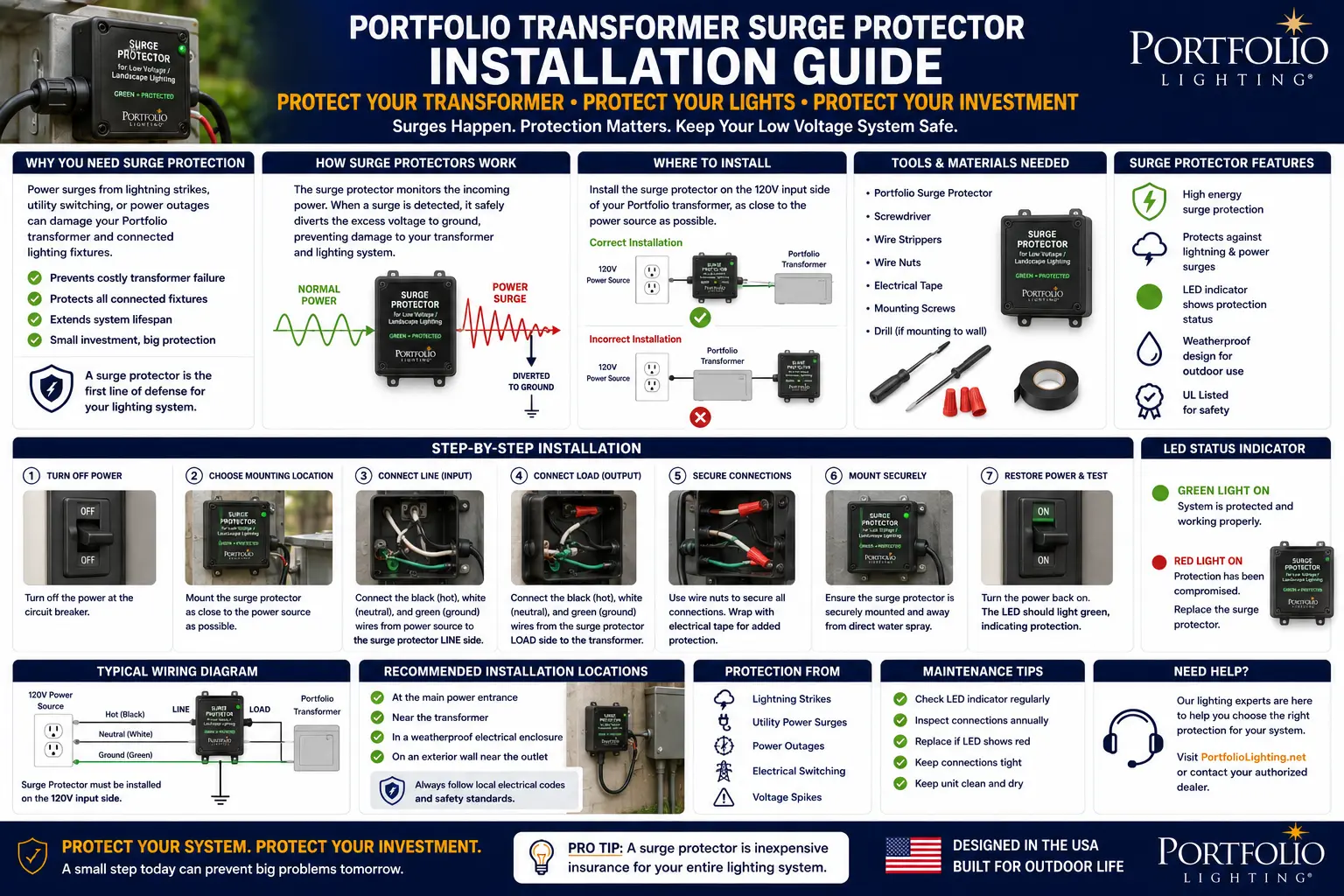
Why Landscape Lighting Systems Are Unusually Surge-Vulnerable
A Portfolio landscape transformer connected to a GFCI outlet on the exterior of your house faces a fundamentally different surge risk profile than your television or laptop. Three factors combine to make outdoor landscape systems among the most surge-exposed electrical equipment on a residential property.
Factor 1: Long Copper Wire Runs Act as Induction Antennas
A lightning strike doesn't have to hit your property to damage your landscape system. When lightning strikes the ground within hundreds of feet — a neighbor's yard, a nearby tree, a utility pole — the massive electromagnetic pulse it creates induces voltage in every nearby conductor. The physics: a rapidly changing magnetic field induces voltage in any conductive loop. Your landscape lighting wire creates exactly such a loop — a large, conductive circuit running through the yard.
The key relationship: the longer the wire run, the more induced voltage. A 200-foot landscape lighting cable run picks up more induced surge energy than a 50-foot run, because the longer wire intercepts more of the electromagnetic field. This is the specific reason why landscape lighting systems — which routinely have 200–500 feet of total wire — are more vulnerable to indirect lightning than most indoor electronics, despite not being connected to any outdoor antenna or exposed metal.
Per Transient Protection Design's landscape lighting documentation: "Lightning frequently damages indoor lighting systems by entering through outdoor lighting conductors. Induced voltage on exterior lighting runs travels back into indoor lighting panels and processors, damaging dimming modules and control electronics."
Factor 2: Ground Path Connections Create Common-Mode Surge Paths
Landscape lighting fixtures are installed with metal stakes in the ground. The ground itself serves as a conductor. When lightning strikes the ground near your property, the electrical potential of the soil near the strike point rises dramatically — then drops as the energy dissipates outward. This creates ground voltage fluctuations that are directly conducted into your landscape system through the fixture stakes' ground connections. The result is common-mode surge voltage entering the system from the ground side simultaneously with any line-side surge entering through the transformer's power supply.
Factor 3: LED Drivers Have Low Overvoltage Tolerance
Per Arrow.com's surge protection documentation: "The older methods of lighting, such as mercury vapor, metal halide or sodium vapor lights, relied upon their robust construction to suppress any transient voltage spikes. LED lighting isn't afforded that luxury and voltage transients can destroy LED power supplies as well as the LEDs themselves."
An incandescent landscape light exposed to a surge might simply burn out a filament — an easily replaced $2 bulb. An LED driver exposed to the same surge may fail catastrophically and irreversibly — requiring replacement of the entire fixture or at minimum the driver board. The semiconductor junctions in LED drivers that make them energy-efficient also make them voltage-sensitive in ways that older light sources were not.
This combination — long wire runs that gather surge energy, ground connections that add common-mode surge paths, and LED components that have limited surge tolerance — makes landscape lighting systems one of the strongest use cases for dedicated surge protection on a residential property. The Portfolio transformer master guide and transformer replacement guide cover what a failed transformer looks like after a surge event.
Two Surge Pathways: Differential Mode and Common Mode
Not all surges enter your system the same way. Understanding the two distinct surge pathways explains why comprehensive protection requires addressing both — and why some surge protectors only address one.
A voltage spike that appears between the hot (line) and neutral conductors. This is the surge pathway that most consumer surge protectors are primarily designed to address. Differential mode surges are the "normal" surge type from utility grid switching, neighboring large appliances cycling on, and capacitor bank operations on the utility lines.
Common sources:Your neighbor's HVAC compressor starting; utility switching capacitor banks; your own refrigerator, AC, or washer starting; grid voltage fluctuations during high-demand periods; nearby (but not directly adjacent) lightning strikes that enter through the utility lines.
Protection approach:Standard MOV-based surge protectors between line and neutral address this pathway. The GFCI outlet's Class C rating (tested at 6,000V, 500A per UL 1449) confirms it is tested against differential mode surges.
A voltage spike that appears between either conductor (line or neutral) and the earth ground conductor. This is the surge pathway most directly associated with lightning — when lightning strikes near a property, the earth voltage in that area rises dramatically, creating a large voltage differential between the earth and the utility neutral. This appears as a common-mode surge on both the line and neutral simultaneously relative to the earth.
Common sources:Direct lightning strikes to the property; indirect lightning strikes to the ground within several hundred feet; lightning strikes to utility lines feeding the property; utility ground voltage fluctuations from large grid events.
Protection approach:Requires MOV protection on the line-to-ground and neutral-to-ground paths in addition to line-to-neutral. Higher-quality surge protectors include all three MOV paths (L-N, L-G, N-G) for complete differential and common-mode protection. Check the product specifications for "three-mode protection" or "L-N, L-G, N-G protection."
Why This Matters for Landscape Lighting Specifically: The long outdoor wire runs and ground-connected fixture stakes of landscape systems make them particularly susceptible to common-mode surges from lightning — the surge pathway that standard line-to-neutral-only protectors don't address. When selecting a surge protector for a landscape lighting transformer, look for three-mode protection (L-N, L-G, N-G) rather than simple L-N-only protection. This is often a specification listed on the protector's data sheet or packaging, sometimes described as "complete surge protection" vs "basic surge protection."
How MOV Clamping Actually Works: The Physics in Plain Language
Every consumer surge protector, and most professional surge protective devices, uses MOVs (Metal Oxide Varistors) as their primary protection element. Understanding how clamping works explains why the specifications matter and what the numbers on the packaging mean.
The MOV as a Non-Linear Resistor
A metal oxide varistor is a semiconductor component made primarily of zinc oxide granules sintered into a disk. Its defining property: resistance that varies non-linearly with applied voltage. At normal voltages (up to about 330–400V for a 120V circuit protector), the MOV has extremely high resistance — essentially billions of ohms. It sits passively in parallel with the protected equipment, carrying no meaningful current. At normal operating conditions, it is electrically invisible.
When voltage exceeds the MOV's clamping threshold, resistance drops dramatically — from billions of ohms to just a few ohms in microseconds. At this low resistance, the MOV shunts the excess current to ground rather than allowing it to reach the protected equipment. This current-to-ground path limits the voltage that the equipment sees. The clamping voltage — the peak voltage that passes through to the equipment during the clamp — is a key specification.
Clamping Voltage: Lower Is Better
The clamping voltage is the maximum voltage that will appear at the surge protector's outlets during a surge event. A surge protector with a 330V clamping voltage limits equipment exposure to 330V during a surge. One with a 400V clamping voltage lets 400V through. The difference matters: LED drivers typically have overvoltage tolerance in the 180–240V range depending on design. Anything above that may cause damage. Lower clamping voltage = better protection.
Per Acuity Brands' DTL photocontrol surge protection documentation: "DTL's standard 160 joule, 320 volt RMS clamps at 850 volts. The mass of the MOV provides direct absorption for the surge, allowing faster response time. Using a spark gap arrestor, particularly during higher surges, will potentially weaken the photocontrol's structure. For example, if a 1600 volt surge strikes and the gap arrestor doesn't fire until 2,500 volts, the internal structure of the photocontrol and fixture must absorb the initial voltage. Our standard 160 joule MOV will arrest the same surge at 850 volts, eliminating potential internal damage." This illustrates why MOV clamping, which responds at a predictable threshold, provides better protection than gap-type arresters that wait for a higher trigger voltage.
Response Time: Nanoseconds
MOVs respond to overvoltage conditions in nanoseconds — billionths of a second. A lightning-induced surge voltage rise time (the time it takes for voltage to go from normal to peak) is typically 1.2 microseconds for a standard test waveform. An MOV clamping in nanoseconds is fast enough to respond well before the surge reaches its peak. This sub-microsecond response time is why MOV-based protection is effective against lightning-induced transients, despite the surge's extreme speed.
The Silent MOV Failure Problem: Why Your "Protected" Indicator Light Is Lying
This is the most important practical fact about consumer surge protectors — and the one that makes the replacement schedule non-negotiable rather than merely advisable.
MOVs Are Sacrificial Components
Every surge an MOV absorbs permanently degrades it. The zinc oxide granules inside the MOV undergo irreversible physical changes when they convert surge energy into heat — the material structure deteriorates slightly with every absorbed event. This degradation is cumulative. After absorbing enough total surge energy (measured in joules), the MOV can no longer clamp effectively. Its clamping voltage rises, then at some point it fails completely.
The failure mode when the MOV's joule capacity is exhausted: the MOV fails open-circuit (high resistance at all voltages, providing zero clamping) or in some cases fails short-circuit (low resistance continuously, which triggers the protector's thermal fuse and shuts down the outlets). The open-circuit failure is the most dangerous scenario for landscape transformers.
The Green Light That Means Nothing
Most consumer surge protectors include an indicator LED — typically labeled "Protected," "Grounded," or "Surge Protection Active." The intent is that this light should go dark when the MOV fails. In practice, the implementation varies and the light cannot be trusted as a reliable MOV status indicator. Per APGE's surge protector documentation: "Many strips have a 'protected' or 'grounded' LED that goes dark when MOVs fail; if yours has one and it's off, replace the strip immediately." The critical qualifier: many strips have this feature. Many don't. Even those that do may only detect some failure modes.
Per Insurance Claim Recovery Support: "blown MOVs (Metal Oxide Varistors) — those protective components in electronics that sacrifice themselves during a surge — look cracked or discolored like small fallen soldiers." Physical inspection of the MOV inside the device is the most reliable check — but this requires opening the protector, which is not practical for routine maintenance.
The Replacement Schedule Is Not Optional
Given that you cannot reliably determine whether your surge protector's MOV is depleted by looking at it:
- Replace all surge protectors every 3–5 years as a calendar-based maintenance task, regardless of apparent function
- Replace immediately after any known major surge event — a nearby lightning strike, a visible power fluctuation accompanied by buzzing or dimming, or a circuit breaker trip that wasn't caused by overcurrent
- Do not assume the "Protected" LED indicates actual protection — use it only as an indicator of a known failure, not as confirmation of continued protection
- Favor surge protectors with documented failure modes — some UL 1449 listed devices have tested failure indicators; look for this in the product's UL listing documentation
A landscape lighting transformer in a storm-prone region (Florida, Gulf Coast, southeastern US, Great Plains) may experience dozens of meaningful surge events per season — not just the dramatic lightning strikes but the frequent utility voltage fluctuations, capacitor switching transients, and micro-surges that occur during every electrical storm. Each of these events consumes joule capacity from the surge protector's MOV. A 400-joule protector that is three years old and has experienced a Florida summer of regular electrical activity may have zero remaining protection capacity — with its "Protected" LED still showing green. The recommendation for these regions is 1,000+ joule ratings and annual inspection-and-replacement schedules.
GFCI vs Surge Protector: Why They Protect Against Completely Different Hazards
This is the most common source of confusion in outdoor landscape electrical protection — and the misunderstanding causes people to believe they're protected when they're not.
| Feature | GFCI (Ground-Fault Circuit Interrupter) | Surge Protector (SPD) |
|---|---|---|
| What it detects | Current imbalance between hot and neutral conductors — current flowing on an unintended path (through a person, through water) | Overvoltage — transient spikes that exceed normal operating voltage by hundreds or thousands of volts |
| Trip/activation threshold | 4–6 milliamps of ground fault current — the amount of current that can cause cardiac fibrillation | Clamping voltage — typically 330–400V AC above which the MOV begins conducting to ground |
| Response action | Disconnects power to the circuit within 1/40 second — cuts the hazardous current path | Diverts excess voltage to ground while allowing normal voltage to continue — does not disconnect power |
| What it protects | People from electrocution via ground fault | Equipment from voltage damage via transient overvoltage |
| Does it protect against surges? | No — surges do not trip the GFCI. A surge can pass through a GFCI outlet and destroy downstream equipment without the GFCI detecting anything. | Yes — this is its primary function |
| Does it protect against shock? | Yes — this is its primary function | No — surge protectors do not detect ground fault current and cannot prevent electrocution |
| Required outdoors? | Yes — NEC 210.8 requires GFCI protection on all outdoor 15A and 20A receptacles | Not code-required but strongly recommended for landscape transformers |
The Delayed Failure Phenomenon: Why Surge Damage Shows Up Weeks Later
This is the most counterintuitive and most practically important fact about surge damage to landscape lighting systems — and the one that causes property owners to wrongly conclude their system survived a surge event unharmed.
Why Components Don't Always Die Immediately
A surge that is strong enough to cause complete immediate destruction is a relatively rare event. More commonly, a surge partially degrades semiconductor components — creating microscopic structural changes in LED junctions, driver capacitors, transformer winding insulation, or control electronics — without immediately pushing them past their functional failure threshold.
Per Southern Lights landscape lighting documentation: "A power surge can weaken internal components without immediately killing them. Things like ICs, suppression diodes, and voltage regulators can degrade and fail days, weeks, or even months later. Here's why: What still works today might fail tomorrow."
The mechanism of delayed failure is cumulative stress. A semiconductor device designed to operate at 12V that has been partially damaged by a surge may now operate at 12V but with degraded insulation margins, increased leakage current, and reduced thermal stability. Normal operation continues — until: a hot summer day increases internal temperatures beyond the degraded thermal margin; a second small surge (which the undamaged device would have easily survived) pushes the degraded device past failure; or simple fatigue accumulation over thermal cycles reaches the point where the degraded structure fails mechanically.
Signs of Delayed Surge Damage in Landscape Systems
These symptoms appearing weeks after a known electrical storm may indicate delayed surge damage rather than independent component failure:
- Multiple LED driver failures in a short window — when three or four fixtures fail within weeks of each other, simultaneous manufacturing defects are unlikely. Post-surge progressive failure is the more probable explanation.
- Transformer output voltage drift — measure the transformer's 12V output with a multimeter. If it reads significantly different from the rated output (below 11V or above 13V) when it previously read correctly, the transformer's voltage regulation circuit may have been partially damaged.
- Photocell or timer malfunction after previously reliable operation — these control electronics are among the most surge-sensitive components in a landscape transformer. Erratic scheduling, missed cue times, or photocell failures in the weeks after a storm may indicate partial surge damage to the control board. See the photocell not working guide for diagnosis.
- Flickering that appeared after a storm and wasn't present before — micro-surge-induced damage to LED drivers can produce flickering as the driver operates near its degraded margin. See the Portfolio lights too dim guide and lights work sometimes guide for symptom patterns.
I've had two landscape lighting service calls that followed identical patterns: client calls in late August, three fixtures dead, transformer photocell acting erratic. Client says nothing happened to the system. When I ask about storm activity in July, they confirm there was a significant electrical storm with lightning nearby. Classic delayed surge damage — the system appeared fine for six weeks while degraded components slowly failed under normal operating stress. The transformer itself survived (the transformers are usually more robust than the LED drivers in the fixtures) but the control board needed replacement and four fixtures had failed drivers. Total cost: $600–800 in parts and labor. A $25 surge protector installed at the outlet, and a $300–500 whole-house SPD at the panel, would have had an excellent probability of preventing all of it.
Three-Layer Surge Protection Strategy for Landscape Transformers
The most comprehensive surge protection for a landscape lighting system uses three distinct protection layers at three different points in the power path. Each layer addresses different surge energies and different entry points. The layers are complementary — you don't choose one, you implement all three for the most vulnerable installations.
Specifications: 40–80 kA surge current rating for typical residential use; 100 kA for high-lightning-risk areas. UL 1449 listing required. Requires electrician for installation. Cost: $300–600 for device + installation.
Per Color Kinetics' surge protection documentation: "If the distance between a protected distribution panel and several luminaires is more than 20 meters, using a second protection stage is recommended, even if the protection level of the first stage seems to be sufficient." For landscape transformers mounted more than 65 feet from the panel — which includes most residential landscape installations — a second-stage protection point is needed regardless of whether a panel SPD is installed.
Options for this layer:
Option A — Plug-in surge protector: A UL 1449-listed outdoor-rated surge protector plugged into the GFCI outlet, with the transformer's plug then inserted into the surge protector. Select one rated for outdoor use, with 1,000+ joule rating, clamping voltage ≤400V, and three-mode protection (L-N, L-G, N-G). Weather-resistant housing is essential if the outlet is not covered.
Option B — GFCI outlet with integrated surge protection: Replace the existing GFCI outlet with a combination GFCI+SPD outlet (Leviton, Hubbell) that provides both shock protection and surge clamping in a single device. This is the cleanest solution with no external components and full weatherproof integration with the outlet box cover. Requires basic outlet replacement skill or an electrician.
Most consumer Portfolio landscape transformers do not include internal surge protection as a specified feature. Specialty transformer-mounted or secondary-side surge protection devices exist for professional-grade systems; these typically mount inside the transformer enclosure and protect the secondary output terminals.
Per Transient Protection Design's lighting system documentation: "Modern LED landscape transformers are often installed outdoors and far from the main electrical service. These transformers are fully exposed to surge energy. TPD offers compact surge protection devices that install directly inside transformer enclosures, protecting both low-voltage outputs and internal electronics at a frequently overlooked location."
For Portfolio-brand consumer transformers: Layer 3 is the most difficult to implement without replacing the transformer with one that includes internal protection. For the purposes of protecting a standard Portfolio transformer, prioritizing Layers 1 and 2 provides substantial protection.
How to Choose: Joule Rating, Clamping Voltage, UL 1449, and kA Rating
The specifications on surge protector packaging use terminology that looks intimidating but reduces to three or four numbers that determine whether a device is appropriate for landscape transformer protection.
Joule Rating: The Most Important Specification
The joule rating is the total surge energy the device can absorb before its MOVs are depleted. Higher is always better. For landscape transformer protection in typical residential settings:
- 200–400 joules: Minimum acceptable — provides limited protection against small surges. Not recommended for storm-prone areas or high-value transformer systems.
- 600–1,000 joules: Good protection for most residential locations with occasional storm activity
- 1,000–2,000 joules: Recommended for southeastern US, Gulf Coast, Florida, and Great Plains — high-lightning-activity regions where the transformer may see dozens of meaningful surge events per season
- 2,000+ joules: Best practice for high-value landscape systems, commercial-grade installations, or properties that have experienced prior surge damage
Clamping Voltage: Lower Is Better
The clamping voltage is the peak voltage that will reach your transformer during a surge event. Lower clamping voltage = better equipment protection. For 120V outlet surge protectors:
- 330V clamping voltage: Excellent — the best commonly available clamping voltage for residential devices
- 400V clamping voltage: Good — adequate for most landscape transformer protection
- 500V or higher: Marginal — provides some protection but allows higher voltages through that may still damage LED drivers
Per Belkin's surge protector documentation: "Many budget or lower quality surge protectors don't clamp or kick in until higher voltages of 500VAC or higher are reached and by then electronic devices could already be damaged."
UL 1449 Certification: Non-Negotiable
UL 1449 is the Underwriters Laboratories standard for surge protective devices. A UL 1449 listing means the device has been independently tested and verified to meet specific safety and performance standards. Per APGE's surge protector guidance: "UL 1449 certification: This is the independent safety standard from Underwriters Laboratories that confirms the device has been tested and verified for surge suppression. It's not a marketing claim — it's a tested certification. Don't buy a surge protector that doesn't carry it."
For outdoor landscape applications: confirm UL 1449 listing, and also confirm the device is rated for outdoor/wet-location use if it will be exposed to weather. Many plug-in surge protectors are indoor-only and will fail rapidly in outdoor conditions even in a covered outlet box.
kA Rating: For Whole-House Panel SPDs
For panel-mounted surge protective devices (Layer 1), the kA (kiloamp) rating indicates how much surge current the device can handle. For residential use:
- 40–60 kA: Adequate for typical residential installations in moderate lightning zones
- 80–100 kA: Recommended for high-lightning-activity regions or homes with significant outdoor electrical infrastructure
Step-by-Step Installation: Point-of-Use Surge Protector at the Transformer Outlet
This is the Layer 2 installation — the plug-in surge protector at the transformer's outdoor GFCI outlet. This is the most accessible surge protection step for a homeowner and provides meaningful protection for the transformer without requiring an electrician.
What to Do After a Surge Event
Knowing that the delayed failure phenomenon exists changes the post-surge response from "wait and see if anything is broken" to "proactive inspection before delayed failures create bigger problems."
Immediate Checks (Within 24 Hours of a Known Surge Event)
- Check the surge protector's indicator light. If the "Protected" LED is dark, the surge protector has detected its own failure — replace it immediately before running the landscape system again.
- Measure transformer output voltage. Use a multimeter on the transformer's secondary terminal block with the transformer running. Should read 11.5–13.5V depending on the tap selected. Readings significantly outside this range may indicate primary circuit damage. See the how to test a landscape lighting transformer guide for the complete measurement procedure.
- Check all landscape lighting zones. Turn on all zones and note any fixtures that are not working, are flickering, or are noticeably dimmer than before the surge. Document which fixtures show symptoms.
- Inspect the transformer for physical damage. Look for burn marks, scorched insulation near the power cord or outlet plug, or melted plastic in the transformer housing. If any thermal damage is visible, do not reconnect — contact your homeowner's insurance and consult the landscape lighting insurance guide for the claim process.
Proactive Checks Over the Following 4–6 Weeks
- Walk the landscape lighting system weekly and note any fixture changes — new failures, new flickering, any brightness changes
- Re-test transformer output voltage at 2 weeks and 4 weeks post-surge to catch any drift in the transformer's voltage regulation
- If multiple fixtures fail in the 4–6 week window following a surge event, this is consistent with delayed failure and warrants proactive inspection of the transformer's internal control board
- Replace the point-of-use surge protector after any known significant surge event, even if the indicator light is still green
Landscape Transformer Surge Protector FAQ
Does plugging my transformer into a GFCI outlet protect it from lightning surges?
No — a GFCI outlet and a surge protector protect against completely different hazards. A GFCI detects current flowing on an unintended path (ground fault) and cuts power — it protects people from electrocution. A surge protector detects voltage spikes and diverts excess voltage to ground — it protects equipment from overvoltage damage. A surge can pass through a GFCI outlet without tripping it and destroy the transformer and fixtures downstream. The GFCI outlet your transformer plugs into satisfies the NEC safety requirement for outdoor receptacles but provides zero protection against surge events. You need both — GFCI for safety and surge protection for equipment. See the GFCI requirements guide for the complete outdoor GFCI framework.
How do I know if my surge protector is still working?
You often cannot tell with certainty — this is the fundamental problem with consumer MOV-based surge protectors. The "Protected" indicator LED may remain green after the MOV has been fully depleted by accumulated surge events. The most reliable approach is to replace surge protectors on a scheduled basis: every 3–5 years for typical use, every 1–2 years in high-lightning-risk regions (Florida, Gulf Coast, Great Plains), or immediately after any known major surge event (nearby lightning strike, visible power fluctuation). If the "Protected" LED is dark or has changed color, replace the device immediately. If you cannot remember when the surge protector was installed, replace it — the cost of a new 1,000-joule outdoor surge protector ($20–40) is trivial compared to transformer replacement ($80–300) or fixture replacement ($15–50 each).
Can a surge damage my landscape lights without damaging anything else in my house?
Yes — and this is a documented real-world scenario from the landscape lighting professional community. The transformer's primary function includes absorbing and limiting voltage spikes before they can reach the household wiring. In some surge events, the landscape transformer effectively sacrifices itself to protect the indoor wiring and electronics. Per landscape lighting forum documentation: "I had two cases, one where the transformers fried but the house had no damage/appliances etc that fried." The outdoor copper wire runs gathering induced surge energy from the electromagnetic pulse of a nearby lightning strike can channel enough energy to destroy the landscape transformer without the surge reaching significant amplitude on the indoor branch circuits. This is why the transformer plug blades sometimes fuse into the outlet (the surge was localized and concentrated at that connection point) even when the rest of the house shows no surge damage.
What joule rating do I need for a landscape transformer surge protector?
For typical residential installations: 1,000 joules minimum for good protection. For southeastern US, Florida, Gulf Coast, or Great Plains (high-lightning-activity regions): 1,500–2,000 joules. The joule rating represents the total surge energy the device's MOVs can absorb before they're depleted and the device stops protecting. Higher joule ratings provide more protection per event and longer service life before depletion. For most consumer landscape transformers (Portfolio, Malibu, Hampton Bay), a point-of-use surge protector rated at 1,000–1,500 joules with a clamping voltage at or below 400V and UL 1449 certification provides meaningful protection against all but the most severe direct lightning events.
My landscape lights are flickering since a storm last month. Could it be surge damage?
Yes — this is a classic delayed failure pattern. Surge damage to LED drivers and transformer electronics often doesn't cause immediate failure; damaged components degrade progressively and begin failing under normal operating stress in the weeks following the surge event. Flickering that appeared after a storm and wasn't present before is consistent with LED driver damage from the surge. Check voltage at the transformer's output terminals first (should be 11.5–13.5V) using a multimeter — low voltage is a separate cause of flickering. If voltage is in range, inspect individual fixtures: remove and test each flickering lamp by swapping it with a known-good lamp. If the flickering follows the lamp (the swapped lamp flickers in the new fixture), the lamp driver has been damaged. If the flickering stays in the fixture regardless of which lamp is installed, the fixture's wiring or socket has been damaged. See the lights work sometimes guide for the complete systematic diagnostic procedure.
Related Transformer, Electrical Code, and Troubleshooting Guides
- Portfolio Transformer Master Guide
- Portfolio Transformer Troubleshooting
- Portfolio Transformer Replacement
- Transformer Reset Guide
- Transformer Not Working
- How to Test a Transformer
- Transformer Sizing Guide
- GFCI Requirements Guide
- Arc Fault & GFCI Code
- Electrical Code Safety Guide
- Insurance & Liability Guide
- Landscape Lighting Troubleshooting
- Portfolio Landscape Lights Not Working
- Lights Work Sometimes Guide
- Portfolio Lights Too Dim
- One Zone Not Working
- Photocell Not Working
- Failure Points Guide
- Landscape Lighting Corrosion Guide
- Landscape Lighting Maintenance
- MR16 LED Replacement Bulbs
- Load Calculation Guide