
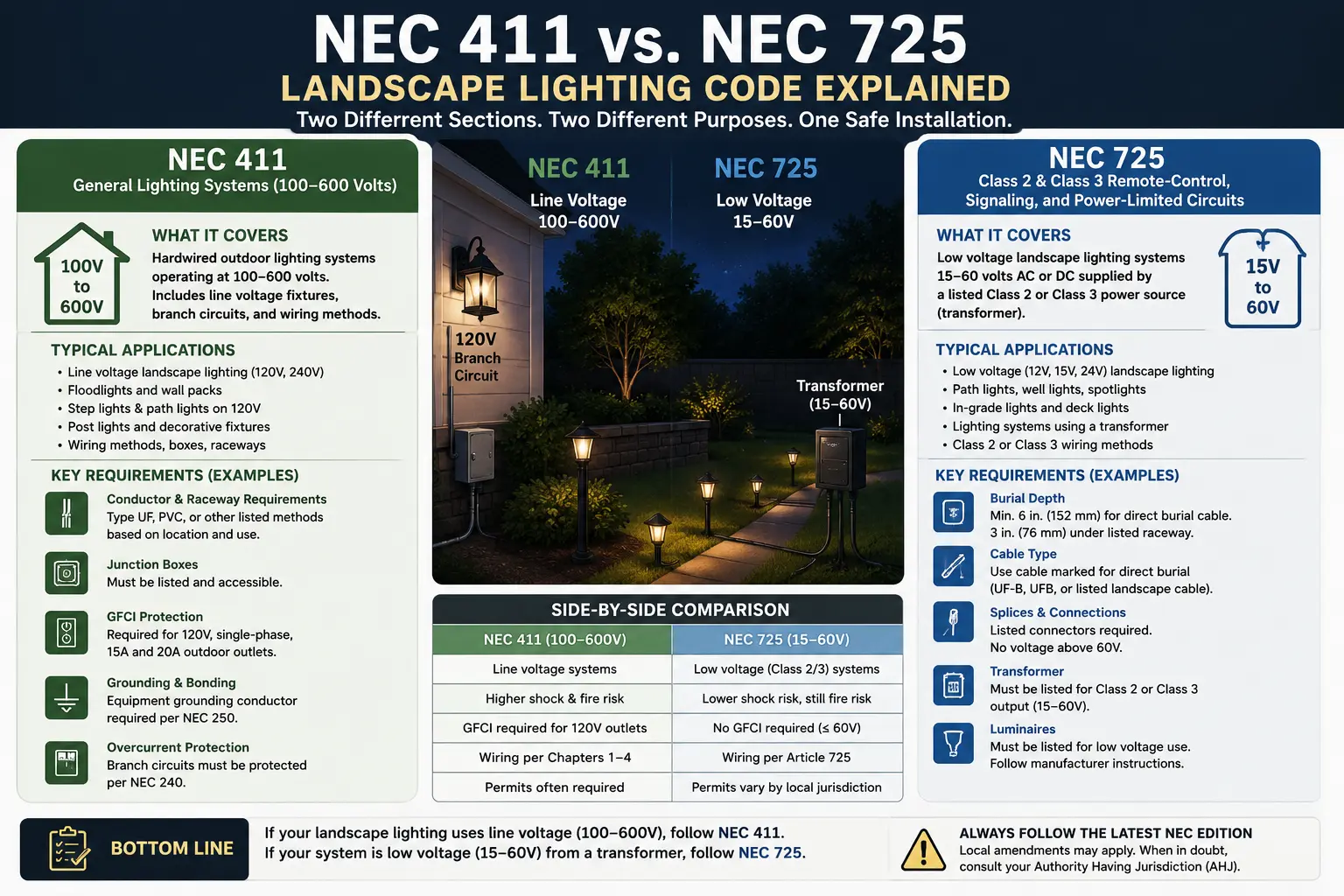
Trying to figure out whether your landscape lighting system falls under NEC 411 or NEC 725? Start by separating the fixture system from the power source. Most confusion happens because homeowners, installers, and even product pages use “low voltage,” “Class 2,” and “landscape lighting” as if they all mean the same thing.
They do not. A low-voltage lighting system is not automatically a Class 2 system. A Class 2 transformer is not automatically permission to bury any wire anywhere. A 12-volt fixture is not automatically exempt from outdoor listing, burial, splice, mounting, or damage-protection requirements. The NEC article that matters depends on the equipment, the power source, and the way the circuit is installed.
This guide is written for the real-world point where the code language meets a homeowner’s yard: a listed transformer mounted outside, low-voltage cable in mulch or soil, fixtures on stakes, pierce connectors or gel splices, and an inspector or electrician asking whether the installation is a lighting system under Article 411, a Class 2 circuit under Article 725, or both.
NEC 411 vs NEC 725: The Practical Difference
NEC Article 411 is about low-voltage lighting systems. In plain language, it is the article people usually think of when they are dealing with lighting that operates at 30 volts or less and is supplied by a listed low-voltage power source. That is why landscape lighting discussions often start with Article 411.
NEC Article 725 is about remote-control, signaling, and power-limited circuits. It covers Class 1, Class 2, and Class 3 circuits. In landscape lighting, Article 725 usually enters the conversation when the transformer or power supply is marked as Class 2 or when the wiring is being treated as power-limited.
The two articles are not enemies. They often describe different sides of the same installation. Article 411 helps identify the lighting system. Article 725 helps explain the Class 2 power-limited circuit rules if the power source is listed and limited that way.
NEC 411 usually points to the lighting system
Think fixtures, low-voltage lighting equipment, listed lighting power supply, and systems operating at 30 volts or less.
NEC 725 usually points to the power-limited circuit
Think Class 2 transformer output, power-limited wiring, circuit classification, and the limitations created by the listed source.
For broader safety context, compare this guide with the landscape lighting electrical code safety guide, NEC 2026 landscape lighting code updates, and low-voltage lighting permit requirements.
NEC 411 vs NEC 725 Decision Matrix
| Question | NEC 411 Angle | NEC 725 Angle | What to Check on the Job | Common Wrong Assumption |
|---|---|---|---|---|
| Is this a low-voltage lighting system? | Yes, if it is a lighting system supplied by a listed low-voltage lighting power source within the voltage limits. | Only relevant if the output is Class 2 or Class 3 power-limited. | Transformer label, fixture rating, installation instructions. | “Low voltage means Class 2.” |
| Is the transformer Class 2? | Article 411 still matters if it supplies the lighting system. | Class 2 status depends on the listed power source output limits. | Look for “Class 2” on the transformer or power supply label. | “Any 12V transformer is Class 2.” |
| Can I bury the cable? | Lighting system must follow listing and outdoor-use requirements. | Power-limited wiring still needs suitable cable and protection from damage. | Direct-burial cable marking, depth, local code, protection. | “Class 2 wire can be shallow anywhere.” |
| Can I use any connector? | Connections must suit the lighting system and environment. | Power-limited does not excuse poor splices or wet-location failures. | Connector listing, gel fill, corrosion protection, strain relief. | “Low voltage splices don’t matter.” |
| Does the system need GFCI? | Outdoor supply and transformer location matter. | Class 2 output may be power-limited, but the 120V supply is still normal power. | Outdoor receptacle, GFCI rules, transformer cord/plug, mounting. | “The low-voltage side makes the receptacle irrelevant.” |
What Class 2 Really Means on a Landscape Lighting Transformer
“Class 2” is not a casual description. It refers to a power-limited circuit supplied by a listed source with defined output limits. In a landscape lighting system, that source is usually the transformer or LED power supply. The label matters more than the sales description.
If the transformer is marked Class 2, the output has been limited in a way that affects wiring rules and shock/fire risk assumptions. That does not mean the installation has no rules. It means the circuit is evaluated differently from ordinary branch-circuit wiring. The cable still needs to be suitable for the environment. The connections still need to resist moisture. The transformer still needs to be installed according to its listing. The 120-volt receptacle or hardwired supply still has to be code-compliant.
A common mistake is assuming that every 12V landscape transformer is Class 2. Some larger landscape transformers supply higher wattage systems and may not be Class 2 on the output. Others have multiple taps or output ratings that need to be read carefully. When in doubt, look at the nameplate and installation instructions, not the fixture box marketing.
For transformer-specific help, see the low-voltage landscape lighting transformer guide, transformer sizing guide, transformer troubleshooting guide, and outdoor transformer mounting code requirements.
How Landscape Lighting Fits the NEC Articles
A typical residential landscape lighting system has a 120V input side and a low-voltage output side. The input side may be a cord-and-plug transformer connected to an outdoor receptacle, or it may be a hardwired transformer installed by an electrician. The output side runs through low-voltage cable to path lights, spotlights, deck lights, step lights, well lights, wall wash fixtures, or in-grade fixtures.
Article 411 is most useful when looking at the low-voltage lighting system as a whole. It helps frame the requirements for listed power supplies and low-voltage lighting equipment. Article 725 becomes relevant when the output circuit is specifically a Class 2 or Class 3 circuit. The inspector may ask for the transformer label because that label is what proves the circuit classification.
This is also why two systems that both look like “landscape lighting” may be treated differently. A small listed Class 2 LED power supply feeding a few low-wattage fixtures is not the same as a large multi-tap transformer feeding a long, high-load property system. The wiring may look similar in the mulch, but the source and load determine the code discussion.
Small Class 2 LED landscape system
Usually lower wattage, power-limited by the listed source, and often simpler to evaluate if all components are listed and installed as instructed.
Large multi-tap landscape transformer system
May provide more output capacity and require closer attention to load, voltage drop, cable size, overcurrent behavior, and transformer listing.
Mixed low-voltage and line-voltage outdoor lighting
Needs a clear separation between the low-voltage lighting system and any 120V outdoor fixtures, receptacles, junction boxes, or controls.
Why Inspectors Ask About NEC 725 on a Landscape Lighting Job
Inspectors usually ask about NEC 725 when they are trying to confirm whether the output is truly power-limited. They are not usually asking because the path light brand matters. They are asking because the installation method depends partly on the source supplying the circuit.
If you say, “It is low voltage,” the follow-up question may be, “What kind of low voltage?” A 12V landscape lighting circuit supplied by a listed Class 2 source is different from an unmarked transformer output. A transformer with a clear Class 2 label gives the inspector a defined starting point. A transformer with no marking, a missing door label, a damaged nameplate, or an unknown replacement power supply creates uncertainty.
The cleanest inspection answer is not a debate. It is documentation. Keep the transformer label readable. Keep the installation instructions. Use cable marked for direct burial outdoors. Use connectors intended for wet or damp landscape environments. Mount the transformer where the manufacturer permits it. Follow local burial-depth and damage-protection rules.
If you are preparing for inspection, also review landscape lighting inspection checklist, permit inspection failure reasons, and landscape lighting insurance liability guide.
Burial, Splices, and Connectors: Where NEC 411 and NEC 725 Confusion Gets Expensive
The most expensive misunderstanding is thinking that power-limited means consequence-free. Low-voltage landscape cable still fails when it is nicked by edging equipment, chewed, pinched under stone, pierced by a poor connector, buried too shallow for the site conditions, or spliced with a connector that fills with water.
NEC discussions often focus on the article number, but field failures usually happen at the connector. A system can use the correct transformer and still fail if the installer uses indoor wire nuts in wet soil, clamps a pierce connector onto cable too thick for the pins, or buries a splice under tension. Moisture and resistance do not care that the system is low voltage.
Class 2 may limit the available power, but it does not make corrosion disappear. A high-resistance splice can dim the rest of the run, create flicker in integrated LED fixtures, cause intermittent operation after rain, or make the transformer appear defective when the transformer is only reacting to a bad circuit.
For detailed repair and installation help, use landscape lighting wire burial depth code, splice connection code requirements, low-voltage wire connectors, and landscape lighting connectors.
Class 2 status describes power limitation and circuit classification, but it does not tell you whether an LED driver presents a clean load to the transformer or electrical system. Two listed drivers can have very different current waveforms, power factors, crest factors, and harmonic profiles. For projects using numerous electronic fixtures, review the LED driver harmonic distortion compliance guide to understand the difference between product-level driver performance and system-level harmonic limits measured at the point of common coupling.
Field Scenario Matrix: Which Article Comes Up?
| Real-World Situation | Likely Code Discussion | Most Important Evidence | What the Visitor Should Do Next |
|---|---|---|---|
| Small plug-in transformer feeding a few 12V path lights | Article 411 for lighting system; 725 if Class 2 output is labeled | Transformer label and installation instructions | Verify outdoor receptacle, GFCI, cable type, and connector method |
| Large multi-tap transformer feeding 20 fixtures | Article 411 plus transformer listing and load calculations; 725 only if output is Class 2 | Wattage/VA, tap rating, output marking, load total | Calculate load and voltage drop before adding fixtures |
| Direct-burial cable run through mulch to path lights | Lighting system and wiring method requirements | Cable marking, burial depth, damage protection | Confirm cable is outdoor direct-burial type and protected from damage |
| Fixture splice fails after rain | Not usually an article-number problem; usually connector/listing/environment problem | Connector type, corrosion, water entry, strain relief | Replace with proper direct-burial gel splice and inspect downstream voltage |
| Inspector asks whether system is Class 2 | NEC 725 circuit classification question | Class 2 marking on transformer or power supply | Provide label photo and manufacturer instructions |
Common Mistakes When Homeowners Read NEC 411 and NEC 725
Assuming low voltage always means Class 2
The system voltage and the circuit class are different facts. Check the transformer or power supply label.
Ignoring the 120V side of the transformer
The low-voltage output does not eliminate outdoor receptacle, GFCI, mounting, cord, or hardwire requirements on the input side.
Using indoor connectors underground
The output may be low voltage, but underground moisture still destroys unsealed wire joints.
Replacing the transformer before testing the cable
Many “bad transformer” calls are actually damaged cable, corroded terminals, wet fixtures, or failed connectors.
Assuming a permit is never required
Some areas treat low-voltage outdoor lighting as minor work, while others require permits for certain transformer, trenching, or hardwired installations.
How to Talk to an Electrician or Inspector About This
The fastest way to get a clear answer is to stop asking, “Is this 411 or 725?” and start describing the system. Tell them what transformer is used, whether the output is labeled Class 2, whether the transformer is plug-in or hardwired, where it is mounted, what cable is buried, how deep it is buried, what connectors are used, and what fixture type is installed.
A useful description sounds like this: “The system uses a listed outdoor low-voltage landscape lighting transformer. The output label shows 12V and a listed wattage. The cable is marked for direct burial. The splices are gel-filled direct-burial connectors. The transformer is supplied from an outdoor GFCI-protected receptacle.” That gives the inspector real facts instead of forcing them to guess from a product category.
If the transformer is missing its label, treat that as a problem. Without the label, it is harder to prove the output classification, voltage, wattage, listing, or installation limitations. Replacement may be smarter than trying to defend an unknown power source.
Repair and Replacement Direction When the Article Is Unclear
If you are repairing an older landscape lighting system and cannot determine whether the original transformer output was Class 2, do not build new work around guesses. Replace the power source with a listed transformer appropriate for the load and location. Then match the cable, connectors, fixture wattage, and burial method to the new equipment.
If you are replacing fixtures only, the transformer label still matters. A small Class 2 transformer may not have enough capacity for additional or higher-wattage fixtures. A large transformer may need better cable planning because longer runs and higher loads make voltage drop more important. Article numbers do not solve overload or voltage drop.
Use the landscape lighting transformer size calculator, landscape lighting voltage drop guide, wire gauge guide, and landscape lighting brands specifications guide before changing major components.
NEC 411 vs NEC 725 FAQ
Does NEC 411 replace NEC 725 for landscape lighting?
No. Article 411 addresses low-voltage lighting systems. Article 725 may still matter when the circuit is Class 2 or Class 3. The equipment label and installation details determine which rules are relevant.
Is a 12V landscape lighting transformer automatically Class 2?
No. The transformer or power supply must be listed and marked as Class 2 for that classification to apply. Voltage alone is not enough.
Can I bury Class 2 landscape lighting wire shallow because it is power-limited?
Do not assume that. Cable must be suitable for the location and protected from damage according to listing, instructions, and local requirements. Outdoor direct-burial low-voltage cable is normally used for buried landscape lighting runs.
Why does my inspector care about the transformer label?
The label provides voltage, wattage or VA rating, listing information, location rating, and Class 2 marking if present. Without it, the circuit classification and installation limits are harder to verify.
Does Class 2 mean my splices do not need waterproofing?
No. Class 2 limits available power, but outdoor moisture still causes corrosion, voltage drop, flicker, intermittent operation, and failed fixtures. Use connectors designed for direct-burial or wet landscape lighting conditions.
Which article should I mention on a permit or inspection question?
Describe the actual installation instead of relying on one article number. Mention that it is a low-voltage lighting system, provide the transformer label, and note whether the output is marked Class 2.
Code and Safety Disclosure
Electrical codes are adopted and interpreted locally. This guide is an educational reference for homeowners and site visitors, not a substitute for the NEC text, local amendments, product listing instructions, permit office guidance, or a licensed electrician.