
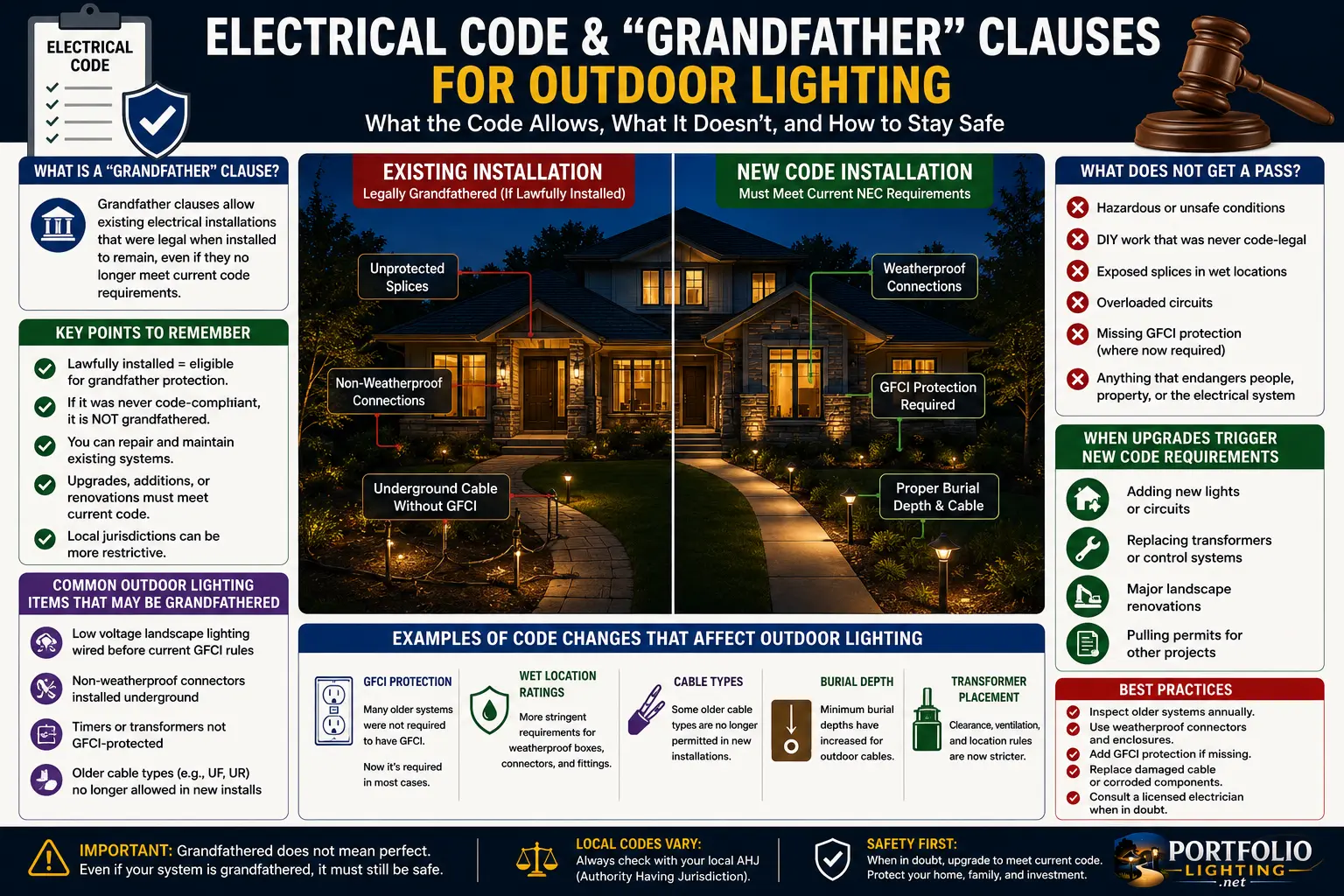
Quick Answer: Is Old Outdoor Lighting Grandfathered?
Old outdoor lighting is not automatically safe, legal, or exempt just because it was installed years ago. A grandfather clause may allow an older installation to remain if it was legal when installed and has not been materially changed, but that protection is limited. Damaged wiring, exposed conductors, missing covers, unsafe splices, water intrusion, improper GFCI protection, failed transformers, deteriorated underground cable, or equipment near pools and docks can still require correction.
The practical rule is this: age may explain why something exists, but it does not excuse a present safety hazard. If you replace equipment, extend a circuit, move a transformer, add smart controls, open a junction box, sell the property, file a permit, or repair a failed underground run, older outdoor lighting may be pulled into current code review.
Logic Summary: Grandfathered Does Not Mean Untouchable
A grandfather clause is best understood as a limited tolerance for older work that was acceptable when installed. It is not a lifetime warranty. It usually does not protect hidden hazards, unpermitted alterations, deteriorated equipment, unsafe repairs, water-damaged wiring, or modern additions tied into an older circuit.
Outdoor lighting is especially tricky because the failure environment changes over time. A system that looked acceptable ten years ago may now have cracked insulation, corroded sockets, buried splices, missing weatherproof covers, open knockouts, a transformer sitting too low, or a junction box that fills with water. The code question is not only “what year was it installed?” The better question is “what condition is it in now, and what work is being performed?”
The most useful diagnostic framework is existing condition → work scope → hazard level → local trigger. Existing condition asks whether the system is intact. Work scope asks whether you are repairing, replacing, extending, relocating, or modifying. Hazard level asks whether someone could be shocked, wiring could overheat, water could enter energized equipment, or a fire could start. Local trigger asks whether a permit, inspection, sale, insurance review, or service upgrade brings the installation under review.
Jump to Section
What a Grandfather Clause Actually Means for Outdoor Lighting
In everyday language, homeowners use “grandfathered” to mean “I do not have to change it.” In electrical work, the concept is narrower. A local jurisdiction may allow an older installation to remain because it complied with the rules at the time it was installed. That does not mean it can be expanded indefinitely, repaired with nonlisted parts, modified casually, or ignored after it becomes hazardous.
Outdoor lighting makes this distinction important because older systems often include several eras of work. A house may have original porch lights, a later landscape transformer, a newer GFCI receptacle, a DIY patio string-light circuit, an added pool-area fixture, and a recent smart plug. Each layer may have been installed under different expectations. When one layer fails, the repair may expose defects in another layer.
That is why “grandfathered” should never be your first assumption. Start with the broader landscape lighting electrical code safety guide, then compare the specific issue against outdoor lighting GFCI requirements, outdoor lighting junction box requirements, and outdoor lighting wet-location listing requirements.
What Is Usually Not Protected by “Grandfathering”
The strongest information gain on this topic is understanding what grandfathering does not cover. Many outdoor lighting hazards are not “old code issues.” They are present defects. A broken weatherproof cover is not grandfathered. A corroded open splice in wet mulch is not grandfathered. A fixture with exposed energized parts is not grandfathered. A water-filled junction box is not grandfathered. A transformer with a damaged cord is not grandfathered.
Unsafe conditions usually have to be corrected because they are no longer just examples of older practice; they are active hazards. The same logic applies when equipment is no longer used as originally installed. A fixture installed in a dry location may not be acceptable if a patio roof was removed and it is now exposed. A cord-connected seasonal setup may not become a permanent installation just because it has been left in place for years.
Events That Commonly Trigger Outdoor Lighting Code Review
| Trigger Event | Why It Matters | Common Outdoor Lighting Example | Likely Result |
|---|---|---|---|
| Fixture replacement | Existing wiring and box condition become visible | Replacing a wall lantern reveals no proper box or missing cover | Repair box, support and weatherproofing before installing new fixture |
| Circuit extension | New work is usually judged under current rules | Adding path lights to an old outdoor receptacle circuit | Upgrade GFCI, wiring method, boxes or load planning |
| Transformer relocation | Mounting height, receptacle protection and cord routing change | Moving low-voltage transformer from wall to ground-level post | Review transformer mounting and outdoor connection requirements |
| Property sale | Home inspector may flag visible safety defects | Loose landscape transformer, open splices or nonweatherproof outlet | Buyer requests correction even if system is old |
| Insurance review | Risk matters even if permit history is unclear | Damaged exterior lighting wiring after storm or fire claim | Insurer may require repair or professional evaluation |
| Smart control retrofit | New control device changes wiring and enclosure use | Adding smart relay inside old outdoor lighting box | Review mixed-voltage wiring, listing and enclosure rating |
Real Outdoor Lighting Scenarios: Grandfathered or Must Fix?
Scenario 1: Old Porch Light Still Works
An old porch light that is intact, properly supported, weather-protected, and not being modified may be allowed to remain until replacement. But if you replace it and discover the wiring is brittle, the box is missing, or the fixture is not rated for exposure, the replacement project may require correction.
Scenario 2: Buried Landscape Splice Still Powers Lights
A buried low-voltage splice that was made years ago is not automatically acceptable just because the lights still work. If the splice is corroded, unlisted for burial, full of water, or causing voltage drop, it is a present failure point. Use the landscape lighting splice connection code requirements and low-voltage wire connectors for landscape lighting to choose a safer repair path.
Scenario 3: Pool-Area Light Was Installed Before You Bought the House
Pool and water-adjacent lighting should never be treated casually under a “previous owner did it” logic. If the installation is near a pool, spa, fountain, dock or water feature, evaluate it under the applicable modern safety expectations. Start with swimming pool lighting clearance code, submersible fountain lighting code requirements, and dock and pier lighting safety standards.
Low-Voltage Landscape Lighting and Grandfather Clauses
Low-voltage landscape lighting often creates false confidence. Homeowners assume 12-volt lighting is always outside the serious code conversation. That is not accurate. Low-voltage systems still involve transformers, primary power, secondary wiring, cable burial, load calculation, connectors, fixture ratings, wet locations, and equipment listing.
The grandfathering question usually appears when an older Portfolio or similar system fails and the homeowner wants to reuse everything. The safest approach is to separate the system into primary side and secondary side. The primary side includes the 120-volt receptacle, cord, plug, GFCI protection, mounting surface and transformer enclosure. The secondary side includes the low-voltage cable, splices, fixtures, stakes, sockets and connectors. Different defects live on different sides.
For repairs and replacement planning, compare Portfolio Lighting transformer master guide, landscape lighting transformer guide, landscape lighting wire burial depth code, and low-voltage landscape lighting failure points.
GFCI, Wet Locations and “It Worked for Years” Logic
One of the most common grandfather arguments is “it worked for years.” That is not a safety standard. Outdoor GFCI protection, wet-location covers, listed enclosures, drip loops and proper cord routing exist because outdoor lighting is exposed to weather and human contact. A system can work for years and still be one rainstorm away from a dangerous failure.
If an old outdoor lighting circuit starts tripping a GFCI after a fixture change, holiday-light addition, patio upgrade or smart plug installation, do not defeat the GFCI. The trip may be identifying moisture leakage that was previously hidden. For related troubleshooting, see landscape lighting keeps tripping GFCI and holiday lighting circuit breaker tripping solutions.
Property Sales, Inspections and Insurance: Why Grandfathering Still Gets Challenged
A home inspector is not usually deciding legal code grandfather status. They are identifying visible safety, performance and maintenance concerns. That means an old outdoor lighting system can be flagged even if it was technically allowed to remain. Missing covers, loose fixtures, open boxes, unsafe extension cords, corroded connectors and nonfunctional GFCI protection are all legitimate inspection concerns.
Insurance review works similarly. Insurers care about risk. If outdoor wiring is damaged, exposed, storm-compromised or connected to a loss, the fact that the installation is old may not protect it. The safest documentation includes photos, model information, repair invoices, transformer labels, permit records, and clear separation between old existing work and new upgrades.
If you are evaluating liability, review the landscape lighting insurance liability guide and landscape lighting contractor licensing requirements.
Smart Controls Can Break the Grandfather Chain
Adding smart control can turn a passive old lighting system into a modified electrical system. A smart plug may be simple. A hardwired smart relay, low-voltage controller, transformer automation module, RGB driver, sensor input or app-controlled junction box is more complex. Once you alter control wiring, enclosure use or equipment ratings, the old installation may no longer be judged as untouched existing work.
The key is to ask whether the smart device is merely plug-in accessory equipment or whether it changes permanent wiring. If it changes permanent wiring, follow product listing, enclosure ratings, conductor separation, wet-location protection and local rules. For a deeper smart-control code discussion, use smart lighting control NEC Article 725 Class 2 guide, smart hub compatibility guide, and Matter and Thread connectivity.
Grandfather Clause Decision Table for Outdoor Lighting
| Condition | Grandfather Argument | Reality Check | Best Action |
|---|---|---|---|
| Old fixture works and is intact | It has been there for years | May remain if not hazardous and not modified | Document condition and replace with listed fixture when needed |
| Missing weatherproof cover | It was always like that | Present defect, not merely old-code condition | Install proper weatherproof cover or repair box |
| Corroded splice in mulch | Lights still turn on | Active failure point and moisture hazard | Replace with listed wet/direct-burial connection |
| Transformer lying on ground | Previous owner installed it | Mounting and water exposure may be unsafe | Review transformer mounting requirements |
| New fixtures added to old circuit | Only a small addition | New work can trigger current requirements | Check load, GFCI, boxes, wiring method and permits |
| Pool-adjacent lighting | It predates current ownership | Water safety overrides casual grandfather assumptions | Have it evaluated under current water-adjacent safety rules |
Repair Priority: What to Fix First
If you are looking at an older outdoor lighting system and cannot fix everything at once, prioritize by hazard. First correct shock and fire risks: exposed conductors, damaged insulation, water-filled boxes, burned parts, hot outlets, missing covers, line-voltage splices outside boxes and repeated breaker or GFCI trips. Second correct wet-location and support issues: fixture mounting, transformer height, enclosure openings, cord strain, buried connectors and direct-burial ratings. Third correct performance issues: voltage drop, dim fixtures, bad timers, corroded sockets and failed photocells.
For performance failures that may look like code issues but are actually system faults, use Portfolio Lighting troubleshooting, Portfolio corroded socket cleaning and repair, green dust lighting connector repair, and bad landscape lighting transformer symptoms.
Electrical Code Grandfather Clauses Outdoor Lighting FAQ
Are old outdoor lighting systems automatically grandfathered?
No. Older outdoor lighting may be allowed to remain in some situations, but unsafe conditions, repairs, extensions, equipment replacement, property transfers, permit work and local rules can require upgrades.
Does grandfathering protect an outdoor lighting system with exposed wiring?
No. Exposed conductors, damaged insulation, open splices, missing covers, water-filled boxes, burned connectors or shock hazards should be corrected even if the installation is old.
Do I have to add GFCI protection to old outdoor lighting?
It depends on the equipment, location and local enforcement, but outdoor receptacles, wet areas and many modern outdoor lighting installations commonly require GFCI protection. A service call, outlet replacement or upgrade can trigger correction.
Can I replace one outdoor light without bringing the whole system up to current code?
Sometimes a like-for-like fixture replacement is limited in scope, but if you alter wiring, extend a circuit, replace boxes, move equipment or reveal unsafe work, additional corrections may be required.
Do low-voltage landscape lights get grandfathered differently than 120-volt fixtures?
Low-voltage systems may have different hazards, but they are not exempt from safe installation. Transformer mounting, listed equipment, burial depth, wet-location connectors and conductor protection still matter.
Can a home inspector flag grandfathered outdoor lighting?
Yes. Inspectors often flag safety defects even if the original installation is old. Grandfathering does not prevent an inspector, buyer, insurer or electrician from identifying hazards.
Expert-Verified Safety Guidance
This page explains practical code-grandfathering logic for outdoor lighting, but local enforcement controls the final answer. Always use a qualified electrician for permanent wiring, water-adjacent lighting, panel issues or repeated breaker/GFCI trips.