
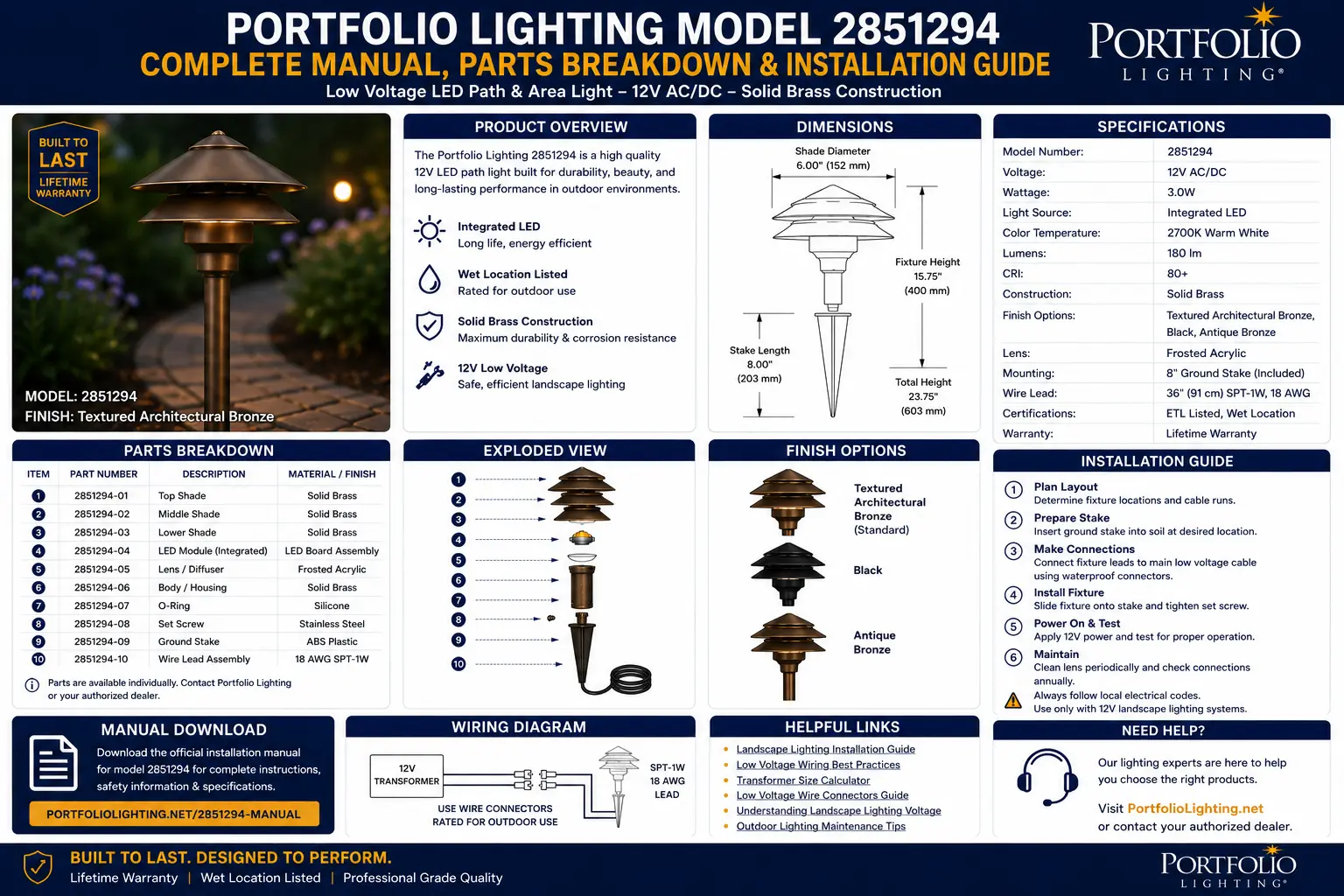
Quick Answer
Portfolio Lighting model 2851294 should be researched as a model-family and parts-identification number, not as a guaranteed single replacement part. Use the number to begin the search, then confirm fixture type, voltage, light source, lens or shade dimensions, mounting hardware, connector style and transformer compatibility before buying anything.
The highest-value move is to document the fixture before disassembly. For discontinued Portfolio models, a clear photo set of the label, lens, shade, base, connector, bulb and transformer often becomes more useful than a missing manual.
The 2851294 Field Method: How to Build Your Own Missing Manual
The most useful thing about model 2851294 is not only the number itself; it is the evidence around the number. Older Portfolio fixtures were often sold through retail channels where the box number, fixture label, finish code and replacement-part number did not always match one-to-one. That means a homeowner searching only the model number can miss the actual part that failed.
For this model, document five things before you buy anything: the full fixture silhouette, the label location, the light source, the lens or shade geometry, and the connector style. Those five clues usually tell you whether you are dealing with a serviceable bulb fixture, a sealed integrated LED, a kit-level model, or a fixture where replacement hardware is the smarter path.
What to Check First on Portfolio Model 2851294
Use this order before ordering parts: first confirm whether power reaches the fixture under load, then inspect the connector, then check the light source, then inspect the lens or shade seal, and only then decide whether the fixture body itself is the failure. This order prevents the most common mistake: buying a replacement fixture when the actual failure is a corroded low-voltage splice.
If model 2851294 is installed in a landscape run, compare the fixture behavior against the Portfolio Lighting troubleshooting guide, the low-voltage wire connector guide, the landscape lighting voltage drop guide and the landscape lighting transformer error code guide before replacing parts.
This page is built to be the main reference for Portfolio Lighting model 2851294 manual clues, replacement parts, troubleshooting and compatibility decisions. Older Portfolio model numbers are often scattered across labels, boxes, components and retailer records, so the safest repair process combines the model number with physical inspection.
I use this guide to walk through the exact logic a homeowner needs: identify the fixture, document the part, rebuild the missing manual, test the system, then choose whether to repair a component or replace the fixture.
Logic Summary: How to Handle Portfolio 2851294
- Start with the number: Search 2851294 exactly, but do not buy from the model number alone.
- Identify the fixture family: Path, flood, wall, post, deck and accent lights use different parts.
- Confirm voltage: Low-voltage, line-voltage and solar components are not interchangeable.
- Measure the physical part: Lens diameter, shade fitter size, stake thread and connector type matter.
- Diagnose before replacing: A dark fixture may be caused by a connector, transformer or cable issue.
- Repair only what is sound: Replace the fixture if water, corrosion or heat reached the electrical area.
What You Will Learn
How to Identify Portfolio Lighting Model 2851294
The number 2851294 is valuable, but it is only the first clue. Before buying replacement parts, determine whether the number appears on the fixture body, a removable part, an old box, a retail listing, a transformer label or an installation sheet.
Compare your fixture with the Portfolio Lighting model number lookup, Portfolio Lighting model parts directory, Portfolio model library and repair index and Portfolio Lighting master model technical database.
| Identification Area | What to Check | Why It Matters | Best Action |
|---|---|---|---|
| Model code | 2851294 on label, packaging, order record or fixture tag | Confirms the search target but may not identify one exact part | Photograph the label before cleaning or removing parts |
| Fixture type | Path light, wall light, flood light, accent fixture, deck light, post light or kit component | Controls the correct parts category and repair logic | Identify the fixture before ordering |
| Voltage rating | 12V low-voltage, line-voltage, solar or integrated system | Prevents unsafe electrical mismatch | Read transformer and fixture labels |
| Light source | Replaceable bulb, MR16, wedge base, candelabra base, integrated LED board or module | Determines whether the light source can be repaired | Open fixture only after power is off |
| Lens or shade style | Glass, plastic, diffuser, globe, flat lens, frosted cover or decorative shade | Controls physical fit and beam pattern | Measure diameter, height, lip and retainer |
| Mounting method | Stake, stem, threaded base, wall plate, deck bracket, post mount or screw flange | Controls replacement hardware compatibility | Measure thread and hole spacing |
How to Rebuild the Missing 2851294 Manual Details
If the exact manual is unavailable, you can still rebuild the key safety and replacement information from the fixture itself. The transformer label gives output and wattage. The bulb marking gives voltage, base and heat load. The connector shows how the fixture ties into the run.
Use the Portfolio technical manuals and wiring diagrams, Portfolio technical archive, Portfolio Lighting model specs, Portfolio installation and instructions and discontinued Portfolio Lighting guide to compare similar fixture families.
| Manual Detail | Where to Find It Without the Manual | Why It Matters | Repair Use |
|---|---|---|---|
| Input/output voltage | Transformer label, fixture label or bulb marking | Separates 12V low voltage from line-voltage fixtures | Prevents unsafe parts mismatch |
| Maximum wattage | Old bulb marking, socket label or transformer load rating | Prevents overheating and transformer overload | Choose bulb or LED retrofit safely |
| Fixture rating | Label, gasket design, housing material and installation location | Shows damp, wet or exterior use expectations | Avoid indoor-only replacements |
| Parts diagram | Physical fixture breakdown and photos before disassembly | Helps rebuild missing part relationships | Document screws, rings, gaskets and retainers |
| Wiring method | Connector type, cable gauge and splice condition | Reveals likely failure points | Decide whether wiring or fixture failed |
| Control method | Photocell, timer, transformer mode, switch or smart plug | Explains on/off failure patterns | Test controls before replacing fixtures |
Portfolio 2851294 Parts Map
The best way to avoid buying the wrong part is to name the failed component before shopping. A lens problem, shade problem, stake problem, bulb problem, connector problem, transformer problem and LED-board problem all have different replacement paths.
For part categories, start with Portfolio Lighting parts and accessories, Portfolio replacement parts, where to buy Portfolio replacement parts, Portfolio Lighting compatibility guide and Portfolio Lighting replacement handbook.
| Replaceable Part | Common Failure Pattern | Matching Detail | Repair Warning |
|---|---|---|---|
| Lens or cover | Cracked, missing, fogged, yellowed or leaking | Diameter, depth, lip, retainer and gasket shape | Wrong lens can leak or touch bulb |
| Shade or diffuser | Chipped, loose, discolored or broken at fitter | Fitter size, height, material and screw contact points | Overtightened screws can crack glass |
| Stake or stem | Broken stake, stripped threads or leaning fixture | Stem diameter, thread size and fixture weight | Weak universal stakes fail in hard soil |
| Bulb | Dead, dim, flickering, wrong color or too hot | Voltage, base type, wattage and length | Oversized bulbs can crack lenses |
| LED module or driver | Dim output, flicker, water damage or dead integrated LED | Board size, driver specs and heat sink design | Often easier to replace fixture |
| Connector or splice | Intermittent light, failure after rain or voltage at wire but no light | Wire gauge, copper condition and waterproofing | Corroded splices cause ghost voltage |
| Transformer or photocell | No output, timer failure, cycling, buzzing or dusk/dawn problems | Output voltage, wattage and control type | Test under load before replacing |
Diagnose Before You Buy: The 2851294 Failure Logic
Many discontinued Portfolio fixtures are replaced too early because the visible fixture gets blamed for a hidden wiring problem. If the fixture is dark, first check whether power reaches the fixture under load. If the fixture flickers, inspect the connector before assuming the LED board failed.
For deeper troubleshooting, use Portfolio Lighting troubleshooting, one-zone landscape lighting troubleshooting, all lights out at once and landscape lights buzzing.
| Symptom | Most Likely Cause | First Test | Next Step |
|---|---|---|---|
| One 2851294 fixture is out | Bad bulb, corroded connector, failed socket or LED board | Swap known-good bulb or test fixture at known-good lead | Repair connector before replacing fixture |
| Fixture works when moved | Loose splice or broken conductor near connector | Inspect copper and connector body | Replace connector and cut back to clean copper |
| Lens keeps fogging | Failed gasket, cracked housing or wrong replacement lens | Inspect gasket seat and water trail | Replace seal or full fixture |
| New bulb flickers | Wrong voltage, polarity issue, poor socket contact or transformer instability | Test bulb in another fixture | Check transformer and connector |
| Whole zone is dim | Voltage drop, overloaded run or undersized cable | Measure voltage at first and farthest fixture under load | Rebalance wiring or resize transformer |
| Transformer cycles off | Overload, short, wet splice or failed transformer | Disconnect zones one at a time | Find short before upsizing transformer |
Transformer, Voltage and Connector Compatibility
If model 2851294 belongs to a low-voltage system, the transformer and cable run are part of the diagnosis. A fixture can be healthy and still perform poorly if the transformer is overloaded, the wire run is too long, a connector is corroded or voltage collapses under load.
Use the Portfolio Lighting transformer master guide, transformer sizing guide, transformer wattage guide, Portfolio low-voltage lighting guide, low-voltage wire connector guide and landscape lighting voltage drop guide.
Should You Repair 2851294 or Replace the Fixture?
Repair makes sense when the failed part is mechanical, the fixture housing is dry, the socket or LED board is clean and the wiring is still flexible. Replace the fixture when water reached the electrical area, the housing is cracked, the socket is corroded, the wire lead is brittle or multiple parts are failing together.
If exact replacement parts are unavailable, compare replacement options for Portfolio landscape lighting, best replacements for Portfolio landscape lighting, Portfolio Lighting alternatives and low-voltage landscape lighting brand comparison.
| Condition | Repair Individual Part | Replace Full Fixture | Why |
|---|---|---|---|
| Only lens, shade or stake is broken | Yes | No | Mechanical part failure with sound electrical components |
| Connector is corroded | Yes | No, unless fixture has water damage | Wiring repair may restore fixture |
| Socket or LED board is corroded | Usually no | Often yes | Electrical area is compromised |
| Housing is cracked | Maybe | Often yes | Water intrusion will likely repeat |
| Exact manual is unavailable | Still possible | Maybe | Ratings and measurements can guide repair |
| Multiple parts are failing | Maybe | Often yes | Replacement may cost less than chasing parts |
| Transformer is unstable | Maybe | Not necessarily | System load and wiring must be checked first |
Related Portfolio Model Guides
For nearby model research, compare Portfolio model 016107 WHCM432R8 lens parts, Portfolio model 0311569 kit parts, Portfolio model 17945-000 shade replacement, Portfolio model 230132 145P parts and Portfolio model FY09-003 0048184 parts and manual.
For replacement categories, also review Portfolio replacement lenses, Portfolio replacement glass, Portfolio replacement shades, Portfolio replacement stakes and Portfolio replacement hardware.
Portfolio Lighting Model 2851294 FAQ
What is Portfolio Lighting model 2851294?
Portfolio Lighting model 2851294 should be treated as a model or item-identification number for an older Portfolio fixture, kit or component family. Before ordering parts, confirm the fixture type, voltage, light source, lens or shade dimensions, mounting hardware and connector style.
How do I find a manual for Portfolio 2851294?
Start by saving the number exactly as printed, photographing the fixture label and comparing the physical fixture against Portfolio model lookup and technical archive resources. If the exact manual is unavailable, use the fixture rating, transformer label, bulb type and wiring method to rebuild the key repair information.
Can I replace parts on model 2851294?
Often yes, if the part can be physically and electrically matched. Common replacement candidates include lenses, shades, covers, stakes, mounting hardware, bulbs, LED modules, wire connectors, gaskets and sometimes transformer or photocell components.
Why is model 2851294 hard to match?
Older Portfolio numbers may represent retail item numbers, fixture families, production runs or component labels. A replacement part that looks similar online may not fit if the lens diameter, fitter size, stake thread, connector style or voltage rating is different.
Should I repair the part or replace the full fixture?
Repair is reasonable when the housing, wiring, socket or LED board and mounting hardware are still sound. Replace the fixture if water reached the electrical area, the housing is cracked, the socket is corroded or several parts are failing together.
What should I photograph before buying parts?
Photograph the full fixture, model label, lens or shade, mounting base, stake or bracket, connector, wire lead, bulb or LED board, transformer label and any gasket or retaining ring.
Bottom Line
Portfolio Lighting model 2851294 should be identified with both the model number and the physical fixture details. Use the number to begin the search, then confirm voltage, fixture type, lens or shade measurements, light source, mounting hardware, connector condition and transformer compatibility.