
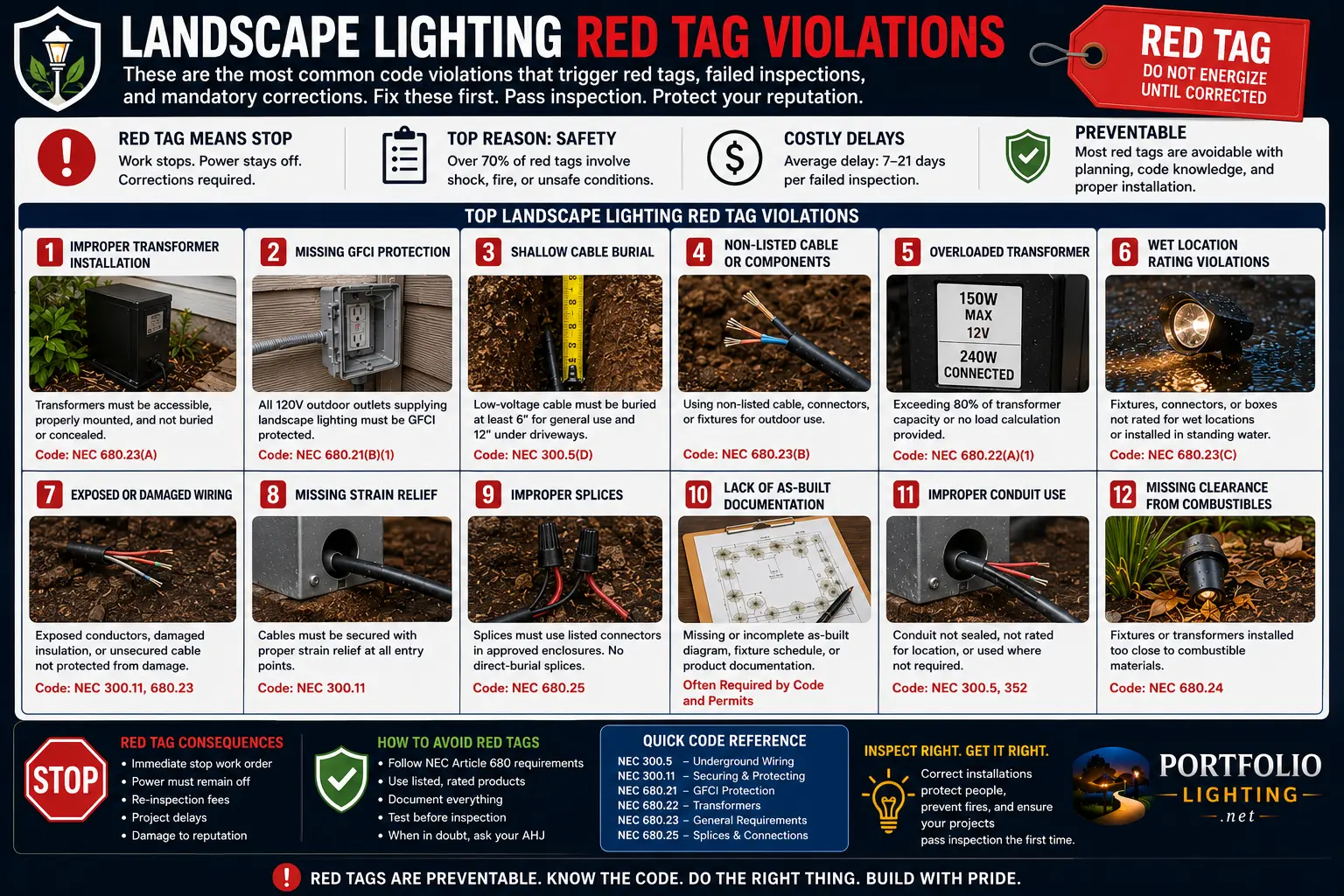
Quick Answer: What Gets Landscape Lighting Red Tagged?
Landscape lighting gets red tagged when an inspector, building department, utility, HOA review, or authority having jurisdiction identifies a serious safety, permit, installation, or documentation problem that must be corrected before work continues or final approval is granted. The most common red tag triggers are exposed energized parts, missing GFCI protection, open outdoor boxes, improper transformer mounting, wet-location defects, buried indoor splices, cable installed where it can be damaged, wrong fixture listings near water, work concealed before inspection, and missing as-built documentation.
A red tag is more serious than a casual punch-list item. It means the project has crossed from “needs cleanup” into “cannot be accepted as-is.” In landscape lighting, that often happens because the finished nighttime effect looks impressive but the hidden infrastructure cannot be verified. If the inspector cannot confirm the power source, protection, transformer rating, cable route, splice method, fixture listing, load calculation, or permit record, the installation may stop even though every light turns on.
Logic Summary: Red Tags Happen When Risk and Uncertainty Meet
A landscape lighting red tag usually does not happen because one path light is crooked. It happens when the inspector sees either a clear hazard or enough uncertainty that approval would be unsafe. The two forces are risk and proof. Risk is the possibility of shock, fire, water intrusion, equipment failure, physical damage, or unsafe use. Proof is the documentation showing that the work was installed correctly, with listed components, in the right locations, before conditions were concealed.
That is why red tags often appear at transition points. The transition from 120V power to low-voltage transformer is a risk point. The transition from transformer terminals to buried cable is a risk point. The transition from cable to splice is a risk point. The transition from dry wall area to wet soil or splash zone is a risk point. The transition from permitted plan to as-built condition is a proof point. If any transition is unsafe or undocumented, the project can fail.
The strongest way to think about a red tag is not “the inspector is being difficult.” It is “the system has a missing safety story.” The correction must rebuild that story: here is the defect, here is the correct listed repair, here is the photo evidence, here is the retest, here is the updated diagram, and here is the request for reinspection.
Jump to Section
Red Tag vs Normal Correction Notice: Why the Difference Matters
A normal correction notice often identifies a fixable issue that does not necessarily stop all work. A red tag is more serious. It can stop work, prevent concealment, block final approval, or signal that an installation has an immediate safety or compliance concern. In some areas, the tag may be physically attached to the jobsite, equipment, panel, permit card, transformer area, or building entrance. In other areas, the red tag may be digital in the permit portal.
For landscape lighting, the distinction usually turns on severity. Missing a fixture label photo may be a documentation correction. Leaving line-voltage wiring exposed in an outdoor junction box may be a red tag. A slightly incomplete fixture schedule may be a permit correction. Burying splices before inspection with no proof of connector type may become a red tag if the inspector cannot verify hidden work.
The practical takeaway is simple: do not keep working as if nothing happened. Read the red tag language. Photograph the existing condition. Identify the failure category. Clarify what must be corrected. Then document the repair in a way that makes the reinspection easy to approve.
Red tags rarely happen without warning. Many of the situations that ultimately trigger stop-work orders begin as overlooked installation shortcuts that progressively become larger safety concerns. The real-world landscape lighting code enforcement database documents how inspectors have addressed transformer violations, concealed wiring defects, improper wet-location practices, and undocumented modifications, offering valuable lessons for anyone trying to avoid becoming the next enforcement example.
Landscape Lighting Red Tag Violation Table
| Red Tag Code | Violation Type | Inspector Concern | Correction Evidence |
|---|---|---|---|
| RT-PS-01 | Unsafe or undocumented power source | Outdoor receptacle, cover, GFCI or line-voltage feed cannot be verified | Photo of corrected power source, GFCI test and permit note |
| RT-TR-02 | Transformer improperly mounted or inaccessible | Water exposure, overheating, no service clearance, hidden equipment | Remounted transformer photo with label visible and accessible clearance |
| RT-SP-03 | Improper wet or buried splice | Indoor connectors, tape-only splices or unknown buried connections | Before/after photos and listed wet/direct-burial connector proof |
| RT-CB-04 | Cable concealed before inspection | Burial depth, routing, conduit, sleeve or protection cannot be verified | Expose sample, provide trench photos or submit as-built proof |
| RT-FX-05 | Fixture not rated for location | Wet-location, pool, dock, spa, fountain or direct-weather mismatch | Fixture label, product sheet and replacement photo |
| RT-LD-06 | Load or voltage drop not documented | Transformer capacity, run length and fixture voltage are unclear | Load calculation, voltage readings and updated run map |
| RT-DOC-07 | Missing permit-ready as-built diagram | Installed work does not match plan or hidden work cannot be located | Updated as-built diagram with fixture schedule and cable routes |
| RT-WA-08 | Water-adjacent lighting not verified | Pool, hot tub, fountain, dock or wet-zone safety concerns | Location-specific review, listings, GFCI/bonding notes where applicable |
Red tags often appear when unsafe conditions or missing proof are discovered too late: exposed wiring, wet boxes, missing GFCI protection, improper transformer mounting, buried indoor splices, concealed cable routes, or undocumented changes from the permit plan. Before work continues or final inspection is requested, use the electrical inspector checklist for landscape lighting systems to verify the same categories inspectors typically review before approving outdoor lighting work.
Power Source Red Tags: The Low-Voltage System Still Starts With 120V
The most common homeowner misunderstanding is that low-voltage landscape lighting is automatically outside serious electrical review. The secondary side may be low voltage, but the transformer still receives power from a line-voltage source. That source may be a receptacle, hardwired feed, exterior box, switch, timer, GFCI circuit, or existing outdoor branch circuit. If the inspector sees unsafe primary power, the entire lighting project can be stopped.
Red tag clues include damaged receptacles, missing in-use covers, cords pinched behind fixtures, questionable extension cord use, non-weatherproof boxes, unverified GFCI protection, repeated wet-weather trips, and transformer cords routed where they can be cut or pulled. A red tag may also happen when the transformer is plugged into a garage or basement source through an improper penetration or when outdoor equipment is powered from a circuit not intended for that use.
Strong correction evidence includes a photo of the corrected receptacle or junction point, GFCI test result, cover type, transformer plug condition, and label showing the equipment served. For broader context, use the outdoor lighting GFCI requirements guide, landscape lighting keeps tripping GFCI guide, outdoor lighting junction box requirements and landscape lighting electrical code safety guide.
Transformer Red Tags: Accessible, Listed, Ventilated, and Above the Problem Zone
A landscape lighting transformer can trigger a red tag even when the lights work. The inspector may not be judging nighttime appearance. They are judging whether the transformer is listed for the installation, mounted according to instructions, protected from water accumulation, ventilated, accessible for service, connected safely, and not overloaded.
Typical red tag conditions include a transformer sitting directly on soil or mulch, a transformer hidden inside shrubs with no service clearance, blocked ventilation, irrigation spray hitting the enclosure, missing knockout plugs, damaged cords, secondary wires entering through unapproved openings, overloaded output terminals, and no visible label. Older Portfolio and similar systems can be especially vulnerable because the transformer may have been moved, covered by landscaping, or modified across multiple seasons.
The correction should show more than “moved box.” Provide a photo of the mounting height, wall or post support, transformer label, connected load summary, output tap, cable exit and clear service area. Use the Portfolio Lighting transformer master guide, outdoor transformer mounting code requirements, landscape lighting transformer guide and bad landscape lighting transformer symptoms for deeper transformer review.
Splice and Connector Red Tags: The Hidden Failure That Stops Approval
Improper splices are one of the fastest ways to get landscape lighting red tagged because they are often concealed in soil, mulch, walls, boxes or fixture bases. A standard indoor wire nut buried in wet soil is not a harmless shortcut. Moisture attacks copper, increases resistance, causes green dust, produces flicker and can lead to heat or complete failure. When hidden splices cannot be verified, an inspector may require excavation, photos, listed connectors, or reinspection before the work is accepted.
A red tag can also occur when splices are made outside an enclosure where one is required, when fixture leads are twisted without proper strain relief, when connectors are not rated for wet or direct-burial locations, or when splices are covered before the inspection stage. The issue is not simply whether the light turns on today. The issue is whether the connection is suitable for the environment it will occupy after rain, irrigation, freeze-thaw movement and soil contact.
Correction evidence should include a before photo, cut-back-to-clean-copper photo if corrosion was present, photo of the listed connector or package label, finished splice photo, and voltage retest under load. Use landscape lighting splice connection code requirements, low-voltage wire connectors for landscape lighting, green dust connector corrosion repair, and landscape lighting connectors to build the correction trail.
Burial and Damage Red Tags: When the Inspector Cannot See What Was Covered
Red tags often happen after work is covered too early. Once soil, mulch, sod, pavers or concrete cover the cable route, the inspector may not be able to verify burial depth, conduit sleeves, cable type, splice locations, or physical protection. This is especially important at bed edges, under sidewalks, near driveways, at retaining walls, around hot tubs, and anywhere future maintenance tools can strike the cable.
Low-voltage cable may seem forgiving, but shallow cable can be cut by edging tools, aerators, planting spades, irrigation repairs, pet digging or landscape renovations. A cable that is technically low voltage can still create shorts, nuisance trips, transformer damage, product failures and warranty disputes. If the project required inspection before backfill and the work was buried first, the red tag may require exposure of selected areas or documentation strong enough to satisfy the authority.
Prevent the problem with trench photos, measuring tape photos, cable jacket photos, route sketches and as-built diagrams. Use the landscape lighting wire burial depth code guide, NEC 300.5 underground conduit fill capacity calculators, as-built lighting diagram requirements for permits and NEC low-voltage lighting inspection checklist before covering hidden work.
Water-Adjacent and Wet-Location Red Tags: Pools, Spas, Docks, Fountains and Saturated Beds
Water-adjacent landscape lighting receives stricter scrutiny because the consequences of a mistake are higher. A fixture near a pool, spa, hot tub, dock, fountain, pond, irrigation-heavy bed or drainage low point may require more than ordinary “outdoor” thinking. The inspector may ask whether the fixture is suitable for the location, whether power and bonding/GFCI requirements are handled properly, whether splices are listed for wet conditions, and whether the fixture placement creates a hazard for wet users.
Moisture defects can also create red tags when they reveal the wrong fixture for the environment. Persistent fogged lenses, pooled water, rusty screws, corroded sockets, mineral deposits or failed LED drivers can show that the fixture is not surviving its exposure. Replacing the lamp without correcting the wet-location problem does not fix the inspection issue.
Use outdoor lighting wet-location listing requirements, Portfolio foggy lens condensation fix, outdoor lighting around hot tubs, swimming pool lighting clearance code NEC 680, and dock and pier lighting safety standards NEC 555 for location-specific planning.
Permit and Documentation Red Tags: When the Work May Be Fine but the Proof Is Missing
Not every red tag is caused by a dangerous physical defect. Some happen because the installation cannot be verified. Missing permit cards, incomplete fixture schedules, no transformer load calculation, no cable route drawing, no voltage-drop data, missing product cut sheets, and undocumented changes from the approved plan can all delay approval. In large outdoor lighting projects, documentation is part of the installation.
Documentation red tags are especially common when a contractor makes field changes that improve the design but never updates the plan. Moving a transformer, changing wire gauge, adding fixtures, switching to solar fixtures, changing a path under hardscape, or adding smart controls may be harmless from a design perspective but problematic if the permit file still shows the old configuration.
The clean correction is an updated as-built package: fixture schedule, transformer location, control equipment, cable route, load calculation, voltage readings, product labels and photos of hidden conditions. Use landscape lighting permit requirements by state, as-built lighting diagram requirements for permits, voltage drop testing documentation for warranty compliance and landscape lighting inspection failure database to build the record.
Smart Controls and Solar Fixtures: Newer Red Tag Patterns
Modern outdoor lighting projects increasingly combine low-voltage landscape lights, solar fixtures, smart hubs, motion sensors, cameras, wireless controls, RGB controllers and app-based scheduling. These upgrades create new red tag patterns because they blur the line between lighting power, control wiring, communication wiring and product compliance.
Smart control red tags can appear when low-voltage control conductors are mixed with line-voltage wiring incorrectly, indoor-rated controllers are installed outdoors, cable entries are improvised, or communication devices are placed in wet enclosures. Solar fixture red tags can appear when a product is used in a way that does not match its listing, battery system, enclosure rating or installation instructions. The safest strategy is to separate the design into power source, control layer, communication path, fixture rating and documentation package.
Use smart lighting control NEC Article 725 Class 2 guide, low-voltage lighting EMI interference NEC 800 guide, smart hub compatibility guide and solar lighting performance standards UL 8750 when newer control systems are part of the project.
How to Clear a Landscape Lighting Red Tag
| Step | Action | Proof to Keep | Common Mistake |
|---|---|---|---|
| 1. Stop affected work | Do not cover, energize or continue the red-tagged portion unless allowed | Photo of tag and affected area | Continuing work and hiding the defect |
| 2. Decode the violation | Classify as power, transformer, splice, cable, fixture, load or documentation | Written category and inspection note | Fixing symptoms instead of the cited issue |
| 3. Preserve before evidence | Take wide and close-up photos before correction | Before photo set | Removing the defect before documenting it |
| 4. Correct with listed method | Use proper rated equipment, connector, fixture, box, cable or mounting method | Product label or package photo | Replacing one improvised repair with another |
| 5. Test and document | GFCI test, voltage reading, load calculation or fixture operation test | Meter photo, checklist, as-built update | Submitting repair photos without performance proof |
| 6. Request reinspection | Submit the correction package and follow local process | Permit portal note or reinspection approval | Removing the tag without official clearance |
Contractor Notes: How to Write a Red Tag Correction Summary
A correction summary should be short, specific and evidence-based. Avoid vague language like “fixed wiring” or “corrected lighting.” Instead, write what was wrong, what was changed, what listed material was used, and how the repair was verified. A strong note might say: “RT-SP-03 corrected. Removed nonlisted buried twist connectors at west path run. Cut conductors back to clean copper. Installed gel-filled direct-burial connectors listed for wet locations. Recorded 12.1V under load at first fixture and 11.4V at farthest fixture. Updated as-built sheet L-2 with splice location.”
This level of detail makes reinspection easier because the inspector does not have to reconstruct the repair from memory. It also protects the installer if a future homeowner, buyer, or warranty reviewer asks what was corrected. Red tag corrections are not only about passing today. They create the long-term maintenance record for the system.
Portfolio Lighting Red Tag Context: Older Systems, Replacement Parts and Retrofit Risk
Portfolio Lighting systems can become red tag candidates when older equipment is modified without documentation. Common examples include replacing halogen lamps with LEDs without recalculating load, moving a transformer during landscaping, adding new fixtures to old wire, splicing replacement parts with indoor connectors, or using discontinued fixtures in wet locations where the listing cannot be verified.
The safest approach is to identify the model, document the transformer, photograph the fixture label if available, inspect connectors, verify voltage under load and avoid guessing about discontinued parts. Use the Portfolio Lighting model number lookup, Portfolio model parts directory, Portfolio master model technical database, and Portfolio Lighting AI assistance when a red tag involves older Portfolio fixtures or unclear replacement parts.
Landscape Lighting Red Tag Violations FAQ
What is a landscape lighting red tag violation?
A landscape lighting red tag violation is a serious inspection failure or stop-work notice tied to unsafe, incomplete, undocumented or noncompliant outdoor lighting work. It usually requires correction before the project can continue or pass final inspection.
Can low-voltage landscape lighting receive a red tag?
Yes. Low-voltage systems can still be red tagged if primary power is unsafe, GFCI protection is missing, splices are improper, cable is damaged, fixtures are not rated for wet locations, transformers are installed incorrectly or required documentation is missing.
What are the most common red tag triggers?
Common triggers include exposed energized conductors, open junction boxes, missing GFCI protection, transformers on the ground, indoor wire nuts in wet soil, cable damaged by tools, wrong fixtures near water, missing permit documents and work covered before inspection.
Is a red tag the same as a normal correction notice?
No. A normal correction may be a smaller issue that needs revision. A red tag is more serious because it can stop work, prevent final approval or indicate an immediate safety or documentation problem.
What should I do first after receiving a lighting red tag?
Stop work in the affected area, read the violation note carefully, photograph the existing condition, identify the failure category, contact the inspector or local authority if unclear, and correct the issue with listed methods and documentation.
How do I document a red tag correction?
Keep the red tag notice, before photos, product labels, correction photos, voltage or GFCI test results, updated as-built diagram, permit notes, contractor invoice and reinspection approval.
Expert-Verified Red Tag Guidance
This guide explains common outdoor lighting red tag patterns in practical field language. Local permit offices, inspectors, product listings and the authority having jurisdiction control final correction requirements.